What causes water stains on the ceiling? In almost every case the answer is moisture reaching the drywall or plaster and then evaporating, leaving behind the dissolved minerals, rust and dust that make up the mark. The moisture itself comes from a leak above you, a plumbing problem, or condensation, and the stain you see is usually several weeks downstream of where the water actually got in.
That last part trips people up. The stain is a symptom, not a location marker. Once you understand that, the diagnosis gets much easier.
Below is what I would check first, in order, followed by how to read the stain, what you can safely do yourself, and which professional to call for each cause.
Table of Contents
- 1What Causes Water Stains on the Ceiling?
- 2Why the stain usually isn’t directly under the leak
- 3How to Tell Water Damage From Other Ceiling Stains
- 4What Causes Water Stains on the Ceiling in Each Area?
- 5Directly under an upstairs bathroom
- 6Near a kitchen
- 7In a laundry room
- 8Along an exterior wall or in a corner
- 9Under a skylight, chimney or plumbing vent
- 10Beneath an attic-mounted air handler
- 11Under a plumbing vent or a stack in the wall cavity
- 12In a garage, porch or enclosed balcony
- 13In a condo or an upstairs neighbor’s unit
- 14Why Is the Ceiling Stain Getting Bigger?
- 15Can You Fix Ceiling Water Stains Yourself?
- 16Safe checks you can do yourself
- 17What not to do
- 18How to remove the stain once the source is dry
- 19When Should You Call a Plumber, Roofer, or HVAC Professional?
- 20Frequently Asked Questions
- 21Why do I have water stains on my ceiling but no leak?
- 22Does rain always cause ceiling water stains?
- 23Is there mold under a ceiling water stain?
- 24Can I paint over a water stain on the ceiling?
- 25Can I ignore a small water stain on the ceiling?
- 26How do I find the source of a ceiling stain myself?
- 27What to Do First
What Causes Water Stains on the Ceiling?
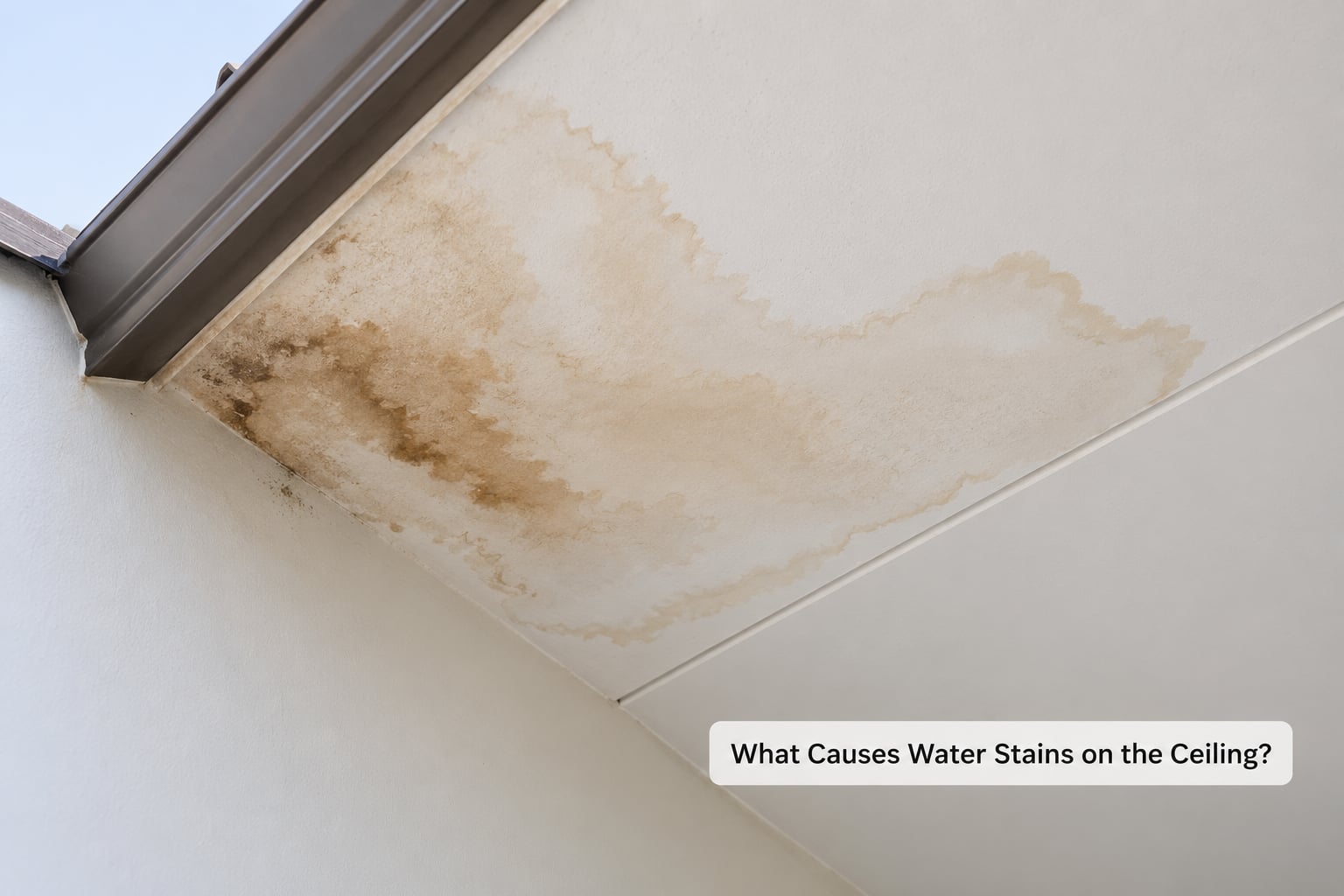
A ceiling water stain is the residue left when water or condensation passes through the paint, paper-faced gypsum drywall or plaster and evaporates at the surface, carrying soluble material with it. Seven sources account for the vast majority of ceiling stains in US homes.
- Roof leaks — failed step flashing, a cracked pipe boot around a vent, missing shingles or a worn roof deck let rainwater into the attic, where it soaks insulation and reaches the ceiling.
- Plumbing leaks — a failed supply line joint, a cracked drain pipe or a water heater fitting above the ceiling drips steadily, often for weeks, before it becomes visible.
- HVAC condensate — the drip pan under the evaporator coil overflows when the pan or primary drain line clogs, and the backup falls straight onto the ceiling below.
- Bathroom leaks — a failed toilet wax ring, a leaking supply valve or a shower pan without a proper membrane sends water down through the floor framing.
- Condensation and ventilation — a bathroom with no working exhaust fan traps warm humid air, and in winter that moisture condenses or freezes on the cold back side of the ceiling.
- Ice dam and snowmelt backup — in cold climates, ice builds at the eaves, melts and runs back under the shingles, entering near the roof edges weeks after the storm.
- A leak that already got fixed — a resolved leak leaves a permanent ring that can darken again after a long humid stretch or a heavy rain even with a dry attic.
Two questions narrow the list fast. Is the stain soft or bulging when you press it? And did it show up after a heavy rainstorm, or does it stay damp on a dry day?
Why the stain usually isn’t directly under the leak
Water does not fall straight down. It soaks into attic insulation, then travels along the top edge of a joist or along a pipe and a wire until it finds the easiest path down, which is often a seam in the drywall several feet from where it entered. Paper-faced drywall wicks along its face like a paper towel, so a small wet spot can darken a patch far wider than the actual intrusion.
This is also why the stain can be weeks behind the event. Attic insulation can hold a surprising volume of water while still looking dry on top, and the ceiling shows nothing until that moisture reaches the back of the board.
How to Tell Water Damage From Other Ceiling Stains
Damp or bulging means water. Dry, flat, uniform discoloration with no history of moisture often means paint. Texture and odor are the fastest checks you can make standing on the floor.
- Soft, spongy or crumbly — water damage. The gypsum core is saturated and sometimes delaminated.
- Firm and dry, flat to the touch — probably paint, though an old leak can leave this behind too.
- Musty or earthy odor — prolonged dampness and early microbial growth.
- Bubbling paint, peeling seam tape, peeled corner tape — water behind the surface that has not dried.
- Uniform tan shading with no single shape — smoke shadowing or aged flat paint, not a leak.
- Brown flecks with curled, shedding paint — calcimine or flat paint covered with water-based paint can fail and shed. Forum threads on r/homeowners and r/HomeImprovement describe this one constantly, and it looks alarming but is purely cosmetic.
- Small rust-colored pinpoints — corroding nail heads or a rust stain from a screw, unrelated to water.
Color alone is not diagnostic. A brown ring with a darker perimeter is the classic pattern, but it tells you almost nothing about the source. Where it sits and when it move tell you far more.
| What you see | What it usually means | Next check |
|---|---|---|
| Brown ring with a darker edge, roughly circular | Water pooled, wicked outward as it dried, residue left at the perimeter | Look directly above along joists, not just straight up |
| Amber or light yellow, recently wet | Early stage leak, still actively evaporating | Check again after the next rain |
| Black or green speckling | Mold growth on a surface that stayed damp | Stop painting and get the area assessed |
| Linear streak or long narrow run | Water tracking along a joist, pipe or seam | Follow the line toward its starting point |
| Diffuse patch with no defined edge | Slow condensation or a wide area of saturation | Check humidity levels and exhaust fan use |
| Concentric rings, patch keeps growing | Recurring or ongoing intrusion | Treat as an active leak until proven otherwise |
The EPA’s general guidance is that mold can begin developing on wet materials within 24 to 48 hours, which is the practical reason not to let a damp ceiling sit while you wait to see if the stain grows.
What Causes Water Stains on the Ceiling in Each Area?
Location is the strongest diagnostic clue you have, because it tells you what is physically above the stain. Most rooms have a limited list of candidates.
Directly under an upstairs bathroom
Check the toilet first. A failed wax ring or a loose supply valve puts water into the subfloor, and the stain often appears several feet away near a joist. Then look at the shower or tub surround for failed grout, a cracked tile or a missing pan liner.
Near a kitchen
The dishwasher supply line, the drain line under the sink, and the water heater are the usual suspects. Kitchen drain leaks are common because the dishwasher connection is often the least protected part of the run.
In a laundry room
Supply hoses on a washing machine fail with little warning, and the machine itself sits directly on the floor so the water reaches the drywall fastest here. If the washers are in a closet above the ceiling, expect a quick and obvious failure.
Along an exterior wall or in a corner
That pattern points up to the roof edge. Look at step flashing, the sealant where siding meets trim, and any wall penetrations for window trim. Wind-driven rain gets behind siding far more often than people expect.
Under a skylight, chimney or plumbing vent
These are roof penetrations, and every one of them has a seal that ages. Skylight curbs crack and chimney flashing lifts or rusts out. A plumbing vent with a dry rotted collar around it is one of the most common roof leak sources there is.
Beneath an attic-mounted air handler
Condensate overflow. Most air handlers sit in the attic on a tray or platform, so a clogged drain line puts water directly onto the joists and the ceiling below with nothing between them.
Under a plumbing vent or a stack in the wall cavity
A wet ceiling stain around a plastic vent or a drain stack usually means the joint above it is dripping. Condensation on an uninsulated cold water pipe running through the attic can do the same thing.
In a garage, porch or enclosed balcony
These flat ceilings have no insulation above them and often no waterproofing, so condensation and rain-driven intrusion both show up here. Homeowners on the forum boards report that a garage ceiling is often the first place a roof problem announces itself.
In a condo or an upstairs neighbor’s unit
The same causes apply, but so does shared-water rules. The building’s manager needs to be involved early, and evidence matters more than opinion when you are dealing with someone else’s unit.
Why Is the Ceiling Stain Getting Bigger?
A growing stain means the water is still arriving, or arriving faster than the ceiling can dry. The common reasons are continued rain with an unresolved roof failure, a failed flashing strip that lets water in slowly, a concealed plumbing leak, blocked roof drainage or an HVAC condensate line that keeps refilling and overflowing.
Condensation is the sneaky one. It produces a slow, steady supply of moisture, so the stain creeps outward over weeks and can look stable for a month, then jump after a humid stretch. Old stains that were never sealed properly often react this way.
| Timing pattern | Likely source | Check next | Who to call |
|---|---|---|---|
| Appears or grows during heavy rain, dries out afterward | Roof deck, flashing, shingle or vent collar failure | Attic during and after rain, roof penetrations from outside | Roofer |
| Shows up after showers or a toilet flush | Shower pan, grout, supply valve or toilet seal | Ceiling below the upstairs bathroom | Plumber |
| Only during summer air conditioning use | HVAC condensate pan overflow or clogged drain | Condensate pan and primary drain line above the unit | HVAC technician |
| Only in winter or on cold mornings | Indoor condensation on a cold surface, ventilation problem | Humidity level, bath exhaust fan, attic insulation and air sealing | HVAC tech or handyman, roofer if attic side is wet |
| Dripping water, constant with no weather pattern | Supply or drain plumbing failure | Shut-off valves above the ceiling | Plumber, same day |
| Returns weeks after being painted | Source never fixed, or latex paint used over a stain without a blocker | Dryness of the area, seasonal return pattern | Whoever did the repair, or a restoration contractor |
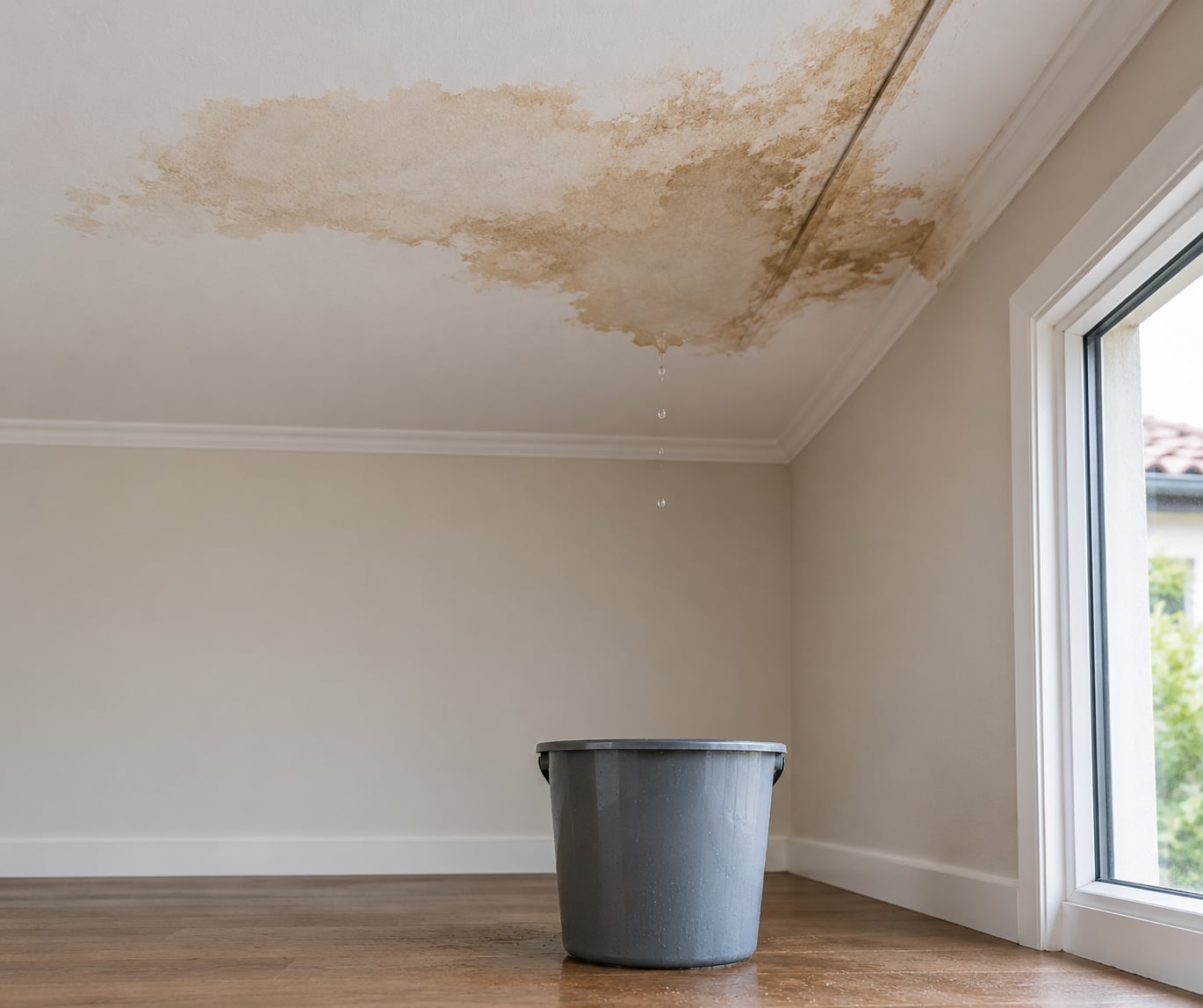
While you narrow it down, put a bucket under any active drip, move furniture and stored items out of the way, and take dated photos. Wide shots of the room plus close shots of the stain give an adjuster or a contractor something to work with later.
Can You Fix Ceiling Water Stains Yourself?
You can usually handle the cosmetic half of the job yourself. Locating and stopping the water is a different question, and if the answer involves structure, wiring or a roof, it is not a DIY task.

Safe checks you can do yourself
- Look up from below with a flashlight at an angle across the stain. Raking light reveals a bulge, a soft spot or a stain edge that flat light hides.
- Compare readings with a moisture meter if you own one or can borrow one. Readings of 20 percent or higher in gypsum mean there is still moisture in the board.
- Run the bucket test on the roof above. With someone watching the ceiling, have a helper pour water near roof penetrations above the stain in small increments and watch for new darkening.
- Use dye tests on plumbing fixtures. A toilet dye tablet or a shower dye test strip left in the fixture will show up in the ceiling water if that fixture is the source.
- Check the attic safely during daylight with a headlamp, stepping only on joists or on a walk board. Look for damp insulation, staining on the sheathing and a wet condensate pan.
- Shower and leave. Turn on every shower and toilet in the room above, then check the stain after 30 minutes and again after a few hours.
What not to do
Do not poke a hole in a bulging ceiling to drain it. You do not know what is behind that bulge. It may be a wire, a junction box, a fire sprinkler line or a structural member, and falling water on an energized circuit is a serious hazard. This comes up constantly in forum advice, and the safe answer stays the same: put a bucket under it and call someone.
Do not paint over a stain with ordinary latex. It will bleed back through within days. Do not bleach the drywall either; it strips the paper face and makes the repair harder.
How to remove the stain once the source is dry
Confirm the area reads dry on a moisture meter and stays dry for at least a week before you start. Cut out and replace any soft or crumbling drywall, then seal the bare gypsum with a shellac-based stain-blocking primer. Let it dry fully, then repaint with flat white ceiling paint in the same sheen as the rest of the ceiling.
Working over a stain without a blocker is the single most common reason a repaired ceiling stain reappears weeks later.
When Should You Call a Plumber, Roofer, or HVAC Professional?
Call the trade that matches what your diagnosis points to, and match it to urgency. Some signs are emergencies rather than appointments.
- Plumber for supply line, drain pipe, water heater fittings, toilet seals, shower pans and anything wet directly above the stain.
- Roofer for anything rain-linked, roof penetrations, flashing, ice dam damage and stained or rotting sheathing in the attic.
- HVAC technician for condensate pan overflow, clogged primary or secondary drain lines, a failed float switch, duct condensation or duct insulation failure.
- Water mitigation or restoration contractor once the source is fixed and the ceiling, insulation or framing is still wet. The ANSI/IICRC S500 standard is the reference for drying and cleaning decisions.
- Electrician before anything else if water is near a light fixture, ceiling fan or smoke detector.
These need attention now rather than this week: sagging or heavily bulging ceiling material, active dripping, standing water near any electrical device, a sewage smell, black or green speckling across a wide area, or a stain that grew sharply during a storm.
One note on documentation for insurance. Policies generally respond to sudden, accidental damage and often exclude gradual seepage, which is where slow plumbing drips tend to land. Timestamped photos taken the day you notice the stain, the ceiling above, and any attic evidence are worth far more than a description from memory.
Frequently Asked Questions
Why do I have water stains on my ceiling but no leak?
Four things usually explain it. The source was a leak that has since dried or been fixed and left a permanent ring. It is condensation rather than a leak, which happens in humid rooms with poor ventilation. The stain is not where the water entered, because it traveled along a joist before it reached the drywall. Or it is not water at all, and you are looking at calcimine paint failure, smoke shadowing or rust from a nail. Checking the texture and whether the mark reacts to weather will separate these quickly.
Does rain always cause ceiling water stains?
No. Rain is the most obvious trigger, but plenty of ceiling stains have nothing to do with weather at all. Plumbing drips, HVAC condensate and winter condensation follow their own schedules and appear on dry days. Rain-linked stains do have a distinct signature: they appear or grow during a storm, they often show a darker perimeter, and they dry and stop changing once the weather clears. A stain that changes with no forecast at all points to a source inside the house.
Is there mold under a ceiling water stain?
Possibly, and you cannot tell by looking. The EPA notes that mold can begin to grow on damp materials within 24 to 48 hours. Black or green speckling, a musty odor, or a ceiling that is still damp after several dry days all point toward growth. If you see none of those, mold is less likely but not ruled out, since growth often starts behind the drywall where moisture collects. Any surface that has stayed wet for more than a couple of days should be evaluated rather than painted over.
Can I paint over a water stain on the ceiling?
Only after the source is fixed and the drywall is genuinely dry, and never with ordinary latex paint alone. Latex over a residual stain usually bleeds back through within days or weeks. The sequence that works is to cut out and replace any soft drywall, seal bare gypsum with a shellac-based stain-blocking primer, let it cure, then repaint with flat ceiling paint matching the existing sheen. If the stain returns after that, the water is still getting in somewhere.
Can I ignore a small water stain on the ceiling?
Not if it is recent. A small brown spot is often the first visible sign of a much larger amount of water sitting in the insulation above it, and that is how slow plumbing leaks stay hidden for months. A stain that is completely dry, flat, firm to the touch and unchanged for months with no water in the ceiling above it is a different situation, and mostly cosmetic. The deciding question is whether it appeared in the last season. If it did, find the source first.
How do I find the source of a ceiling stain myself?
Work from timing first. Does it grow with rain, with showers, only when the air conditioning runs, or only in winter? Then check the space above: shower and toilet dye tests for plumbing, a flashlight raked across the stain for a soft spot, a moisture meter for readings of 20 percent or higher, and a daylight attic walk on joists to look for damp insulation, stained sheathing or an overflowing condensate pan. Document as you go. If the pattern does not point anywhere obvious, call a pro rather than guessing.
What to Do First
Protect the area before anything else. Put a bucket under any drip, move furniture and stored items away, and keep people out of the room if the ceiling is sagging.
Stop the water if you can do it safely: shut off the toilet valve, the fixture valves or the main if a supply line is clearly the source. Leave roof work and anything near wiring to a professional.
Document it with dated photos, the wide room shot and close shots of the stain, before you clean or repair anything.
Then call the right trade based on what the timing told you, and hold off on painting until the area reads dry. Repainting over an unresolved source is how a ceiling stain ends up back in front of you in six weeks.