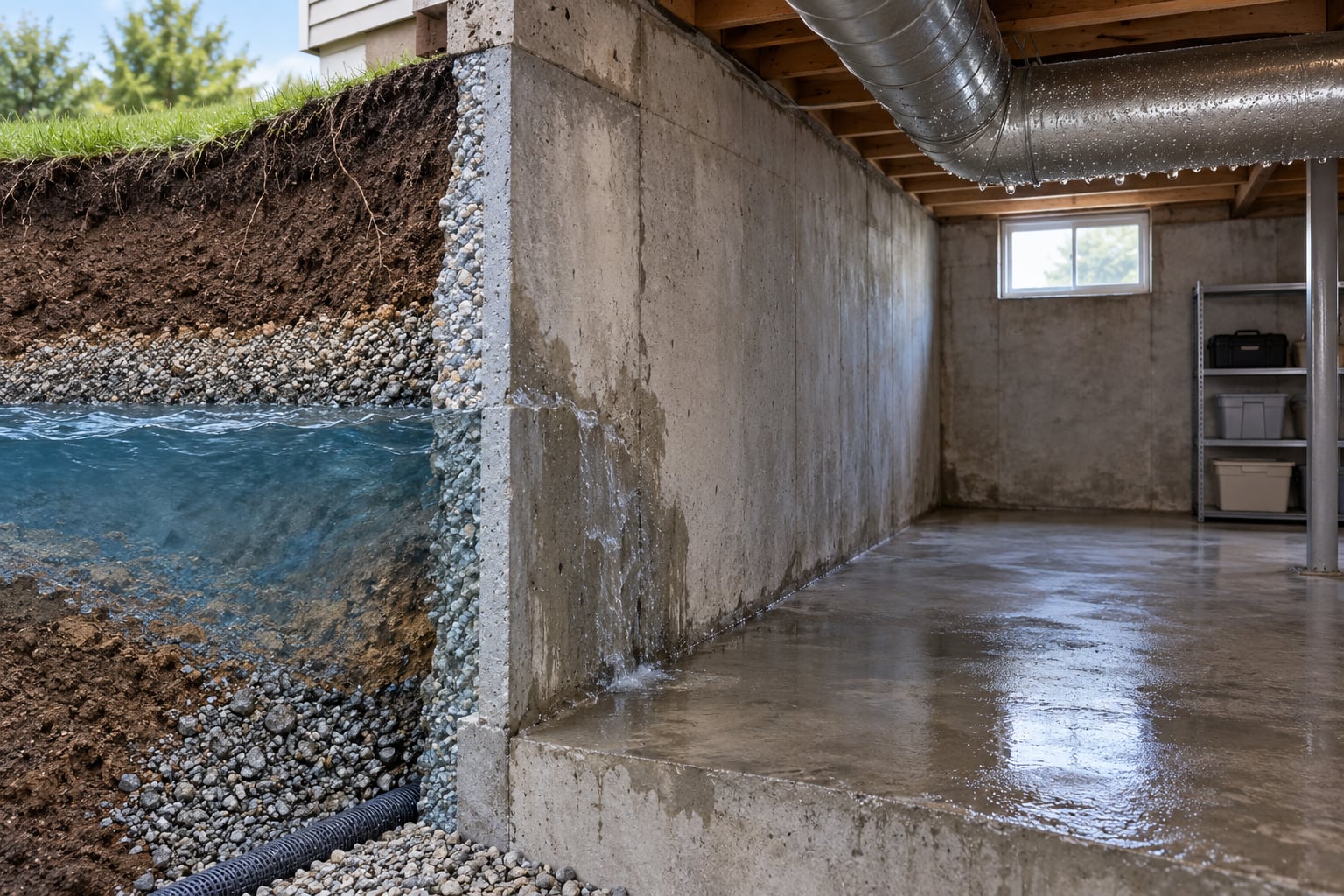
What causes high humidity in a basement? Usually one of four things: moisture-laden air condensing on cold concrete, groundwater wicking up through the foundation, rain and poor drainage pushing water against the walls, or damp air with nowhere to go. About 40 to 60 percent relative humidity is fine. Above 60 percent you are asking for mold.
There is a distinction worth holding onto early. High humidity is water vapor in the air. Water intrusion is liquid water coming in. They are different problems, they produce different signs, and they need different fixes.
Basements are unusually prone to this because the soil around them is a constant, slow moisture source. A wall 8 feet underground sits against damp earth that never fully dries out, while the air inside the room is warmer than the wall. That temperature gap is the whole problem in a nutshell.
Here is how the moisture actually gets in, what each source looks like from the inside, and how to narrow it down before you spend money on equipment that treats the symptom instead of the cause.
Table of Contents
- 1What Causes High Humidity in a Basement?
- 2How Basement Humidity Gets Into Your Home
- 3The Most Common Causes of Basement Moisture
- 4Condensation on cool surfaces
- 5Groundwater seepage through the foundation
- 6Rain and poor drainage around the house
- 7Plumbing leaks and leaking appliances
- 8Failed drains, sump pumps and open wet basements
- 9Moisture from unvented appliances and indoor activity
- 10Seasonal temperature swings and humidity moving upstairs
- 11How to Tell Whether the Humidity Comes From Air or Water
- 12What Signs Point to Each Basement Humidity Source
- 13How to Reduce High Basement Humidity Safely
- 14When a Basement Humidity Problem Needs a Professional
- 15Frequently Asked Questions
- 16What humidity level should a basement have?
- 17Why does my basement feel humid even when it does not rain?
- 18Can a dehumidifier fix a basement humidity problem?
- 19Does high humidity in a basement always mean there is a leak?
- 20When should I call a professional for basement moisture?
- 21Conclusion
What Causes High Humidity in a Basement?
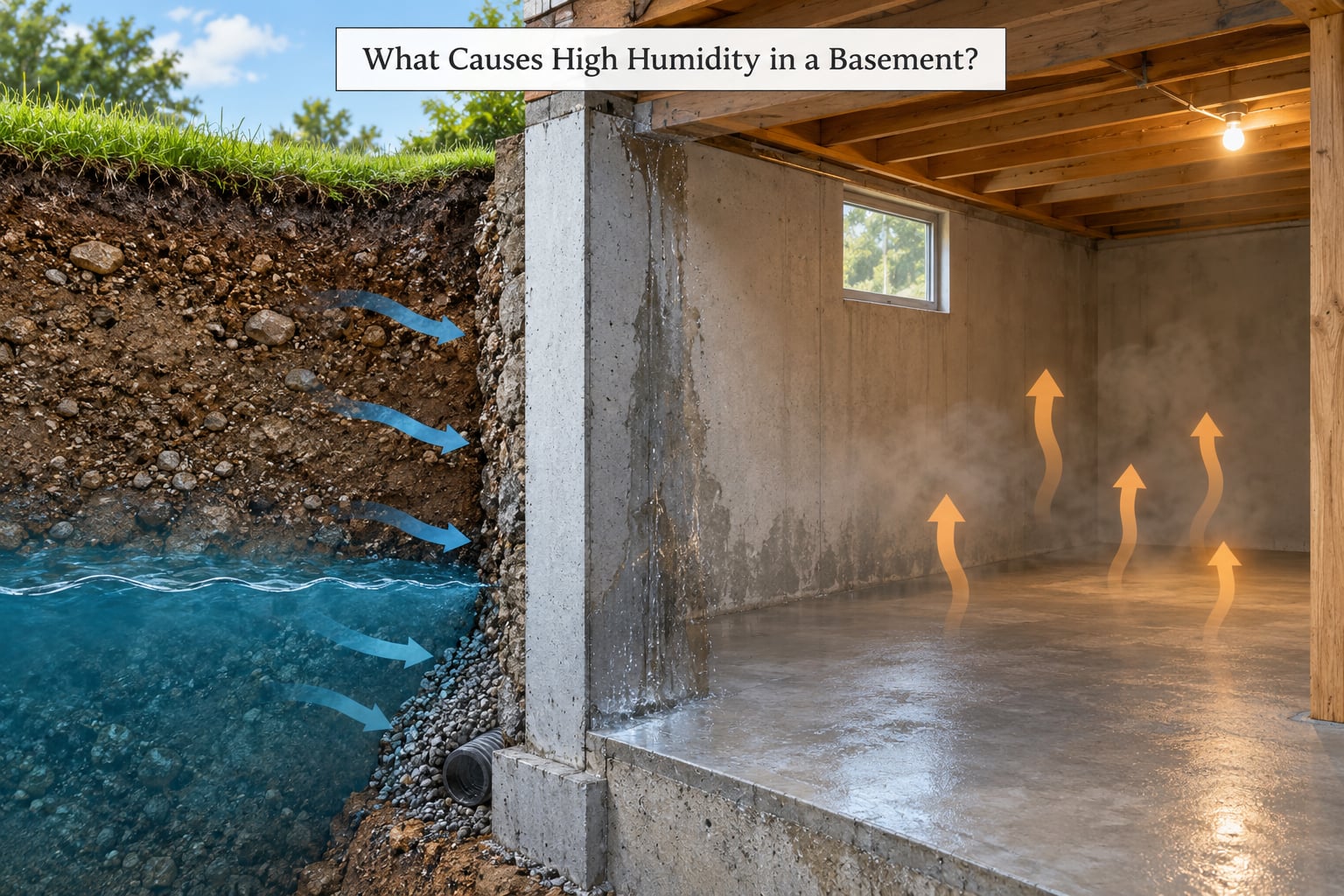
The three dominant causes are condensation on cold surfaces, moisture seeping up from the ground, and poor ventilation trapping humidity in the space. Add plumbing leaks and rainwater drainage problems and you have covered nearly every case a homeowner will meet.
Condensation happens whenever warm indoor air touches a surface colder than the air’s dew point. In a basement that is the concrete floor, the foundation walls, and the metal or ductwork that runs through the room.
Ground moisture is a different mechanism. Concrete and block are porous, so water in the surrounding soil migrates through them by capillary action, then evaporates into the room as vapor.
Ventilation is the third leg. A finished basement often has no operable windows, so a dehumidifier and a closed door are the only air exchange the room gets.
Here is the quick reference for what different readings actually mean.
| Relative humidity | What it means | What to do |
|---|---|---|
| 30 to 40 percent | Dry, sometimes too dry for basements with wood | Leave it alone |
| 40 to 50 percent | Comfortable and safe | Nothing |
| 50 to 60 percent | Acceptable upper range, watch it in warm weather | Keep a hygrometer in place |
| 60 to 70 percent | Action needed, mold risk climbs | Find the source, run a dehumidifier |
| 70 percent and above | Problematic, mold can colonize in 24 to 48 hours | Fix the source, manage continuously |
How Basement Humidity Gets Into Your Home
Relative humidity is the amount of water vapor in air compared to the maximum that air could hold at that temperature. Cold air holds less. That single fact explains most basement behavior.
Warm outside air on a humid day can carry a lot of vapor. Blow that air into a 55 degree basement and its capacity drops, and the excess has to go somewhere. It condenses on the coldest surface it can find.
That threshold is the dew point. If your wall is at 55 degrees and the air around it has a dew point of 60, water forms on that wall. You can see the same thing on a bathroom mirror or a cold drink glass in summer.
Meanwhile the ground is doing its own thing. Rain soaks the soil around the foundation, the water table rises, and that moisture seeps through the wall and floor. It then evaporates into the room, adding vapor with no visible puddle anywhere.
Air circulation matters because moving air speeds evaporation. A still, closed room lets moisture build until it reaches an uncomfortable level. Air that moves constantly strips moisture away from surfaces before it can collect.
Here is how each source reaches the basement and what it leaves behind.
| Moisture source | How it reaches the basement | Warning signs it leaves |
|---|---|---|
| Condensation | Warm air meets concrete below the dew point | Beading water on walls, dripping pipes, sweating windows in summer |
| Ground moisture | Capillary action through porous concrete and block | Mineral crusts, musty smell, damp carpet that never fully dries |
| Rain and grading | Water pushed against the foundation finds entry points | Cove stains, wet patches that appear after storms, rust lines |
| Plumbing | A slow drip or a failed appliance flange | Isolated wet spot, water stains on a ceiling, sudden spike |
| Indoor activity | Laundry, showers, cooking, combustion appliances | Whole-house humidity, upstairs condensation, musty air near ducts |
The Most Common Causes of Basement Moisture
Condensation on cool surfaces
This is the cause that surprises people most, because it happens with no rain and no visible leak. The floor slab and the lower portion of the foundation walls act like a big cold surface, and in summer the indoor air is often warmer and more humid than the slab.
A quick check: wipe the wall dry and watch for beading within an hour or two. Uninsulated duct or water lines running through the room condense first, which is often mistaken for a plumbing problem.
Groundwater seepage through the foundation
Water in the soil is always present, and concrete block, fieldstone and older poured foundations all transmit it. The tell is a damp lower wall that feels cool to the hand and a white powdery bloom called efflorescence, which is dissolved minerals left behind as water passes through and evaporates.
Water in a window well or a foundation drain that is clogged or crushed is the usual culprit. The check is simple: run a garden hose along the foundation for fifteen minutes and see whether the dampness grows.
Rain and poor drainage around the house
Soil that slopes toward the house, gutters that dump at the foundation, or downspouts that end two feet from the wall all push water against concrete that was never designed to hold water back. After a heavy storm, moisture often shows up within minutes.
Look at where the ground sits six inches from the wall, and trace where your downspouts actually discharge. A hose test settles it quickly.
Plumbing leaks and leaking appliances
A weeping toilet supply line, a water heater with a corroded drain, or a cracked drain line under a finished floor produces water that has nowhere to go. The volume is often small, which is why it can stay hidden for months.
The distinguishing feature is location. A plumbing leak produces a wet spot tied to a pipe, drain or appliance, not a damp band running along the base of a wall.
Failed drains, sump pumps and open wet basements
A sump pump that seized over winter, a float switch stuck down, or a failed battery backup means the next real storm has nowhere to go. Water sitting in a sump pit adds steady vapor to the room long after it recedes.
Check the pump by pouring a few gallons into the pit and confirming it starts. If it does not, that is the whole problem, and it is also a safety issue.
Moisture from unvented appliances and indoor activity
A clothes dryer vented into the basement rather than outdoors, a shower without an exhaust fan, a dehumidifying air handler that dumps its condensate, or an unvented water heater all add humidity directly to the air. A family of four generates roughly 10 to 15 pints of moisture a day through cooking, bathing and laundry.
Here is a test homeowners in HVAC forums use: run the shower for fifteen minutes, leave the room, and come back. If the humidity climbs and no condensation formed, the moisture is coming from air, not from the walls.
Seasonal temperature swings and humidity moving upstairs
Basement humidity is often worst in spring and summer and fine in fall and winter, a pattern homeowners on building science forums describe almost word for word. Warm humid outside air enters the house through the stack effect, where indoor air rises and escapes through the attic, and the lower levels are exactly where that incoming air settles.
This is why a musty smell in the basement can end up in upstairs bedrooms and inside the HVAC ducts. The basement is a source, and the rest of the house is downstream of it.
How to Tell Whether the Humidity Comes From Air or Water
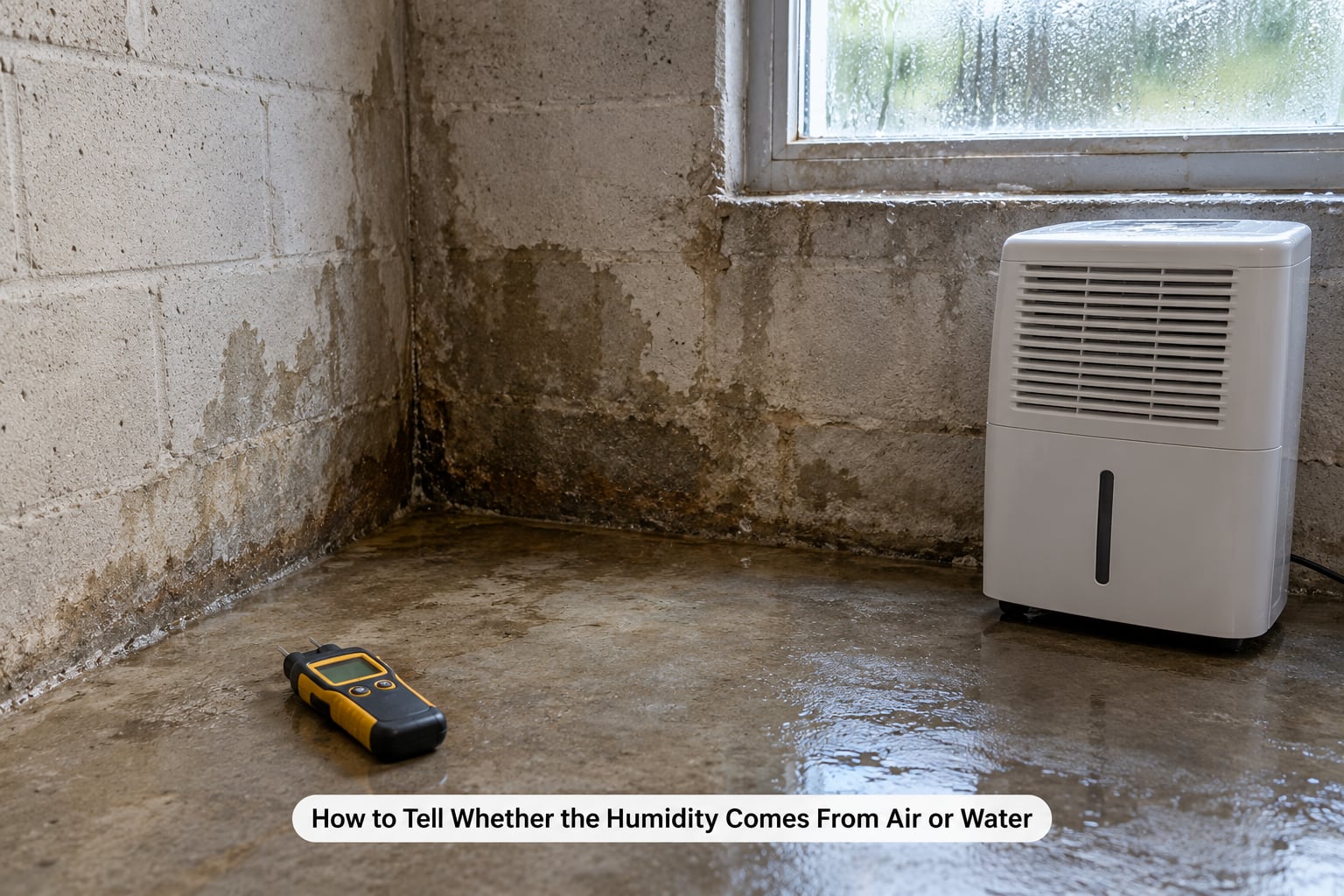
The fastest way to separate the two is to close the basement up for a day, run a dehumidifier on continuous, and watch the collection bucket. Several inches of water in a day points to a real moisture load, whether from air or from water. Not much water with the reading still stuck means the source is below the sensor and the dehumidifier is only chasing the symptom.
A pin or pinless moisture meter gives a second read. Readings of 20 percent or higher in wood framing, and elevated readings in the lower two feet of a concrete wall, suggest water rather than air alone. These meters are rough, so compare spots against each other rather than trusting one number.
Timing is the third clue, and it costs nothing. If the humidity climbs within a day of heavy rain, suspect drainage or a foundation entry point. If it climbs every July no matter the weather, suspect condensation and air exchange.
Watch the surfaces too. Efflorescence and mineral deposits mean liquid water passed through. Beading on the wall that forms with no rain means condensation. Neither leaves a trace, and mistaking one for the other sends you down the wrong repair path.
One more signal that gets overlooked: how much water the dehumidifier collects is itself a diagnostic. Continuous heavy collection means the source is still there. Little collection with a high reading means the source is below the sensor or you have a ducted unit drawing in damp air from outside.
What Signs Point to Each Basement Humidity Source
Start with what you can see and smell. Nearly every basement tells you its source if you know the vocabulary.
| What you notice | Likely cause | Where to look first |
|---|---|---|
| Beading water on walls or ceiling in summer | Condensation on a cold surface | Lower walls, ductwork, window frames |
| White powdery crust on concrete | Groundwater seepage, efflorescence | Base of the wall, mortar joints, cracks |
| Rust-colored runs from a corner or joint | Water tracking through or around the foundation | Cove joints, wall-to-wall seams, window wells |
| Dark or greenish growth on wall or ceiling | Persistent damp surface | North-facing walls, behind stored items |
| Musty odor, stronger after rain | Water in the space, slow leaks | Sump pit, storage areas, wall bases |
| Cardboard boxes damp or musty | Absorbed ground moisture | Anything resting directly on the slab |
| Standing or receding water in the pit | Drainage failure, high water table | Sump pump, check valve, discharge line |
| Doors and windows that stick or swell | Long-term dampness and swelling | Wood framing, doors on the trace side |
Musty smell deserves special attention because it travels. If you smell it in an upstairs bedroom, the moisture is still entering the living space, and a dehumidifier downstairs is buying you time rather than solving the problem.
How to Reduce High Basement Humidity Safely
Match the fix to the source. Treating condensation with a bigger dehumidifier works, but so does adding air exchange for the same room at a fraction of the effort.
For condensation, start by moving moisture out of the room. Run a dehumidifier on continuous rather than on a humidistat that lets the room drift up. Vent the dryer outdoors, add or repair an exhaust fan on the bathroom, and move stored cardboard and wood off the bare slab onto pallets or shelving.
For ground moisture and rain, the work is outside. Regrade the soil away from the house, extend downspouts to discharge six feet or more from the foundation, and clear window wells and drain outlets. A properly sized dehumidifier with a continuous drain line handles what gets through.
For plumbing and drainage, repair the leak, test the sump pump by pouring water into the pit, and clear the discharge line of ice and debris. Any work that involves electrical circuits near standing water belongs to a licensed electrician.
Two cautions. First, do not open basement windows on humid days. The incoming air is usually more humid than what is inside, and you are inviting more moisture into a space that already cannot dry. Second, be careful with insulation and vapor barriers. Adding interior insulation in the wrong place can push the dew point into the wall cavity and produce condensation between the studs, making the space feel worse after the work is done.
Monitor as you go. A cheap hygrometer placed at the finished-floor level, away from a dehumidifier outlet, tells you whether your changes are working better than any opinion you will get from a contractor.
When a Basement Humidity Problem Needs a Professional
Call a plumber for sewage backups, any leak inside the walls or under a finished floor, and a failed water heater. Sewage is a health hazard and it is not a homeowner job.
Call a waterproofing contractor when water enters during every significant storm, when the seepage comes through the walls rather than the floor, or when your foundation drain or sump system has failed repeatedly. This is structural work involving excavation and drainage, not patching.
Bring in a structural engineer for wide or displaced foundation cracks, a wall that bows inward, or a floor that slopes noticeably. Do not attempt to cut or brace a foundation yourself.
Bring in an electrician whenever water and wiring share a space, and use a licensed gas fitter or plumber for anything involving a gas-fired appliance, a water heater flue, or a combustion appliance of any kind.
Mold that covers more than a small patch, returns after cleaning, or comes back within weeks of remediation is worth a professional assessment too. Bleach on a surface does nothing to the moisture feeding it.
Frequently Asked Questions
What humidity level should a basement have?
Most experts put a safe target between 40 and 60 percent relative humidity, with 45 to 50 percent ideal for storage spaces and finished rooms. Sustained readings above 60 percent give mold and dust mites the moisture they need to multiply. Below 30 percent, wood and drywall can shrink and check, which matters more in storage basements than in finished ones.
Why does my basement feel humid even when it does not rain?
Condensation and ground vapor are the usual answers. Warm indoor air touching concrete below its dew point turns to water on the wall or floor, and moisture in the soil migrates through porous concrete and evaporates into the room. A dehumidifier collecting several inches of water a day with no rain in sight points squarely at one of these two.
Can a dehumidifier fix a basement humidity problem?
It controls humidity well, but it manages a symptom rather than removing the source. A unit sized for the square footage, run on continuous with a drain line, will hold a basement in range indefinitely. It will not stop groundwater seepage, a failed sump pump or a leaking pipe, and it will fight an uphill battle if a large moisture load keeps arriving.
Does high humidity in a basement always mean there is a leak?
No. Air and water are two different problems that both show up as a high hygrometer reading. Condensation from warm air on cold concrete and moisture given off by appliances or indoor activity raise humidity with no leak at all. Look for the distinguishing signs: beading water without rain means condensation, while efflorescence, rust runs and a damp band at the wall base suggest water coming through.
When should I call a professional for basement moisture?
Call a plumber for sewage backups and leaks hidden behind finished walls. Call a waterproofing contractor when water enters during most significant storms or the seepage comes through the walls. A structural engineer is needed for wide or displaced foundation cracks and bowing walls, and an electrician whenever water and wiring share a space. Extensive mold growth also warrants professional assessment.
Conclusion
What causes high humidity in a basement? Condensation on cold concrete, moisture seeping up from the ground, rainwater pushed against the foundation by poor drainage, and damp air with no way out. Those four account for nearly every case, and telling them apart is the whole job.
Start with three things. Put a hygrometer on the finished floor and get a real number, then look for the signs that separate water from air: beading water, efflorescence, rust runs and wet spots. Finally, watch whether the reading jumps after rain, which separates a drainage problem from a ventilation one.
Once you know which one you have, the fix is usually straightforward. Regrade the soil and extend a downspout, repair a leak, test a sump pump, or vent the dryer outdoors. A dehumidifier on continuous will hold the space in range in the meantime, and it is worth running even while you work out the source.