Most tap water does not need filtering. It needs filtering when you can point to something specific: a taste, a smell, a color, a stain that keeps coming back, or a result on a lab report you did not expect. If you are not sure where to start, this checklist walks through the same order I would use, from a glass of water on the counter to a certified lab panel, and helps you figure out how to tell if your water needs filtering before you spend anything on a system.
Start with the free checks, which take about ten minutes and catch most problems. Taste and smell are genuinely useful here even though they cannot prove safety. What they do is narrow down which tests are worth paying for.
Table of Contents
- 1What You Need
- 2Step-by-Step: How to Tell If Your Water Needs Filtering
- 3Step 1: Know your source
- 4Step 2: Look at it in a glass
- 5Step 3: Let it sit for an hour
- 6Step 4: Smell and taste it
- 7Step 5: Read the clues the house gives you
- 8Step 6: Screen with strips, confirm with a lab
- 9Matching the Result to the Right Filter
- 10When You Do Not Need a Filter
- 11Home Test Strips vs. a Certified Lab Panel
- 12Common Mistakes
- 13Frequently Asked Questions
- 14Does cloudy tap water always mean it needs filtering?
- 15What taste or smell changes suggest that my water needs a filter?
- 16How can I find out what contaminants are in my tap water?
- 17Should I buy a faucet filter, pitcher filter, or whole-house system?
- 18When should I contact my water utility instead of buying a filter?
- 19What to Do First
What You Need
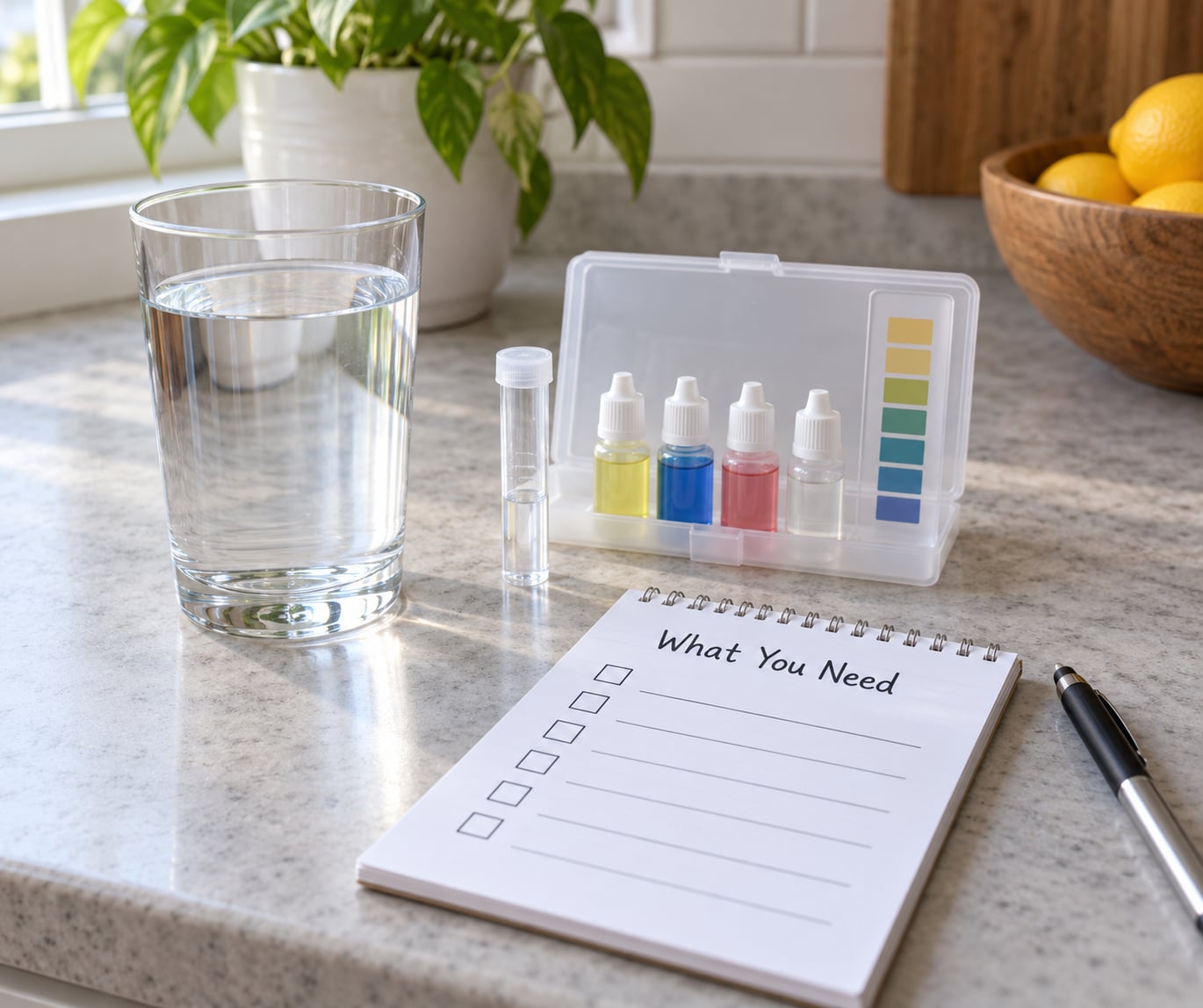
You do not need much to start, and most of it you already own.
- A clear glass, washed with dish soap and rinsed well, so you are not measuring your own cleaning products.
- A white paper towel or sheet of plain white paper for the clarity test.
- A timer or your phone for letting a glass sit and watching what settles out.
- A home test strip kit, if you want a rough screening read on hardness, pH, chlorine, or alkalinity. These are cheap and useful for direction, not for proof.
- Your water source: municipal or private well, and if municipal, the name of your utility.
- A short history of the house: when the pipes were last replaced, when the well was last tested or pumped, and whether anything changed recently.
That last item gets skipped and it is the one that explains the most surprises. Well owners in particular need to know whether the water has always smelled this way or whether it changed after heavy rain, a dry summer, or a flood.
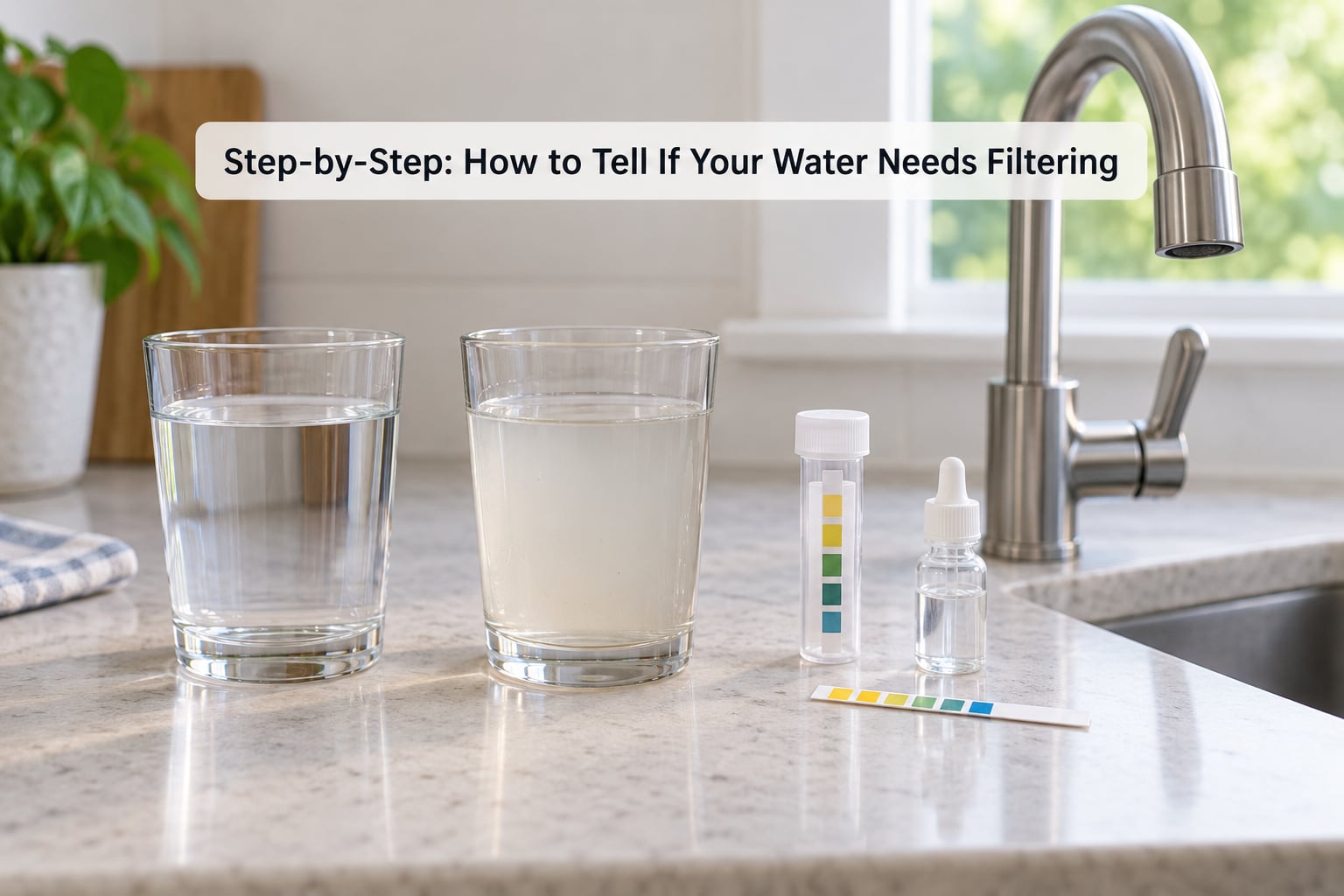
Step-by-Step: How to Tell If Your Water Needs Filtering
Step 1: Know your source
Municipal water and private well water fail in completely different ways, so this one decision changes everything after it. Municipal water is treated and monitored by a utility under the federal Safe Drinking Water Act, and your utility publishes an annual water quality report, usually called a Consumer Confidence Report, which is free and often online. A private well has no utility, no routine monitoring, and no automatic protection. The Safe Drinking Water Act does not regulate private wells, so testing is entirely on the homeowner.
If you are on municipal water and your utility’s report shows no violations, you already have most of the safety answer and any problem is likely aesthetic or plumbing-related. If you are on a well, assume you need an annual panel regardless of how the water tastes.
Step 2: Look at it in a glass
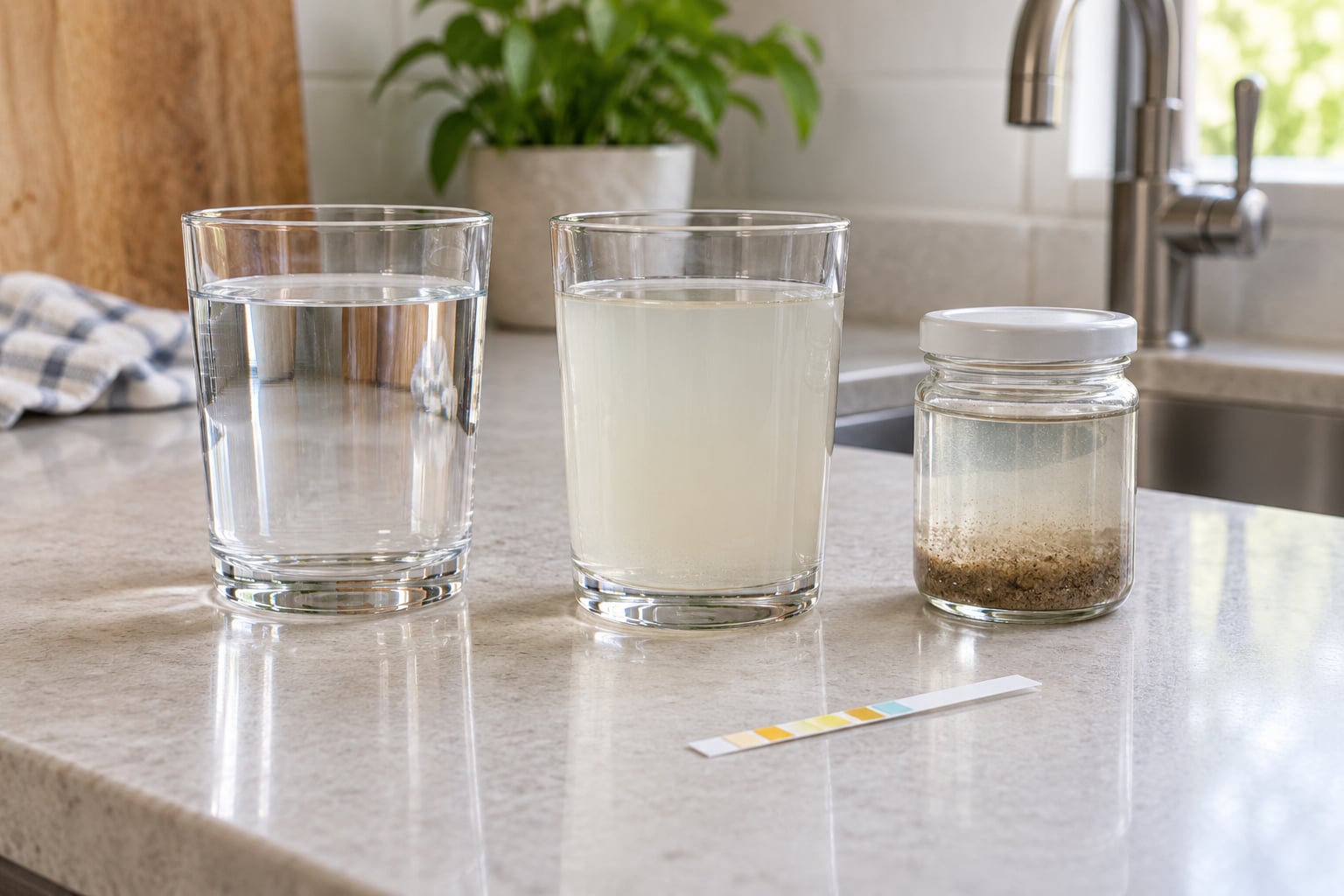
Fill the glass and hold it up to a window with light coming through it. Then set it on that white paper and look straight down through the water. That second view is the one that works, because it gives you a white background to judge against.
Clear means clear, with no haze, no floating specks, and no film on the surface. A faint gray haze points to fine sediment or to colloidal material. Orange or reddish water usually means iron, though manganese can do it too and it stains more brown-black. Black flecks or a gray-black film are a common sign of manganese. Cloudiness that appears only after rain points to turbidity, meaning soil and silt entering the water.
Step 3: Let it sit for an hour
Leave the glass uncovered on a counter away from sunlight for an hour or two. Whatever drops to the bottom tells you something useful: a fine sandy layer suggests sediment or iron bacteria, white flakes that settle as a soft pile suggest calcium or manganese, and a ring or film drying on the glass points to hardness.
Step 4: Smell and taste it
Smell the glass before you taste it. A swimming pool smell means chlorine, which is the residual disinfectant the utility uses to keep water safe in the pipes. It is not a safety problem in itself. A sharp, faintly chemical smell that does not fade after running the tap for a minute is usually chloramine, and chloramine is one of the specific things a carbon filter is built for. Run the tap longer and the chlorine smell fades; the chloramine smell often does not.
A rotten egg smell means hydrogen sulfide, which is common in well water and in stagnant plumbing. It is foul and unmistakable. If it only shows up on one tap, that is a plumbing clue rather than a source problem.
Taste tells you about hardness directly. If your soap will not lather no matter how much you use, and your hair feels coated after a shower, you are dealing with hardness, meaning calcium and magnesium. Both are not health hazards at normal levels, but they are the reason for scale, soap film, and short appliance life.
Step 5: Read the clues the house gives you
Fixtures and appliances are free sensors that have been running for years. Look for these:
- Orange or rust-colored stains in a bathtub or sink, especially one that scrubs off but returns. That is iron.
- Greenish-blue staining on copper fixtures or around brass valves, which points to copper corrosion in older plumbing.
- White crust on faucet aerators and shower heads, and white deposits inside a kettle or coffee maker. Hardness.
- A dishwasher that leaves spots on glasses and a film on plates despite using rinse aid. Hardness.
- Water heater life noticeably shorter than the tank warranty, with heavy scale inside. Hardness, and the most expensive hard water consequence.
- Clouds of sediment that fill the dishwasher or a washing machine after a storm. Turbidity or iron.
If the clues only appear at one faucet or one fixture, the problem is almost certainly plumbing rather than the water supply. Old galvanized pipe, lead service lines, and brass fittings containing lead are the usual suspects, and no filter on the main will fix water coming out of a corroded branch line.
Step 6: Screen with strips, confirm with a lab
Home test strips are screening tools. They give you a rough number in about a minute, they cost very little, and they are useful for noticing a change over time or tracking whether a filter is doing anything. They are not accurate enough to base a purchase on, and reading them wrong is the reason people dismiss them. Use them to decide what to ask a lab about, nothing more.
A certified drinking water laboratory panel is a different category. A lab uses EPA-approved analytical methods, reports in parts per million or parts per billion, and gives you a result you can take to a plumber, a landlord, or a regulator. When you call a lab, ask which analytes are included and make sure the panel covers more than just hardness: coliform and E. coli for bacteria, nitrates, arsenic, lead, iron, manganese, and PFAS if your plumbing or source is a reason to suspect them.
Sample it the way the lab instructs, which usually means a clean, sterile bottle, running the tap for a set time first, and never using the tap you sampled from for drinking before sampling. Well water panels usually get repeated annually, and again after flooding, heavy rain, or any change you notice.
Matching the Result to the Right Filter
Once you know what is in the water, match the filter to the problem. This is where most wasted money happens, because a softener and a filter are not the same device.
| Symptom | Likely cause | What to test for | What usually helps |
|---|---|---|---|
| Rotten egg smell, well water | Hydrogen sulfide | Sulfur compounds, iron, pH | Oxidation filter or aeration |
| Pool smell from the tap | Residual chlorine | Chlorine, chloramine | Activated carbon, point-of-use or whole house |
| Orange or red stains in a tub | Iron | Iron, manganese, pH | Oxidation and filtration, often whole house |
| White scale, soap that will not lather | Hardness, calcium and magnesium | Hardness in grains per gallon | Ion-exchange softener, or a salt-free conditioner |
| Cloudy only after heavy rain | Turbidity, silt, possibly bacteria | Turbidity, coliform, nitrates | Sediment filtration; treatment for microbes |
| Gray or black film, staining | Manganese or iron bacteria | Manganese, iron, bacteria | Oxidation filtration |
| Sweet, slightly chemical taste on some taps only | Possible plumbing corrosion | Lead, copper | Fix the plumbing, not a filter |
| Flat, faintly metallic water on newer plumbing | Pipe or fixture material | Lead, PFAS where relevant | Certified filter, flushing the cold tap first |
A water softener exchanges calcium and magnesium for sodium, so it fixes hardness and scale. It does not remove lead, sediment, chlorine, or bacteria. A carbon filter handles chlorine, chloramine, odor, and some organic compounds. It does not soften water. A sediment filter catches grit and rust but nothing dissolved. Reverse osmosis removes a broad range of dissolved contaminants but strips out minerals, tastes flat, and needs more upkeep. UV disinfection kills bacteria and does nothing for hardness, metals, or sediment.
One practical note on lead: if you have older plumbing, run the cold tap for a minute or two before you drink or cook with it, and use cold water for drinking rather than hot. Hot water picks up more from pipe interiors and solder.
When You Do Not Need a Filter
Plenty of homes need nothing. If you are on municipal water, your utility’s annual report shows no violations, and you cannot name a specific complaint, a filter is optional and purely a taste or convenience purchase. A pitcher or faucet filter for chlorine taste is a reasonable choice with no safety claim attached to it, and that is a preference, not a defect.
Likewise, hard water on municipal supply is an appliance and comfort issue rather than a health one, so a softener is a decision about scale and soap, not about safety. Anyone selling you an expensive system on the strength of a taste complaint alone is selling you a system.
Home Test Strips vs. a Certified Lab Panel
Strips are fast and good for one job: noticing change. Lab panels are slow, more expensive, and the only version of the answer you can defend to a plumber, a landlord, or a health official. For a home that just wants to know whether to soften, strips are plenty. For a new homeowner with an untested well, a baby in the house, an immunocompromised person, or any plan to make a purchase, start with the panel.
Common Mistakes
Filtering before you diagnose. A whole house system installed against a taste complaint often does nothing for the actual problem, because the taste came from chloramine, or from one corroded branch line, or from a water heater. Test first, then buy.
Buying a softener to fix a safety problem. Ion exchange does not remove lead, arsenic, nitrates, or PFAS. If your concern is a contaminant, you want carbon, RO, or a certified filter rated for that specific contaminant under NSF/ANSI 53, not a softener.
Treating taste as proof of safety, or its absence as proof of danger. Many serious contaminants are colorless, odorless, and tasteless at low levels. That is the entire argument for a lab panel and the reason a nice-tasting glass proves very little.
Ignoring the plumbing. If the problem shows up at one tap, or in a house with pre-1987 plumbing, filter replacement will never fix it. Call a plumber and ask about lead service lines, galvanized pipe, and brass fittings.
Buying proprietary replacement parts. Owners of whole house systems report the same frustration repeatedly: cartridges and media that only one seller carries, at a price that has nothing to do with the standard equivalent. Ask any installer what standard parts they use, and keep one spare on hand.
Skipping maintenance. A saturated carbon filter can actually encourage bacterial growth, and a neglected softener bridges over and stops working. Write the change interval on the housing itself.
Two rules cover most of the rest. Look for certification, NSF/ANSI 42 for aesthetic claims, 53 for health-related contaminant reduction, 58 for reverse osmosis, and 61 for lead-free plumbing components. And if a seller tells you one filter removes everything, that is the answer to your question.
Frequently Asked Questions
Does cloudy tap water always mean it needs filtering?
No. Air bubbles and a recent plumbing flush often make water look cloudy for a few minutes, and it clears from the bottom of a glass upward. Water that stays cloudy as it settles has sediment, iron, or bacteria in it. Let a glass sit for an hour and see whether clarity returns from the top down or not at all.
What taste or smell changes suggest that my water needs a filter?
A pool smell is residual chlorine, which fades after you run the tap a minute. A sharp smell that does not fade is usually chloramine, and carbon filtration is what addresses it. Rotten eggs mean hydrogen sulfide, typical in well water. Flat, metallic, or faintly sweet water points to plumbing material rather than a filterable contaminant.
How can I find out what contaminants are in my tap water?
Start with your utility’s annual water quality report, which is free and covers municipal supply. Then get a panel from a certified drinking water laboratory. Ask which analytes are included and make sure the panel covers coliform, nitrates, arsenic, lead, iron, manganese, and hardness rather than hardness alone.
Should I buy a faucet filter, pitcher filter, or whole-house system?
A pitcher or faucet filter is the right call for one drinking tap with a taste or chlorine complaint. A whole-house system makes sense when the problem shows up at every fixture, such as iron staining throughout the house, or when you want filtered water for ice machines and appliances. Match the device to the contaminant, not to the house size, and get a contaminant list before you choose, because guessing is the usual reason how to tell if your water needs filtering goes wrong.
When should I contact my water utility instead of buying a filter?
Contact the utility if the change affects multiple homes on your street, if you received a boil-water advisory, or if the water looks like sediment after heavy rain or flooding. Utility staff can usually tell you whether the source, main, or a main break is responsible. Individual taps with different water point to your own plumbing instead.
What to Do First
Fill a clean glass, hold it to the light, then set it on white paper and let it sit for an hour. That costs nothing and it tells you more than you would expect. After that, read your utility’s water quality report if you are on municipal water, or order a certified lab panel if you are on a well. Buy the filter last, matched to whatever the results actually show. That ordering is how to tell if your water needs filtering without spending twice. If anyone in the house is a baby, is immunocompromised, or if the plumbing is old, move the lab panel to the front of the list.
Updated for 2026.