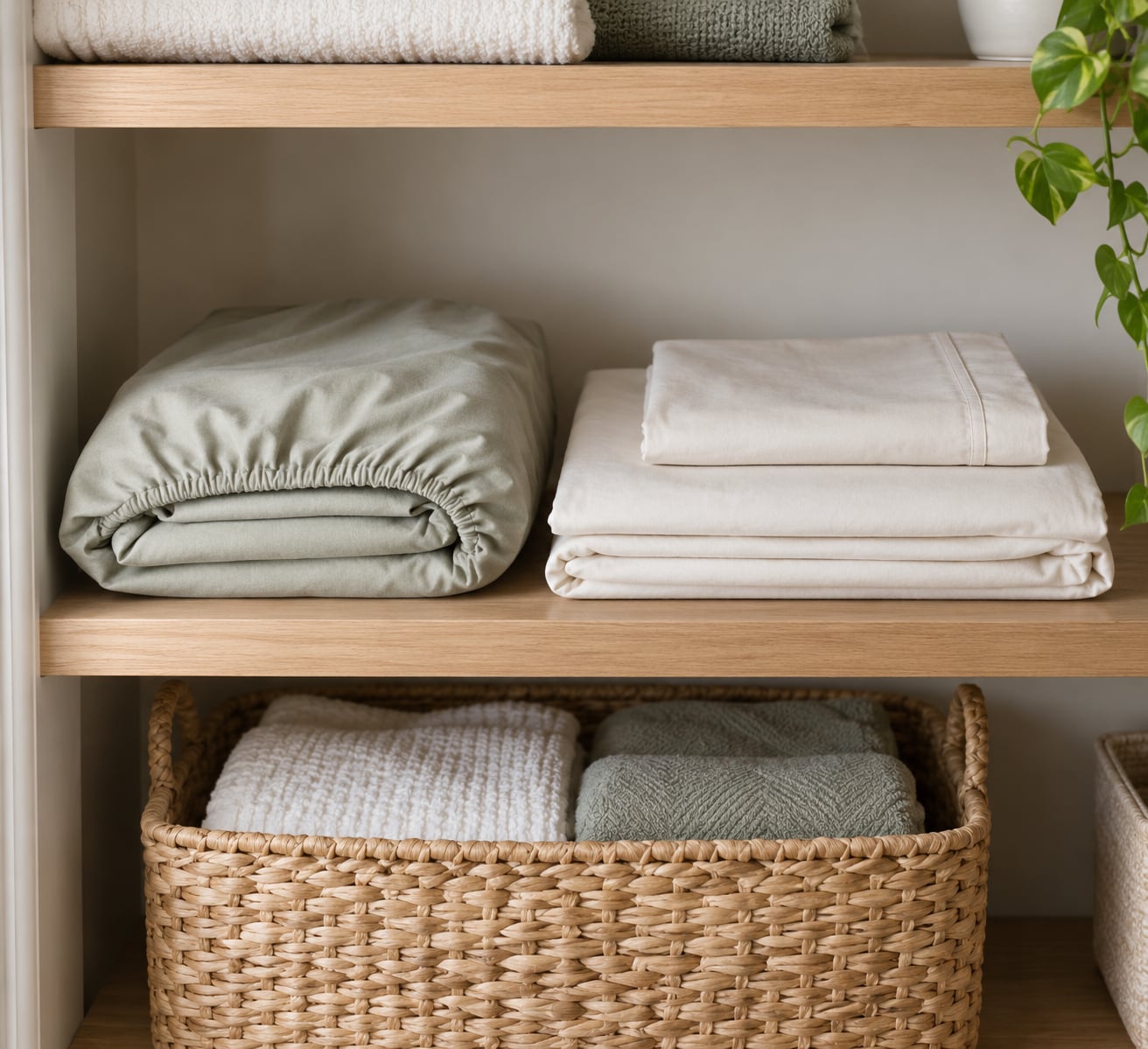
If you have been shoving fitted sheets into a ball and hoping for the best, the whole trick is this: turn the sheet inside out, gather all four elastic corners into one pile, tuck the last two corners into the first two, then lay the square flat and fold it in thirds. That takes about 30 seconds and produces a rectangle roughly a quarter of the mattress size, so it stacks flush with your flat sheets instead of springing off the shelf.
The reason most tutorials frustrate you is that they tell you to wrap one corner at a time. That instruction came from an era when fitted sheets had elastic only at the corners. Modern sheets have elastic running around the entire inner perimeter, so working a single corner at a time pulls the fabric out of square and tangles it. Collecting the corners together first is what fixes it.
No special equipment, no gadgets, no helper required. Just a surface you can spread out on.
Table of Contents
- 1What You Need
- 2Step-by-Step: How to Fold a Fitted Sheet
- 3The Four-Corner Method
- 4The Quick Roll Method
- 5Common Mistakes
- 6Frequently Asked Questions
- 7Does this folding method work for deep pocket fitted sheets?
- 8Should I fold a fitted sheet inside out or right side out?
- 9Where should I store folded fitted sheets in a closet?
- 10Can I store a folded fitted sheet in a drawer?
- 11What is the difference between a fitted sheet and a flat sheet?
- 12Conclusion
What You Need
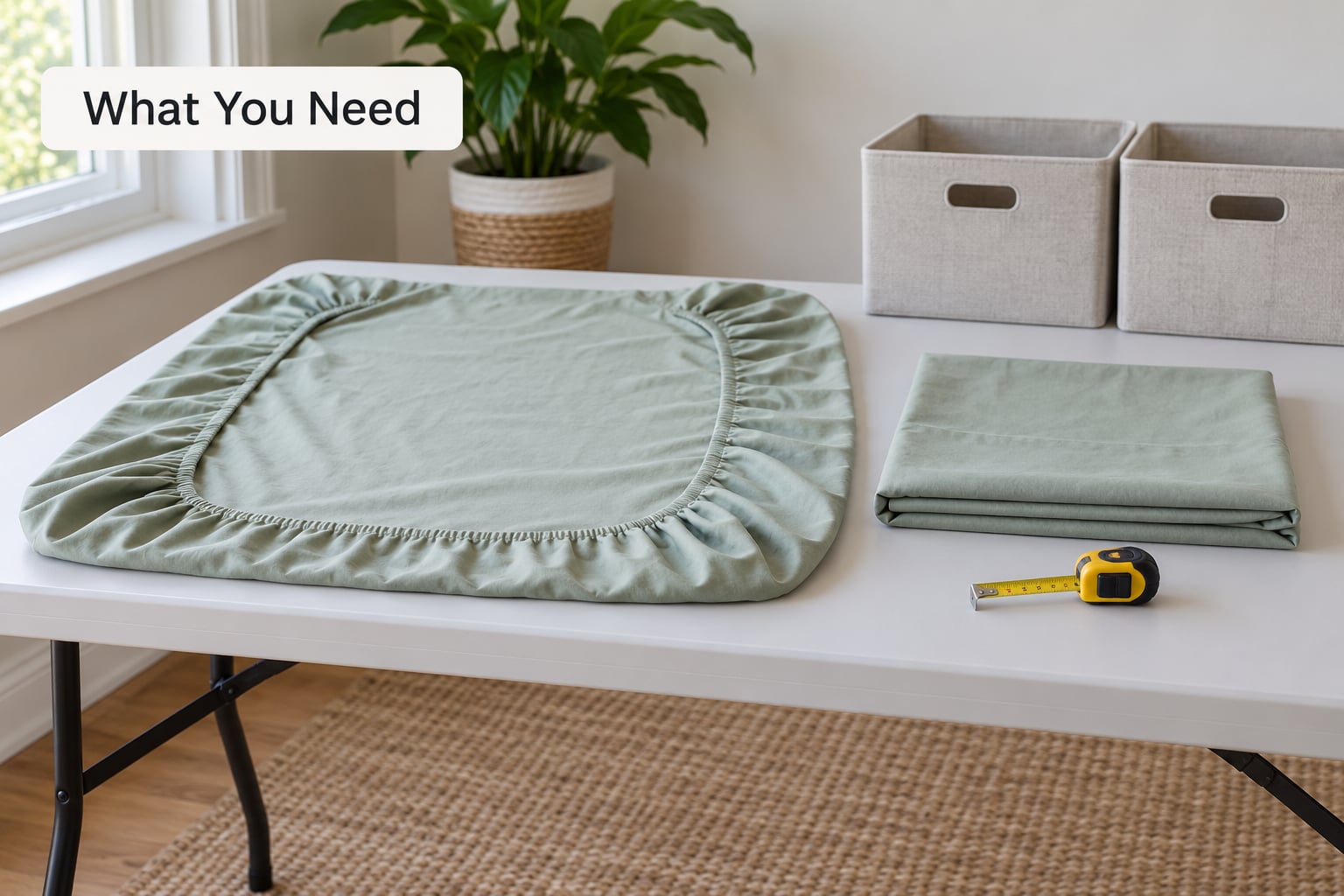
A flat surface big enough for the sheet to lie open. The bed itself works, and so does a clear stretch of floor or a table you have pushed against a wall.
The fitted sheet itself, dry. Folding a sheet straight out of the dryer is what creates most of the lumps people complain about later.
Optional extras that make the job easier: a second pair of hands for king and queen sizes, a small ruler or tape measure if you want every bundle in your stack to be identical, and the matching pillowcase, which doubles as a storage bag once the fold is done.
A quick word on what you are folding. A flat sheet is a plain rectangle of fabric that lies on top of the bedding. A fitted sheet has elastic sewn around its inner edge so it grips the mattress and will not slide off. That elastic is the entire reason folding one is harder than folding anything else in the laundry pile.
Step-by-Step: How to Fold a Fitted Sheet
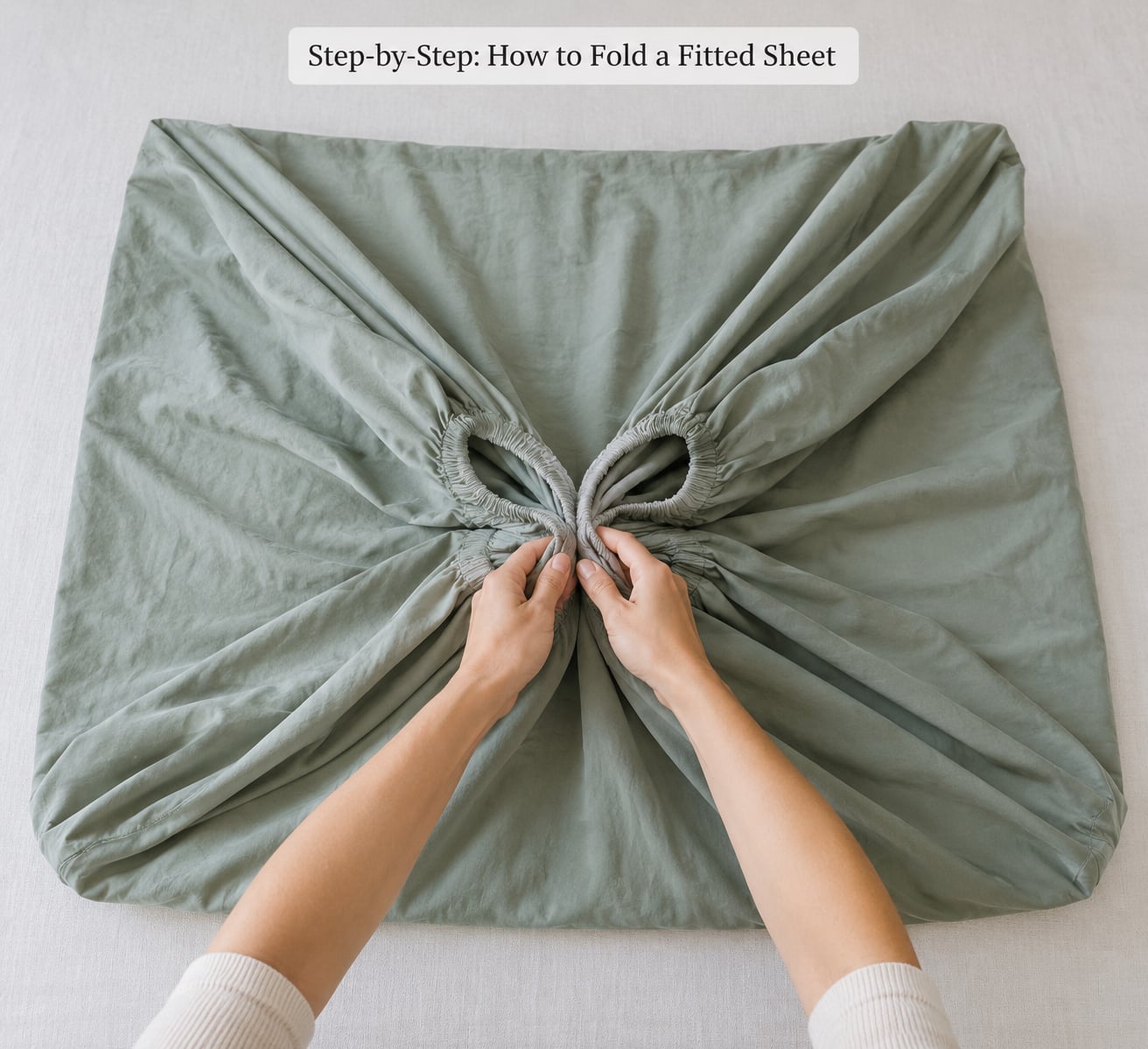
Work on a surface with enough room to spread the sheet out flat. Follow these five steps in order, and do not skip to the last one before the corners are nested.
- Turn the sheet inside out. Pull one corner over the opposite corner and work the fabric inside out until the elastic edge is facing you and exposed, not hidden inside a pocket you have to hunt for.
- Slip a hand into each of two adjacent corner pockets. Pick two corners next to each other along one short end of the mattress, and push your hands right into the gathered corners until your knuckles are in the elastic.
- Fold one corner over the other. Bring one corner down onto the second corner, matching the elastic edges as closely as you can. The two corners should now sit inside each other like two hands in one pocket.
- Gather the remaining two corners and tuck them in. With your free hand, pick up the last two corners together as a pair and stuff both into the pocket you just made. Do not handle them one at a time.
- Lay the square flat and fold it into thirds. Set the bundle down, smooth it with both palms, find a straight edge, fold one third over the middle, then fold the remaining third over the top.
Check your work by looking at the folded rectangle. If the elastic is visible on the outside or the layers slide, the corners were not fully nested. Open it up and do step four again, this time pushing the corners deeper into the pocket.
For king and queen sizes, the same five steps work, but the final fold changes. Once you have the flat square, fold it in half instead of in thirds and then in half again. A queen or king sheet folded in quarters still fits a shelf, while a thirds fold on a king leaves you with a rectangle too wide to stack.
The Four-Corner Method
The steps above are the standard corner-nesting method, and it is the one most people settle on. Once your hands are inside two adjacent corners with the elastic facing out, it should look exactly like two hands in one pocket, because that is literally what it is.
The detail that makes or breaks the result is step four. When the last two corners come in, bring them in as a pair, both hands at once, one inside the other. This is the single fix for the lumpy, half-bunched result that sends people back to the video to check whether they missed a step.
The elastic ends up on the inside of the bundle, fully enclosed. Nothing pokes out, so the rectangle sits flat in a stack and the elastic is not slowly stretching itself out of shape against a shelf edge. Some people like the finished square printed-side out and others inside out, and it genuinely does not matter for storage.
You will not get a crisp 90-degree corner, and you are not doing it wrong. Elastic is under tension all the way around, so it keeps pulling the fabric slightly out of shape. A slightly soft square is the realistic outcome here, and plenty of readers have described the first clean fold as the moment the whole chore suddenly clicked.
The Quick Roll Method
Rolling works well for a small linen closet, a dorm room, an RV, or anywhere a rectangle will not quite fit. It is faster than folding and the result holds its shape on a shelf.
- Lay the sheet flat on the surface with the elastic edge facing down, so the fabric is not fighting you.
- Align the two short ends so the fabric is even, then fold the sheet loosely in half lengthwise, edges just touching, not pinched tight.
- Roll from one end toward the other, keeping the roll loose enough that air still moves through it and tight enough that it holds together on the shelf.
Loosely is the important word. Stretch the elastic out of shape with a tight roll and the sheet will not lie flat again for weeks. Store rolls standing up in a basket or crate so they do not roll under the shelf, and label them if your linen closet runs deep.
Common Mistakes
Wrapping corners one at a time. This is the big one, and it is the reason the internet is full of people insisting they cannot fold a fitted sheet. Fix it by picking up the final two corners together and nesting them both into the pocket from step three.
Folding only the top edge. A fitted sheet will not fold like a flat sheet, and treating it like one just gives you a long narrow strip with a bulge on one side. The corners have to come together before any long fold happens.
Leaving the sheet twisted. After you lay the square flat, run both palms across it from the center outward. If the fabric does not lie open without a twist, the two tucked corners went in facing different directions. Unfold it back to the square and swap one corner around.
Pulling the elastic tight. Stretching the pocket to make it look neater damages the elastic over time and makes the fold lumpy. Push the corners in and let them sit naturally instead.
Folding a damp sheet. Moisture locks in wrinkles and can end up with a musty smell in a closed linen closet. Folding straight out of the dryer is fine if you are stacking immediately, but a fully air-dried sheet folds noticeably cleaner.
Stretching a deep pocket sheet flat. Deep pocket sheets have more fabric above the elastic, so the corner you grab has extra material in it. Push your hand all the way to the true corner rather than stopping at the top of the elastic, and expect the finished square to be a little plumper than a standard pocket.
Two smoothing habits help more than anything else. Shake the sheet out hard before you start, and press the folds with the flats of your palms rather than your fingertips. Once the rectangle is done, store it in the matching pillowcase and the whole set counts as one tidy bundle instead of three loose pieces.
Frequently Asked Questions
Does this folding method work for deep pocket fitted sheets?
Yes, with one adjustment. Deep pocket sheets have extra fabric above the elastic, so the corner you reach for feels fuller. Push your hand all the way to the true corner past the elastic rather than stopping at the top of it. The finished square will be slightly plumper than a standard pocket, but it folds and stacks the same way.
Should I fold a fitted sheet inside out or right side out?
Either works for storage. Turning the sheet inside out at the start makes the elastic easier to find and grip, which is why the method begins that way. What matters more is that all four elastic corners end up hidden inside the bundle with nothing poking out. The elastic left exposed against a shelf edge will slowly stretch out of shape.
Where should I store folded fitted sheets in a closet?
On a shelf at roughly chest height, in a stack with the flat sheets and pillowcases of the same size. A folded fitted sheet is about a quarter of the mattress area, so it fits the footprint of a folded flat sheet. Keep elastic edges hidden inside the fold and avoid the top shelf, where dust settles and the weight of nothing sits on top of the stack.
Can I store a folded fitted sheet in a drawer?
Yes, a fitted sheet folded in thirds sits flat enough for a dresser drawer, which makes it a good fit for small bedrooms where closet space is limited. Fold the flat sheet and pillowcase the same way and you can fit an entire set in one drawer. Line the drawer with a shallow tray if the stack shifts around when you open it.
What is the difference between a fitted sheet and a flat sheet?
A flat sheet is a plain rectangle of fabric that goes over the top of your bedding. A fitted sheet has elastic sewn around its inner edge so it grips the mattress and stays put. A flat sheet folds in half and stores in seconds. The elastic is the only reason a fitted sheet needs a special folding method at all.
Conclusion
Start with one move: lay the sheet flat, gather all four elastic corners into your hands at once, and nest them together inside out. That single change from the one-corner-at-a-time instruction is what turns a tangled mess into a square you can actually stack.
From there it is two flat folds. No board, no gadget, no second person unless you happen to be folding a king. Once the rectangle is done, drop it in the matching pillowcase and your linen closet finally looks like a linen closet. Updated for 2026.