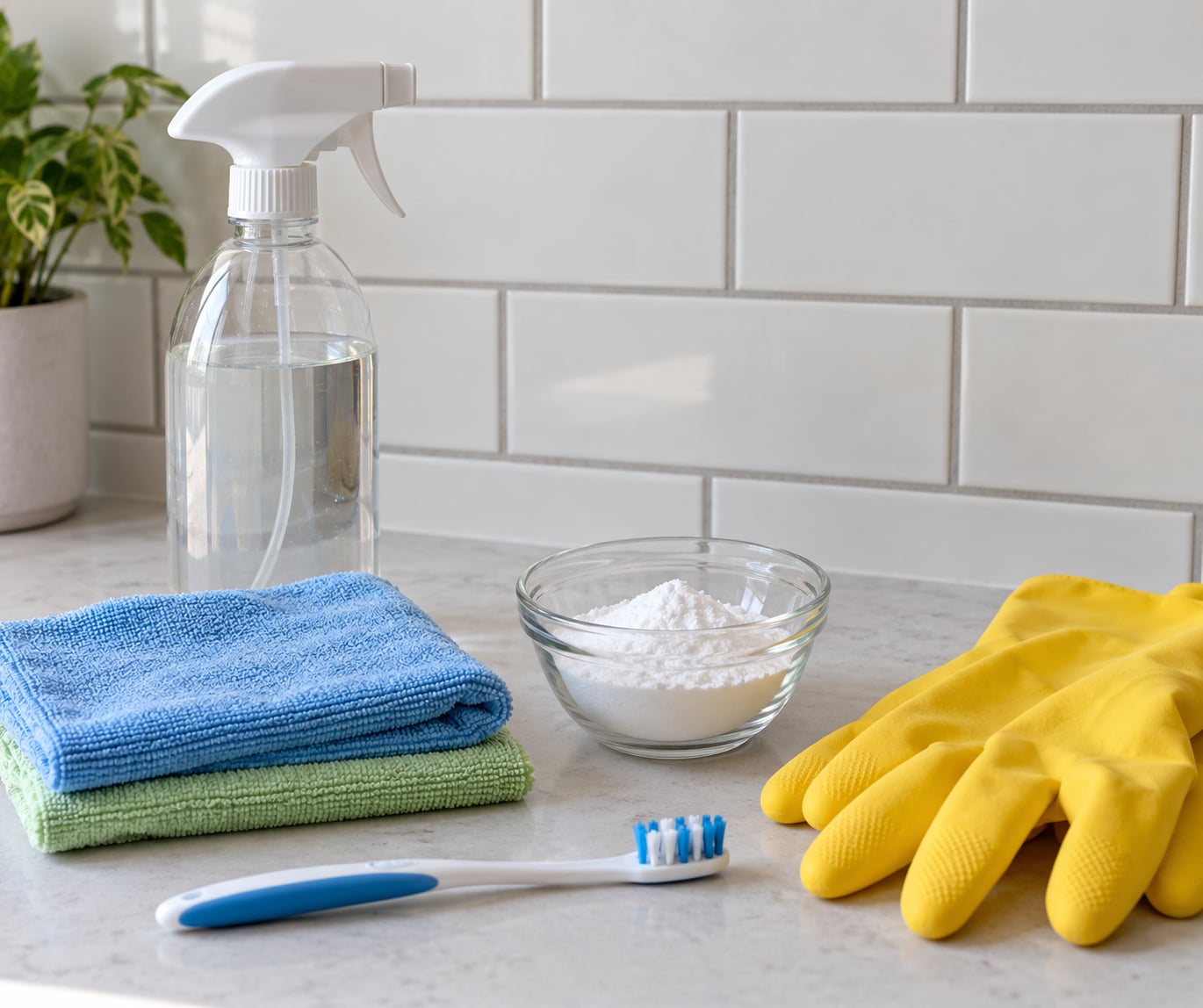
You can clean grout without scrubbing forever, and the difference is soak time rather than elbow grease. Mix a neutral cleaner with warm water, spread it over the grout lines, let it sit for 5 to 10 minutes, then lift the loosened dirt with a damp microfiber cloth. A stiff brush is a finishing tool for the few marks that refuse to lift, not the main event.
Grout is the weak point of any tile job. Tile is glassy and wipes clean; grout is a porous cement filler that soaks up grease, soap scum and hard water deposits instead of letting them sit on the surface. That is why a mopped floor can still look dirty, and why grout in a shower goes dark again within weeks.
Below is the whole routine: what to gather, six steps, and the mistakes that turn a 20-minute job into an afternoon of kneeling on a hard floor.
Table of Contents
- 1What You Need
- 2Step-by-Step
- 31. Test the Cleaner on a Small Area
- 42. Remove Loose Dirt and Surface Debris
- 53. Apply a Foaming or Soaking Cleaner
- 64. Agitate Only the Stubborn Spots
- 75. Wipe and Rinse the Grout Lines
- 86. Dry and Inspect the Result
- 9Common Mistakes
- 10Frequently Asked Questions
- 11What is the easiest way to clean grout without scrubbing?
- 12Can I use baking soda to clean grout without damaging it?
- 13How long should a grout cleaner sit before I wipe it away?
- 14Is bleach safe for cleaning bathroom grout?
- 15How often should grout be cleaned in a kitchen or bathroom?
- 16When should I replace old or crumbling grout instead of cleaning it?
What You Need

Almost all of this is already in the house, which is the other half of why the method is cheap to run.
- Warm water and a neutral cleaner. A pH-balanced tile and grout cleaner is the safest all-rounder, especially on unsealed or delicate grout and on natural stone.
- Baking soda. Slightly alkaline and mildly abrasive, it works well on soap scum and everyday kitchen grime. Use it when you want to skip a chemical cleaner entirely.
- A spray bottle or a small bowl for mixing and applying. A spray bottle is best for a shower wall, a bowl is better for a paste you spread with a fingertip.
- Two or three microfiber cloths. Change them as they pick up dirt. A cloth that has turned grey is just re-depositing what you lifted.
- An old toothbrush with soft bristles, for corners, the tight joint where two walls meet, and the grout around a toilet base.
- Rubber gloves and, for a bathroom, an open window or a running fan.
A stiff nylon grout brush belongs in the drawer, not in your hand during step one. Use it only at the end on marks that did not lift, and never a wire or metal brush, which scratches the tile face and strips sealant off the grout.
A commercial no-scrub grout cleaner is worth having on hand for built-up shower floors where a paste cannot stay put on a vertical or sloped surface. Follow the label dwell time rather than the timings below, and patch-test first.
Step-by-Step
The whole approach rests on dwell time. A cleaner left sitting on grout keeps working after you walk away, which is exactly the scrubbing you wanted to skip. Scrubbing mostly works because you keep re-wetting a dry line; a soak never lets it dry out.
1. Test the Cleaner on a Small Area
Find a hidden line, behind the toilet or under a bath mat, and wet it with your mixture. Wait the full dwell time, then wipe and look. If the grout looks duller, blotter or more stained than before, dilute the cleaner with more water and test again, or switch to plain baking soda paste.
This matters most on colored grout and on marble, slate and other natural stone, where acidic and strongly alkaline products can dull the surface. Stone needs a cleaner labelled safe for natural stone.
2. Remove Loose Dirt and Surface Debris
Wipe the lines with a dry microfiber cloth, or run a vacuum with a brush head over the floor, before anything wet goes down. Loose grit mixed into a wet paste turns into a fine abrasive that scuffs the tile as you wipe.
For a kitchen backsplash, this is also the moment to knock down grease film with a drop of dish soap and a wet cloth. You are not trying to clean yet, just clearing the way.
3. Apply a Foaming or Soaking Cleaner
For a paste method, stir together roughly two parts baking soda to one part water until it is the consistency of thick cream. For a spray method, dilute a neutral cleaner in warm water according to its label and mist the grout until the lines are evenly damp, not flooded.
Work the mixture into the lines with a fingertip or a gloved finger rather than a brush. Push it into the joint, then let it sit: 5 to 10 minutes for light grime, up to 15 for soap scum and dark lines. Keep the lines damp during the wait. If the paste starts to dry out and crust, mist it again, because a dry paste stops working.
4. Agitate Only the Stubborn Spots
Most grime lifts on its own after the dwell. What is left is usually a mark right at the edge of a tile or a corner, so use a soft toothbrush there and nothing else.
Use short light strokes along the direction of the grout line, not crosswise scrubbing, and keep the brush off the tile face. A stiff brush left on a porcelain shower floor will cut the surface, and the scratched surface holds dirt faster than the one you cleaned.
5. Wipe and Rinse the Grout Lines
Fold a clean microfiber cloth and press it along the wet lines. The cloth picks the loosened grime up; rinsing first just moves it around. Turn to a dry section every few feet.
Then go over the floor once with a barely damp cloth to lift the surfactant film and any baking soda residue. Keep this pass lean. A soaked floor pushes cleaner back down into the joint and into the grout lines you just cleared, and the next few days feel damp.
6. Dry and Inspect the Result
Let the area air-dry fully before judging it, with a fan running in a bathroom. Cement grout often looks a shade darker while damp and comes back to true color over a few hours, so do not reapply cleaner to a wet-looking line.
Mark the spots that did not change and treat only those the next day, with a second application. Two short soaks beat one long scrub, and re-wetting a half-cleaned line more than once rarely moves further than the first one did.
Common Mistakes
Using too much water. A soaking floor does not clean grout better, it just drives cleaner into the joint and delays drying. Damp lines, not wet ones.
Scrubbing harder than the chemistry. If the mixture has not had its full dwell time, the answer is more time, not more pressure. Force and grout wear down at the same rate.
Using an acidic cleaner on grout you have not identified. Vinegar is mild and fine for routine film on ceramic and porcelain, but it will etch natural stone and, over years of use, wear down cement grout. Neutral is the safe default.
Mixing bleach with vinegar or another acid. The combination gives off chlorine gas. In a closed bathroom that is genuinely dangerous, and it happens more often than anyone would like to admit. Never combine a chlorine bleach with vinegar, lemon juice, or any citrus cleaner. Ventilate whatever you use.
Cleaning half a room. Grout lines that meet at a threshold or a wall corner collect the dirt you missed. Work in one continuous area, and start at the cleanest end so your wiping hand stays ahead of the mess.
What keeps grout clean after this is boring and it works. Squeeze a little water or a pH-neutral cleaner onto the floor after showers and wipe it down, rather than waiting for soap scum to harden. Dry the grout around the tub edge when you can, and keep a mat that gets lifted and washed rather than sitting wet in place. If your grout is porous and takes water, sealer gives the surface something to shed; sealed floor grout usually stays noticeably cleaner for a year or two before it needs doing again.
Frequently Asked Questions
What is the easiest way to clean grout without scrubbing?
Mix baking soda with warm water into a thick paste, spread it along the grout lines with a gloved finger, and leave it 5 to 10 minutes. Wipe with a damp microfiber cloth and follow with a barely damp cloth to lift residue. Most household grime lifts during the soak, so a toothbrush is only needed on corners and edges.
Can I use baking soda to clean grout without damaging it?
Yes, on ceramic and porcelain tile, and on cement grout, baking soda is a safe everyday choice. It is mildly alkaline, so avoid it on natural stone such as marble, slate, or travertine unless the stone is sealed. Patch-test colored grout first, and skip it entirely on epoxy grout, which does not need cleaning agents at all.
How long should a grout cleaner sit before I wipe it away?
Give a baking soda paste 5 to 10 minutes for light grime and up to 15 minutes for soap scum or dark lines. Keep the lines damp the whole time by misting if the paste starts to crust. Always follow the label time on a commercial cleaner, and wipe sooner if the tile face starts to look dull or the color changes.
Is bleach safe for cleaning bathroom grout?
Diluted chlorine bleach does clean grout, and it is one of the faster options for mildew. Never mix it with vinegar, lemon juice, or any other acid, because that releases chlorine gas, and never use it on natural stone. Use oxygen bleach when you would rather avoid chlorine, and expect to reseal the grout afterwards if bleach has stripped the sealant.
How often should grout be cleaned in a kitchen or bathroom?
Wipe down bathroom and kitchen grout about once a week with water and a pH-neutral cleaner, and always squeegee or towel the shower floor after use to stop soap scum hardening. A deeper soak is only needed when you can see the staining. Sealed grout usually needs a refresh of sealer every one to two years depending on traffic and water exposure.
When should I replace old or crumbling grout instead of cleaning it?
Clean rather than replace when the grout line is still solid, just discolored. Replace it when the grout is powdery, cracking, flaking, or missing in places, or when water pools in the line instead of draining. A grout pen can restore color on a sound surface cheaply, but crumbling grout has to be cut out and replaced.
Start small. Mix a thin baking soda paste, spread it on one hidden line, and give it a full 10 minutes before you commit to a whole floor. If the line comes back brighter, you have your method, and the rest is just the same wait with fewer sections.