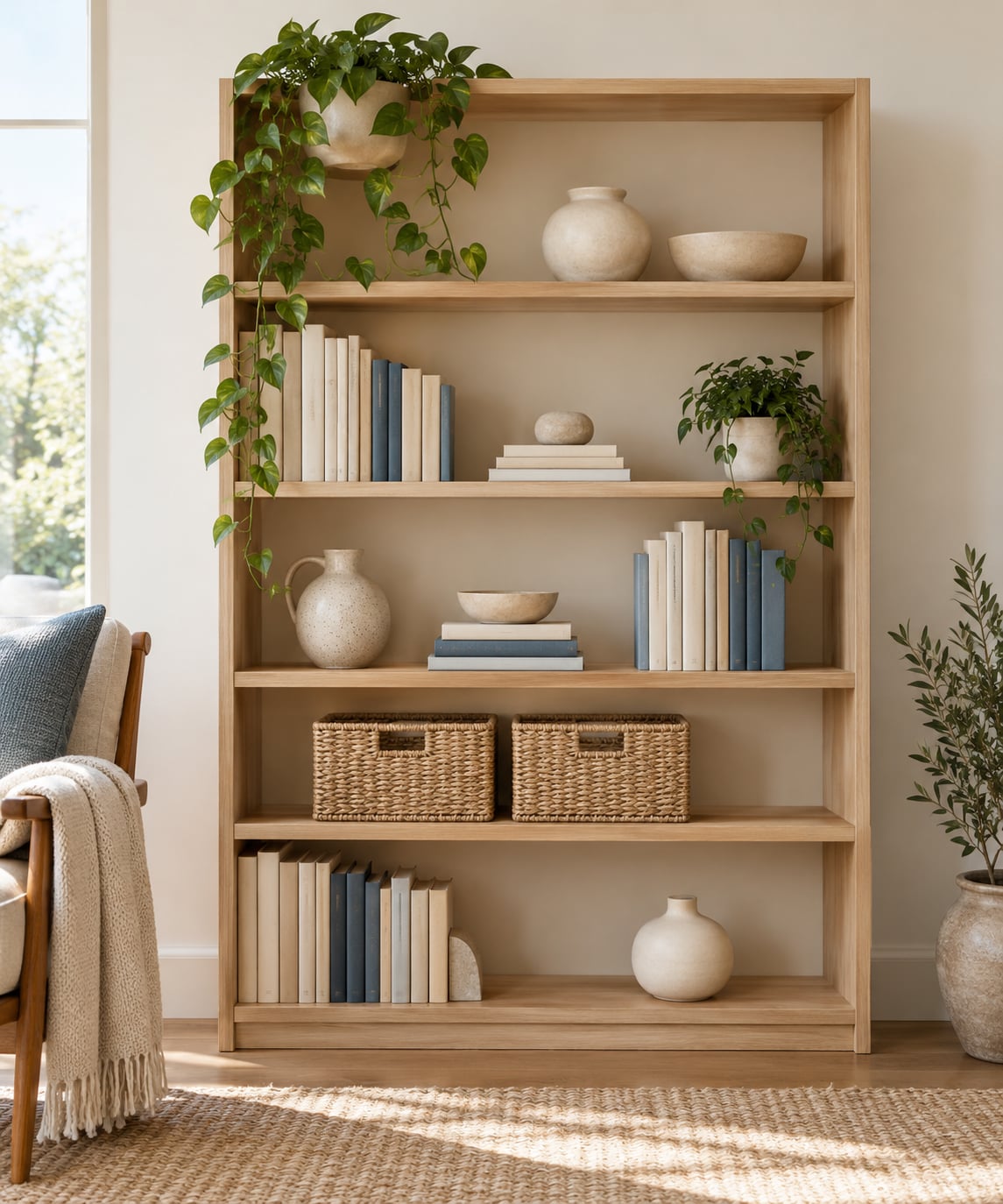
A bookshelf looks organized when the books sit in deliberate runs, the tallest item on each shelf anchors one end, decor objects appear in odd-numbered groups, and about 40 percent of the shelf is left empty. The formula underneath is simple: roughly two-thirds books, one-third objects, and a lot of breathing room. A single shelf takes about fifteen minutes once you’ve sorted your stuff into groups, so a full bookcase wall is a weekend afternoon.
I’ve restyled the same six shelves in my living room more times than I’d like to admit, and the version people compliment is always the emptiest one. That keeps being the useful lesson: editing is what makes a display look styled rather than stocked.
Table of Contents
- 1What You Need
- 2How to Style a Bookshelf That Looks Organized
- 3Step-by-Step: Sort, Group, Arrange, and Refine
- 4Step 1: Sort Books and Objects Into Groups
- 5Step 2: Choose a Simple Visual Order
- 6Step 3: Build Layers and Leave Open Space
- 7Step 4: Add a Few Personal Display Pieces
- 8Step 5: Step Back and Refine the Balance
- 9Common Mistakes
- 10Frequently Asked Questions
- 11What is the bookshelf rule?
- 12What is the rule of three in shelf styling?
- 13How do you arrange books on a bookshelf by color?
- 14How do you balance books and decor on a shelf?
- 15How much empty space should a bookshelf have?
- 16How do I organize a bookshelf when I have too many books?
- 17Conclusion
What You Need
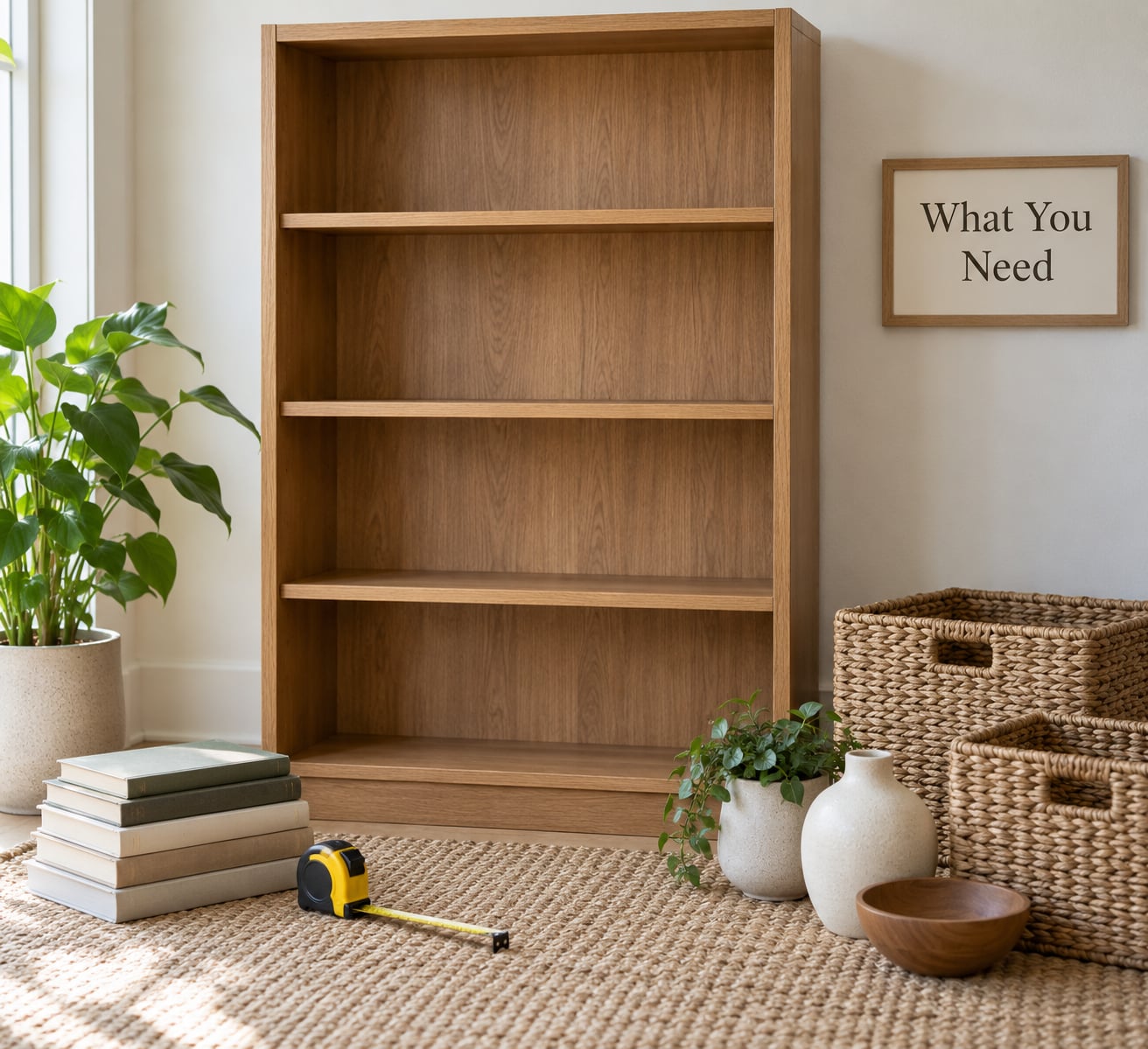
Measure before you style. Shelf clearance is the number that decides everything else, and most people pick objects that are wrong for it. Write the interior width and height of each shelf on a scrap of paper, and mark which shelves are lower than 10 inches tall, since those can only hold a horizontal stack and a couple of small pieces.
Next, sort everything into four piles: books you’re actively reading, books you’re keeping but rarely touch, objects that live on shelves, and everything else. The last pile is the one that quietly wrecks a display, so make it before you style anything.
Choose your palette next. Pick three colors from your books or your room and treat them as the whole allowance for that shelf, including decor. Warm wood tones plus one neutral plus one accent is usually enough. If you skip this step you’ll notice the clash two hours after you’ve filled the shelf, when the spines and the objects are fighting each other.
Gather a few props from what you already own before you buy anything. Useful ones are bookends with real weight, a woven or fabric basket, one plant that trails over an edge, a framed print small enough to lean against the back panel, and a stack of three or four of your own books to use as risers.
How to Style a Bookshelf That Looks Organized
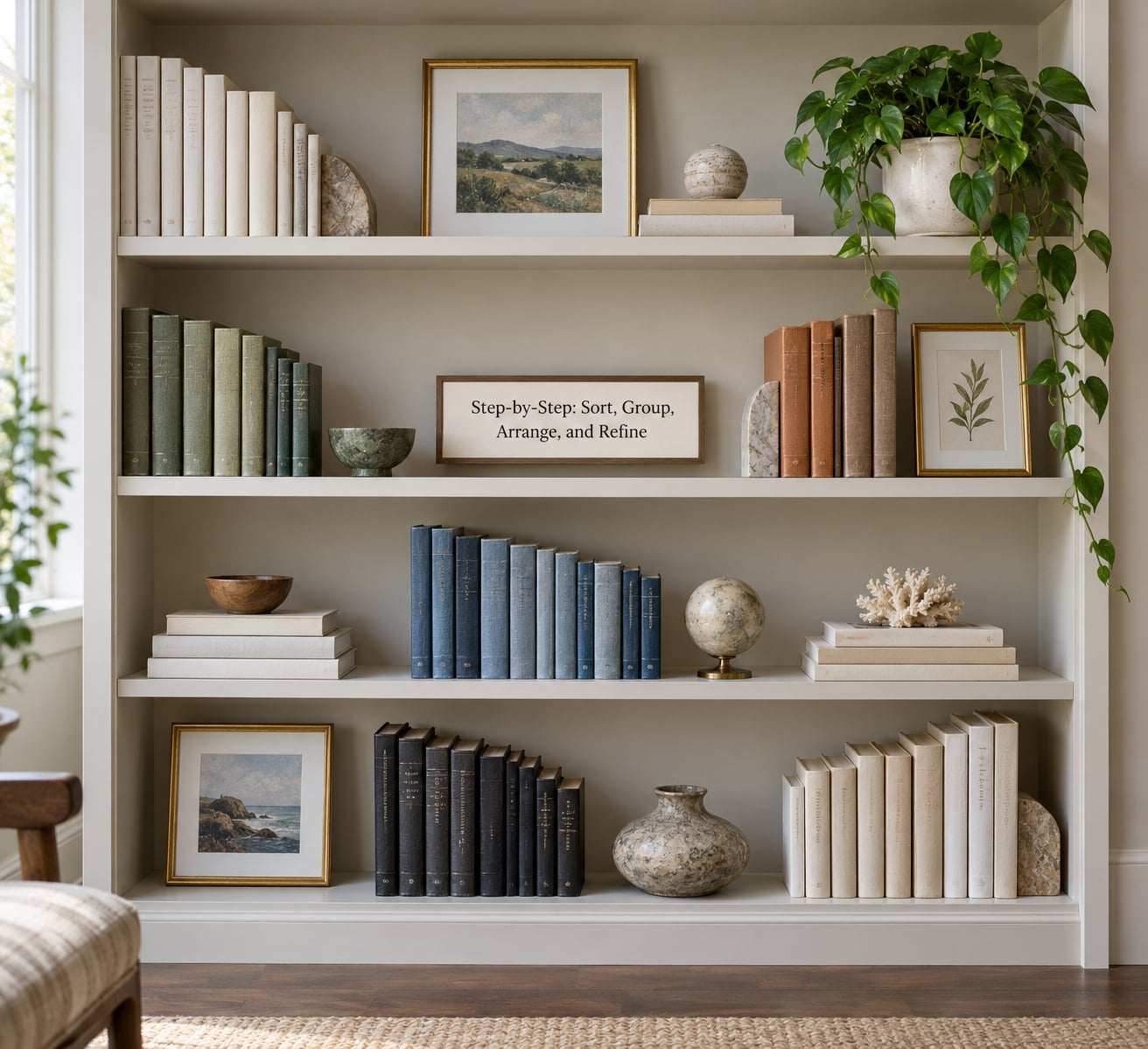
The whole method comes down to four principles: group like with like, vary the height, limit the palette, and leave the shelf partly empty. Those four do more work than any single object you add.
Group into deliberate runs. A shelf that reads as organized has clear blocks rather than one long row. Three groups of eight books looks designed; twenty-four books in a single line looks like storage. Break a run wherever the spine color or height changes noticeably, and put a bookend at each end so the block has a visible border.
Anchor each shelf with its tallest item. Put the tallest object you own for that shelf at one end rather than in the middle, and keep it under about two-thirds of the shelf’s clearance. That gap above the tall piece is the single most-missed detail in home shelving, because it lets the eye read the shelf as open instead of crammed.
Repeat in odd numbers. Three ceramics, five framed prints, seven small objects in a cluster. Even numbers land flat because the eye pairs them off, while odd numbers leave something unresolved and therefore interesting. This is the rule of odds, and it’s why a set of four identical vases across a shelf never quite works.
Hold the line on empty space. Aim for around 40 percent of each shelf to be bare. If you can’t see the back panel anywhere, you’ve gone too far. One section per shelf left empty is usually enough, and it’s cheaper to add than to remove later.
Color matters less than you’d expect. A shelf grouped by color looks striking in a photo and painful in daily use, because finding one book means scanning a gradient. A safer middle ground is to sort by genre or size but keep the palette tight, so the spines read as a coordinated block without becoming a rainbow.
Texture does the quiet work. Wood spines, matte ceramics, a rough basket and a glossy photo frame give a shelf depth even when everything is the same color. Three different materials in one grouping is plenty.
Step-by-Step: Sort, Group, Arrange, and Refine
Step 1: Sort Books and Objects Into Groups
Work shelf by shelf, top down, and pull everything off before you put anything back. Pulling books forward by two inches while you sort keeps them from slumping, which is the fastest way to make a shelf look tired before you’ve made a single decision.
Group the books by whatever you actually use to find them. For most people that means fiction and nonfiction separated, then each run sorted by size so the spines step up evenly. Sort objects by type, not by room, so you know what you have.
How to tell it worked: every book is in one of your four piles, and nothing is sitting on the floor because you ran out of pile.
Step 2: Choose a Simple Visual Order
Pick one order per shelf and commit to it. Alphabetical is the most useful for finding things, color is the calmest to look at, height is the tidiest when your books are badly mismatched, and genre is the best compromise for a working shelf. Mixed order looks intentional only when a deliberate break marks it.
Books you actually use should be spine-out in vertical runs. Face-out is for one or two favorites a shelf, never for a whole row, since each visible cover becomes a second visual block competing with the spines.
How to tell it worked: you can point to any book on the shelf and describe where it is. If you can’t, the order is decorative rather than useful.
Step 3: Build Layers and Leave Open Space
Start each shelf with a horizontal anchor: your three to four largest books laid flat at one end, heaviest at the bottom of the stack. Then fill vertically beside them, aligning the spines at the front edge. Mixing one or two horizontal stacks into a row of vertical spines is what stops a shelf looking like a spreadsheet.
Leave at least one gap roughly the width of a book between groups, and skip a section entirely somewhere on the shelf. If your bookends sit more than about twelve inches apart, the books between them will lean, so either close the run or use a wider-ended bookend. A shelf of nothing but paper spines needs one plant or one object; a shelf full of objects needs no decoration at all.
How to tell it worked: standing back, you see two or three clear blocks and at least one stretch of back panel.
Step 4: Add a Few Personal Display Pieces
Add one or two objects per shelf, in groups of three, five or seven. Framed art leaning against the back, a basket for the small loose items, ceramics in a warm neutral, a trailing plant, a candle, or your own book stack used as a riser for a small object all work. Greenery is the most forgiving item you own because it softens the joinery and hides awkward gaps at the shelf ends.
Fewer coordinated objects beat more mismatched ones every time. One reader’s aha moment came after four days of trying to fill shelves: the cleanest result came from adding the least amount of stuff. Lighting matters more than people expect too, since a warm lamp tucked into one corner changes how the whole wall reads at night.
How to tell it worked: you can name the reason for each object being there. If an object is only there because the shelf looked empty, take it away.
Step 5: Step Back and Refine the Balance
Stand six feet away and look at the whole shelf as one shape. Check that the visual weight isn’t all on one side, that the tallest items alternate rather than line up, and that no single color dominates more than about a third of the run. Then remove one object per shelf. That last removal is the step everyone skips, and it’s usually the one that makes the shelf look edited.
Books come out of these shelves constantly, so the arrangement needs a five-minute weekly reset: pull the fallen, re-square the spines, and shift the stacks back into line. A bookcase wall with hundreds of books will never hold a permanent arrangement, and designing for that is smarter than fighting it.
Common Mistakes
Packing the shelf edge to edge. Filling every inch reads as storage because there’s no contrast to notice. Fix it by removing one full book’s width somewhere on each shelf and leaving it empty.
Perfect symmetry. Matching both ends exactly looks staged, not styled. Keep one side weighted and let the other run lighter.
One height across the shelf. Every spine the same height produces a flat line. Fix it by stacking the largest books flat at one end and stepping the vertical runs up from there.
Pushing everything to the back. Books sitting against the wall read as a recess, and the shelf looks shallow. Pull the spines forward about two inches so they align with the front edge.
Too many colors. Every spine a different hue and every object a third hue makes the shelf noisy. Cap the shelf at three colors and let the rest be background.
Treating all shelves the same. Repeating one arrangement top to bottom flattens the wall. Vary the density shelf to shelf, putting your fullest shelf next to your emptiest one.
Hiding the books you actually read. Moving usable books into baskets because they don’t match the palette means you’ll stop using them. Style the display shelves and keep the working shelves alphabetical.
Frequently Asked Questions
What is the bookshelf rule?
The most-used bookshelf rule is a three-part ratio: fill about two-thirds of each shelf with books, one-third with objects, and leave roughly 40 percent empty. A second rule sits on top of it, the rule of odds, meaning you repeat each type of object three, five or seven times. Even numbers look paired off and flat, odd numbers look considered.
What is the rule of three in shelf styling?
It means grouping three similar items together rather than spacing them apart, so the eye reads them as one unit. Three ceramics side by side look deliberate; one ceramic between every other book looks accidental. The number works because the eye tries to close a group of three and finds nothing missing. You can use five or seven when a shelf is wide, but avoid even counts.
How do you arrange books on a bookshelf by color?
Sort spines into a gradient from dark to light, then vary the order on each shelf so the eye isn’t given the same rainbow twice. Color sorting looks calm and gives the shelf a strong focal band, but it makes one hard to find. Reserve it for shelves you mostly look at rather than shelves you pull books from daily, and keep three colors maximum.
How do you balance books and decor on a shelf?
Match the weight of objects to the gap they fill rather than the amount of space. One tall, narrow object balances a wide empty stretch; three small pieces balance a short gap. Keep the tallest item at one end of the shelf rather than centered, under two-thirds of the shelf clearance, and check from six feet away that neither end is heavier than the other.
How much empty space should a bookshelf have?
Roughly 40 percent of each shelf, which usually means one clear section where the back panel shows. What you want is contrast between a full block and a bare area, not an evenly sparse shelf. If you cannot see any back panel, take books out until you can. Empty space reads as deliberate when it is concentrated and looks accidental when it is scattered.
How do I organize a bookshelf when I have too many books?
Split the shelves into display and working zones rather than styling everything. Use the shelves above eye level for collections you rarely open, packed alphabetically with no decor, and reserve the middle shelves for books you actually read. Add a basket or two at the end for overflow, and accept that a full bookcase wall looks tidy through grouping and spine alignment, not through empty space.
Conclusion
Start with the sort, not the decorating. Pull everything off one shelf, group the books into two or three runs, pick one visual order, and leave one stretch of the shelf bare. Then add three objects, step back, and take one away. That sequence is how to style a bookshelf that looks organized, and it stays working as the books come out and go back over the months. Updated for 2026, and still true next year.