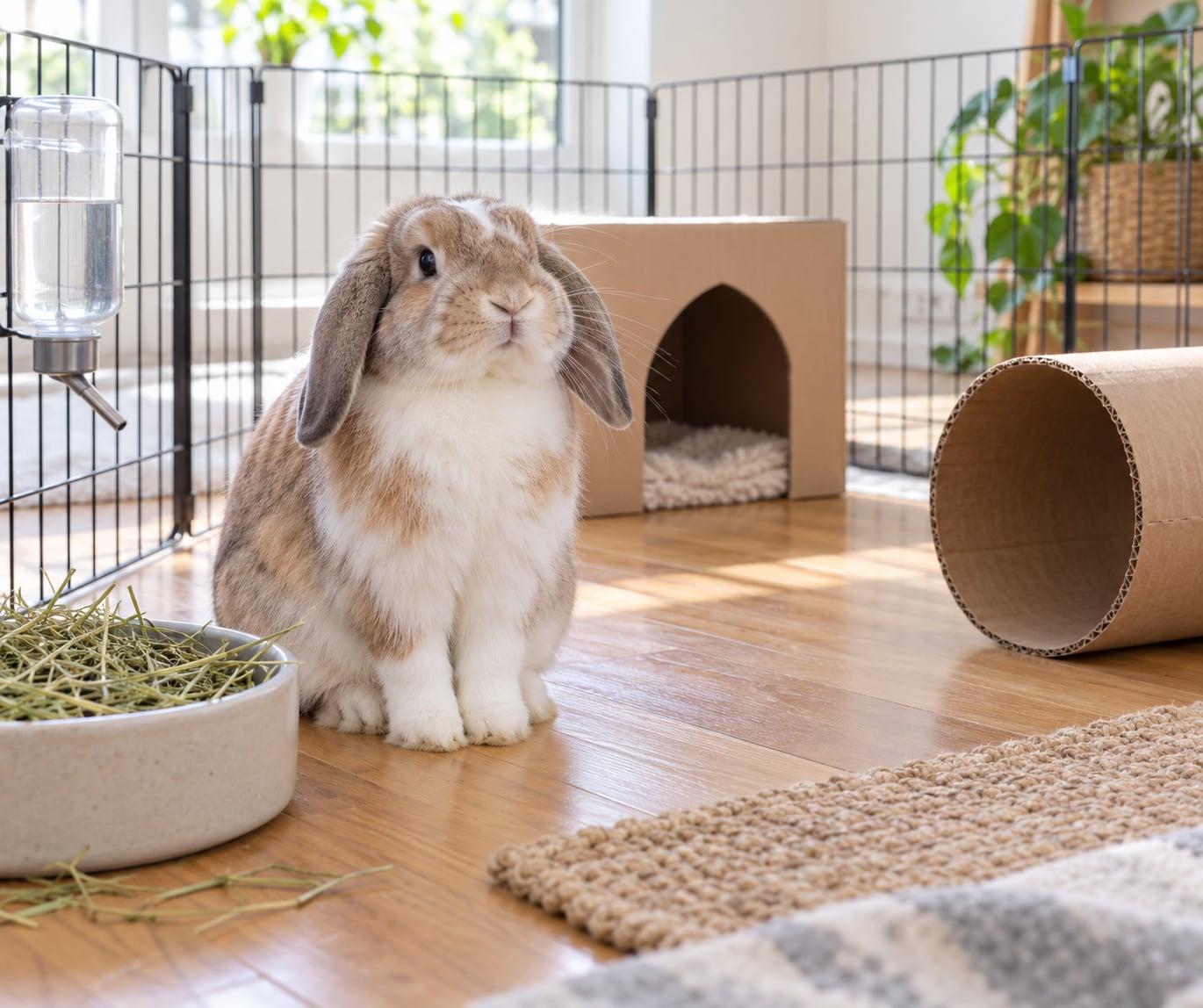
A happy rabbit is one that shows relaxed, vulnerable body language, like flopping, loafing and pancaking, along with playful movement such as binkies, zoomies and tooth purring. If you know how to tell if your rabbit is happy, you also know what a change looks like, because the best clue is always your own rabbit’s normal routine.
That matters more than most people expect. Rabbits are prey animals, so they rarely announce discomfort. They also hide illness unusually well, which means their everyday behavior is often the first and only warning an owner gets.
One caveat before we start: no single sign proves anything on its own. Ears tell you very little in isolation, and a still rabbit can be resting or unwell. What settles the question is the pattern across a day or two, compared against the baseline you build from watching your own rabbit.
Table of Contents
- 1How to Tell If Your Rabbit Is Happy: 9 Signs to Watch
- 2Relaxed Body Language: How to Tell Comfort From Tension
- 3Eating and Drinking Normally
- 4Movement, Play, and Curiosity
- 5Grooming and Self-Care
- 6Sleep, Rest, and Safe Hiding
- 7How Rabbit Body Language Changes With Stress
- 8What to Do When You Notice a Sudden Change
- 9Daily Habits That Support a Happy Rabbit
- 10Frequently Asked Questions
- 11Is it normal for a happy rabbit to hide?
- 12Why is my rabbit grinding its teeth?
- 13Does a quiet rabbit mean it is unhappy?
- 14How can I check on my rabbit without stressing it out?
- 15When should I contact a veterinarian about my rabbit?
- 16Conclusion
How to Tell If Your Rabbit Is Happy: 9 Signs to Watch
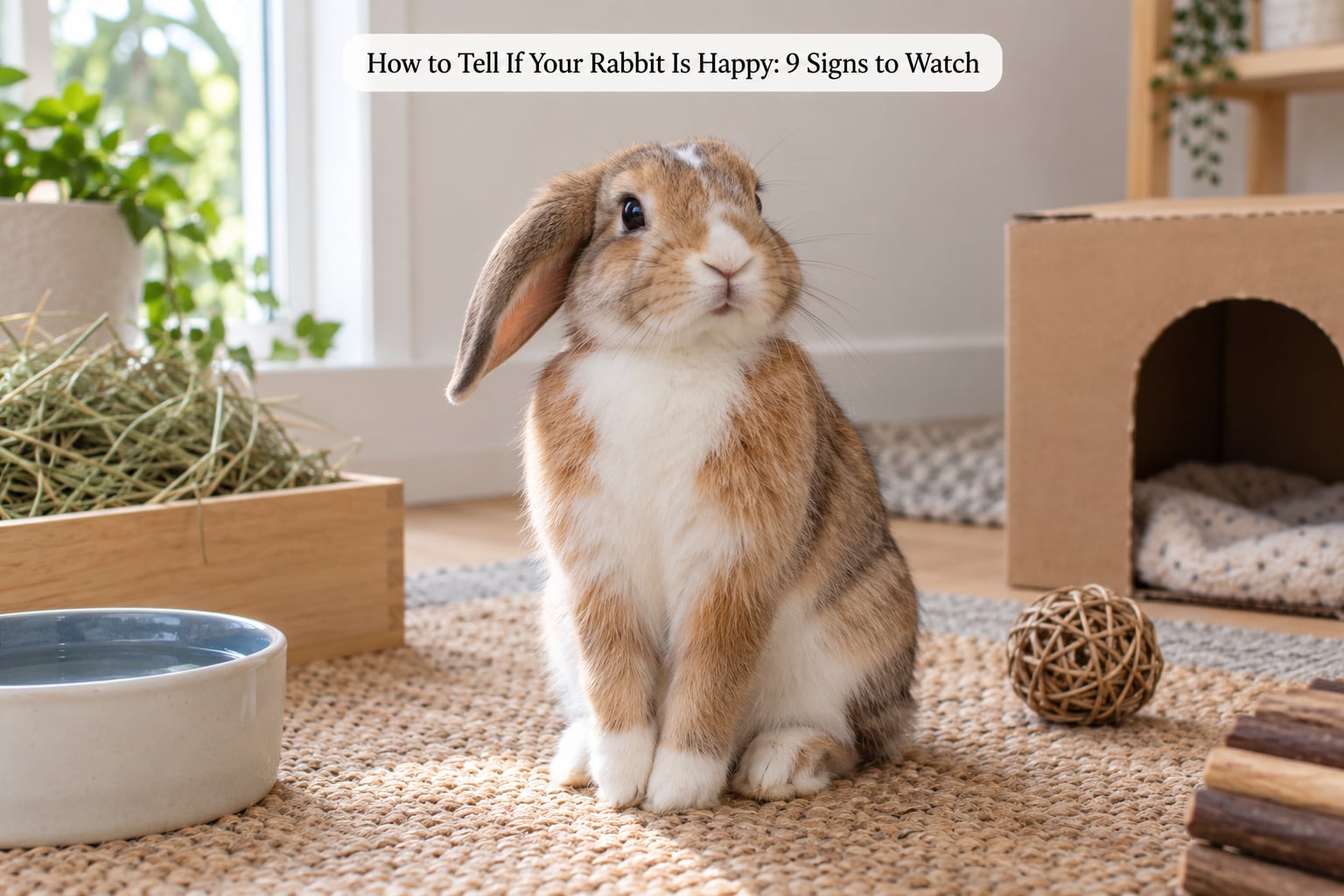
Rabbits show contentment in ways that look unimpressive until you know what they mean. These are the nine signals worth watching for, and what each one actually means.
- Loafing. Front paws tucked under the chest, rump rounded, eyes soft. A rabbit who can hold that shape is comfortable.
- Flopping and splooting. Dropping onto one side or stretching out flat with the back legs out means the rabbit feels safe enough to be helpless.
- Pancaking. Spreading flat on the floor with the legs splayed out, belly down, eyes closed. A deep sleep posture.
- Binkies and zoomies. That twisting half-jump with a mid-air kick is leftover play behavior and hard to fake.
- Steady nose twitching. A soft, rhythmic nose movement happens when a rabbit is settled rather than on alert.
- Eating and drinking normally. Steady hay consumption, regular pellets, and interest in the usual greens.
- Grooming and clean fur. Regular self-grooming with no bald patches or matted areas.
- Affection toward you. Chinning, nose nudges, following you, circling your feet, or grooming your hand.
- Relaxed sleep and resting spots. Choosing a hide, a corner, or a spot near you for long sleep periods.
Relaxed Body Language: How to Tell Comfort From Tension
Relaxed rabbit body language starts with a loose, unheld posture. The body looks slightly heavy, not braced. A loafing rabbit is compact and symmetrical, and the fur sits flat rather than puffed along the back.
Ears on a settled rabbit sit in varied natural positions. One up, one sideways, both loosely back. They rotate constantly because a rabbit is sampling sound direction, so ear position tells you far less on its own than most lists suggest.
The eyes matter more. A comfortable rabbit has bright, clear eyes and spends real time with them half closed. Moving from alert open eyes to soft half-closed eyes as you enter the room is a sign they have accepted you as uninteresting enough to relax around.
A gentle, rhythmic nose twitch accompanies calm. Rabbits twitch their noses constantly for normal reasons, including regulating breathing and sensing scent, so it is the pace and softness of the twitch that matters rather than the twitch itself.
Flopping is the clearest signal of all. When a rabbit drops onto its side near you, often with a sigh, it is choosing to be unable to flee. Owner communities consistently treat a flop within a few feet of a person as the strongest sign of trust there is.
Contrast that with a tense rabbit: persistent hiding, flattened ears held tight, a hunched body tucked against a wall, repeated flinching at ordinary household sounds, or wide eyes with dilated pupils. Those mean the opposite of relaxed.
Eating and Drinking Normally
Appetite is the most reliable daily signal a rabbit gives. A healthy rabbit eats almost constantly, because grass hay has to pass through the gut continuously. Expect steady hay consumption, measured pellets, regular access to fresh water, and genuine interest in the greens they normally enjoy.
Droppings matter just as much. A content rabbit produces frequent, well-formed droppings. Owners who track daily droppings often catch problems earlier than owners watching for appetite changes alone.
Reduced eating is serious in rabbits. It can point to dental problems from overgrowth or malocclusion, gastrointestinal stasis, stress, or pain from an ear infection or urinary issue. Excessive thirst, drooling, or visible difficulty chewing are also warning signs.
If any of these show up, contact a rabbit-savvy veterinarian promptly. Never give human medication to a rabbit, and never wait for other signs to appear first.
Movement, Play, and Curiosity
Movement separates a comfortable rabbit from a merely quiet one. Happy rabbits explore, dig, chew safe objects, investigate new areas of a room, and change position often.
A binky is the signature move: a partial jump combined with a sudden twist of the body and a kick in the air. It can look startling the first time you see it. It is a leftover play behavior from the juvenile stage that adults keep, and it is nearly impossible to produce in a frightened rabbit.
Zoomies, quick turns, and racing around an exercise area serve the same purpose. So does picking up a toy, shoving it, and dropping it, which is play rather than destruction.
Now the part most guides skip. Plenty of happy rabbits never binky. Senior rabbits, disabled rabbits, large breeds, and rabbits with a history of poor handling often skip it entirely. Forum discussions about this come up constantly, and the consensus is clear: the absence of binkying is not evidence of unhappiness. Look at the whole picture instead.
A rabbit may also be much calmer in a familiar room than in a new environment. Comparing a quiet Sunday morning with a chaotic afternoon of visitors tells you about the household, not about the rabbit.
Grooming and Self-Care
A rabbit who is comfortable tends itself regularly, licking its face, ears, flanks and front paws in turn. Clean fur, no mats behind the ears, and normal scratching all point to a rabbit who feels well.
Watch for the reverse. Matted fur, bald patches, fur thinning on the back or flanks, heavy scratching, excessive licking of one area, or chewing at a spot that seems uncomfortable all deserve a veterinary check.
Overgrooming often shows up in the middle of the back or on a hind leg, and it frequently signals pain rather than boredom. Dental problems and skin parasites are two common underlying causes.
Sleep, Rest, and Safe Hiding
Rabbits sleep a great deal, often in long stretches, and they like to do it somewhere enclosed and defensible. A hide, a cardboard box, a covered bed, or the gap behind the sofa all make sense.
Hiding by itself does not mean unhappiness. Most rabbit owners provide hiding places as standard welfare equipment precisely because a rabbit needs somewhere private.
What matters is the difference between chosen rest and forced withdrawal. Relaxed hiding has a rabbit emerging regularly to eat, drink, toilet and move around. Concerning hiding is constant, comes with not eating, or shows up suddenly with a change in resting location.
Nocturnal and crepuscular rhythms also complicate this. A rabbit that is lively at dawn and dusk and quiet at midday is following an inherited pattern, not withdrawing from you.
How Rabbit Body Language Changes With Stress
Stress in rabbits shows up as stillness rather than drama. A frightened rabbit often freezes instead of fleeing, which is why a motionless rabbit deserves attention rather than relief.
Common stress and fear signals include a very still body, wide eyes with dilated pupils, ears pinned flat against the skull, a hunched posture tucked against a wall, rapid tail movements, repeated thumping of the hind feet, loud teeth grinding, refusal to approach, and repeated attempts to escape or bolt into a corner.
Grunting and lunging are usually fear responses too. Owners often describe these appearing right before or during a bonding session. If your rabbit grunts when you reach in, that is information: you are moving too fast, not that the rabbit dislikes you.
Common triggers include a noisy household, unfamiliar animals or people, heat, mishandling, being lifted without warning, inadequate space, and boredom from an empty enclosure.
| Behavior | What a content rabbit does | What a stressed rabbit does |
|---|---|---|
| Ears | Loose, varied positions, rotating often | Pinned flat to the skull |
| Eyes | Bright, often half closed | Wide, with dilated pupils |
| Posture | Loafing, flopping, pancaking | Hunched, pressed to a wall, frozen |
| Appetite | Steady hay eating, frequent droppings | Reduced eating or drinking, none |
| Movement | Exploring, binkies, circling, digging | Pacing, freezing, escape attempts |
| Sound | Soft tooth purring, quiet grunting | Loud teeth grinding, repeated thumping |
| Grooming | Regular full self-grooming | Overgrooming, matted fur, bald patches |
Tooth purring versus teeth grinding confuses more owners than any other behavior, and the difference matters medically.
| Sound | What it sounds like | Usual cause | What to do |
|---|---|---|---|
| Tooth purring | Soft, low, rhythmic clicking | Contentment, often during petting | Nothing, this is a good sign |
| Teeth grinding | Loud, harsh, continuous | Pain, often dental or GI | Book a rabbit-savvy vet |
| Chattering teeth | Brief single click | Annoyance or mild warning | Give the rabbit space |
Where you can, change one factor at a time. Adding a hiding place and moving the enclosure are separate changes, and shifting them one by one tells you which one mattered.
Never punish a rabbit for grunting or lunging. It is a statement about how the moment felt from the rabbit’s side, not defiance.
What to Do When You Notice a Sudden Change
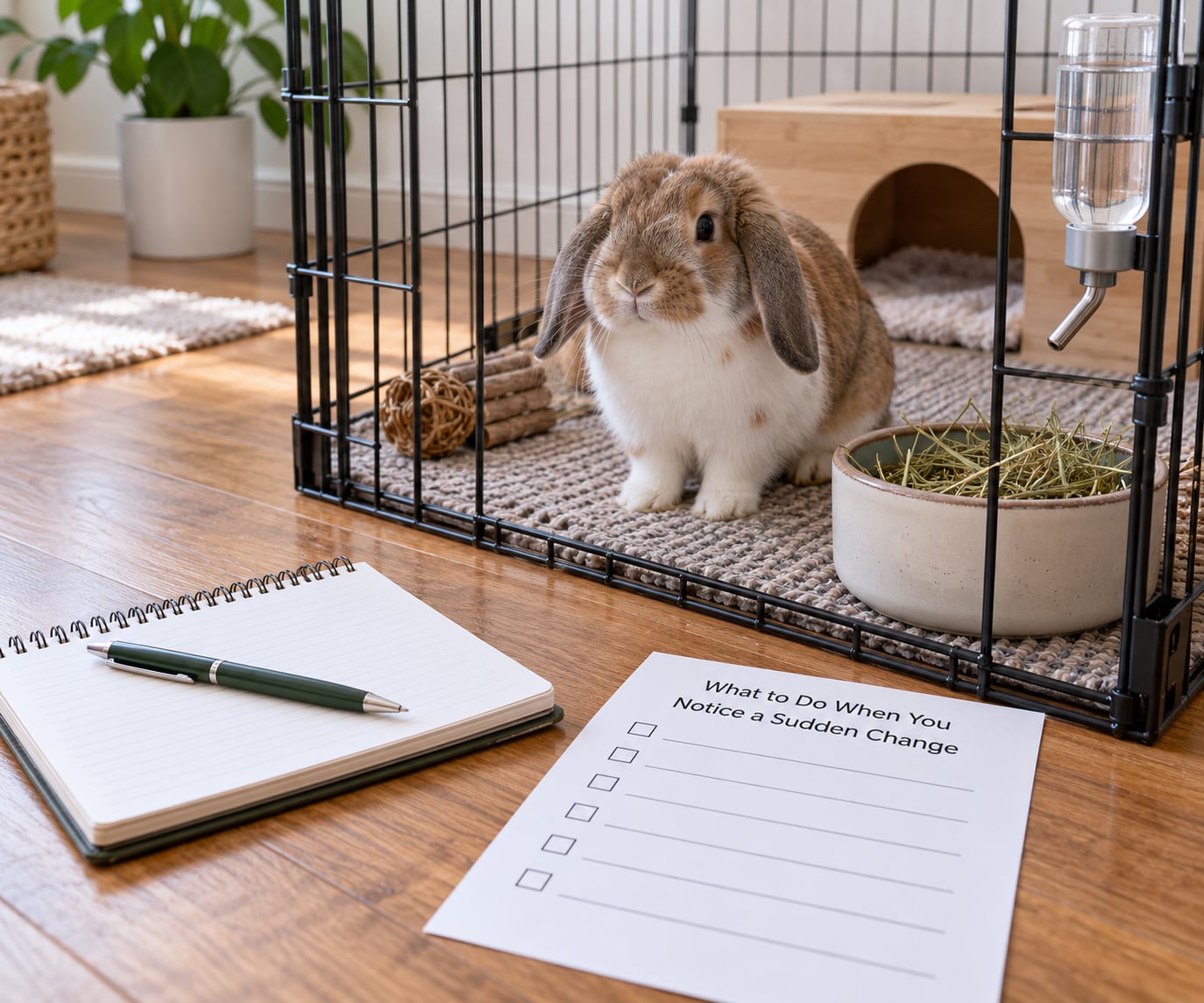
When something shifts, write down what you see rather than what you assume. A short daily note is enough.
Record five things each day: how much hay went in the bowl, whether droppings look normal, whether movement and posture match the usual, how breathing sounds, and whether the rabbit responds to familiar routines like coming to the door or being offered a treat.
Then compare the week to the week before. Owners who already know their rabbit’s baseline catch problems in days instead of weeks.
Call a rabbit-savvy veterinarian when a change is sudden or persists beyond a day or two. Seek urgent care for labored or noisy breathing, collapse, severe injury, head tilt or loss of balance, a swollen or painful belly, or not eating.
Rabbit-savvy means exotics experience. General practice vets see far fewer rabbits than dogs and cats, so a clinic that treats small mammals regularly will get the diagnosis right the first time more often.
Never give human medication without veterinary direction. Many common human painkillers are dangerous to rabbits.
Daily Habits That Support a Happy Rabbit
The foundations are boring and they matter more than any toy.
- Unlimited grass hay. The backbone of the diet, and the single best way to support gut movement and tooth wear.
- Appropriate leafy greens. A measured portion daily, introduced gradually.
- Measured pellets. A small daily amount rather than a self-serve bowl.
- Constant fresh water. Check bowls and bottles daily; some rabbits drink more than you expect.
- Daily exercise. Several hours of supervised free-roam or a large secure pen, every day.
- Hiding places. At least one per rabbit, plus somewhere to hide from a bonded partner if needed.
- Companionship. Many rabbits do best bonded, though a bonded pair is not a substitute for human attention and a single rabbit can live well with enough space and enrichment.
- Gentle handling. Support the chest and hindquarters, never lift by the ears.
For petting, most rabbits prefer the top of the head, the cheeks and the area between the ears. Stroke gently and stop when the rabbit moves away or thumps. Rabbits that flop and tooth purr while being stroked are telling you the method is right.
Two habits from rabbit communities are worth repeating. Sit on the floor at rabbit level instead of standing over your rabbit, and let them approach you rather than reaching in to scoop them up. That single change speeds up bonding more than any other.
And when you spot a sign, ask whether your rabbit is doing it in context. A rabbit hiding during a vacuum cleaner is not an unhappy rabbit. A rabbit hiding while alone, off food, in a room it used to enjoy, is worth a vet call.
Frequently Asked Questions
Is it normal for a happy rabbit to hide?
Yes. Hiding is normal, healthy behavior, and most owners provide hides as standard welfare equipment. A content rabbit emerges regularly to eat, drink, use the toilet and move around. Concerning hiding is constant, comes with reduced eating, or appears suddenly with a change in resting location.
Why is my rabbit grinding its teeth?
Two sounds get confused. Soft, low, rhythmic tooth purring means contentment and is common during petting. Loud, harsh, continuous teeth grinding usually signals pain, often from dental problems or gastrointestinal stasis. If the grinding is loud or persistent, contact a rabbit-savvy veterinarian.
Does a quiet rabbit mean it is unhappy?
Not necessarily. Senior rabbits, disabled rabbits, large breeds and rabbits with a history of poor handling are often calm and may rarely binky. Rabbits also follow a crepuscular pattern, so a quiet midday is normal. Compare the quiet period against the rest of the day, and against how your rabbit behaved recently.
How can I check on my rabbit without stressing it out?
Sit quietly at rabbit level rather than standing above, and let the rabbit come to you. Sit on the floor near the pen, keep movements slow, and avoid reaching in or picking up. Watching from a normal seated position for a few minutes gives you a better read on posture, breathing and appetite than any quick physical check.
When should I contact a veterinarian about my rabbit?
Contact a rabbit-savvy vet when a behavior change is sudden or lasts more than a day or two, and seek urgent care for labored breathing, collapse, severe injury, head tilt or loss of balance, a swollen or painful belly, or not eating. Never give human medication without veterinary direction.
Conclusion
Start today by watching your rabbit for a full day and writing down what normal looks like: posture, hay eaten, droppings, movement, grooming, sleep and social behavior. That baseline is the most useful thing you will own as a rabbit keeper.
Then read the whole pattern, not a single posture. Loafing, flopping, eating steadily, moving around and seeking you out together mean a content rabbit. A meaningful change in that pattern, especially appetite or droppings, is the signal to contact a rabbit-savvy veterinarian.