Knowing how to teach a dog to come when called comes down to one thing: reward the arrival, fast, every single time. Pick a cue your dog does not already use for anything else, mark the moment they reach you, feed within a second, then walk them straight back to sniffing. Two minutes a day does most of the work, and it is never scolding.
The method below is the one I hand to friends and foster carers. It suits puppies who have never heard the word, adult rescues who have never been taught anything, and the terrier who pretends not to hear. There are no e-collars, no leash corrections and no raised voices in it.
Sessions stay short, distance and distractions go up slowly, and every repetition is set up so the dog can get it right. If your dog is anxious around people, reactive to other dogs, or physically stiff or deaf, mention that to a vet or a reward-based trainer before you start pushing distance.
Table of Contents
- 1What You Need
- 2Step-by-Step: How to Teach a Dog to Come When Called
- 3Step 1: Choose a Clear Recall Cue
- 4Step 2: Reward the Dog for Coming to You
- 5Step 3: Repeat the Cue in a Safe, Quiet Area
- 6Step 4: Gradually Add Distance
- 7Step 5: Add Mild Distractions
- 8Step 6: Practice With a Long Line
- 9Common Mistakes and Quick Fixes
- 10Frequently Asked Questions
- 11What to do when a dog won’t come when called?
- 12How long does it take to train a dog to come when called?
- 13Should I use a word or a whistle to call my dog?
- 14How do you train a stubborn dog to come?
- 15Is it too late to teach an adult or rescue dog a recall?
- 16How do I stop my dog dodging my hand when it reaches me?
- 17Conclusion
What You Need
None of this is expensive and most of it you already own. What matters is that the treats are genuinely worth coming back for.
- High-value treats: something your dog does not get every day. Small pieces of cheese, cooked chicken, sausage, hot dog, liver cake or a packet of training treats cut into pea-sized bits. Size matters less than novelty.
- A treat pouch: a pocket or waist bag that keeps your hands free, so your hand can be the signal and not the treat bag.
- A toy: tug or a ball, for dogs who care more about play than food.
- A marker: a clicker or a marker word such as “yes” that tells the dog the exact instant you want them to repeat.
- A 6-foot leash: attached to a harness or a properly fitted collar, for the first sessions in hallways and living rooms.
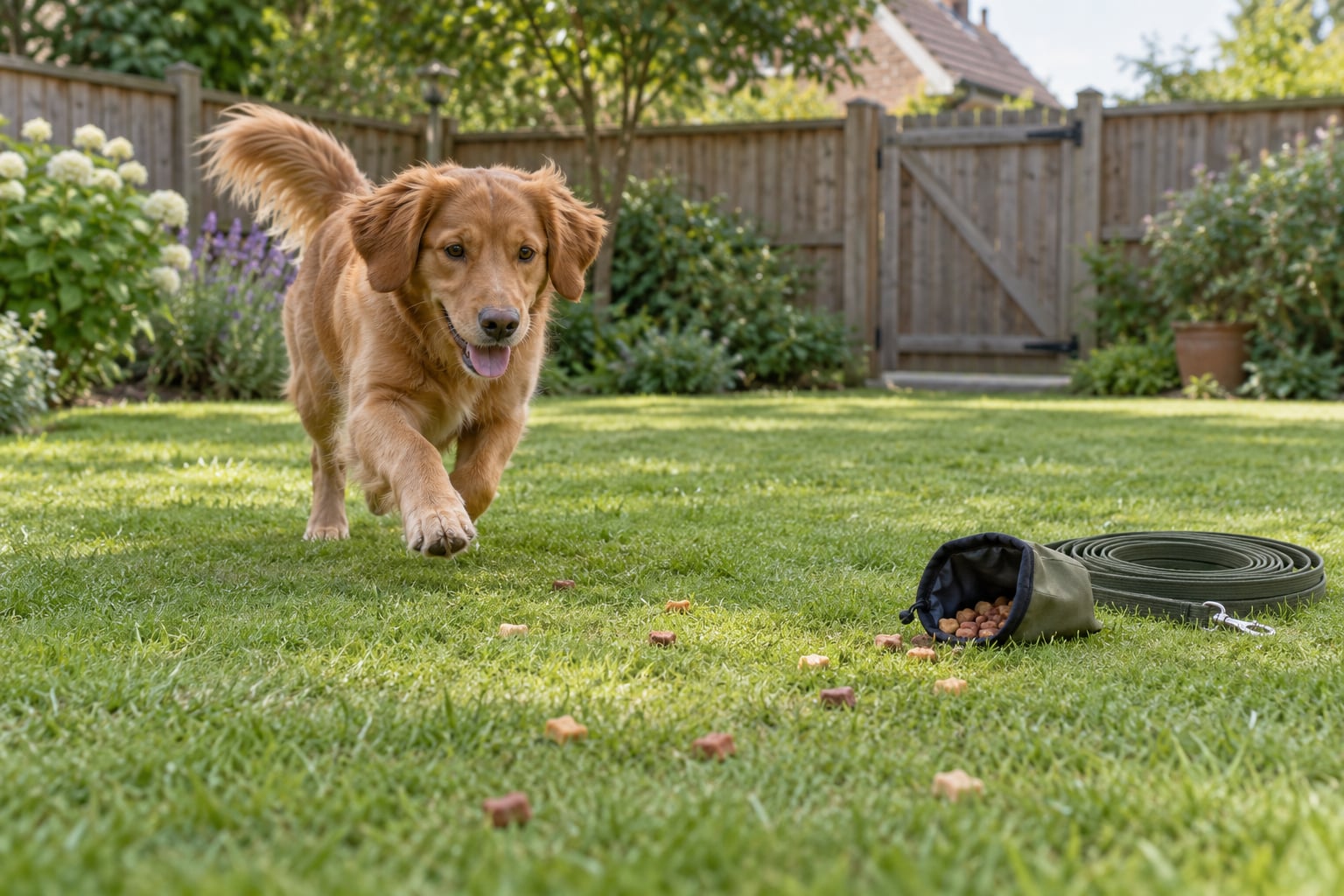
- A long line of 15 to 30 feet: for later work in a secure field, once the recall holds indoors.
- A quiet, boring place: a hallway or a back room beats a busy park every single time.
Set the session rule before you start: two minutes, five or six repetitions, then stop while the dog still wants more. A dog training on a full stomach is a dog who has no reason to move.
Step-by-Step: How to Teach a Dog to Come When Called
Step 1: Choose a Clear Recall Cue
Pick one word and never give it a second job. “Come” is fine, and so are “here” or a nonsense word like “lunch” that nobody in the house uses for anything else. Avoid words that already carry other meanings, because a recall word overloaded with six jobs is a recall word with no meaning.
Say it in a bright, excited tone, exactly the same way every time. Tone does more work than vocabulary. Most people hold the same word at different volumes and speeds and then decide the dog is being selective.
Give the dog a hand signal to fall back on: clap once, slap your thigh, or turn and run backwards. For dogs with heavy or floppy ears, for deaf dogs, and for any noisy place, pair the word with a whistle and use whichever one travels better.
Step 2: Reward the Dog for Coming to You
Say the cue the moment the dog takes one step towards you, then walk backwards so they follow you rather than stopping. Getting down low helps. Kneeling dogs get a faster, less hesitant approach than humans standing over them.
Click or say your marker word as their nose reaches your hand, and feed immediately. The delay matters more than anything else in this article: a treat delivered three seconds late rewards whatever the dog was doing in between, which is usually sniffing the floor.
Then handle the arrival so it stays pleasant. If you use a collar, grab it briefly and gently and deliver the treat while your hand is there, so the hand on the collar becomes the good news. A soft touch on the shoulder or a scratch under the chin does the same job without the collar at all, and many owners find it removes the dodge.
Release the dog straight back into the game. Recall is the start of fun, not the end of it.
Step 3: Repeat the Cue in a Safe, Quiet Area
Run five or six repetitions in a hallway or a quiet living room. Keep the success rate high, roughly four out of five, because a repetition that fails teaches the wrong thing faster than a repetition that succeeds.
If the dog does not respond, do not repeat the word. Repeating “come, come, come” teaches that the second and third word are optional and that ignoring is perfectly fine. Wait two seconds, do something interesting, and try again in a minute. Anyone learning how to teach a dog to come when called gets the reward timing right and then loses the behaviour in week two by rushing everything else.
Rotate who gives the cue. A dog that only recalls to one person is half trained, and the other half usually has to be fixed in a park rather than a living room.
Stop while the dog is still enjoying it. Endless sessions are what make a young dog decide that coming back is boring.
Step 4: Gradually Add Distance
Raise the challenge in small jumps: one metre, three, six, then the length of a room, then a garden. Only move up when the current distance has gone boring and reliable. If the dog fails at ten metres, drop straight back to three and rebuild.
Raising distance before the behaviour is solid is the single most common way to lose a recall. A cue that works at three metres is not a cue that works at thirty.
Trainers call this stage proofing: keeping the behaviour identical while the conditions around it get harder. Distance first, distractions second, never both at once.
Step 5: Add Mild Distractions
Work up the difficulty list slowly: an empty room, then another person in the room, then a doorbell, then a dog at a distance, then the edge of a park. Add one thing at a time and only once the last thing is easy.
Wait for the dog to be settled before you call. A dog mid-play-frenzy or mid-lunging after a squirrel is not choosing to ignore you, it simply cannot hear anything over what it is doing. In that moment, walk over, collect your dog, and wait for a quieter second.
If recall fails three times in a row at one level, you have gone too far. Step back down.
Step 6: Practice With a Long Line
Attach the long line to the back clip of a harness or a properly fitted collar. Never use a martingale, a headcollar or anything that tightens under load, because the gentle tension that makes a long line safe is exactly what those setups punish.
Start with about five metres trailing loosely on the grass, and keep the first sessions in an enclosed space or a secure field. A long line is a training tool, not permission to work near roads until the recall is genuinely solid.
Stand on the line with one foot before you ever pick it up. It takes two seconds, prevents rope burn on your hands, and stops the line pick-up from becoming the part of the walk the dog dreads.
Keep the line clear of water, legs and other dogs. As reliability improves, hand over more and more freedom in short bursts, keeping the line on the dog rather than looped over your wrist.
Common Mistakes and Quick Fixes
Most dogs who are “stubborn” about recall have simply been taught, unintentionally, by someone who wanted the same thing.
- Repeating the cue. Say it once. If the dog does not move, stop calling, and try again later when you are not frustrated.
- Rewarding late. Keep treats at your waist in a pouch and feed within a second of arrival, not after the lead is on.
- Training too long. Two minutes, three times a day beats fifteen minutes once. Short and repeated wins every time.
- Calling to end fun. Calling the dog to clip the lead on teaches that the cue means the walk is over. Use a different word, such as “car” or “walk”, for the lead going back on, and better still walk over to your dog and carry the lead to them.
- Scolding after a miss. Never scold a dog after a missed recall. They link the word to whatever happened in the following ten minutes, and next time the word predicts trouble.
- Calling from too far away. Match the call to the level the dog has actually trained at, not the distance you wish they worked at.
- Calling for unpleasant reasons. If you use the recall word to end a vet visit, give a bath or take something away, you are building a separate cue. Use a different signal for the negative stuff.
One more that catches people out: if recall is not improving after a few weeks of short daily sessions, or there is fear, chasing, guarding or aggression involved, book a reward-based trainer or a vet behaviourist rather than training harder. Repeatedly calling a frightened dog only confirms that the word means something bad.
Frequently Asked Questions
What to do when a dog won’t come when called?
Stop repeating the cue. Repeating the word teaches your dog that ignoring it works. Check your distance: call from the range your dog has actually been trained at. Make sure your treat is worth more than whatever the dog is doing, and reward within a second of arrival, not after the lead is on. If they still ignore you, walk over and reward something else, then try again in a few minutes.
How long does it take to train a dog to come when called?
A simple indoor recall usually starts showing within a few days of five or six repetitions twice a day. Reliable behaviour in busy places takes several weeks of consistent short practice, and takes longer for older dogs, rescues, and any dog distracted by squirrels or other dogs. Expect a realistic answer of one to three months of daily work rather than one dramatic session.
Should I use a word or a whistle to call my dog?
Either works, and using both gives you a backup. A whistle carries further and cuts through noise, which makes it useful in parks and for dogs with heavy or floppy ears that miss softer verbal cues. A spoken word works well at home and off the lead in a secure field. Pick one as the primary cue and keep it identical every single time you use it.
How do you train a stubborn dog to come?
Stubbornness is usually a reward problem. Raise the value of the reward: use cooked chicken, sausage or cheese instead of plain biscuits, and shrink the pieces. Change the setup rather than the dog: a hallway has no competition, a garden full of scents does. Never call a dog that will not respond, because each repeat confirms that ignoring you is fun and harmless.
Is it too late to teach an adult or rescue dog a recall?
No. Adult dogs learn recall at any age, and many rescues simply never had one that was worth coming back for. Expect a slower first fortnight while the dog checks whether the word pays, then normal progress. For a senior dog, shorten sessions, use softer treats, and consider a hand target on the floor instead of a full run if joints or hearing are an issue.
How do I stop my dog dodging my hand when it reaches me?
Reward the arrival before you touch the collar, not after, so the hand already means good news. Keep the grab very brief and gentle and feed while your hand is there. Or skip the collar entirely: touch the shoulder or scratch under the chin, reward, then clip on. If the dodge persists, drop back to a shorter distance where the dog is arriving happily.
Conclusion
Start with one cue, one high-value treat and two minutes of easy repetitions in a quiet hallway. Reward the arrival within a second, touch the collar gently, then let the dog go straight back to what it was enjoying.
Keep that word tied to good things forever. Raise distance before distractions, practise three short times a day instead of one long one, and never scold a dog for missing a recall. Do it for how to teach a dog to come when called and your walk stops feeling like a chase.