Dogs cool themselves almost entirely by panting, so knowing how to keep a dog cool in hot weather comes down to three things: shade, cold water within reach, and less time in the sun. A short walk before breakfast is worth more than a long one at four in the afternoon, and a cooling mat or damp towel buys you minutes, not permission to keep playing. If your dog is vomiting, wobbling or suddenly unresponsive, that is a trip to the emergency vet now, not a phone call later.
Nothing here replaces your veterinarian. The guidance below covers routine prevention and first aid steps you can take while you head to the clinic, and every medical decision about your dog belongs with a vet.
Table of Contents
- 1What You Need
- 2Step-by-Step
- 31. Check the Weather and Your Dog’s Risk
- 42. Provide Shade and a Cool Environment
- 53. Keep Fresh Water Within Reach
- 64. Adjust Walks and Outdoor Activities
- 75. Use Cooling Products Safely
- 86. Watch for Signs of Overheating
- 97. Create a Hot-Weather Emergency Plan
- 10Common Mistakes
- 11Frequently Asked Questions
- 12Should I put ice water on a dog that is overheated?
- 13Is it safe to shave a dog’s coat in hot weather?
- 14How do I know if my dog is too hot outside?
- 15When should I take my dog to the veterinarian for heatstroke?
- 16Are cooling mats, bandanas, and frozen toys safe for dogs?
- 17How to Keep a Dog Cool in Hot Weather
What You Need
None of this needs a big budget or a dedicated room. Gather it before the first hot day rather than at 2 p.m. when you need it.
- Two or more water bowls in different rooms, plus one in the car. Bowls are easier to hit than a dispenser and easier to check.
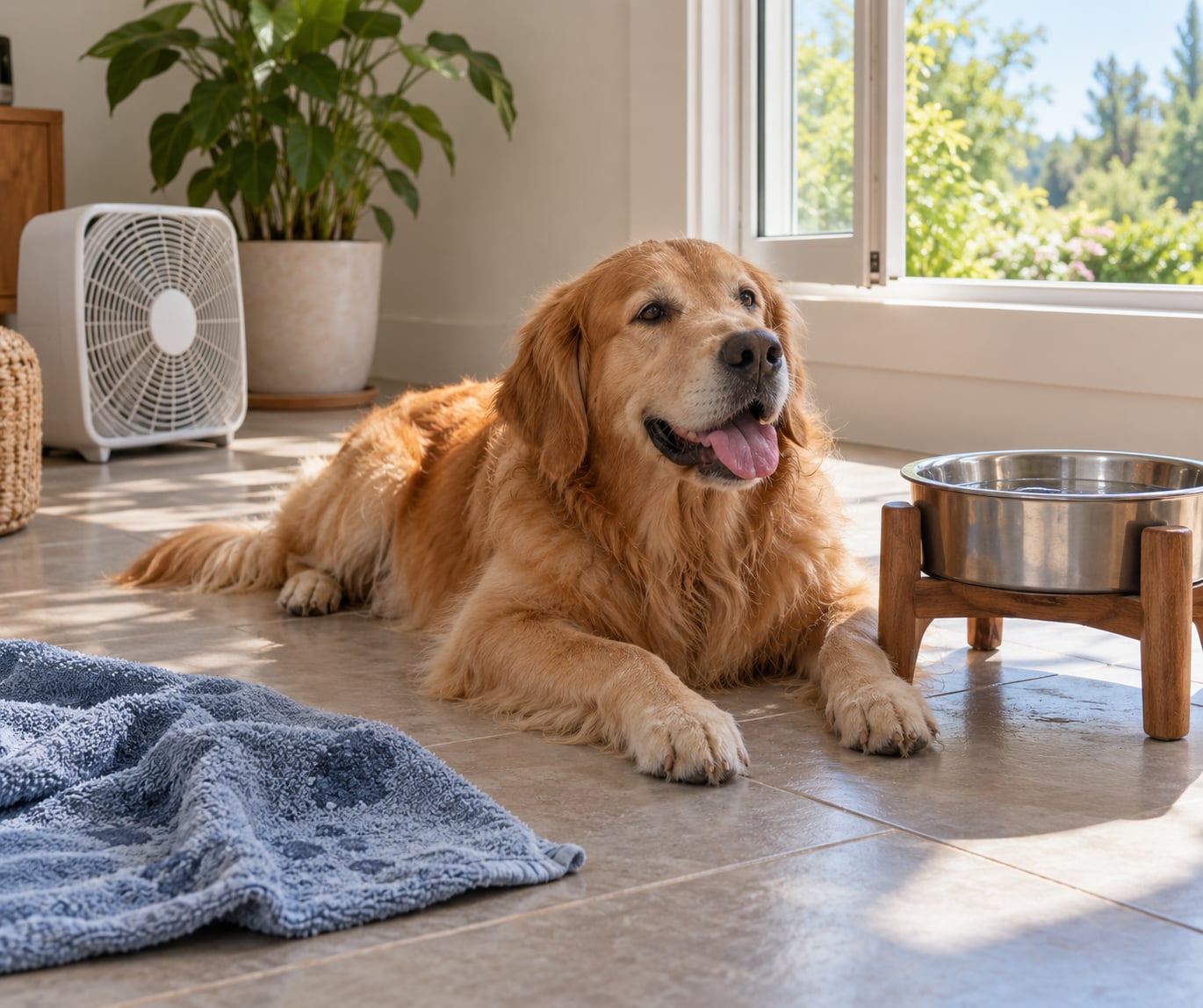
- A cool floor surface — tile, sealed concrete or a mat. It pulls heat out of a lying dog far better than carpet.
- Shade structure for outdoors: a canopy, an umbrella staked into the ground, or a shaded side of the house that stays shaded all afternoon.
- A fan, and a fan plus an open window creates real airflow. A fan alone in a closed hot room does very little.
- A towel and a spray bottle for wetting the dog down, plus a bowl or tub for a cool paw soak.
- A thermometer that measures air temperature and one that measures rectal temperature, if you own one.
- Cooling kit: a cooling mat, a soaked bandana, or a few frozen chews. Optional, useful, never a replacement for shade and water.
- Your nearest emergency vet’s number, saved in your phone with the address and route written out.
Step-by-Step
1. Check the Weather and Your Dog’s Risk
Start with the heat index, not the bare number on your phone. A 90 degree day with heavy humidity is harder on a dog than a 95 degree day in dry air, because panting only works by evaporating water and humid air evaporates it poorly. This is also why a swim in warm water can add little: in humid weather the water can be warmer than the air.
My simple rule is walks before nine in the morning or after seven in the evening, and if the heat index reaches 90 degrees I keep the outing to a few minutes of business in the shade or skip it. Short and often beats long and rare.
Then adjust for the dog in front of you. Flat-faced breeds (pugs, bulldogs, boxers, Boston terriers) have narrowed airways and cannot move air efficiently, so they overheat faster at lower temperatures. Thick double-coated dogs, seniors, puppies, overweight dogs, dark-coated dogs, and dogs with heart, airway or kidney conditions all carry more risk. Dogs in a home without air conditioning need a deliberate cooling plan rather than an open window and hope.
2. Provide Shade and a Cool Environment
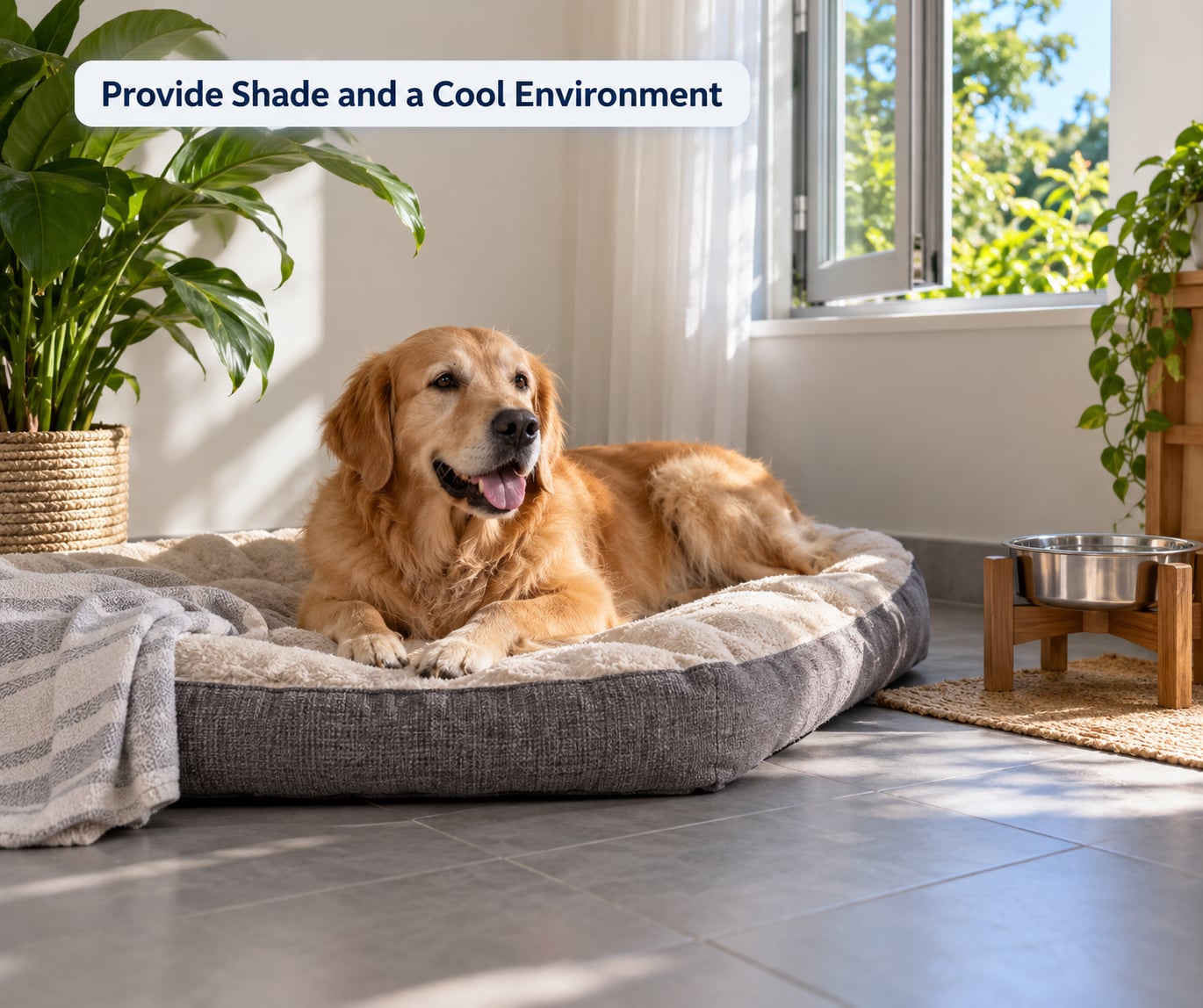
A dog needs somewhere cool to be, not just somewhere shaded. Shade blocks direct sun, but in humid weather the shaded ground can still be dangerously warm. Add airflow, a cool floor and ideally a cross-ventilated room where air actually moves.
Outdoor shade should cover the whole resting area, not just a corner, and it should be there at the hottest hour. Check it the same way you would check the sun’s position — by visiting at two in the afternoon. Indoors, put your dog on tile rather than carpet, and keep one room cooler than the rest of the house so there is somewhere to retreat to.
You will know it is working if your dog lies down in that spot within a couple of minutes of arriving and stays there rather than pacing and searching for cooler ground.
3. Keep Fresh Water Within Reach
Fresh, cool water goes out first thing every morning and gets refilled all day. On a hot day an outdoor bowl may need refilling several times, and it is worth carrying water on walks instead of relying on the one dog park fountain.
Never restrict water to “keep the bladder healthy.” That advice is dangerous in heat, and drinking more is one of the ways a hot dog sheds heat. Ice cubes or a small frozen block in the bowl are fine for a healthy dog to drink. Bone broth frozen into cubes, and frozen chews or lick treats, add moisture and give a hot dog something to do.
Watch the bowl and the gums. Dry or tacky gums, sunken eyes and skin that stays tented after you pinch it point to dehydration. Panting alone does not prove it, and a cool nose or damp paw prints mean nothing about hydration.
What about the popular 3-3-3 rule for senior dogs? It is a general lifestyle guideline about activity, not a heat rule, and it does not protect a dog from overheating on a hot afternoon.
4. Adjust Walks and Outdoor Activities
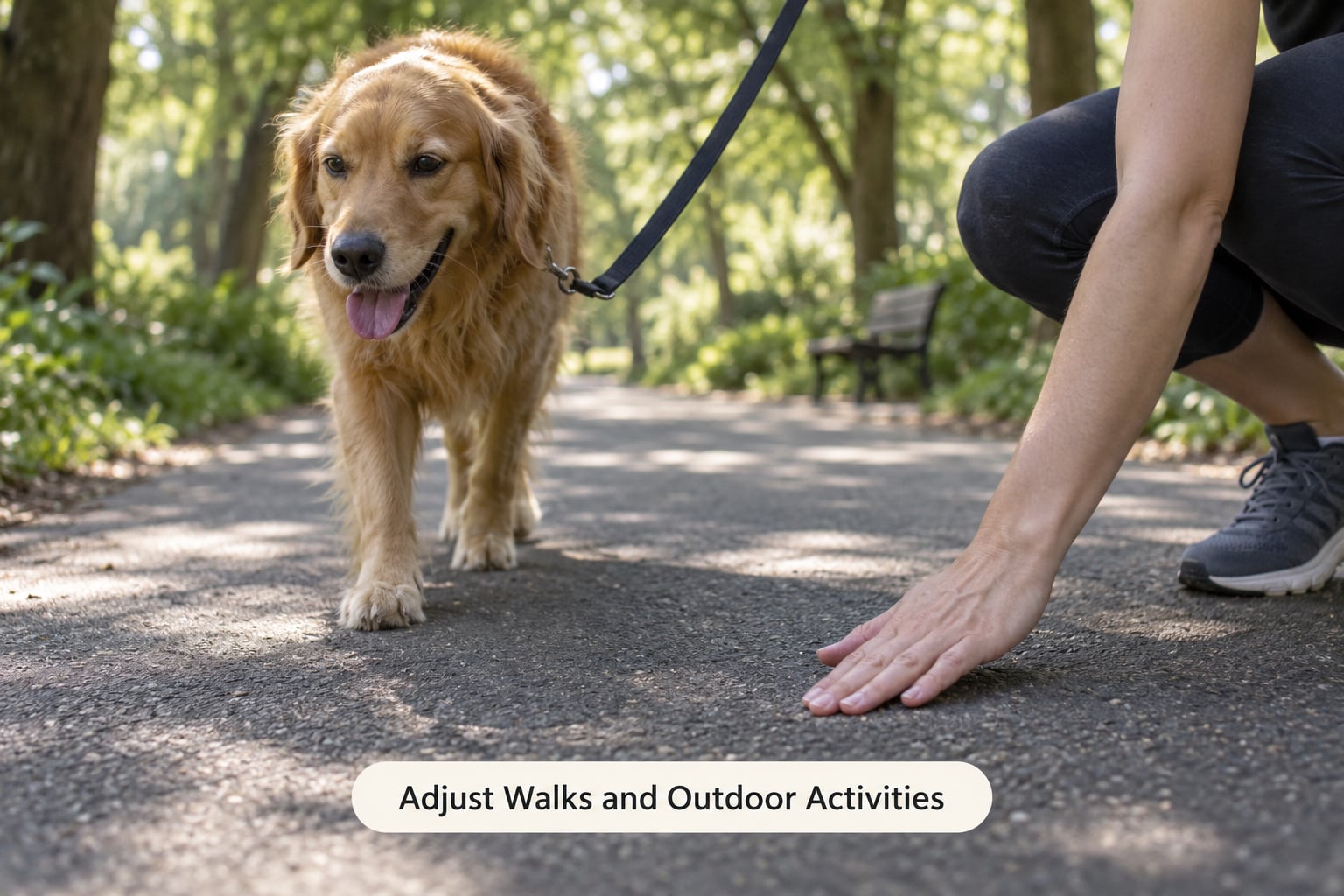
The pavement test takes five seconds and saves a burn. Press the back of your hand flat against the asphalt or concrete and hold it there for a full five seconds. If that is uncomfortable for you, it is too hot for paw pads, and you walk somewhere else. Paw pads absorb heat directly and asphalt in full sun can be far hotter than the air temperature you checked this morning.
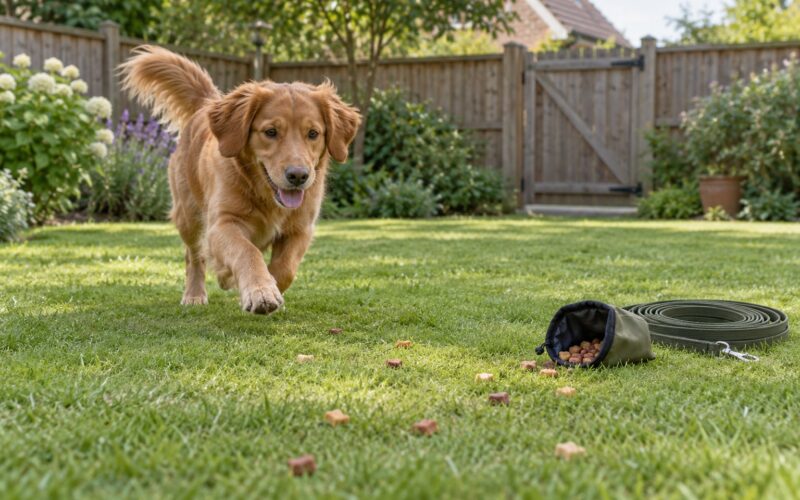
Walk on grass, dirt or shaded routes when you can. Trim sessions shorter, add more of them, and stop the moment the panting turns hard and noisy or the dog lags behind. Bring water. Pay attention to behavior too — plenty of dogs will keep following a ball right past the point where they should stop, so plan the exit before you leave rather than arguing with a determined Lab halfway home.
On high-risk days swap the walk for indoor work: a snuffle mat, a lick mat stuffed with plain yogurt or wet dog food, a sprinkler session in the early evening, or a frozen puzzle toy. Mental work tires a dog out without the body temperature cost.
5. Use Cooling Products Safely
Cooling gear helps. It also gets marketed as more than it is, so set your expectations honestly.
- Cooling mats work by drawing heat from the body into the gel or water inside. Owners report many dogs ignore a room-temperature mat until it has been in the freezer, so freeze it according to the instructions and offer it as a choice, not a treat.
- Evaporative vests are soaked in water and cooled by evaporation plus airflow. Hikers report soaked vests holding up for roughly 20 minutes before they need re-soaking. Plan a water source if your dog is wearing one on a walk.
- Frozen toys and frozen broth cubes are low-risk hydration rewards you can make yourself.
- A shallow kiddie pool or splash pad under supervision is consistently the best free at-home option. Never leave a dog alone in water, and rinse the pool after use.
- A damp towel plus a fan is the cheapest effective combination there is, and it works fastest on the belly, armpits, ears and paw pads.
Water is the one cooling aid with a real safety rule attached. Avoid lakes and ponds with green or dusty-looking surface film, which can carry blue-green algae, and remember that pond or pool water can be warmer than the air in humid weather. Spraying your dog with cool tap water is fine and helps, provided it is cool, not ice cold, and you keep air moving across the wet coat.
Every one of these sits on top of shade, water and rest. None of them make a hot environment safe.
6. Watch for Signs of Overheating
Normal summer panting is fast, shallow and from the mouth, and it settles within minutes of rest. Heat stress looks different: panting that will not slow down, heavy drooling, bright red or dry gums, a dog who suddenly seeks out the coolest floor and lies down, and an animal who seems focused but quiet instead of playful.
Heat exhaustion becomes heatstroke when the signs escalate. Watch for stumbling or unsteady movement, vomiting, diarrhea, confusion or not responding to their name, weakness, and collapse. Gums that go pale, grey or blue are an emergency sign. One confusing detail: a dog in severe heatstroke may stop panting, because the body can no longer produce the response. A hot, quiet, unresponsive dog is worse news than a loud, panting one, not better.
If you suspect heatstroke, move the dog into shade or air conditioning, wet the body with cool tap water and keep air moving across it, offer small amounts of water if they are alert and swallowing, and call the emergency vet on the way. Do not delay the call to try other things first.
7. Create a Hot-Weather Emergency Plan
Write this down once, before you need it, because you will not be thinking clearly while panicking.
Save your regular vet, your nearest 24-hour emergency clinic and one backup clinic, with addresses. Know which one is genuinely closest, not the one that is familiar, and check the route during a cooler hour so you are not learning it for the first time in traffic. Put the number on the fridge and in your phone.
Know which room is coolest, where the fan is, where the towel and the spray bottle live, and how you will transport your dog quickly. If you crate in the car, never put a crate in a parked vehicle; the temperature inside a car can climb around 20 degrees in ten minutes, and a cracked window barely slows it.
A quick check on a cooler night after a long hot day is worthwhile, too. Heat illness can show up hours later, and a dog that seems fine at bedtime is not always fine at 2 a.m.
Common Mistakes
Exercising at peak heat. The middle of the day, roughly 10 a.m. to 4 p.m., is the worst stretch for walks and play. Move them to early morning or evening rather than shortening them into the hottest hours.
Using ice or ice water on an overheated dog. Ice-cold water constricts surface blood vessels, which traps heat in the body, and ice applied directly can cause rapid cooling of the skin and shivering that generates more heat. Cool tap water plus airflow is the safer method.
Pouring alcohol or essential oils onto a hot dog. Neither belongs on a panting animal, and neither is a cooling method.
Leaving a dog unattended in a parked vehicle or a hot yard. Cars heat up faster and more dangerously than almost anyone expects, and a dog in a yard may be far less able to move itself into shade than its owner assumes.
Shaving a double-coated dog. Husky, Newfoundlander, Bernese mountain dog and Malamute owners often reach for clippers as a heat fix. The undercoat is the insulation that keeps heat out and traps cooler air against the skin, so shaving can leave the dog worse off in both directions. A tidy trim and a thorough de-shed of loose coat is fine. For shaving, ask your vet first.
Giving human medication. Paracetamol, ibuprofen and similar drugs are toxic to dogs and are a frequent cause of emergency visits. Never give them without explicit veterinary direction.
Two habits cover most of the rest: watch the dog rather than the forecast, and keep the coolest spot and the freshest water available all day rather than only during walks.
Frequently Asked Questions
Should I put ice water on a dog that is overheated?
No. Ice-cold water and ice packs tighten surface blood vessels, which keeps heat inside the body, and direct ice can cool the skin too fast. Use cool tap water on the belly, armpits, ears and paw pads, keep air moving across the wet coat, and call your vet or nearest emergency clinic while you do it. Ice cubes in the drinking bowl are fine for a healthy dog.
Is it safe to shave a dog’s coat in hot weather?
Usually not, especially for double-coated breeds. The undercoat insulates in both directions, so shaving can leave a dog more exposed to sun and unable to hold cool air next to the skin. A trim and a thorough de-shed of loose hair are safe. Speak with your vet before shaving, particularly for husky, malamute, Newfoundland and Bernese mountain dogs.
How do I know if my dog is too hot outside?
Run the five-second pavement test: press the back of your hand on the ground for five seconds and if it is uncomfortable, it is too hot for paw pads. On the dog, watch for panting that will not settle, heavy drooling, bright red or dry gums, slowing down and seeking out the coolest floor. Turn back the moment you see those, not after the dog insists on continuing.
When should I take my dog to the veterinarian for heatstroke?
Take them in immediately for stumbling, vomiting, diarrhea, weakness, confusion, collapse, pale or blue gums, or a hot dog who stops responding. Do not wait to see whether rest helps and do not delay the call while you try other remedies, because internal organs can be damaged before the signs look serious. A rectal temperature above the normal 100 to 102.5 degree range also warrants a same-day call.
Are cooling mats, bandanas, and frozen toys safe for dogs?
They are safe for most dogs and helpful in the right conditions, but they supplement shade, fresh water, airflow and rest rather than replacing them. Watch chew size for puppies and senior dogs with poor teeth, supervise anything soaking up water in case of chewing, and skip frozen treats for dogs on restricted diets or with dental problems. Evaporative vests stop working well after roughly 20 minutes and need re-soaking.
How to Keep a Dog Cool in Hot Weather
Here is the short version. Keep one genuinely cool resting place ready, keep fresh cool water out and refilled all day, and cut the hottest hours out of the walk and play schedule entirely. Then watch the dog, not the thermometer, because panting that will not settle is your earliest and most reliable warning.
Move on to a cooler hour if you notice heavy drooling, red or dry gums, or a dog who suddenly goes quiet and still. Do not reach for ice or human medication. And if you see stumbling, vomiting, pale or blue gums, or a dog who stops responding, get to the emergency vet immediately — that is the one situation where waiting costs more than the drive.