To get rid of pet odor in the house, find the source first, break down what it left behind, then stop it from coming back. Most people start in the wrong place: spraying fragrance over a carpet that still has urine residue soaked into the pad, then wondering why the smell returns in four days.
The order matters more than the products. Fragrance, air fresheners and deodorizing sprays cover a smell for minutes because they add competing chemicals to the air. Only removing the residue removes the smell, and residue means removing the source, treating the protein deposits with an enzymatic cleaner, and then keeping the area dry and free of odor.
- Remove the source. Find where the odor is actually coming from before you clean anything else.
- Break down the residue. Enzymatic cleaner and a hot wash dismantle the organic proteins that produce the smell.
- Prevent the return. A short daily and weekly routine keeps a clean house from getting smelly again.
Most of it takes an afternoon, plus 30 minutes on a weekend for the follow-up. Here is how to get rid of pet odor in the house without burning a whole Saturday.
Table of Contents
- 1What You Need
- 2Step-by-Step: How to Get Rid of Pet Odor in the House
- 3Identify and Remove the Odor Source
- 4Ventilate and Clean the Affected Areas
- 5Wash Fabrics and Pet Bedding
- 6Deodorize Each Room Without Masking Pet Odor
- 7Prevent Pet Odor From Returning
- 8Common Mistakes That Bring Pet Odor Back
- 9Masking the smell instead of removing it
- 10Cleaning too lightly, or only the top layer
- 11Mixing cleaners or using strong fragrance
- 12Ignoring hidden areas
- 13Skipping the maintenance routine
- 14What Not to Use Around Pets
- 15Frequently Asked Questions
- 16How can I get rid of dog smells in my house?
- 17What is the best way to eliminate pet odor from my home?
- 18What is the most powerful pet odor eliminator?
- 19Why does my house still smell like pets after cleaning?
- 20How long does it take to get rid of pet odor in carpet?
- 21How do you get dog smell out of a house from previous owners?
- 22Conclusion
What You Need
Gather supplies before starting, so you are not walking away mid-clean to find the right bottle.
For removing the source: rubber gloves, paper towels or old towels, a plastic bag for waste, and a flashlight. You also want a wet/dry vacuum or a carpet extractor for accidents you have already blotted.
For breaking down residue: a pet-safe enzymatic cleaner made for urine, a pH-neutral floor cleaner, a soft brush, and plain white vinegar. Enzymatic cleaners are not the same as disinfectants, and that difference is the whole trick.
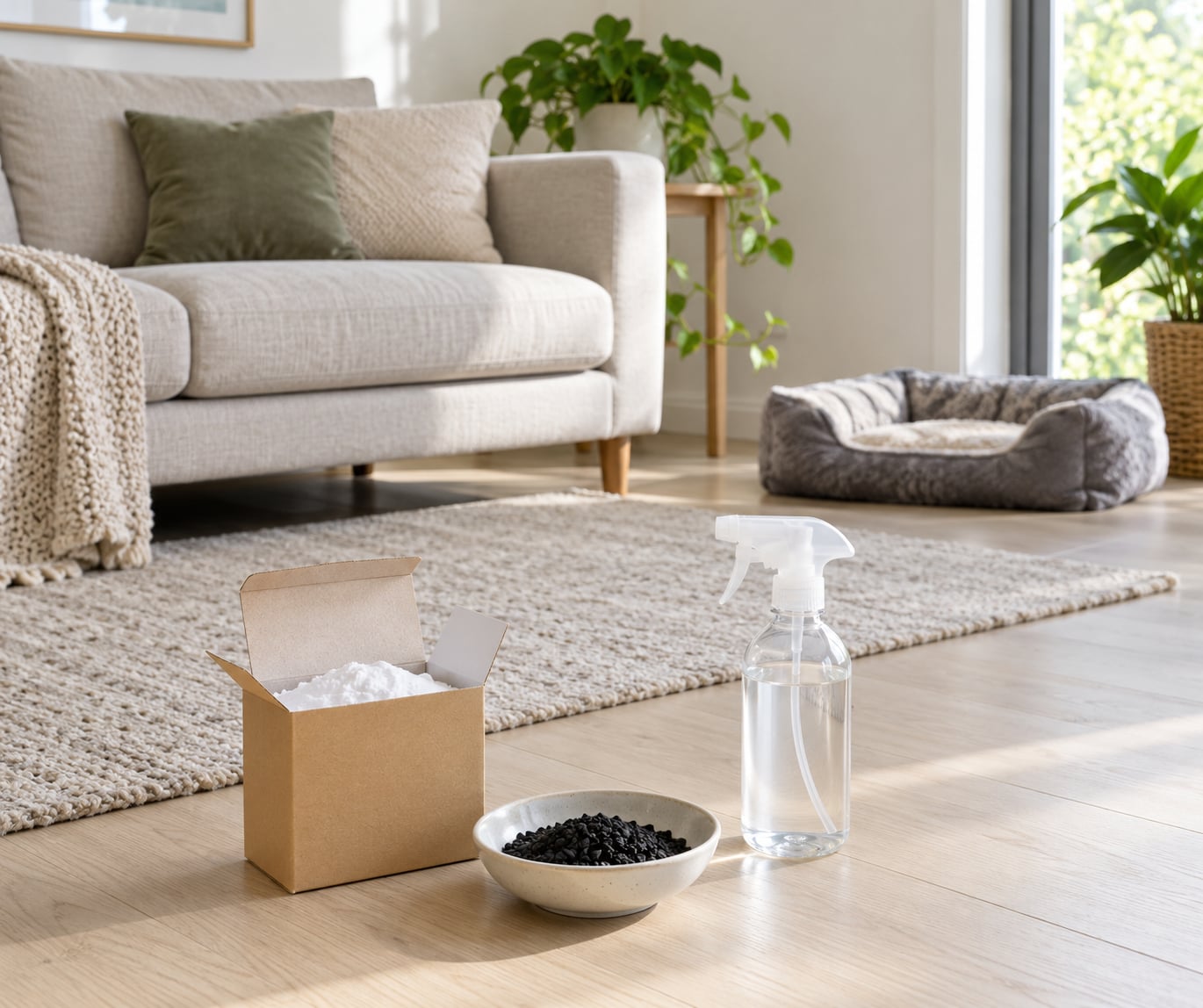
For deodorizing: plain baking soda, activated charcoal, and a box of low-pH enzymatic powder if the odor is coming out of carpet. Check every bottle for a pet-safe label, and keep lids closed while pets are in the room.
For ventilation: two windows that open from opposite sides of the house, a box fan if you have one, and a spare furnace or HVAC filter.
A safety note before you start: keep pets out of the room until surfaces are dry and rinsed, and never mix bleach with ammonia or vinegar. That combination releases toxic gas, and people have been hospitalized from it in their own homes.
Step-by-Step: How to Get Rid of Pet Odor in the House
Identify and Remove the Odor Source
Find the source before you clean, because cleaning a room where the source is still active only resets the clock. Start by sniffing low: at floor level, along baseboards, inside couch cushions, under the dog bed, in the litter box area, and near vents.
- Sharp ammonia smell, strongest near floors or in a bathroom or crate: urine. Look for a damp, darker patch of carpet, a soft spot in the pad, or a wall corner where a dog has stood to mark.
- Warm, dusty, musky smell that shows up after a week of hard shedding: dander and shed hair sitting in upholstery, on vents and under furniture.
- Very strong fishy or fecal smell right behind the tail: anal-gland secretion. This one needs a vet, not a cleaner.
- Sour or yeasty smell from the ears or paws, with the pet scratching: an ear yeast or skin infection. Also a vet issue.
- Overpowering litter-box smell that spreads into the hallway: an overfull box, a small uncovered box, or litter that has sat too long.
- Musty smell that comes back within days of cleaning: moisture left in a cushion, foam insert or rug pad, which is now a breeding ground rather than a spill.
Remove waste, soiled bedding and any soaked absorbent pads first, bag them and take them out. For a fresh accident, blot with towels and rinse with cool water. For dried urine, saturate the spot with an enzymatic cleaner rather than scrubbing, and keep working while you can still find where the odor is strongest.
Ventilate and Clean the Affected Areas
Open windows on opposite sides of the house for 10 to 15 minutes so air actually moves through, rather than one window in a closed room. A box fan in a doorway speeds it up. If the outdoor air quality is poor on that day, ventilate later rather than pulling in a different problem.
Then work from the top down. Vacuum furniture cushions and carpet with a crevice tool, moving along baseboards and under furniture where hair and dust collect. A HEPA vacuum captures fine dander instead of blowing it around.
Mop hard floors with a pet-safe, pH-neutral cleaner, and give extra attention along baseboards and door frames, where urine wicks into seams. Clean litter boxes with hot water and a mild unscented detergent once a week. Owners on r/CleaningTips make the same point about general cleaners: they make a room smell better for about a minute.
Wash Fabrics and Pet Bedding
Wash pet beds, blankets, crate pads, cushion covers and your own bedding on the hottest setting the fabric label allows, usually 140°F or above for bedding, and add a cup of plain white vinegar to the detergent as you fill the machine. Use a biological or enzyme laundry detergent rather than a heavy fragrance one, and run an extra rinse so nothing stays trapped in the fibers.
Cushions and foam inserts rarely survive a wash. Soak them for 30 minutes in warm water with enzyme detergent, scrub with a brush, rinse well, and dry them completely on their side with a fan. If a foam insert still smells after two full dry cycles, replace it. Foam holds urine deep inside and never fully releases it.
Owners on r/CleaningTips and r/dogs point out that the smell often comes back as the enzyme-treated fabric dries, so a second treatment on dry fabric is worth doing.
Deodorize Each Room Without Masking Pet Odor
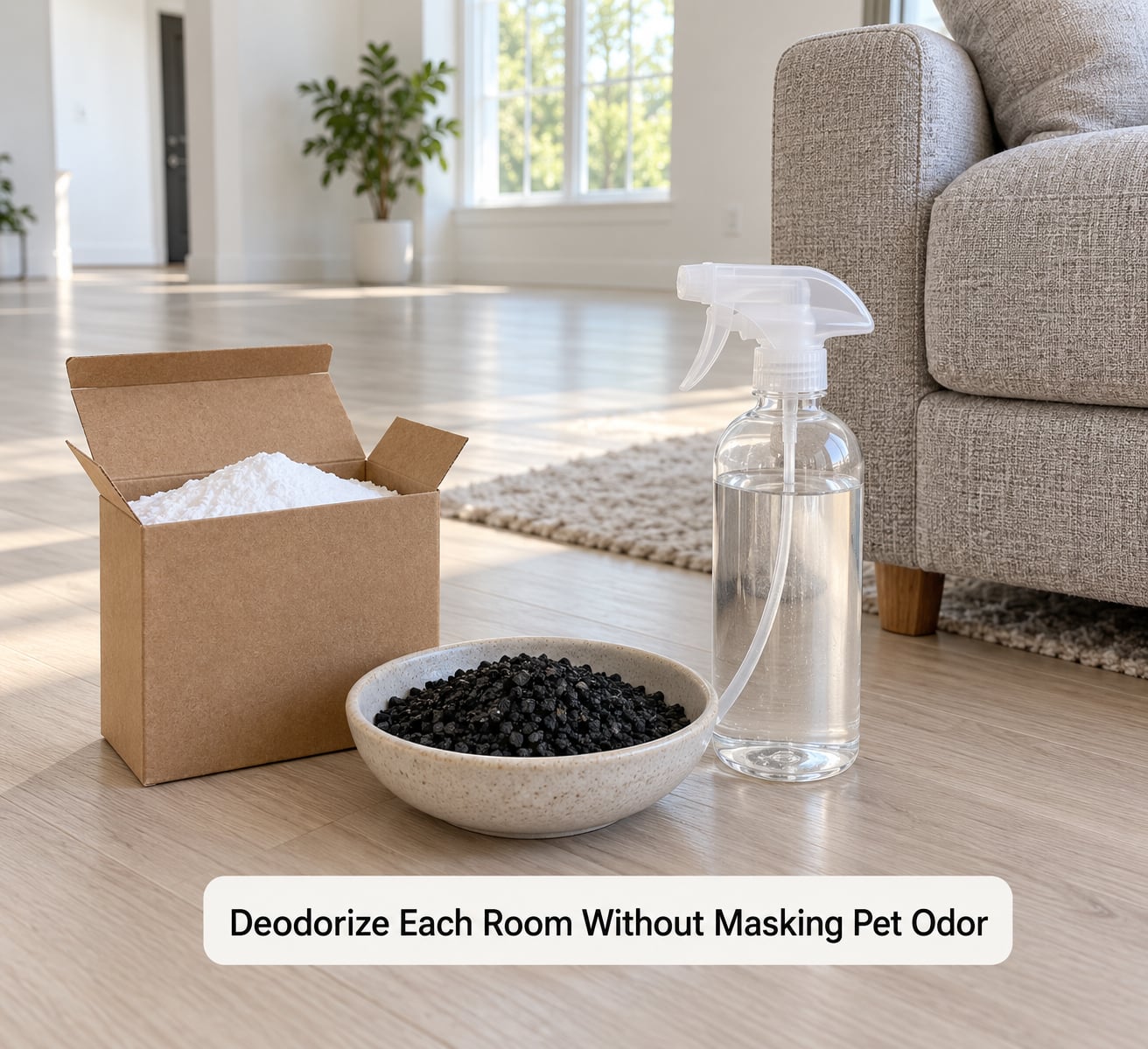
Deodorizing is the last step, and it only works on a surface that is already clean. Spraying a fragrance product onto a dirty carpet just seals the smell in under a perfume layer.
Baking soda absorbs odor molecules from the air and settles into carpet fibers. Sprinkle it over clean, dry carpet or upholstery, leave it 15 to 30 minutes, then vacuum it up. Keep it out of reach of pets while it sits, and never leave a large open box out. Baking soda is safe to walk on once vacuumed, but swallowed in quantity it is not harmless.
Activated charcoal holds odor compounds with a huge surface area. A small open bowl near the litter box or inside a closet works slowly and quietly; replace it every few weeks when it goes grey.
White vinegar in a 1:1 dilution with water works as a mild acid neutralizer on hard floors, tile and sealed wood. Skip it on unsealed natural stone, and keep it off wool and other natural fibers.
Enzymatic cleaner is the strongest option on carpet and upholstery. Pour it on instead of spraying, saturate the whole affected area, then keep the room closed and dry for the full dwell time on the label, commonly several hours. Enzymes break down the organic proteins in urine rather than covering them, which is why the wet smell gets worse before it gets better. That worsening smell is the enzymes working, and owners on r/dogs and r/Catownerhacks say people give up exactly there.
Prevent Pet Odor From Returning
The reason a house still smells a week later is that a source you never found is still active, or a damp cushion dried slowly and reactivated. Break that cycle with a small routine.
- Daily: scoop the litter box and remove waste, wipe spills immediately, and open two windows briefly.
- Weekly: wash pet beds and blankets on hot, vacuum under furniture and along baseboards, scrub the litter box, and check HVAC filter.
- Monthly: enzymatic treatment on any carpet or upholstery that stays damp, and a walk-through with a flashlight in dim light.
On hardwood, urine wicks down into the wood and the subfloor, where surface spraying cannot reach. Once the area is fully dry, seal the boards and seams with a primer sealer made for that floor finish, which stops moisture carrying odor back up. If the smell is still there after sealing, the pad or subfloor section has to be replaced.
If the odor seems to come from the animal itself, a veterinarian is the right call rather than more cleaning. Anal-gland issues, ear yeast, dental disease and skin infections all produce a smell that no cleaner removes.
Common Mistakes That Bring Pet Odor Back
Masking the smell instead of removing it
Air fresheners, scented candles and deodorizing gels are the single most common mistake. They add volatile compounds to the air, which compete with the original smell, and they do nothing to the residue underneath. Many households end up with two competing odors instead of none.
The fix is simple: take the source out, then deodorize. If you like a scent, add it last, and keep it light.
Cleaning too lightly, or only the top layer
Most of the residue sits in the carpet pad, under the rug, inside a foam cushion or in the seam of a baseboard. Blotting the visible surface leaves the majority of it in place. Saturate the area until it is genuinely wet, treat it, and give it the full dwell time before you judge the result.
Mixing cleaners or using strong fragrance
Bleach mixed with ammonia or vinegar releases toxic gases. Phenol-based cleaners and heavy fragrances are hard on pets, and people with asthma or migraines often find a heavily scented room worse than the original odor. Stick to unscented, pet-safe products and use one cleaner at a time.
Ignoring hidden areas
Air vents and ductwork collect fur and dander, and they blow it back into every room. Vents, under-bed space, fabric toys, collars and bowls are all easy to miss. Vacuum the vent registers, change your HVAC filter, and rotate toys out for washing or replacement.
Skipping the maintenance routine
A deep clean that happens once resets nothing. Odor comes back because dander and accidents accumulate again, so the weekly rhythm is what keeps a house smelling clean.
What Not to Use Around Pets
- Baking soda in quantity: safe on a carpet you vacuum, not safe to eat. Large amounts swallowed can cause serious problems, and some cats will lick a fresh patch deliberately. Put pets elsewhere while it sits.
- Essential oil diffusers: no visible particles still means inhaled vapors, and cats in particular are sensitive to several common oils. Skip the diffuser and open a window instead.
- Ozone generators: they are marketed for odor, but ozone is an irritant and pet owners have reported trouble with their animals after running them. A HEPA plus activated carbon purifier does the air cleaning without it.
- Phenol and pine-based cleaners: commonly toxic to cats and not worth the trade for scent.
Safe alternatives are plain baking soda used carefully, white vinegar diluted, unscented pH-neutral floor cleaner, enzymatic cleaner, a washable pet bed with a removable cover, and a HEPA and carbon air purifier.
Frequently Asked Questions
How can I get rid of dog smells in my house?
Start by finding the source, because fragrance sprays only cover odor for minutes. Remove waste and soiled bedding, treat urine residue with an enzymatic cleaner on carpets and upholstery, wash pet beds on hot with vinegar added, and mop hard floors with a pet-safe cleaner. Air the house out for 15 minutes a day and follow a weekly vacuum and wash routine.
What is the best way to eliminate pet odor from my home?
The best way to eliminate pet odor from your home is a three-part method: remove the source, break down the residue, then prevent the return. Enzymatic cleaner on carpets, upholstery and bedding does the residue work, since enzymes break down the organic proteins in urine instead of masking the smell. A short weekly routine stops it rebuilding.
What is the most powerful pet odor eliminator?
For persistent urine odor in carpet, upholstery and pet bedding, an enzymatic cleaner is the most powerful option you can use yourself, because it digests the proteins that create the smell rather than covering it. Deodorizers and air fresheners are weaker and temporary. If odor is in a hardwood subfloor, foam cushion or duct, the source has to be sealed or replaced.
Why does my house still smell like pets after cleaning?
Usually one of four reasons: the source was never found, so accidents continue off-sight; the residue is deeper than you treated, in a carpet pad, foam insert or baseboard seam; the area stayed damp and grew a musty smell; or a fragrance product is masking the original odor with a competing one. Check damp furniture, vents and the area behind furniture first.
How long does it take to get rid of pet odor in carpet?
Fresh urine removed and treated the same day usually fades within a few hours of drying. Dried or repeated accidents take longer, often a few days, because enzymes need dwell time and may need a second treatment once dry. Odor soaked into carpet pad, subfloor or a foam bed insert may not come out at all and needs replacing. Keep pets off treated carpet until it is fully dry.
How do you get dog smell out of a house from previous owners?
Work in escalating order. Ventilate the home for a day, then remove carpet, rugs and upholstered furniture that sit on the worst areas. Treat carpets and hard floors with an enzymatic cleaner and let it dwell fully, wash any remaining fabrics hot, and clean vents and ducts. Seal hardwood seams with a primer sealer, replace pet beds and foam inserts, and consider professional remediation for severe or long-standing cases.
Conclusion
Three things do most of the work. First, find the source and remove it, because no product reaches odor you have not located. Second, clean the affected area properly, using an enzymatic cleaner on carpet, upholstery and bedding and letting it dry completely rather than masking it with fragrance.
Third, stop future moisture and accidents: scoop daily, wash bedding weekly, open the windows briefly, and check vents and hidden areas. If the smell seems to be coming from the animal itself, talk to your veterinarian instead of the cleaning aisle.