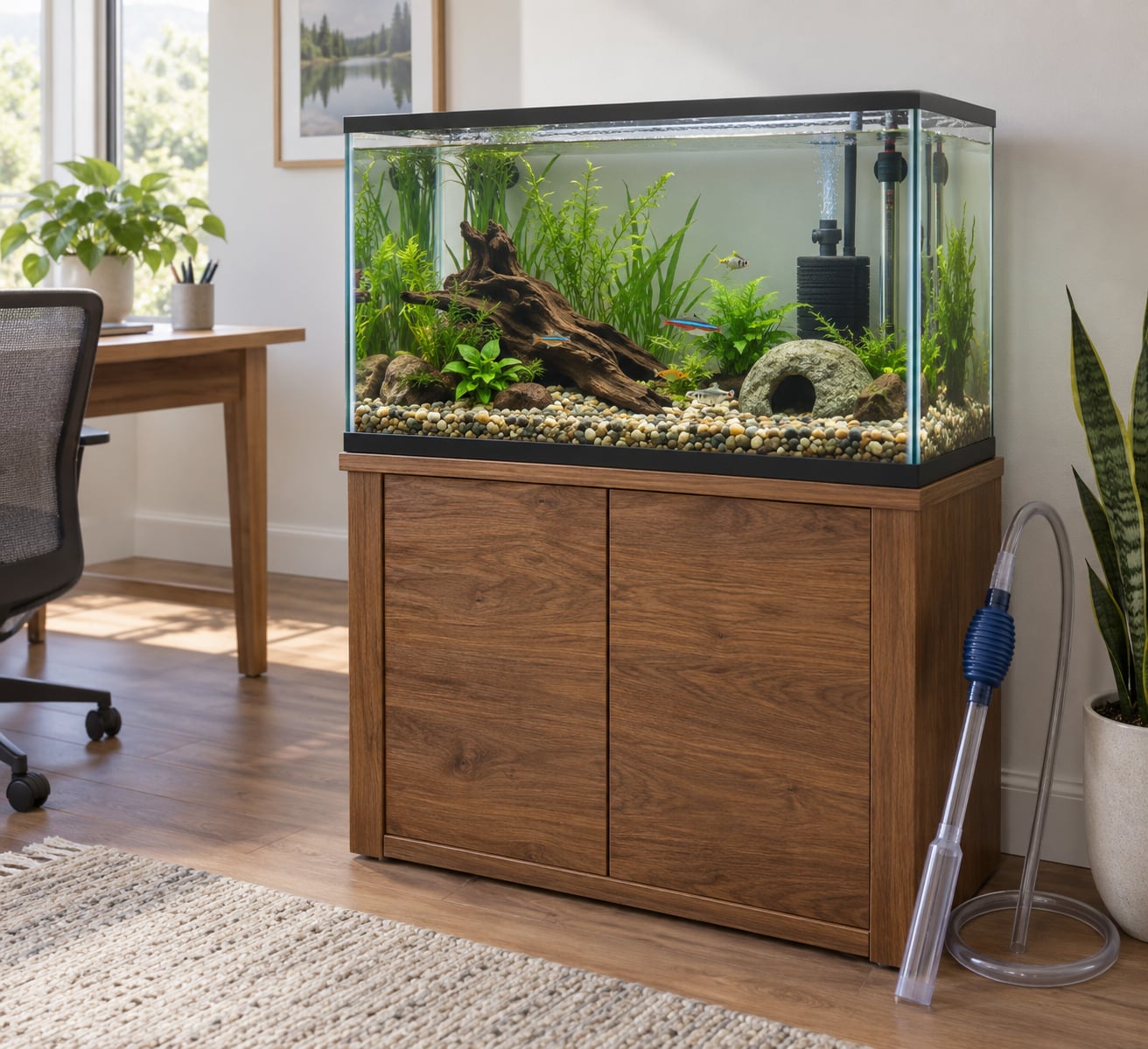
Setting up a fish tank is mostly waiting. You can assemble the whole thing in an afternoon, but the tank is not ready for fish until beneficial bacteria have built a biofilter that converts ammonia into nitrite and then into nitrate. That biological startup, called cycling, usually takes four to six weeks with no fish in the tank. Everything else is straightforward once you understand that sequence.
Anyone asking how to set up a fish tank for beginners ends up facing the same two timelines: a weekend of physical setup, then a month of patience while the biology catches up. This guide walks through the full freshwater aquarium setup in order: what to buy, how to place and connect the equipment, how to condition tap water, how to cycle without fish, and how to stock the tank once your tests come back clean.
Key takeaways
- Essential equipment: a level tank on a proper stand, filter, adjustable heater, thermometer, water conditioner, substrate, a lid, and a liquid test kit.
- Heater sizing: 3 to 5 watts per gallon, then step up one size if your room runs cold.
- Cycling the tank: budget four to six weeks fishless, and do not add fish while ammonia or nitrite still register on your test kit.
- Main care caveat: test water weekly and change 25 to 30 percent of it every week once fish are in.
Table of Contents
- 1What You Need
- 2How to Set Up a Fish Tank for Beginners Step by Step
- 31. Choose the Right Tank and Stand
- 42. Install the Filter, Heater, and Thermometer
- 53. Add Substrate, Decorations, and Hiding Places
- 64. Fill the Tank and Condition the Water
- 75. Cycle the Tank Before Adding Fish
- 86. Introduce Your First Fish Gradually
- 97. How to Set Up a Fish Tank Care Routine for the First Week
- 10Common Mistakes When You Set Up a Fish Tank
- 11Adding fish before the cycle is done
- 12Skipping the water conditioner
- 13Buying a tank that is too small
- 14Overstocking
- 15Overfeeding
- 16Washing decor or filter media in soap
- 17Worried about cloudy water
- 18Running the light 24 hours a day
- 19Frequently Asked Questions
- 20How long do you need to set up a fish tank before adding fish?
- 21Can I put fish in a tank the same day I set it up?
- 22What is the first fish to put in a new aquarium?
- 23Why is my new fish tank water cloudy?
- 24Do I need a quarantine tank for new fish?
- 25How do I tell if my fish tank is overstocked?
- 26Conclusion
What You Need
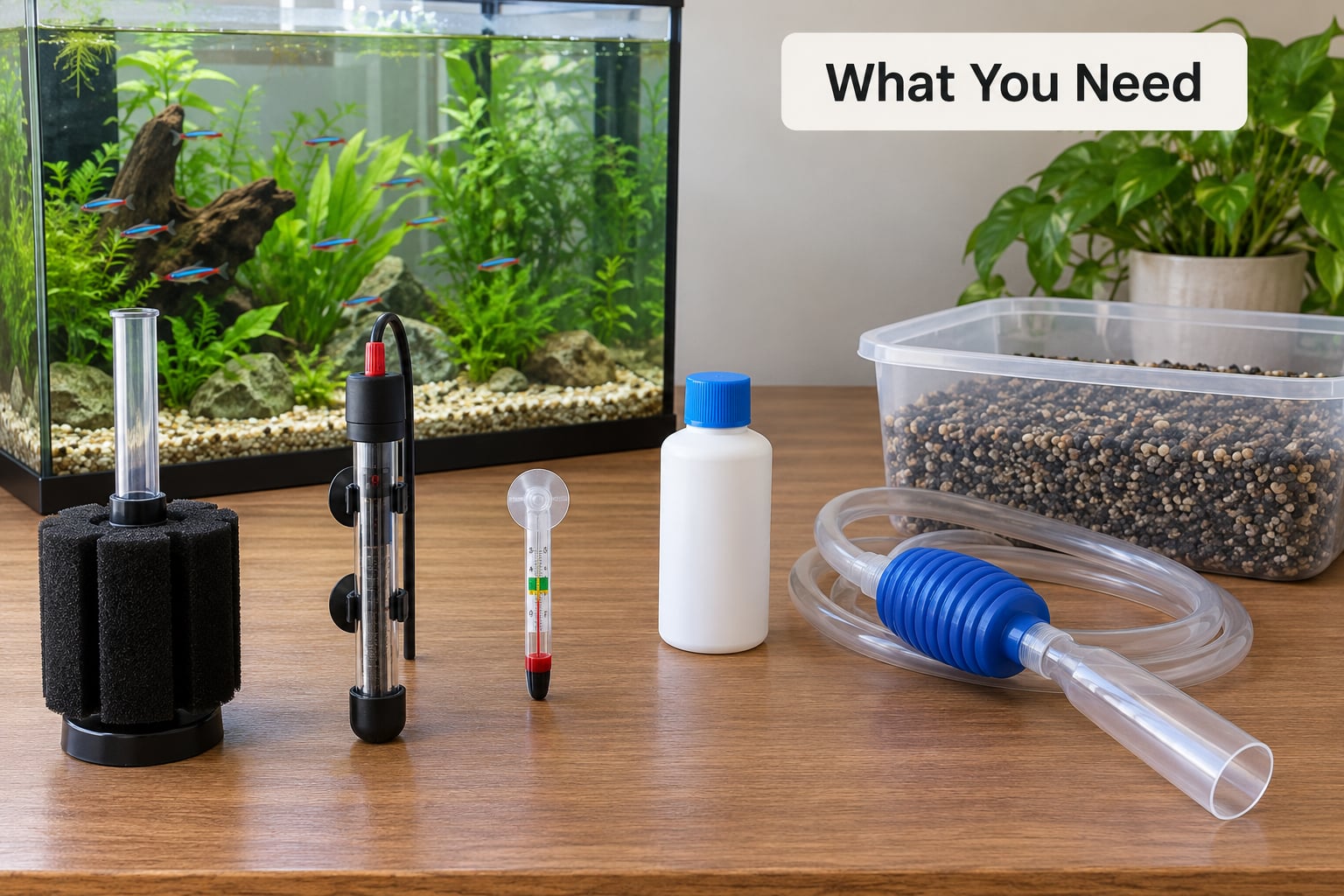
Buy the tank and stand first, then size everything else to it. A kit that bundles a tank, filter, and light is convenient, but you still need a heater, a thermometer, a water conditioner, and a test kit, because most kits leave those out.
- Tank and stand: a rimmed glass aquarium is the safest first choice. Acrylic is lighter and cheaper but scratches easily and yellows with age.
- Filter: sponge filters are cheap, gentle on fry and shrimp, and hard to break. Hang-on-back filters move more water per dollar. Canister filters handle bigger tanks but cost more and have more parts to keep clean.
- Adjustable heater with thermostat: submersible, fully filled, and rated for your tank size.
- Liquid test kit: strips are cheap, but liquid tests for ammonia, nitrite, and nitrate are far more accurate, which matters most during the first two months.
- Water conditioner: a dechlorinator that neutralizes chlorine and chloramine. Look for one that also binds ammonia.
- Thermometer: an inexpensive stick-on or floating dial is enough.
- Substrate: gravel or sand for community tanks, aquasoil for planted tanks. Skip anything with sharp edges or painted pebbles that can flake.
- Hood or glass lid: reduces evaporation and stops a jumpy betta from leaving.
- Gravel vacuum: also called a siphon, for pulling debris out of the substrate during water changes.
- Light and a timer: an LED fixture on a 6 to 8 hour daily cycle keeps algae in check.
- Hiding places: driftwood, a cave, or a few stacked rocks with open ends so a nervous fish can get out of sight.
Pick a tank at least 10 gallons for your first attempt. A bigger tank holds more water, which dilutes mistakes and swings in temperature or chemistry more slowly. If you want a betta, a 5 gallon tank is the true minimum, and 10 gives you room to add a few tank-mates later.
Heater wattage scales with tank size and how cold the room is.
| Tank size | Heater wattage, warm room | Heater wattage, cool room |
|---|---|---|
| 5 gallon | 25 W | 50 W |
| 10 gallon | 50 W | 75 W |
| 20 gallon | 75 W | 100 W |
| 29 to 40 gallon | 100 W | 150 W |
| 55 gallon | 150 W | 200 W or two smaller heaters |
Heating or cooling a 20 gallon tank moves roughly 170 pounds of water, and the glass, substrate, and rock add to that. Plan the stand for a floor that handles the load, and check that your joists run under the spot you picked before you buy anything heavy.
How to Set Up a Fish Tank for Beginners Step by Step
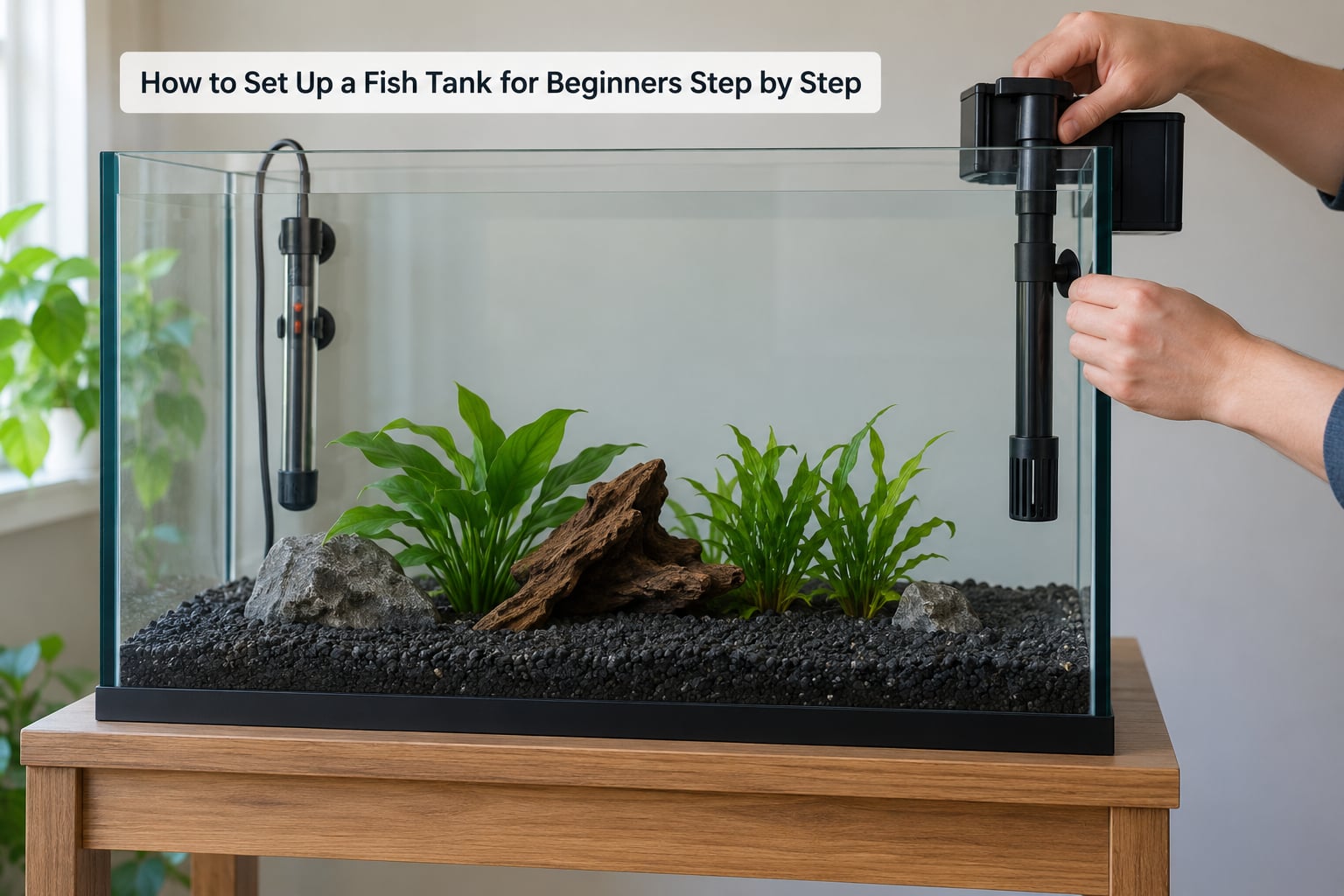
Work through the seven steps below in order. The order matters more than the speed: skipping ahead is what kills fish in new tanks.
1. Choose the Right Tank and Stand
Wide and short beats tall and narrow for most beginners. A wide tank gives fish more swimming space and more surface area for gas exchange, and a tall narrow tank makes a heavy load harder to carry. Standard widths like 20 gallon long or 29 gallon give you room for a community tank later without changing equipment.
Set the stand where the tank will live before you fill anything. Keep it away from direct sunlight, which grows algae, and away from heating vents or drafty doors, which force the heater to work constantly. Make sure an outlet is within reach of the filter and heater cords but not so close that you are running extension cords through standing water.
Level the stand with shims if it wobbles, then check the tank by looking along the bottom rim from a low angle. A rimmed glass tank should sit flat on the frame all the way around. Do not put a Styrofoam mat, foam mat, or soft pad under a rimmed tank, because an uneven pad can crack the bottom pane.
2. Install the Filter, Heater, and Thermometer
Place the heater along the back glass, horizontally if it is a submersible model, with the water line of the heater slightly above the eventual water line. Vertical placement in a corner also works but reduces circulation. Keep the heater away from the filter intake, because constant flow over the thermostat sensor makes it run cool.
Hang the filter at the back so the intake tube stays well below the surface once the tank is full. Route airline tubing down the back corner and use a check valve so a power outage does not siphon the tank down. Keep enough slack in the tubing to reach the wall outlet without pulling the filter off the glass.
Every plug that sits below the water line needs a drip loop: a loop in the cord that hangs lower than the outlet so water runs back to the tank rather than into the socket. Cut power before you route any cord and keep hands out of the water while the heater is plugged in.
Fill the tank halfway, turn the filter on, and let it run for 15 minutes. Water should flow through the media and return without spitting air, and the heater should begin to warm the water. Check the thermometer in an hour; if the temperature has not moved at all, the heater is not seated in the water properly.
3. Add Substrate, Decorations, and Hiding Places
Rinse gravel in a colander under running water until the water runs clear, usually two or three passes. Do not wash substrate or decorations with soap, even a little, because residue keeps fish stressed long after the tank is running. If you are planting, soak your root tabs in water for the depth the package specifies.
Pour substrate in gently with a plastic cup so it does not chip the glass, then slope it slightly higher at the back for a planted tank. Rinse rocks and driftwood the same way, and skip anything with sharp or flaking edges, thin plastic, or metal that could rust in the water.
Arrange decor so that open swimming space runs across the front and the middle, with caves and plants at the back and sides. Fish need to be able to get away from anything aggressive, and a tank where every gap is a dead end invites fights.
4. Fill the Tank and Condition the Water
Add dechlorinator before the tap water goes in, following the dose on the bottle for the volume you are adding. Adding it afterward dilutes it and leaves some chlorine behind. Chlorine is harmless to people drinking the water and lethal to fish at aquarium concentrations, and chloramine does not off-gas the way chlorine does, so it needs a conditioner that specifically breaks it down rather than something that merely ages the water.
Fill with a hose or a clean bucket rather than a shower or sink sprayer, which can bring in detergent, toothpaste, and hair products. Leave two or three inches of headspace for the filter to return water and for you to reach a fish with a net.
Run the heater until the tank reaches the temperature of the fish you plan to buy, which is usually 74 to 78 F for tropical species. Many thermometers read a degree or two high or low, so compare yours against a second one before you trust it.
Once the tank is full, refill changes the same way: dechlorinate first, and keep a jug of conditioned water ready. Never top off a tank with untreated tap water, even a cup.
5. Cycle the Tank Before Adding Fish
Here is the part people rush, and it is where most new aquariums fail. Fish waste and uneaten food produce ammonia, which is toxic. Nitrifying bacteria first convert ammonia into nitrite, which is also toxic, then convert nitrite into nitrate, which is far less harmful and is removed through water changes. A tank is cycled when the bacteria handling step two are strong enough to keep pace with the ammonia step one produces. That is the nitrogen cycle, and the colony living in your filter media and substrate is your biofilter.
Do not start with fish. A fish-in cycle looks faster because you get to skip two boring weeks, but the fish produce the ammonia and they are the first thing exposed to the toxic intermediate stages. New tank syndrome is simply the damage that happens when a tank gets stocked before the cycle finishes, and it is the single most common way beginner tanks fail.
There are three ways to do it:
- Fishless cycle: dose pure ammonia to about 1 to 2 ppm, run the filter and heater, feed nothing, and test every few days until ammonia and nitrite both read zero and nitrate appears. Four to six weeks is a realistic timeline, and it is by far the safest option.
- Bottled bacteria: a commercial nitrifying bacteria culture added to the filter can sometimes seed a cycle in a week or two. It works best when the filter media is already wet, seeded, and the tank is at temperature. It is not a shortcut that lets you skip testing, and many fishkeepers find it does nothing in a brand-new tank.
- Fish-in cycle: you add a couple of hardy fish to generate ammonia. Expect four to six weeks of 30 to 50 percent water changes every two or three days to keep the fish alive, and expect the fish to be stressed the whole time.
You will know the cycle is complete when ammonia reads zero, nitrite reads zero, and nitrate is present but under roughly 20 to 40 ppm. Nitrate on its own does not prove a cycle, because nitrate can arrive from your tap water or show up briefly during a cycle that then stalls. Test with the same kit, at the same time of day, and wait until two tests a week apart both come back clean.
Once cycled, keep feeding the tank. If ammonia creeps back above zero after the fish go in, the biofilter cannot handle the current load, and more water changes are the fix.
6. Introduce Your First Fish Gradually
Pick species for their adult size, temperament, temperature range, and swimming zone, not for how they look in the store bag. Ignore the one inch of fish per gallon rule, which forum regulars rightly mock; stocking depends on filtration and bioload, so a single 10 gallon tank can house a modest community while two goldfish in the same tank will struggle.
Schooling species like tetras, danios, and corydoras need to be bought in groups of six or more or they stay stressed and timid. Long-bodied fish such as fancy guppies, angelfish, and bettas need more swimming length and calmer water. Skip mixing a male betta with other long-finned fish, and skip any species you cannot find compatibility data for.
Match the store water to your tank before buying. Float the sealed bag for about 15 minutes to even out the temperature, then pour a little tank water into the bag before netting the fish out. A drip line for sensitive species is better still: run a thin tube from the tank into the bag and let it trickle for an hour or two so salinity, pH, and temperature equalize slowly.
Turn the tank light off during acclimation and for the first few hours afterward, add any hiding spots a shy fish needs, and do not feed for the first day. A fish that hides for two days and starts swimming again is normal. A fish gasping at the surface or flashing against the gravel is not, and that is a signal to test the water and move the fish to a separate container of conditioned tank water while you investigate. This is also where a veterinarian comes in: swim bladder trouble and fin rot both need proper diagnosis rather than home remedies.
A bare 10 gallon quarantine tank is worth setting up alongside your display tank. It is a plain container with a sponge filter, a heater, and a lid, and it lets you watch new fish for disease before they reach the main tank. Snapping a quarantine tank up later means starting a second cycle.
7. How to Set Up a Fish Tank Care Routine for the First Week
Pick two days a week and treat them as non-negotiable appointments. That is the entire routine.
- Feed: two small meals a day, only what gets eaten in two or three minutes. Overfeeding feeds the bacteria that make the tank cloudy and produces the ammonia that burns fish gills.
- Test: check ammonia, nitrite, and nitrate weekly for the first two months, then spot-check weekly after the tank settles.
- Change water: replace 25 to 30 percent weekly once the tank is established, using water you dechlorinated in advance and temperature-matched. During the first weeks after stocking, and any time ammonia shows up, change 30 to 50 percent every two or three days instead.
- Siphon: run the gravel vacuum through the substrate during each water change. Swirling water in the tank only suspends debris and puffs it back up.
- Clean the filter: when the flow slows noticeably, rinse the sponge or media in water you just siphoned from the tank. Never rinse filter media in tap water, and never replace all of it at once, because the bacteria live there.
- Check the heater and thermometer: confirm the temperature still matches the thermostat setting at the same time each day.
Hold the light schedule at 6 to 8 hours a day. Running the light around the clock is the usual cause of the green algae film people find in their second or third week.
Common Mistakes When You Set Up a Fish Tank
Almost every failed new tank comes down to one of these. Each has a simple correction.
Adding fish before the cycle is done
Clear water means nothing. A brand-new tank can look perfectly clean for two weeks and still have zero bacteria, so the first ammonia spike hits the fish hard. Start fishless, and if you already added fish early, move them into conditioned water in a separate container, change 50 percent of the tank daily, and hold off on feeding until ammonia and nitrite read zero.
Skipping the water conditioner
Tap water is treated for people, not fish. A conditioner that neutralizes both chlorine and chloramine costs very little and protects gills and the beneficial bacteria. Dose it for the volume you are adding, every time.
Buying a tank that is too small
Two-gallon and 2.5 gallon tanks sold for children cause most of the sad stories on fishkeeping forums. Volume buffers temperature and chemistry changes, and a small tank swings dangerous in a single hot afternoon. A betta still wants 5 gallons as a floor, and goldfish are long-term residents of 40 gallon-plus tanks, not bowls.
Overstocking
The one inch per gallon rule dates from a time with different filtration and is unreliable. Ask instead how much filtration you have rated for, how much food enters the tank, and whether the species are peaceful. When in doubt, add fish slowly, a few at a time, with a two to four week gap, and test after each addition. Signs of a crowded tank are persistently elevated nitrate, gasping fish, or fish that never seem to eat.
Overfeeding
Uneaten food rots into ammonia. Small frequent amounts beat one large meal, and skipping a day here and there is harmless for most adult fish.
Washing decor or filter media in soap
Soap residue keeps fish stressed and kills the bacteria that live in your filter. Rinse everything in plain water, and rinse filter media in tank water you have just siphoned out.
Worried about cloudy water
A bacterial bloom that turns the water milky, usually a couple of weeks after stocking, is not a failure. It is an imbalance between bacteria and algae. Cut back on feeding, reduce the light hours, avoid replacing filter media, and wait it out. The water usually clears on its own once the balance settles. If you see green water instead, algae is winning and the light schedule needs to change.
Running the light 24 hours a day
Algae needs light, including ambient room light. Keep the light on a timer for 6 to 8 hours and close the blinds in the room.
Frequently Asked Questions
How long do you need to set up a fish tank before adding fish?
Plan on four to six weeks if you cycle the tank without fish, which is the safe approach. Bottled nitrifying bacteria can shorten that to one or two weeks in a warm, well-filtered tank, though many keepers see no difference. The real answer is not a date but a test reading: add fish when ammonia reads zero and nitrite reads zero, with nitrate present but under 20 to 40 ppm. Two clean tests a week apart is safer than one.
Can I put fish in a tank the same day I set it up?
You can, but the fish will almost certainly not survive. A tank set up today has no nitrifying bacteria, so the ammonia from fish waste and uneaten food will climb within days and burn their gills. If you have already done it, move the fish into a separate container of dechlorinated tank water, change 50 percent of the tank daily, and hold off on feeding until both ammonia and nitrite read zero.
What is the first fish to put in a new aquarium?
Choose by adult size, temperature range, and temperament rather than appearance. Beginner-friendly options include a school of six or more tetras or zebra danios, a group of corydoras, or a single betta in 5 gallons or more. Add one species at a time so you know which fish is causing trouble if something goes wrong. Avoid mixing species with conflicting temperature needs, and never add two fish at once if you have no room to separate them.
Why is my new fish tank water cloudy?
Milky water a couple of weeks after stocking is almost always a bacterial bloom, not dirt or a broken tank. You have disturbed the filter and added nutrients, so bacteria are growing faster than algae can eat them. Reduce the light to 6 to 8 hours a day, cut back on feeding, do not replace filter media, and let it clear on its own over a couple of weeks. Green water means algae, which responds to the same light change.
Do I need a quarantine tank for new fish?
A simple 10 gallon container with a sponge filter, a heater, and a lid is enough, and it is worth setting up from day one. Quarantine lets you watch new fish for a week or two before they reach your main tank, which matters for everything from fungus to snails you did not order. The catch is that a quarantine tank needs its own cycle, so start seeding it at the same time as your display tank.
How do I tell if my fish tank is overstocked?
Ignore the one inch per gallon rule and watch the tank instead. Signs of too many fish include nitrate that stays high despite weekly water changes, fish gasping at the surface, slow growth, and frequent illness. Use the filter’s rated flow as a ceiling rather than a target, and remember that more fish means more waste. If you are unsure, wait two more weeks before adding anything, then add a single fish and test for a week.
Conclusion
Start with three things this week: pick a rimmed glass tank of at least 10 gallons on a stand that is level and rated for the weight, buy the heater, filter, conditioner, and a liquid test kit to match it, and set the whole thing up in one session. Then leave it running and dose ammonia for a fishless cycle.
Test every few days for the next month. When ammonia and nitrite both read zero with nitrate present, add one hardy species in a small group, keep the light on a timer, and settle into two water-change days a week. That steady routine is what keeps the tank healthy, and this guide is updated for 2026 as products and water chemistry guidance change.