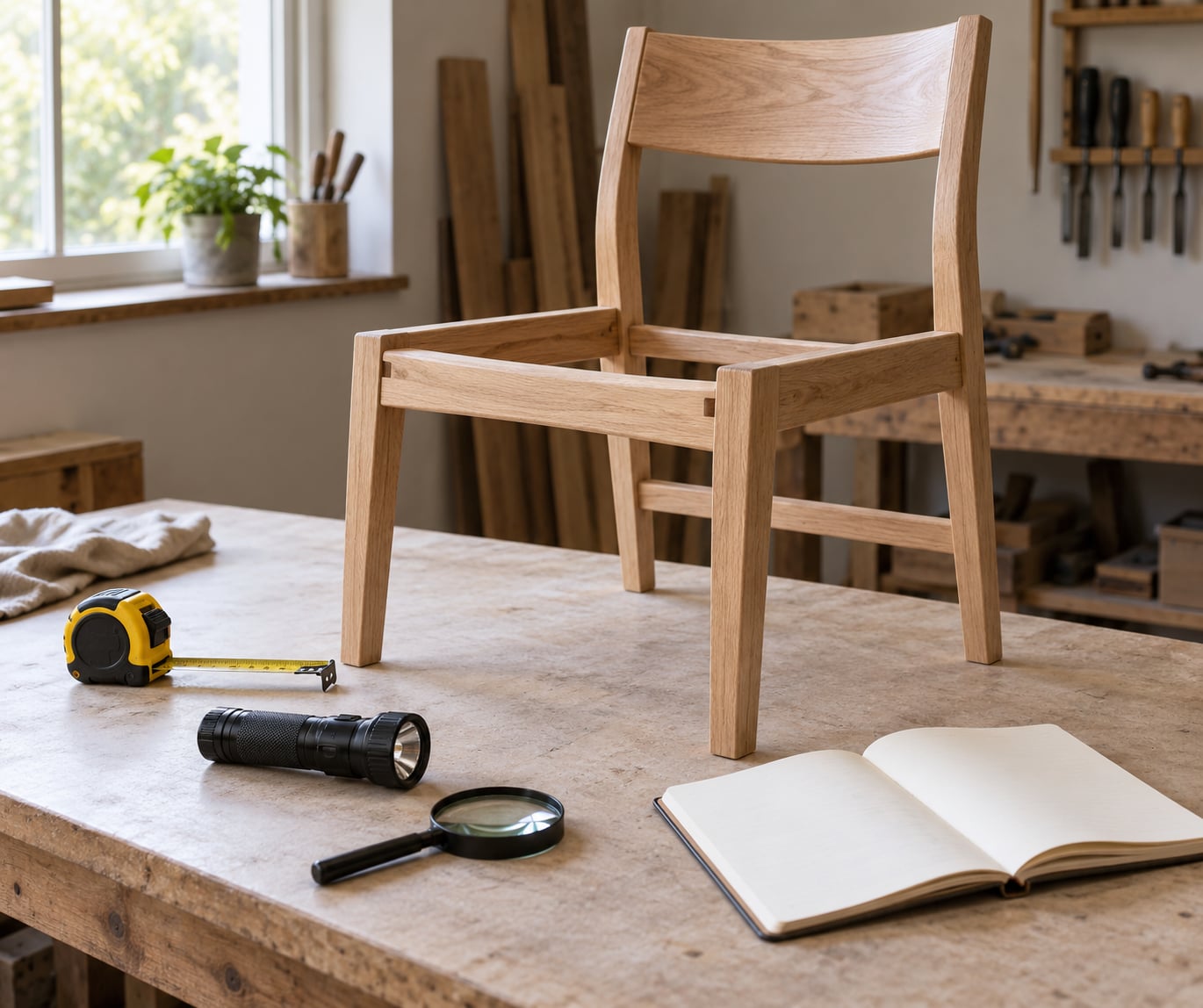
To tell if furniture is good quality, spend five minutes on the parts you cannot see in a showroom photo: the frame, the joints, the back panel, the cushion foam and the hardware. A piece that wobbles, creaks under load or has a back panel you can flex with one hand is telling you something a listing never will.
That matters because furniture is heavy, visible and meant to last a decade or more. Most bad purchases are not ugly or uncomfortable at first. They are simply built thin, then they start failing in year three. Here is the inspection routine I use, split into eight checks you can run in a store, at home on a used piece, or against a product page before checkout.
Table of Contents
- 1What You Need
- 2Step-by-Step: How to Tell if Furniture Is Good Quality
- 31. Check the Overall Stability
- 42. Inspect the Frame and Joinery
- 53. Look for Durable Materials: How to Tell if Furniture Is Good Quality by Its Core
- 64. Examine the Surface and Finish
- 75. Test the Hardware and Moving Parts
- 86. Check Comfort and Everyday Function
- 97. Review Construction Specifications
- 108. Use the Return Policy and Guarantee
- 11Common Mistakes
- 12Frequently Asked Questions
- 13How can I tell solid wood from veneer?
- 14Can you check furniture quality when buying online?
- 15How do I know a sofa frame is solid wood and built well?
- 16Should I buy second-hand furniture with the same checks?
- 17What does the furniture warranty actually cover?
- 18Conclusion
What You Need
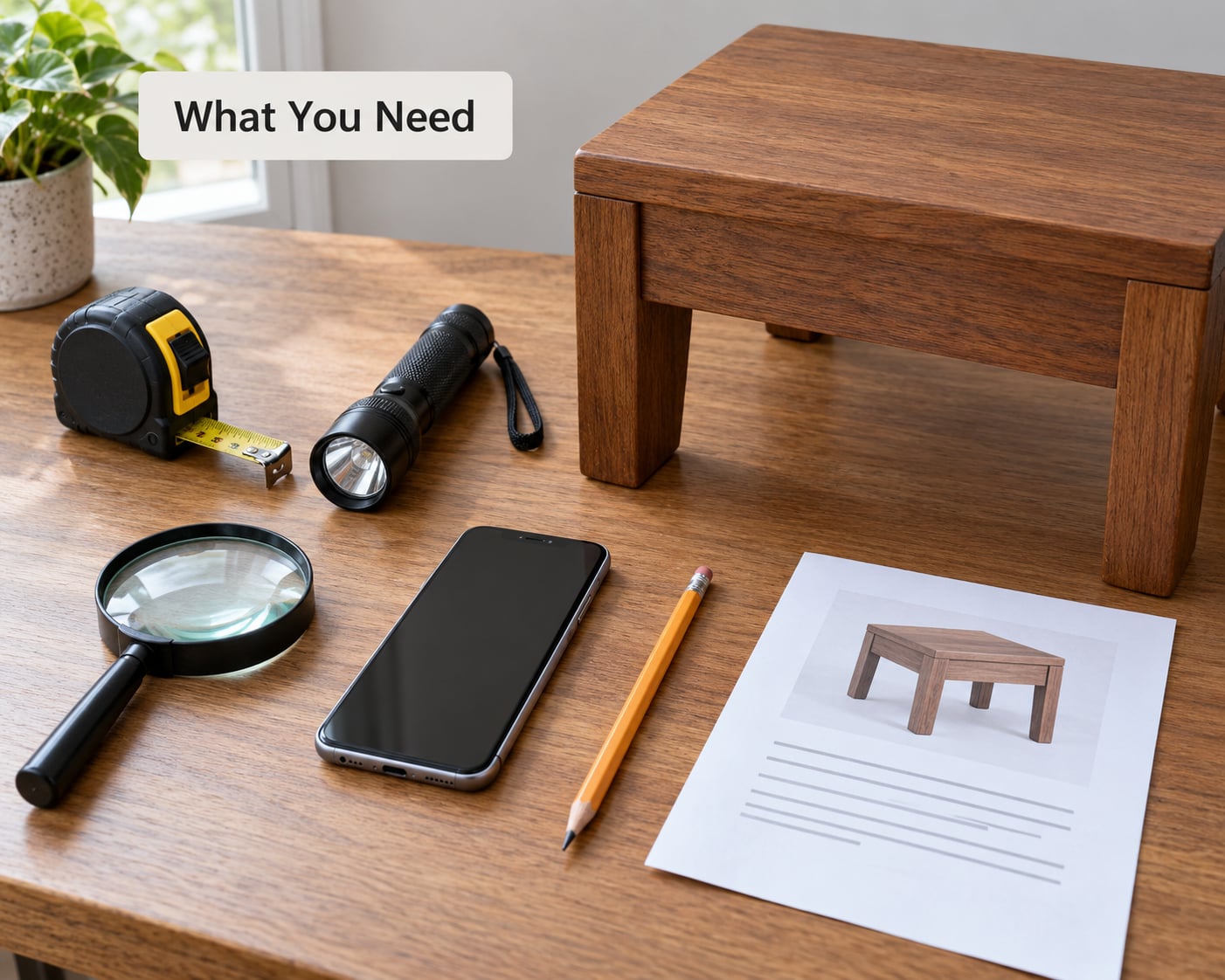
You need less than most people expect. A phone with a decent camera does most of the work, since you will want photographs of the underside, the back panel and the drawer corners before anyone unpacks it.
Add a tape measure to confirm the piece fits its space, and a flashlight or phone torch for looking into corners and under cushions. A magnifying glass helps on veneer edges and fabric weave, though your phone camera zooms in just as well on most of them.
Bring a pencil and your phone notes so you can record the wood species, foam density and warranty terms the salesperson gives you. Those three details answer more questions than anything else you will learn in the store.
If you are shopping used, add a small flashlight with a magnetic base and a phone voice recorder, because the previous owner’s claims about condition are worth having in writing.
Step-by-Step: How to Tell if Furniture Is Good Quality
1. Check the Overall Stability
Put the piece on a flat floor and press firmly on each corner in turn. A well-built piece stays planted on all four feet. A wobbling one rocks because a leg is out of square or the frame is racked.
Sit down hard, shift your weight from side to side, then stand and press the seat deck with both palms. Flexing that means weak webbing or a thin frame. Listen for creaks under load, because a quiet piece under normal use is fine and a squeaking one is a warning.
For tables, lift one corner gently. If the opposite leg rises evenly, the legs carry load through joinery rather than tape or brackets holding them on.
2. Inspect the Frame and Joinery
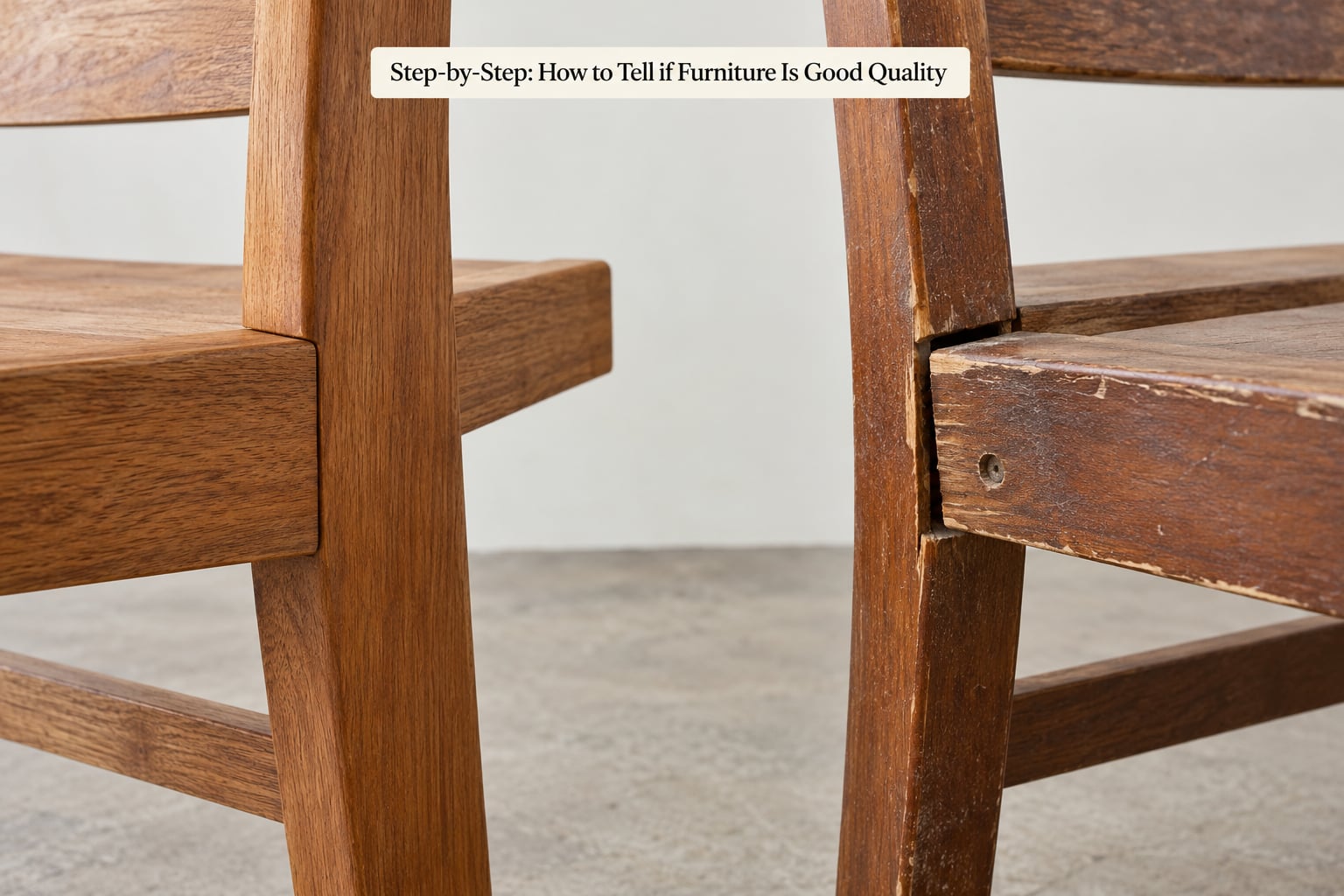
Turn the piece over. A solid hardwood or multi-layer plywood frame has a continuous rail structure with the joints visible at the corners. Gaps at a corner, a back panel resting in a rebate, or screws alone at the leg joint all point to a piece that will eventually rack apart.
Look at the drawer corners with the drawer fully pulled out. Interlocking dovetail fingers at all four corners are the strongest signal you will find in a showroom. Machine-cut dovetails with even, tight fingers are good; hand-cut ones are better still. A corner with visible staples, brad nails or a mitre held by glue is a warning sign.
The back panel deserves its own test. Press it hard with your thumb. A thin, hollow-sounding back that flexes will let a sofa or cabinet rack, and it is one of the most common reasons inexpensive furniture fails early.
| Construction method | What it looks like | Strength and repairability |
|---|---|---|
| Mortise and tenon | Rectangular tongue seated in a matching socket | Excellent; glue and pins can be renewed years later |
| Dovetail | Interlocking trapezoid fingers at drawer corners | Excellent; pulls apart only with force and heat |
| Dowel joint | Round wooden pegs into drilled holes | Very good when glued; visible pegs tell you it is there |
| Finger or box joint | Interlocking comb-shaped fingers | Good; common in drawer boxes and cabinetry |
| Tongue and groove | Continuous plank-to-plank boards | Good for panels and table tops; needs seasonal movement room |
| Corner blocks | Glued triangular blocks in seat corners | Good reinforcement, usually combined with another joint |
| Staples or screws only | Metal fasteners driven through thin panels | Weak; works loose under repeated load and sway |
Members of r/furniture describe the most-used in-store tell the same way: turn the piece over and look at the back and edges. That is where particle board, thin cardboard backings and edge banding give the piece away in seconds.
3. Look for Durable Materials: How to Tell if Furniture Is Good Quality by Its Core
Wood type is where most buyers guess wrong. Look at an unfinished edge, the underside, or anywhere the finish is worn. Solid wood shows end grain and pores; a thin veneer over a core shows a smooth, uniform layer with a slightly different colour, and often a plastic or paper edge band.
| Material | How to identify it | What it tells you |
|---|---|---|
| Solid wood | End grain visible on the cut edge, varied pore pattern across the surface | Strongest and most repairable; can be sanded and refinished |
| Wood veneer | Thin, continuous grain over a core; uniform thickness at the edge | Fine when thick and edge-banded, but the core decides durability |
| Multi-layer plywood | Layered grain visible on cut edges, alternating plies | Excellent structural sheet for frames and backs |
| MDF | Very smooth, uniform, fibre-textured edge, no grain | Stable and smooth for painted or veneered faces; swells at raw edges |
| Particle board | Coarse chips visible in the core, often brown | Budget choice; unrepairable once the edge lifts or it swells |
Veneer is not automatically a bad sign. Woodworkers on r/wood point out that anything with a large surface area in solid wood will move and crack more than a stable veneer, which is why good tables use veneered or solid tops carefully seasoned for the local climate.
For soft seating, the numbers matter more than the fabric. Seat foam density above roughly 35 lb per cubic foot holds its shape; below about 30 it flattens within a few years. Press a cushion hard for ten seconds, release, and watch how long it takes to come back. Quick recovery means high-resilience foam. Slow recovery that leaves a dent is the low-density foam that causes most sagging seats.
Underneath, look for eight-way hand-tied springs or a properly tensioned webbing grid. If you can see the webbing sagging into a curve between the rails, the support is already failing.
For fabric, a Martindale rub count above 20,000 suits a sofa that sees daily family use, and above 30,000 suits a room with kids or pets. Anything advertised as upholstery without a count is a sign the maker does not know.
| Species | Relative hardness | Character | Best suited to |
|---|---|---|---|
| Oak | Hard | Open grain, shows wear well | Dining tables, desks, benches |
| Ash | Hard | Flexible, shock-resistant | Seats, bent frames, tool handles |
| Maple | Hard | Fine, even grain | Cabinetry, butcher blocks |
| Walnut | Medium to hard | Rich colour, softer figure | Tables, case goods |
| Teak | Hard | Oily, weather resistant | Outdoor and bathroom pieces |
| Cherry | Medium | Darkens attractively with age | Case goods, bedroom furniture |
| Birch and beech | Medium | Pale, uniform | Frames, painted pieces |
| Pine | Soft | Softwood, knots, warm tone | Utility rooms, shelves, rustic styles |
4. Examine the Surface and Finish
Run your hand along the top in good light. Orange-peel texture, brush marks in lacquer, drips in stain and a colour that shifts between the top, the legs and the drawer fronts all mean the finish was rushed.
Check the colour match between components, since a mismatched stain between two legs of the same chair is visible from across a room. Look at corners and edges for thin spots where the finish has worn through, and for bubbling or peeling that means it was applied over damp wood.
A Houzz thread about a Thomasville dining table put it plainly: the finish could be scratched by touching the top, which is the practical complaint to watch for. A hard-wax oil or a well-cured lacquer feels dry and cool, not tacky or waxy.
5. Test the Hardware and Moving Parts
Open and close every drawer and door several times. Good drawers glide on ball-bearing or soft-close runners and stay where you push them. Cheap runners bow under load, let the drawer drop, and grind against the side.
Press the cabinet back and side panels to check for racking, then tug the handles firmly. A handle that moves means the screws are working loose in the panel, which is one of the most common failures in otherwise decent pieces.
Solid brass hardware and stainless steel outlast plated steel that pits and flakes at the edges. On casters, spin them and check the mounting plate is screwed to solid material rather than to the edge of a panel.
6. Check Comfort and Everyday Function
Sit properly, not perched. Check that the seat supports you at the back of the thigh, that the back supports the lower back, and that the armrests are at a height you can use without shrugging.
Lean back hard and hold. A quality piece resists and settles back rather than tilting onto a rear leg. Also test the clearance: can you walk around a sofa, fit a dining chair at the table, and open the drawers when the piece is where it will actually sit?
Run your hand along every edge and seam. Sharp corners, exposed staples and fabric edges that pull away from the foam are signs the piece was not designed to be sat on for a decade.
7. Review Construction Specifications
Online, you cannot touch anything, so read what the listing commits to. Wood species and whether it is solid, veneer or engineered. Foam density and support type. Back panel material. Hardware grade. Dimensions and weight limits. Care instructions and warranty length.
Then match the claims against the photographs. Ask the seller for one extra photo of the underside and the back panel, because a seller who will not send them is telling you something. Reviews that mention sagging, wobbly legs or peeling veneer in year two are worth more than the overall star rating.
If the specification is missing entirely, treat that as a signal. A maker who knows the foam density and the timber moisture content will usually say so.
8. Use the Return Policy and Guarantee
Quality is partly what happens after purchase. Check the return window, who pays return freight, and whether assembly-required pieces count as damaged. Check the warranty length and whether it covers the frame and joints separately from the finish and fabric, since most do not.
Inspect furniture the moment it is delivered, before the driver leaves. Photograph every corner, the glass if there is any, and the packaging. Note any scuff, crack or missing fastener on the delivery paperwork, because damage that is not written down at the door is very hard to claim afterwards.
Ask two questions before you pay: will replacement hardware parts be sold separately in a few years, and does the piece come apart for repair or reupholstery. Both answers tell you whether the maker expects the furniture to last.
Common Mistakes
Judging by appearance alone. The finish is the easiest part to make look good and often the fastest to fail. Flip the piece over before you fall in love with the top.
Assuming veneer means cheap. A thick veneer over a good core on a well-seasoned panel is stable and can outlast solid wood in a dry climate. Read the substrate instead of judging the skin.
Ignoring the wobble test. A chair that rocks at the front leg will rattle and loosen its joints within a couple of years. Check every corner before you check the price tag.
Equating a higher cost with better build. Markup pays for brand, delivery networks and advertising. The frame, the foam and the joinery are where the money either went or did not.
Skipping the return and warranty terms. A generous return window is part of quality because it covers the defects you cannot see in a store. Read it before the sofa is in your living room, not after.
Skipping the underside. Back panels, corner blocks and drawer interiors tell you more about a piece than any styled photograph. Give yourself two minutes with the piece upside down.
Frequently Asked Questions
How can I tell solid wood from veneer?
Look at an unfinished edge, the underside or anywhere the finish is worn. Solid wood shows end grain and a varied pore pattern, while veneer shows a thin uniform layer over a core with a slightly different colour. The edge is the giveaway: solid wood is the same all the way through, veneer is thin and usually banded, and particle board shows coarse brown chips. Ask for a photo of the underside before you buy online.
Can you check furniture quality when buying online?
Yes, but you work from documentation rather than from your hands. Read the listing for wood species and whether it is solid or engineered, foam density, back panel material, hardware grade, warranty and return terms. Then request one photo of the underside and the drawer interior. Reviews that describe sagging, wobbling or peeling after a year are far more useful than the average star rating.
How do I know a sofa frame is solid wood and built well?
Sit hard and shift your weight, then press the seat deck with both palms. Any flexing or creaking means weak webbing or a thin frame. Turn the sofa over and look for a continuous hardwood or plywood rail structure, corner blocks and a back panel that does not give under your thumb. Ask for the foam density: seat foam above roughly 35 lb per cubic foot is what keeps cushions from flattening.
Should I buy second-hand furniture with the same checks?
Use the same checks and add three more. Look for structural repair attempts, mismatched stain between parts, stripped screw holes and water staining, which can mean a swollen particle board core. Pull every drawer fully out and check the runners are not bent. Solid wood and good joinery are worth more second-hand, since a joint can often be re-glued and a particle board panel cannot.
What does the furniture warranty actually cover?
Most frame warranties cover the structure and joints for years, while finishes, fabric and hardware are often limited to one or two years. Check whether coverage is on the frame only or the whole piece, whether it transfers if you sell the home, and whether labour and parts are included. Replacement hardware sold separately after the warranty ends is a good sign the maker plans for repair.
Conclusion
Start with stability: press each corner and sit down hard, because a wobble or a flexing seat deck tells you more in thirty seconds than any product description. Then turn the piece over and inspect the frame, the joinery at the drawer corners and the back panel, followed by the finish and the moving hardware.
Before you pay, confirm the specifications match what you can actually observe and check the return window and warranty terms. If you do those four things in 2026, you will know how to tell if furniture is good quality on any piece, new or used.