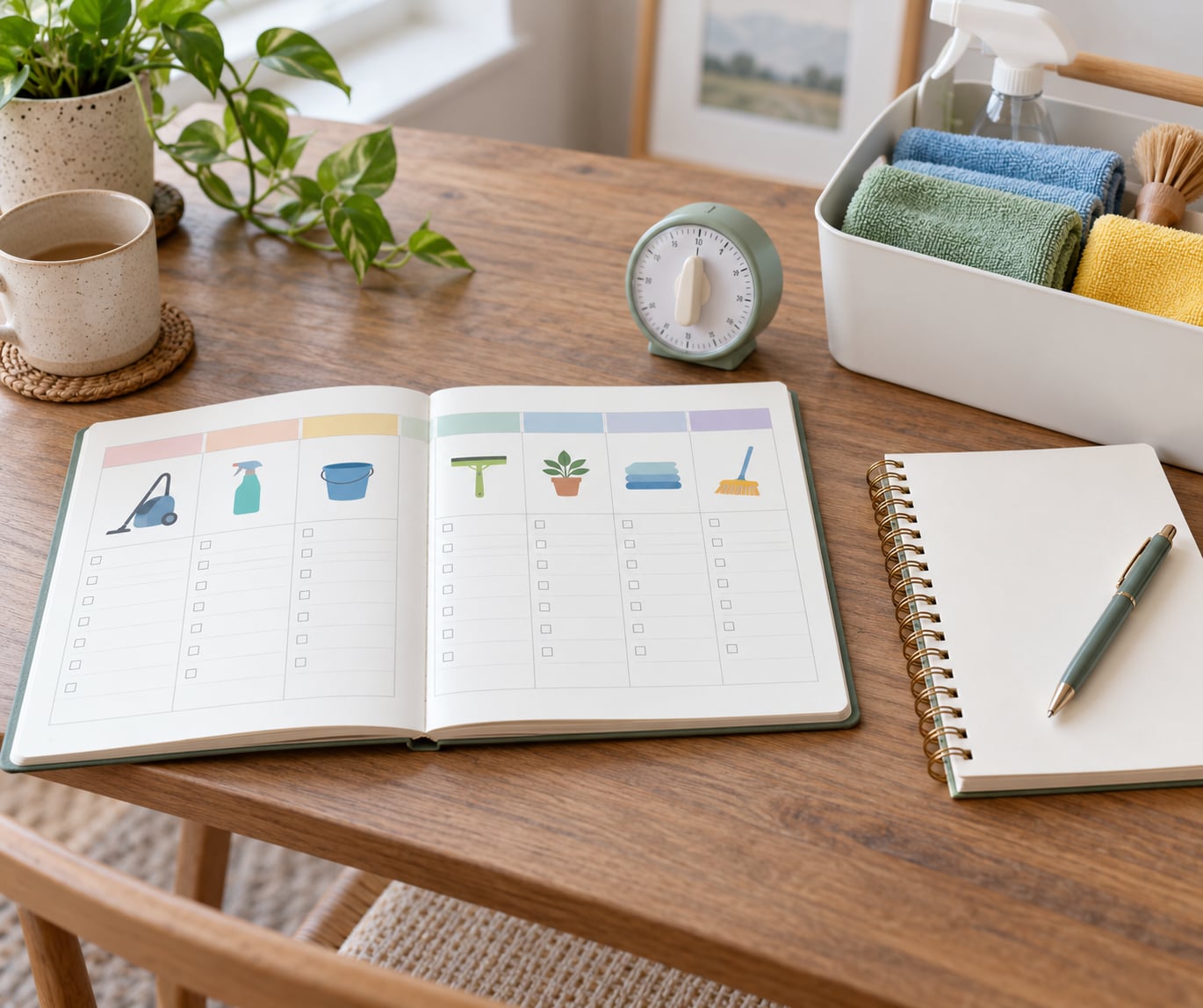
A cleaning schedule you stick to has four parts: short task lists sorted by how often they need doing, fixed days assigned to each list, a start small enough that finishing feels easy, and a rule for what happens when you miss a day. Most schedules fail at the second part, because they assume a week you don’t actually have.
The whole system takes about 45 minutes to build and a couple of weeks to make automatic. You do not need a nicer house or more free hours. You need a schedule that survives an ordinary Tuesday.
Table of Contents
- 1What You Need
- 2Step-by-Step
- 31. List the spaces and chores that matter most
- 42. Estimate how long each task realistically takes
- 53. Match tasks to your available energy and time
- 64. Build a weekly cleaning schedule
- 75. Start small and track completed sessions
- 86. Review and adjust the schedule every week
- 9Common Mistakes
- 10Frequently Asked Questions
- 11What is the 5-5-5 rule for cleaning?
- 12What is the 80/20 rule for cleaning?
- 13What should I clean daily versus weekly?
- 14How do I get back on track after falling behind on cleaning?
- 15Is a written cleaning schedule better than just doing it when it looks dirty?
- 16Should everyone in the household have their own cleaning schedule?
What You Need
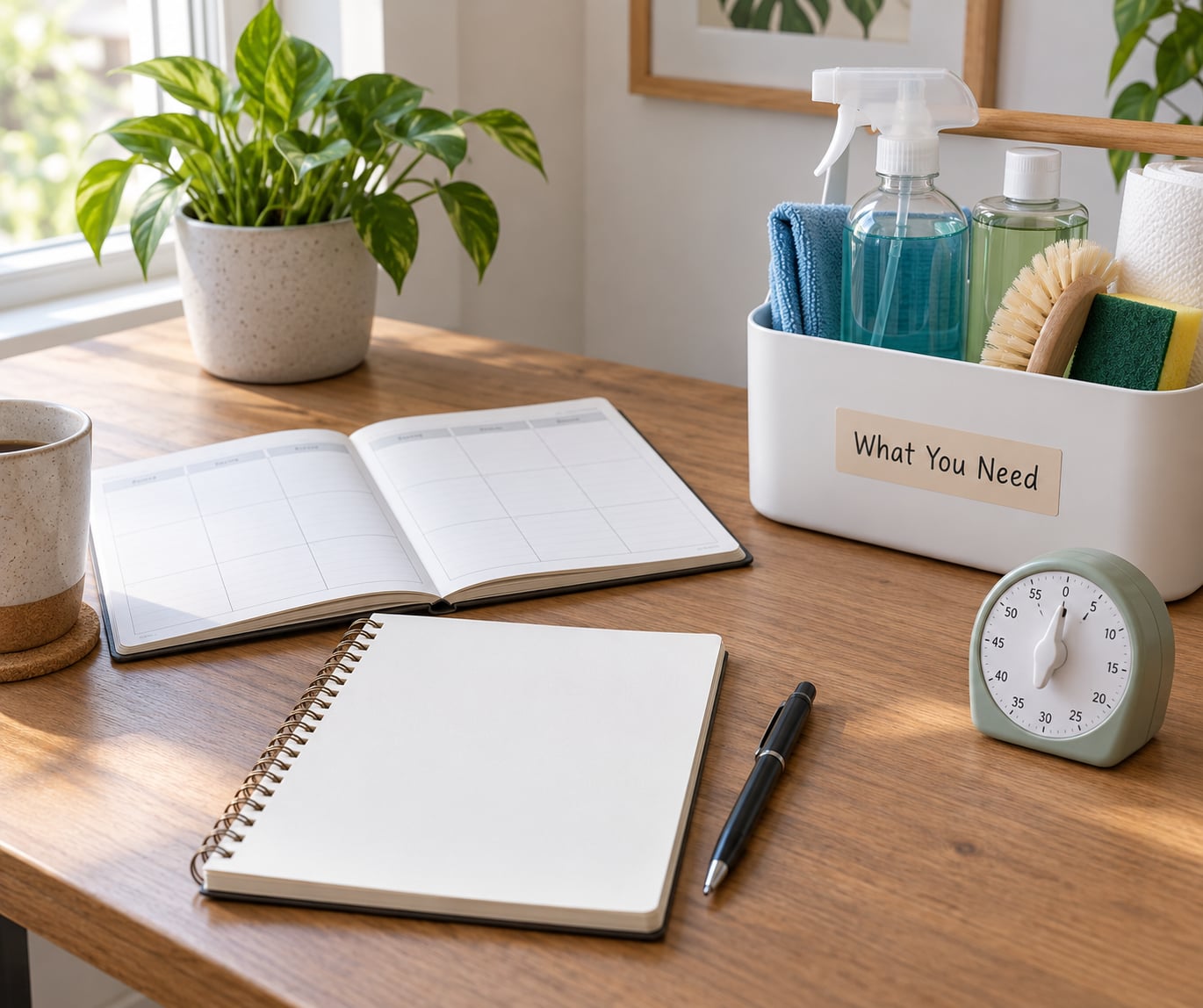
You need a place to write, a place to keep the schedule, and an honest picture of your week. That’s the whole list.
- A calendar, paper or digital, that you actually look at. A wall calendar beats a notes app if your phone lives face down.
- A task list that can hold around 30 tasks before it starts feeling like a to-do document from work.
- A timer so a session has a hard stop. Your phone works; a kitchen timer just looks more official.
- Supplies within reach, ideally in one caddy or bin per floor. A routine dies when the first job is hunting for the spray bottle.
- Your real weekly time budget, including the interruptions you get. A toddler, a dog and a long commute all eat into the same clock.
- Your priorities. Write down the two or three spaces that bother you most right now. Those go on the list first.
Skip anything fancier than that. A colour-coded planner app for a household of one is a hobby, not a system.
Step-by-Step
1. List the spaces and chores that matter most
Walk through your home once with a notebook and write down every cleaning task you can think of, without judging it. You are collecting raw material, not building the schedule yet. Most people find 25 to 40 jobs on that walk, which is roughly three times what a sustainable weekly routine can hold.
Now sort them into two piles. Essential jobs affect health, comfort or how the space functions: dishes, laundry, trash and recycling, kitchen counters, toilets, floors in high-traffic areas, sheets. Nice-to-have jobs are appearance-only: polishing the coffee table, reorganising a drawer, washing the windows.
Your essential pile is your working list. The nice-to-have pile becomes the monthly tier or gets dropped entirely. Anything that survives four weeks of being ignored was never really your chore.
2. Estimate how long each task realistically takes
Time three ordinary tasks with your phone timer and use those numbers instead of the ones you assume. I’m consistently wrong about drying times and always wrong about how long the bathroom takes when I haven’t done it in a while.
Then add a fudge margin. If wiping counters took four minutes, plan for five. If the bathroom took twenty-five, plan for thirty. Interruptions are not a rare exception in a real household, they’re the normal condition, and a schedule that assumes uninterrupted focus fails by Wednesday.
Now you have an honest number for every task, which is the only number that matters.
3. Match tasks to your available energy and time
Where you put a task matters as much as whether it’s on the list. Vacuuming takes energy and gives you nothing back; putting the house to bed at night is quick and makes the morning easier. The first belongs in a Saturday morning slot, the second in the ten minutes after brushing your teeth.
Most weeks have three realistic windows:
- Low energy, low time — 5 to 10 minutes. Dishes, counters, decluttering a surface, taking out trash.
- Mid energy, mid time — 20 to 30 minutes. Laundry, a bathroom wipe-down, mopping one room.
- Higher energy, longer block — 45 to 60 minutes, once or twice a week. Vacuuming, deep cleaning, decluttering a closet.
Working parents often have exactly one usable window, and it’s after dinner when everyone is too tired to be reasonable. Build the schedule around that window instead of pretending there’s an evening you’ll get back.
4. Build a weekly cleaning schedule
Give each day one zone rather than a pile of scattered chores. The room-per-day rotation is the most repeated pattern among people who actually keep this going, because it removes the daily decision entirely. You don’t choose what to clean on Tuesday; you know it’s Tuesday.
Here is a realistic template you can copy straight into a notes app and fill in:
| Day | Zone | Tasks | Time |
|---|---|---|---|
| Monday | Kitchen | Wipe counters, empty the drying rack, wipe the microwave door | 15 min |
| Tuesday | Bathrooms | Sinks, toilets, mirror, quick floor mop | 30 min |
| Wednesday | Bedrooms | Change sheets, tidy surfaces, empty the hamper | 20 min |
| Thursday | Living areas | Dust surfaces, vacuum the main floor, declutter the coffee table | 45 min |
| Friday | Whole house | Trash and recycling out, laundry started | 20 min |
| Saturday | Buffer and deeper jobs | Whatever didn’t happen, plus a monthly task | 60 min |
| Sunday | Rest or a 15-minute family reset | Beds made, floors picked up, nothing deeper | 15 min |
Keep three things in place. Anchor each block to something fixed, like after breakfast or after the kids are down. Leave the buffer day genuinely free. And protect one day with no real cleaning on it, because a seven-day schedule has no slack in it at all.
5. Start small and track completed sessions
Run the first two weeks as a trial at roughly half the scheduled time. If Tuesday says 30 minutes of bathroom work, do 15. Finishing early is what builds the association between starting and feeling good; running out of steam mid-task is what teaches you to avoid starting.
Track it the cheapest way that works for you: a tick mark in a notebook, a recurring phone reminder, or a habit tracker app. The point isn’t the record, it’s the visual evidence that the streak is longer than the gap.
Writing the plan as an implementation intention helps more than most people expect. Instead of “I’ll clean the bathroom,” write “after I pour my morning coffee, I’ll wipe the bathroom sink and mirror.” Tying a new habit to an existing one removes the decision about when.
Give it two weeks before judging it. Most routines that people think never formed were simply judged too early.
6. Review and adjust the schedule every week
Spend ten minutes each Sunday looking at three things: which tasks you completed without rescheduling, which ones got moved every week, and whether anything new arrived.
Tasks that moved every single week tell you the estimate was wrong, not that you failed. Halve the time or split the task. Tasks you never once touched should come off the list, because a permanent skip is just guilt in writing.
Review every two or three weeks rather than daily. A daily audit turns a routine into a judgement about your character, and that’s the fastest way to quit.
Common Mistakes
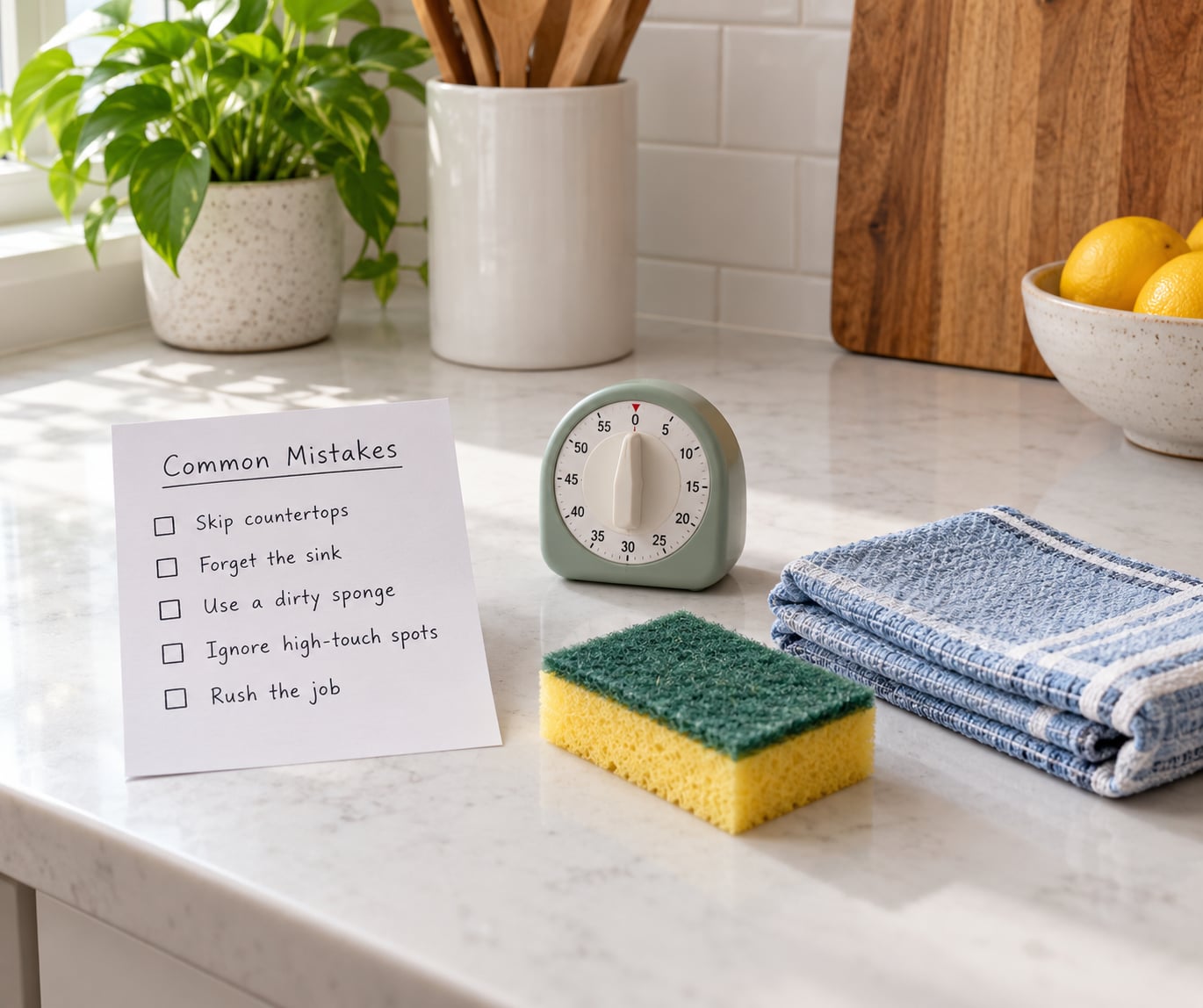
Overloading one day. Saturday-catch-everything schedules look efficient on paper and collapse by 11am. Spread the load across five or six days and let one day be the buffer.
Vague tasks. “Clean the kitchen” is a starting-over project. “Wipe counters and empty the drying rack” has an end you can see, which is most of what makes it finishable.
Supplies in another room. Every trip to fetch something costs you two minutes of momentum. Keep a caddy per floor and refill it weekly as part of Friday’s short block.
Adding tasks without removing any. Lists only grow unless you prune. Add a rule: every new task replaces something else or gets assigned to someone else.
Treating one missed session as failure. Missing a day is a lapse, not a relapse. The rule that keeps routines alive is simple: never miss twice. If you skip Tuesday, do a short version on Wednesday and the streak is intact. Two skips in a row is what turns a bad week into an abandoned schedule.
Using the checklist as a scoreboard. A wall of unticked boxes creates guilt, and guilt is the opposite of motivation. If a full schedule makes you tense, cut it to three daily tasks and let the rest be occasional.
One honest permission slip: doing it when it looks dirty, with no schedule at all, is a legitimate approach. Plenty of people keep a tidy home that way. The test is whether the flexible version feels like freedom or like drifting.
Frequently Asked Questions
What is the 5-5-5 rule for cleaning?
The 5-5-5 rule is a starting-size cleaning schedule: five minutes of cleaning a day, five tasks a week, and five bigger jobs a month. It works as a first version of any cleaning routine because the numbers are small enough to complete on your worst day. Once the habit holds for two or three weeks, raise one number at a time rather than all three.
What is the 80/20 rule for cleaning?
The 80/20 rule for cleaning says roughly 20 percent of your cleaning tasks produce most of the visible cleanliness. Those are floors, kitchen and bathroom surfaces, dishes, trash and laundry. A bloated cleaning schedule is usually one that spends too much time on the remaining 80 percent, like window sills and decorative objects. Cutting the bottom of that list is the fastest way to make a schedule fit real life.
What should I clean daily versus weekly?
Clean daily the things that create messes or affect food and hygiene: dishes, kitchen counters, making beds, taking out trash, wiping bathroom sinks after use and picking up toys. Clean weekly the deeper jobs: vacuuming, mopping, scrubbing toilets, changing sheets and taking out recycling. If a task feels daily but you keep skipping it, it probably belongs to the weekly tier at a smaller size.
How do I get back on track after falling behind on cleaning?
Do a fifteen-minute emergency reset instead of trying to catch up. Pick the two rooms you spend the most time in, clear surfaces, wipe the obvious fixtures, and stop when the timer goes. Then restart the schedule at half its usual length for one week. Never miss twice is the useful rule here: one missed session is noise, two in a row is what ends a routine.
Is a written cleaning schedule better than just doing it when it looks dirty?
A written schedule wins when the problem is deciding what to do or forgetting tasks in a shared home. The flexible approach wins when a list makes you anxious or your weeks genuinely have no predictable free time. Many people run both: a fixed weekly skeleton for the essential jobs, and judgment calls for everything else. If the schedule is never checked off, it is probably too long.
Should everyone in the household have their own cleaning schedule?
In a shared home, yes, because ownership is what stops the same job being assumed by everyone and done by no one. Give each person named tasks rather than shared zones, usually three to five daily tasks and two to four weekly ones depending on how much time they have. A written split also makes it fair when someone is sick or busy for a week.
Start with the version you can finish on your worst day, not the version you can finish on a good one. Write down three daily tasks tonight, put them on Monday through Wednesday, and run the first week at half time. Adjusting the schedule once you’ve lived with it for two weeks is the whole trick behind how to make a cleaning schedule you stick to — the list is a starting point, not a promise.