If you want to know how to make a small bedroom feel bigger, start with five things: more light, longer sightlines, more visible floor, furniture sized to the room, and less clutter. Walls do not move, but the way your eye reads them changes completely when the bed stops blocking the window and the pile on the dresser disappears.
Most of it costs nothing and takes a weekend. A tape measure, an afternoon of decluttering, and one rearranged piece of furniture usually deliver more perceived space than a fresh coat of paint, and this guide works whether you rent or own.
Updated for October 2026.
Table of Contents
- 1What You Need
- 2Step-by-Step: How to Make a Small Bedroom Feel Bigger
- 3Measure the Room and Find the Problem Areas
- 4Declutter and Reduce Visual Clutter
- 5Arrange the bed and furniture to make a small bedroom feel bigger
- 6Use storage that fits under or behind furniture
- 7Make the walls and ceiling look brighter
- 8Add light and a large mirror carefully
- 9Use vertical space and a focal point
- 10Common Mistakes That Make a Small Bedroom Feel Smaller
- 11Frequently Asked Questions
- 12What colors make a small bedroom feel bigger?
- 13How should I arrange furniture in a small bedroom?
- 14Do mirrors really make a bedroom look bigger?
- 15What can I use instead of bulky bedroom furniture?
- 16How can I make a small bedroom look bigger without painting?
- 17What is the best bed placement in a narrow room?
- 18Conclusion
What You Need
None of this is required. Most readers can do steps one through three with a pencil and a free afternoon, and see a difference before buying a single thing.
- A measuring tape. The cheap 25-foot kind is fine. You want it for the room and for the furniture footprint.
- Painter’s tape or painter’s markers. For taping out where a bed or dresser could go before you drag it.
- Trash bags, a donation box, and a laundry basket. Three containers beat one. Sorting takes twice as long when everything lands in a single pile.
- Removable hooks and command strips. These carry a surprising amount of weight and cost almost nothing. Weight limits are printed on the packaging, and they are lower than most people assume.
- Storage bins that fit under your bed. Measure the gap first, then buy to the measurement rather than the other way around.
- A tall narrow mirror. Only if the wall opposite a window is free and reasonably flat.
- Layered lighting. One floor or table lamp is not enough in a room with less than two light sources.
- Basic cleaning supplies. Dust on a light switch plate is a visible distraction in a small room, where everything is close enough to notice.
Before you buy organizers or sample paint, test the change. Tape a footprint on the floor, or live with one cleared surface for a week and see whether you actually missed the clutter.
Step-by-Step: How to Make a Small Bedroom Feel Bigger
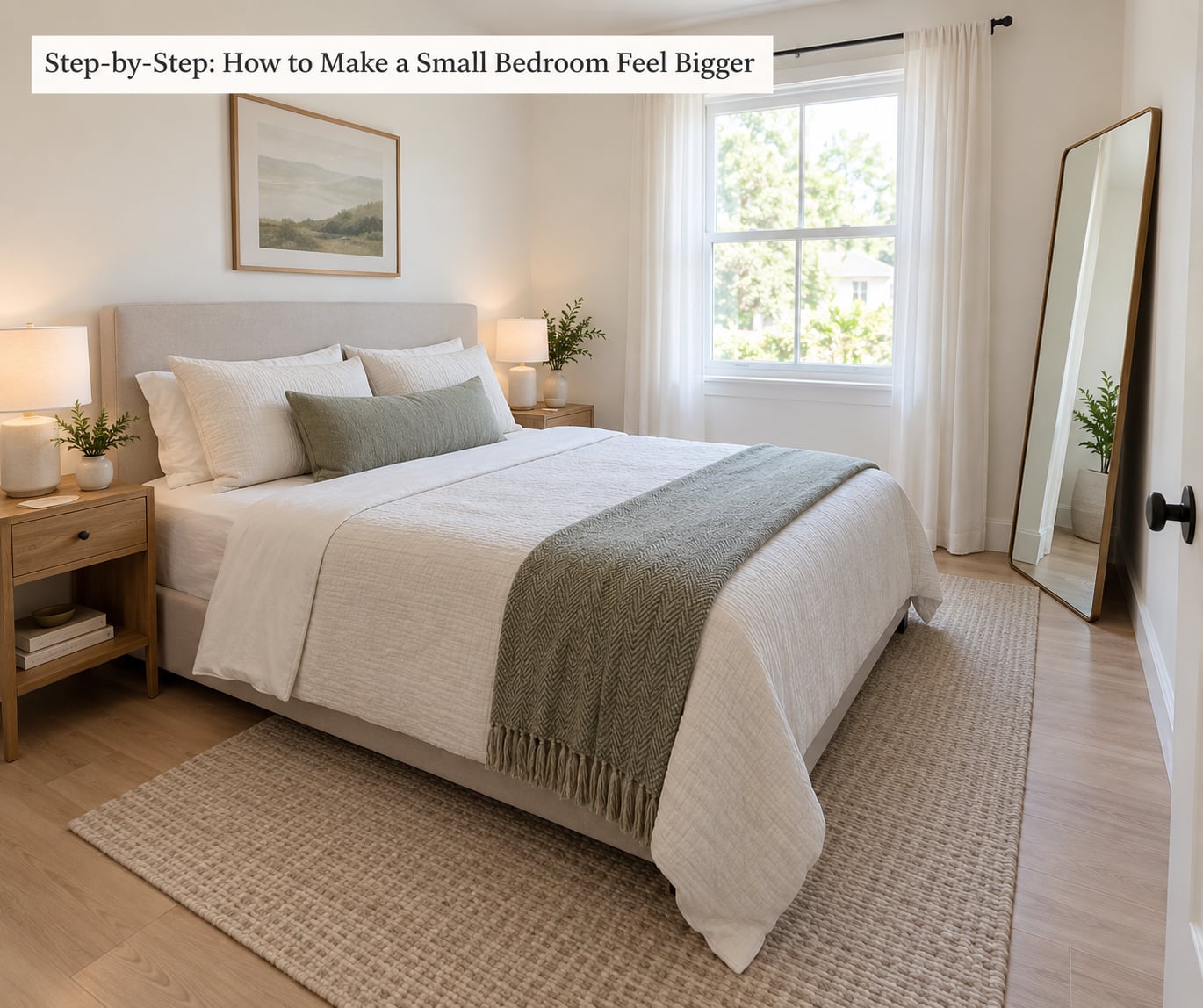
Work through these in order. Each one is cheap or free, and each one makes the next easier to judge because you will be looking at a room with one fewer problem.
Measure the Room and Find the Problem Areas
Measure every wall, the ceiling height, the door swing, the window position and the footprint of each large piece of furniture. Then draw a rough floor plan on paper, even a bad one. The plan matters less than the exercise of thinking about the room as a shape instead of a mood.
Use painter’s tape to outline the footprint of anything you are considering moving, including the space needed to open a drawer and to walk past it. A bed that fits technically but leaves you sideways in the dark is not a fit.
Four questions tell you whether your problem is physical or visual crowding:
- Does the door open all the way without hitting anything?
- Can you reach and open the window without moving furniture?
- Is there a clear route from the door past the bed to the window?
- Does every large piece of furniture earn its footprint?
If the answer is yes to all four and the room still feels tight, you have visual crowding: too many competing objects, patterns and dark spots. Skip to the declutter step and skip the measuring.
Declutter and Reduce Visual Clutter
Sort everything into two groups. Daily-use items stay in the room; occasional-use items leave for the attic, a garage, a top shelf or a storage unit. Most small bedrooms are not short of storage, they are short of floor, and the overflow usually lives on a chair, a rack or the top of the dresser.
Contain what stays. Closed-front storage, baskets with lids, and boxes with doors all read as one quiet surface. Open bins full of mixed objects read as visual noise, which is exactly the opposite of what you want.
Keep surfaces deliberately bare. Clear the top of the dresser, the windowsill and the desk, leaving one or two objects per surface. A single vase or a small lamp looks deliberate; six small things look like clutter at a distance.
Build a reset habit. A 10-minute nightly pass, putting things back where they belong, does more for a small room than any single Saturday purchase. You will know the step worked when you can see a stretch of bare surface from the doorway.
Arrange the bed and furniture to make a small bedroom feel bigger
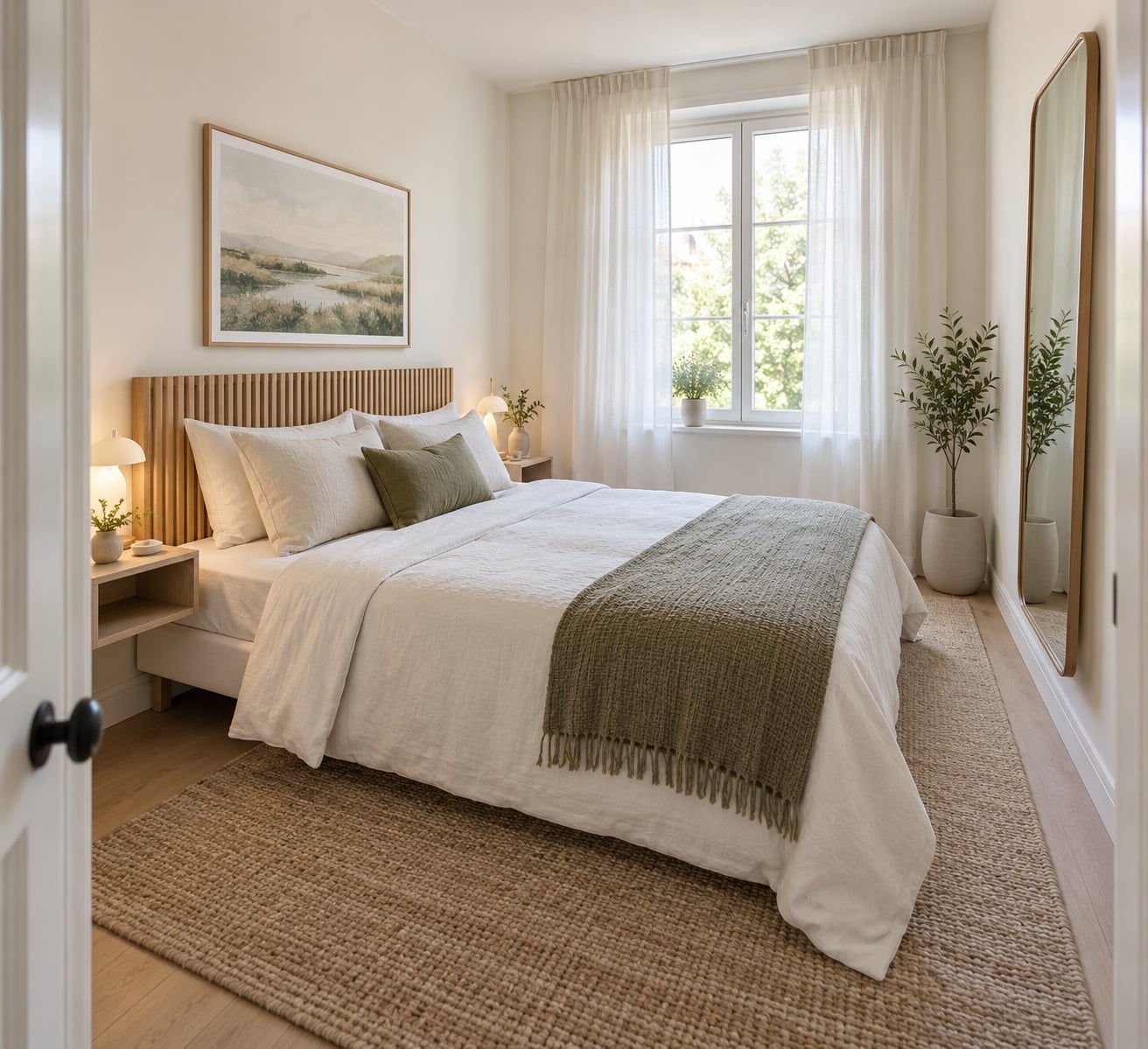
Put the bed against the longest wall if you can, or the wall with the fewest doors, windows and radiators. Float a bed with narrow legs or a low frame rather than a bulky frame with a thick footboard, because the gap underneath reads as extra floor. Push it tight to the wall when the room is tight, and leave a walkway about 30 inches wide from the door to the far side.
Blocked sightlines make a room feel shorter than it is. Anything over roughly shoulder height in the middle of the room chops the space in half visually, so keep the center path low and clear.
Choose pieces that do more than one job. A storage ottoman gives you somewhere to sit, somewhere to store linens and a surface for a tray. A flip-top end table or a small wall-mounted bedside shelf frees the floor where the bed meets the wall. A see-through or cane headboard keeps sightlines open when the bed has to sit in front of a window.
In a very narrow room, slide the bed lengthwise so the walkway runs along one side rather than around the foot. In an L-shaped room, push the bed into the straightest leg and use the corner for a low chair or a slim dresser instead of trying to make a symmetric layout.
Use storage that fits under or behind furniture
Under-bed bins are the highest-capacity storage in most small bedrooms. Low-sided boxes or vacuum bags slide under a platform bed where tall tubs will not. Label them on the long side so you can read them without hauling everything out, and leave a hand’s width at one end for the things you use weekly.
Use the back of the door. An over-door organizer with hooks and shallow shelves turns a blank slab into a closet, and it comes down cleanly when you move, which matters if you rent.
Go up the walls with floating shelves no deeper than about 12 inches. Anything deeper than that reads as a bulky piece of furniture and starts to shrink the room again. Heavy books and storage bins go low, light objects go high. Keep the wall above a bed calmer than the rest of the room, and avoid heavy shelving directly over a sleeping head unless it is properly anchored into studs.
Measure before you buy organizers. Most sizing mistakes come from buying a bin for the closet and discovering the closet has a 9 inch opening.
Make the walls and ceiling look brighter
Paint the walls and the ceiling in the same hue, or in two shades of the same hue. The change in tone between wall and ceiling creates a hard line at eye level, and removing it makes the ceiling read taller and the walls read further apart. This is the single cheapest visual change in the whole list if you already own a paint roller.
Stay in the light half of the color range: soft whites, warm off-whites, pale greys, muted sage and dusty blue. Very dark paint shrinks a room because it absorbs light instead of bouncing it. One saturated accent on one wall is fine, as long as the other three stay quiet.
Run carpet or flooring in one continuous direction where you can, and choose one rug large enough to sit under the bed rather than a small rug floating in the middle. A small rug in a small room reads as an unfinished puzzle piece.
Renting? Skip the paint and get most of the effect from large removable color blocks: peel-and-stick wallpaper panels on a single wall, a big textile hung as art, or light-colored bedding pulled up to the headboard. Same idea, no deposit at risk.
Add light and a large mirror carefully
Curtains should hang from the ceiling line or as close to it as the hardware allows, and land on the floor or just above it. Hanging them halfway up a short window chops the window in half and makes the ceiling look lower. Mount the rod wide enough that the panels sit outside the frame when open, which widens the window’s apparent span.
Layer your lighting: ambient light that fills the room, task light at the bedside, and an accent somewhere you spend time. Two or three sources at different heights beat one bright ceiling fixture every time, because a single source casts shadows in the corners.
A mirror works by what it reflects, not by how large it is. Place one opposite a window or opposite the longest clear stretch of wall so it doubles that surface. A mirror facing a cluttered garment rack will faithfully show you the clutter twice over, which is the one thing people miss when they buy a large mirror and wonder why nothing changed.
Do not hang a mirror where it catches glare from a window or a lamp you read by, and do not place it flat against a low-traffic wall at an angle that fragments the view. Also keep a large leaning mirror from tipping toward a walkway; wall-mount it if there are children or pets in the room.
Use vertical space and a focal point
When the eye lands on something tall, the room reads as tall. That is the logic behind a pair of tall curtains, a hanging pendant, a high shelf, or one piece of vertically oriented art above the bed.
Pick a single focal point and let the rest of the room support it. In most small bedrooms that is the bed and the wall behind it. A simple upholstered or slatted headboard gives that wall a job without adding clutter, and one tall framed piece above it is enough.
Readers on renter forums push back hard on the standard advice to put shelves above the bed, and the objection is fair. That wall gets dusty, it gets hit during mattress changes, and it needs stud-mounted hardware. If you do it, anchor it, keep it shallow, and use it for light or frequently used items rather than heavy storage.
Keep the space above eye level mostly empty, and move storage up in open, evenly spaced places rather than in one crowded corner. Two matching sconces or wall lights, hung at reading height, free the nightstands entirely and give the wall a symmetrical line.
Common Mistakes That Make a Small Bedroom Feel Smaller
Nearly every cramped small bedroom I can think of shares at least one of these. Each one is cheap to undo.
- Oversized furniture. A dresser that cannot have two doors open at once is costing you floor. Fix: swap it for a narrower or shallower piece and keep only what fits comfortably.
- A matching furniture set. Buy boxes of the same finish and the room turns into one heavy block. Fix: keep the finish, vary the shapes.
- Too many colors. Fix: pull everything to one family plus a single accent color.
- Curtains hung too high and too short. Fix: raise the rod near the ceiling line and let the panels touch the floor.
- Large furniture in front of windows. Fix: rotate the bed 90 degrees onto an adjacent wall, or use a see-through headboard if it cannot move.
- Every wall used. A crowded room needs breathing room. Fix: leave one wall mostly empty, ideally the one you see when you walk in.
- A pile of small reflective things. Many small mirrors and shiny objects fragment the view instead of opening it. Fix: keep one mirror, remove the rest.
- Wide bulkky baskets on show. Woven baskets without lids read as a wall of texture. Fix: use lidded or covered containers.
Renter-friendly shortcuts that need no painting or drilling: peel-and-stick hooks, removable shelf strips, one large mirror, lighter bedding, window film that keeps heat but softens glare, and a freestanding shelf unit faced with peel-and-stick wallpaper instead of a built-in. Free changes always come first, and every purchase should solve a specific problem you can name.
Frequently Asked Questions
What colors make a small bedroom feel bigger?
Light, low-contrast colors make a small bedroom feel bigger because they reflect light and blur the edges where surfaces meet. Stay with soft whites, warm off-whites, pale greys, muted sage or dusty blue, and paint the ceiling the same hue as the walls to remove the hard line at eye level. Use one saturated accent on a single wall and keep the rest quiet. Dark paint on all four walls does the opposite, absorbing light and drawing the room in.
How should I arrange furniture in a small bedroom?
Start by protecting a walkway about 30 inches wide from the door to the window, then push the largest pieces against the longest or least interrupted walls. Keep the center of the room low and free of anything tall enough to block sightlines, and let the bed float with narrow legs or a low frame so the floor reads as continuous. Tape footprints on the floor with painter’s tape before you move anything heavy. Repeat the walk-through at night, when a tight path is most obvious.
Do mirrors really make a bedroom look bigger?
They do, but only when they reflect something worth doubling. A mirror opposite a window or opposite the longest uncluttered wall roughly doubles that surface and adds apparent depth. A mirror angled toward a messy garment rack or a crowded dresser just shows you the clutter twice. Size matters less than aim. Skip a mirror that catches glare from a lamp or window, and wall-mount a large one if children or pets could tip it.
What can I use instead of bulky bedroom furniture?
Swap solid pieces for multi-function ones: a storage ottoman replaces both a chair and a lidded basket, a wall-mounted bedside shelf replaces a nightstand, and a flip-top end table keeps a phone, book and charger within reach without a floor footprint. Floating shelves no deeper than about 12 inches add capacity without adding bulk. Daybeds, trundles and folding guest beds give you a sleeping surface that disappears into the wall’s footprint during the day.
How can I make a small bedroom look bigger without painting?
Move the bed and other large furniture first, since placement changes sightlines at no cost. Then declutter, remove visible cords and cover storage with lids or doors, and pull the textiles into one light color family. Hang curtains from the ceiling line down to the floor, add two or three light sources at different heights, and place one large mirror opposite a window. Removable hooks, over-door organizers and peel-and-stick panels handle storage without touching the walls.
What is the best bed placement in a narrow room?
Run the bed lengthwise along the longest wall so the walkway passes down one side rather than around the foot of the bed. If the window wall is the longest, slide the bed there with a see-through or cane headboard so the window stays usable and sightlines continue through the room. Keep about 30 inches of clear walking space, avoid blocking a radiator, and place a slim wall-mounted shelf over each side instead of nightstands to recover the corners.
Conclusion
If you learn how to make a small bedroom feel bigger from one page, learn this: light, clear sightlines, visible floor and right-sized furniture do the work. Clutter and a blocked window undo everything else you do.
Start with the free moves this weekend. Measure the room, tape out a new bed position, clear every surface, and pull the textiles into one light color family. Only then measure a mirror, a shelf or a storage bin, and buy the one thing that solves a problem you can actually name.