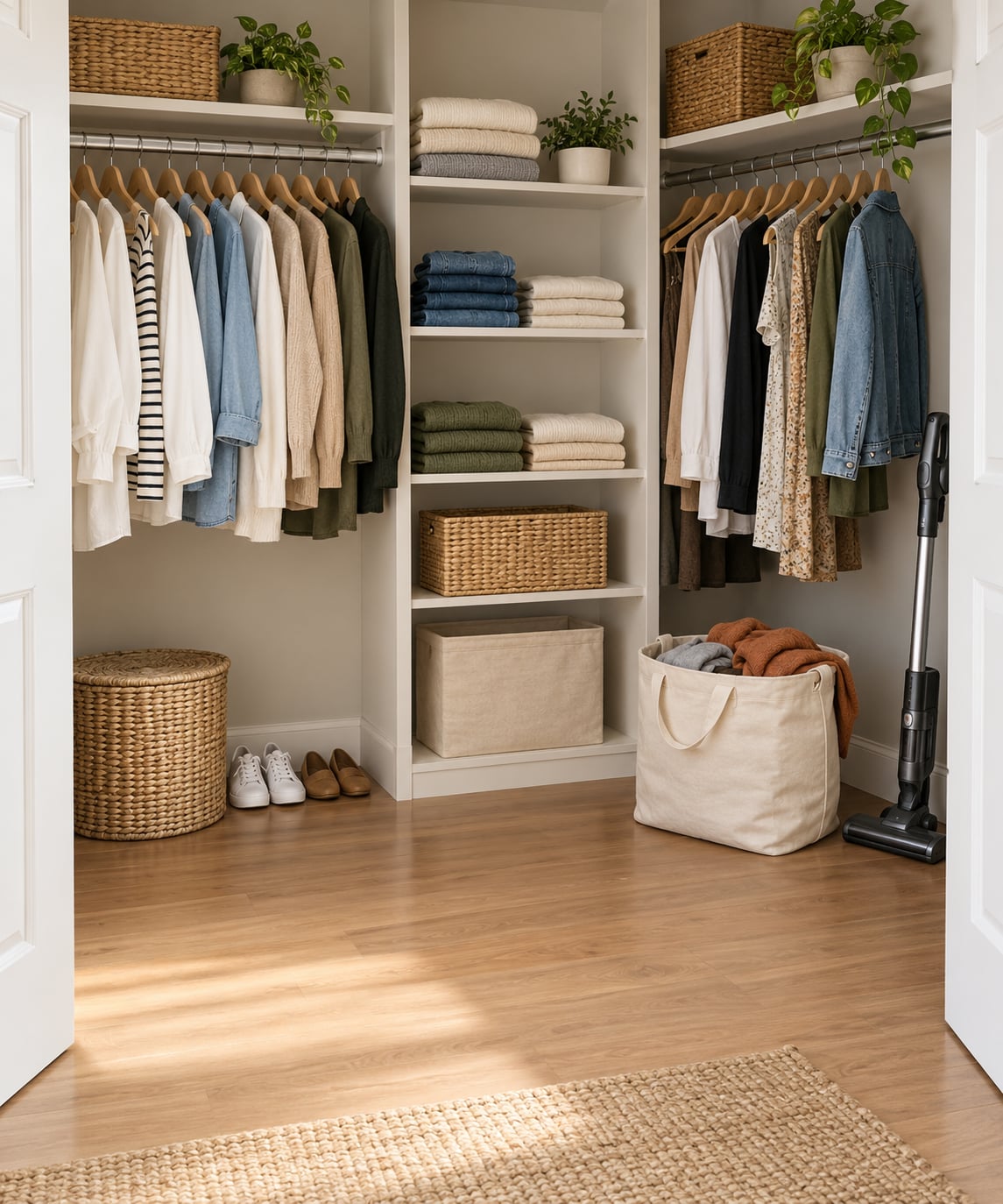
To declutter a closet in one weekend, you need two focused blocks: Saturday to empty, edit and bag everything, Sunday to clean, zone and re-hang what stays. Plan for around eight to ten hours total, broken into 90-minute sessions with real breaks, and the closet is genuinely usable by Sunday evening.
The reason most weekend declutters fail has nothing to do with effort. It’s that people try to empty, decide and rebuild a whole closet in one heroic Saturday, burn out by 3pm, and end up shoving everything back in on Sunday night with no system at all.
So this plan splits the work honestly. Saturday is subtraction, Sunday is construction. Nothing goes back until the space is clean and the zones are decided.
Table of Contents
- 1What You Need
- 2Step-by-Step: How to Declutter a Closet in One Weekend
- 3Step 1: Plan Your Weekend and Set a Deadline
- 4Step 2: Remove Everything and Create Sorting Zones
- 5Step 3: Sort Items Into Four Simple Categories
- 6Step 4: Clean the Closet and Its Contents
- 7Step 5: Plan the Closet Zones Before Putting Things Back
- 8Step 6: Return and Organize Each Zone
- 9Step 7: Finish with a Quick Reset Plan
- 10Common Mistakes
- 11Frequently Asked Questions
- 12What is the 3-3-3 rule for decluttering?
- 13What is the 5-5-5 rule for decluttering?
- 14What not to throw away when decluttering a closet?
- 15How long does it take to declutter a closet in one weekend?
- 16How do I stop my closet from getting messy again?
- 17What do I do with clothes I do not wear but want to keep?
- 18Conclusion
What You Need
None of this requires a shopping trip. Most people who plan to buy organizers end up buying less, because the volume drops and the shelves you already have suddenly fit the clothes you’re keeping.
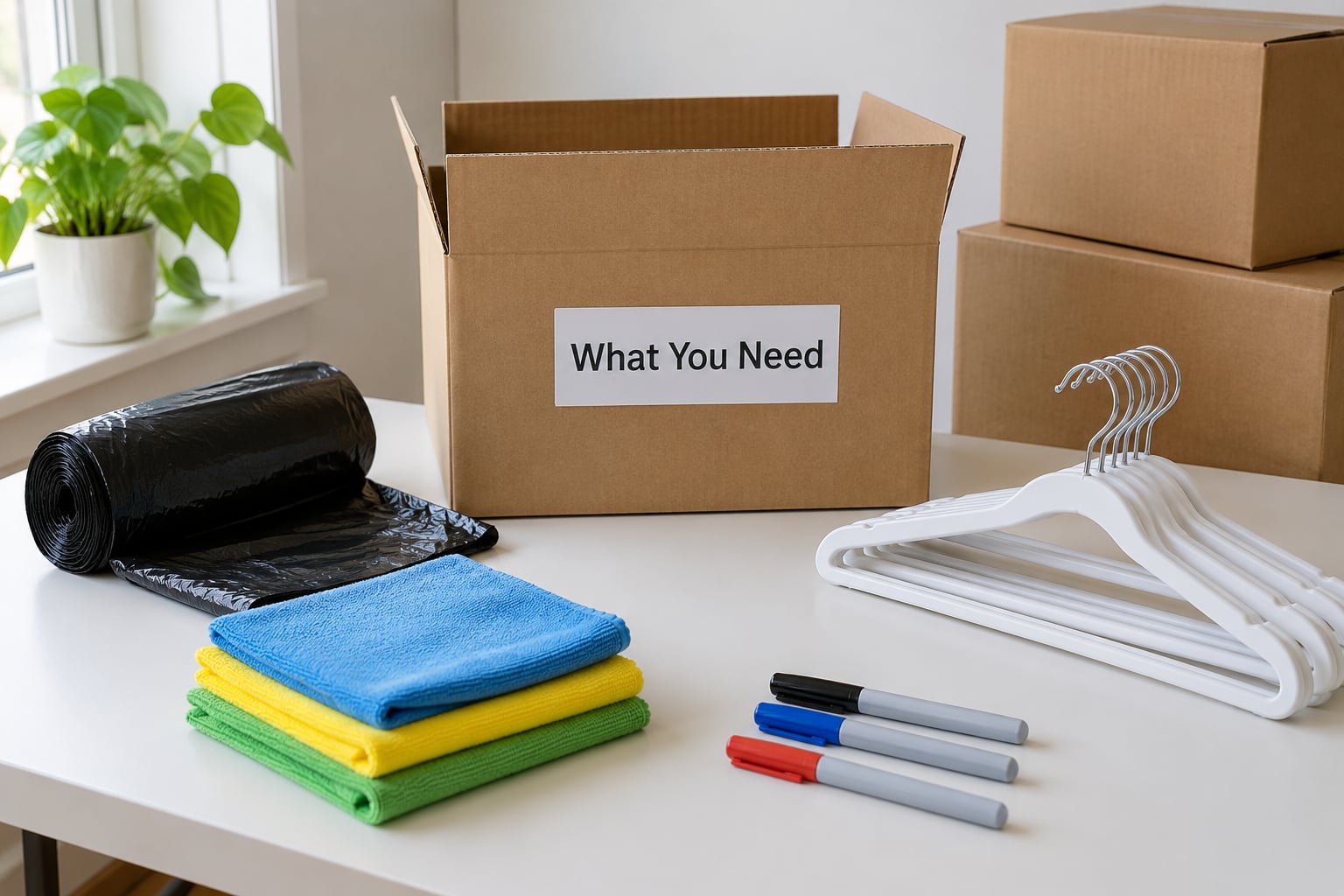
- Boxes, baskets or laundry hampers for staging the keep pile by category. Empty cereal boxes or the boxes from your last online order work fine.
- Trash and recycling bags and a marker for labeling. Masking tape stuck to the floor beats labels if you have a lot of sorting zones.
- Matching hangers in one style and one color. Mismatched hangers are the fastest way to make a tidy closet look messy again.
- Cleaning supplies: microfiber cloths, an all-purpose cleaner, a vacuum, a step stool and gloves if you’re pulling things out of high shelves.
- A staging surface, usually a bed or a cleared stretch of floor. Do not stage on the same floor you’ll need to walk on all weekend.
- A donation plan you schedule before you start, not after. This is the step almost everyone skips, and it’s why bags of clothes sit in a hallway for six months.
Pick your donation destination on Friday evening and look up its schedule. Some organizations offer pickup for large loads; others have drop sites with set hours. Knowing which one you’re using is what makes the Saturday bagging step finish.
If you’re decluttering in autumn, or any season really, this is a good weekend to pull out everything you’re not wearing this year. That’s the biggest volume you’ll ever remove in one pass.
Step-by-Step: How to Declutter a Closet in One Weekend
Here is the shape of the weekend. Adjust the order for a walk-in closet or a child’s closet, but keep the Saturday/Sunday split intact.
- Friday evening (30 minutes). Gather supplies, choose the donation route, clear the staging area. Outcome: everything is ready before Saturday.
- Saturday morning (90 minutes). Empty the closet completely, wipe and vacuum it, check for pests. Outcome: clean empty space and a floor covered in sorted piles.
- Saturday afternoon (2 to 3 hours). Sort category by category into keep, donate, wash, toss. Outcome: four destinations for every item.
- Saturday evening (45 minutes). Bag donations by type and confirm pickup or drop-off. Outcome: the donate pile is physically gone.
- Sunday morning (90 minutes). Clean and refresh the keep pile, map out the closet zones. Outcome: clean clothes and a written layout.
- Sunday afternoon (2 to 3 hours). Re-hang and put back frequency-first, fold the rest. Outcome: a rebuilt closet you can reach into.
- Sunday evening (30 minutes). Final walk-through, set up the maintenance habit. Outcome: a closet that stays usable.
Step 1: Plan Your Weekend and Set a Deadline
Block the time before someone else does. Saturday 9am to noon and 2pm to 4pm, Sunday the same, is enough for most closets. Write it on the calendar as an appointment, not a vague intention. Knowing how to declutter a closet in one weekend starts with those four protected hours, not with the boxes.
Work in 90-minute blocks with a real break between them. Sorting is the most draining part, and the people who finish are almost never the ones who pushed through six hours straight. Eat something and drink water before the second session starts, not after you’ve lost your focus.
Decide in advance what is out of scope. A walk-in closet with a full shoe wall, a full attic storage situation and a children’s closet in the same weekend is three projects. Pick the closet that annoys you most and let the others wait.
Step 2: Remove Everything and Create Sorting Zones
Take everything out, including the double-hanger stacks and the bag at the back you forgot existed. Group the piles on the floor or the bed by category: tops, bottoms, dresses, outerwear, shoes, bags, accessories, kids’ items.
Pull out categories you rarely touch first. Shoes and winter coats generate volume fast, and seeing four garbage bags of shoes is what gives you momentum for the harder decisions that follow.
Lay down labeled zones along the wall as you go: keep, wash, donate, sell, trash. Some people add a sixth zone, repair, for the one button or loose hem that’s worth ten minutes with a needle.
Step 3: Sort Items Into Four Simple Categories
Sort by category, not by hanger. Pulling one item at a time off a rail is how a two-day job becomes a two-week job.
For each garment ask four questions: does it fit, does it work, is it in condition, and did I wear it in the last year? The last question is the one that matters most. Clothes you keep for hypothetical future selves are usually the clothes crowding out what you actually wear.
Handle duplicates on the spot. You do not need seven black tops. When something is genuinely hard to call, put it in one labeled box, write today’s date on it, and give it 30 days. Anything still in the box at the end of the month leaves the house, and you stop pretending you own it.
If you want a shortcut, the rules people use vary a lot. The 3-3-3 rule keeps three years’ worth of seasonal items, wears each one three times a year and donates three times a year. Marie Kondo’s method asks whether an item sparks joy, which is thorough but slow in a time-boxed weekend. The 5-5-5 rule keeps five years’ worth and keeps five of each category, which is the fastest of the three. For a weekend, use 5-5-5 to make the call and skip the joy-checking.
Step 4: Clean the Closet and Its Contents
With everything out, wipe the shelves, the rail, the back panel and the door frame. Vacuum the corners and the track. Check for a musty smell or evidence of pests before putting anything back, since discovering that on Sunday means starting over.
Anything going into the keep box gets a chance to be washed or aired out. Clothes that sit in a closed closet for years pick up smell, and once that smell is on them, people stop reaching for them and the pile starts over.
Skip anything beyond basic cleaning. Don’t attempt a hardware fix on a broken zipper during the sort. If it’s worth repairing, it goes in the repair box and gets handled next week.
Step 5: Plan the Closet Zones Before Putting Things Back
Stand in the empty closet and pick the zones before you lift a single hanger. Everyday clothing goes in the easiest reach. Seasonal and off-season items go on the top shelf or into under-bed bins. Shoes need floor space or a door rack. Accessories get a small shelf, not a whole drawer.
Measure first. A folding board or stackable drawer unit only works if you know the depth of the shelf and the height of the opening, and it works better when you choose it after the volume is already down.
Give every zone a capacity limit based on what fits comfortably, not what you wish fit. Empty space is the point. A closet with breathing room is easier to keep tidy than one packed to the door.
Step 6: Return and Organize Each Zone
Work from the least-used zone to the most-used so the space nearest the door isn’t blocked while you finish the back. Hang by length and, more usefully, by frequency: everyday pieces at eye level and within easy reach, occasional wear further along the rail.
Use one hanger style throughout a zone. Double-hangers are useful for pants and skirts, but only if the pair isn’t squashed, so leave a little gap between them. Fold rather than hang anything that crushes when hung, such as knits, tees and jeans.
File folding makes folded stacks easy to see from the front, so a plain shelf doesn’t turn into a guessing game. Fold to the size of the shelf, use plain cardstock dividers between categories, and label the front of each box so you don’t have to unpack a bin to know what’s inside.
Put the everyday clothes in last and hang them by outfit. Fewer decisions at 7am is the entire point of the weekend.
Step 7: Finish with a Quick Reset Plan
Walk through the finished closet on Sunday evening with the weekend list in hand. Pull out anything that doesn’t fit the zones, anything you can’t remember the reason for keeping and anything that needs a home elsewhere in the house. Small removals now are cheaper than a re-clutter next month.
Make the donation drop-off happen. Bagged clothes left in a hallway are the single most common reason a declutter doesn’t stick, so schedule the pickup, run the drop-off or post the resale items before Sunday night ends.
Then set up two habits. Put a 15-minute reset on the last Sunday of each month, and adopt one-in-one-out: every new piece that comes in goes with something that leaves. 2026 is a good year to start, because a rule that runs quietly in the background beats a one-time purge every spring.
Common Mistakes
Doing it all in one day. The fix is the Saturday/Sunday split, with a hard stop at a set hour. A finished two-day project beats an abandoned one-day project every time.
Buying organizers first. New bins and hangers before the declutter means you organize the same volume twice and spend money on storage for things you’re about to donate. Remove first, then see what’s still missing.
Keeping an open-ended maybe pile. A box with a date and a decision attached is fine. A box with no date becomes a second closet in the corner. Thirty days, then it goes.
Refolding and reorganizing things the closet doesn’t need. Seasonal clothing and kids’ clothes that don’t fit now belong in a bin elsewhere in the house, not folded neatly in your closet.
Re-hanging without a frequency order. If the everyday clothes end up at the back and the rarely worn coats are at eye level, the closet will look organized and feel useless within two weeks.
Skipping meals and breaks. Decision-making quality drops sharply in the third hour of sorting, which is exactly when people start regretting the whole project. A break is part of the plan.
Never scheduling the donation. Decide the route before Saturday, not after. Otherwise the bags sit there and the closet stays half-finished no matter how well the rest went.
Frequently Asked Questions
What is the 3-3-3 rule for decluttering?
The 3-3-3 rule keeps three years of clothes, requires that you wear each piece at least three times a year, and asks you to donate three categories or three items worth of clothing each year. It is a gentle filter that cuts volume slowly rather than in one purge. For a single weekend project it works better as a background habit than as the main decision tool, because keeping three years of everything can still leave a crowded closet.
What is the 5-5-5 rule for decluttering?
The 5-5-5 rule keeps five years of worth of items, five of each clothing category, and expects five wears per item each year. It is the fastest of the popular decluttering rules because it caps each category immediately instead of judging every item on its own merits. That makes it the better fit for a one-weekend closet cleanout, especially if you tend to stall on single decisions. Pair it with a wear-history check and the hard calls go fast.
What not to throw away when decluttering a closet?
Hold onto genuinely sentimental items, quality hand-me-downs and kids’ clothes still worth passing on, plus anything currently out of season that fits and works. Also keep formalwear you wear once a year but would struggle to replace, and pieces you are actively wearing that just need a repair. The common thread is intent: if you can name the occasion or the person it is for, it stays. If you cannot, the maybe box will decide in 30 days.
How long does it take to declutter a closet in one weekend?
Budget eight to ten hours across two days for a standard bedroom closet. Saturday takes about four hours to empty, clean and sort everything, plus 45 minutes to bag donations. Sunday takes three to four hours to map zones, re-hang and fold. A walk-in closet with a full shoe collection can double that. Anyone who promises a finished closet in two hours has not emptied one lately.
How do I stop my closet from getting messy again?
Most re-cluttering happens because new clothes have nowhere designated to go and the weekend’s rules fade after a month. Set a 15-minute monthly reset on a specific date, keep the zones you created rather than rebuilding new ones, and use one-in-one-out so every new piece comes with one going out. Leave a little empty space in each zone on purpose, because a closet with slack stays organized and a full one does not.
What do I do with clothes I do not wear but want to keep?
Put them in a labeled box with today’s date on it and set a 30-day review. Wear them during that month if you can, and anything untouched goes to donation, consignment or resale at the end of it. Holding them in a closet corner instead is what creates the permanent overflow that eventually re-clutters the whole space. If the item is worth more as a memory than a garment, keep one or two and let the rest move on.
Conclusion
Start tonight, not Saturday. Choose your donation route, clear the staging surface and block the time in the calendar, because those three small things are what make the weekend finish.
Saturday is subtraction, Sunday is rebuild. If you only manage one day, empty and sort on Saturday, schedule the donation drop-off on Sunday, and re-hang next weekend. Half a plan that leaves the house beats a full plan that never starts.