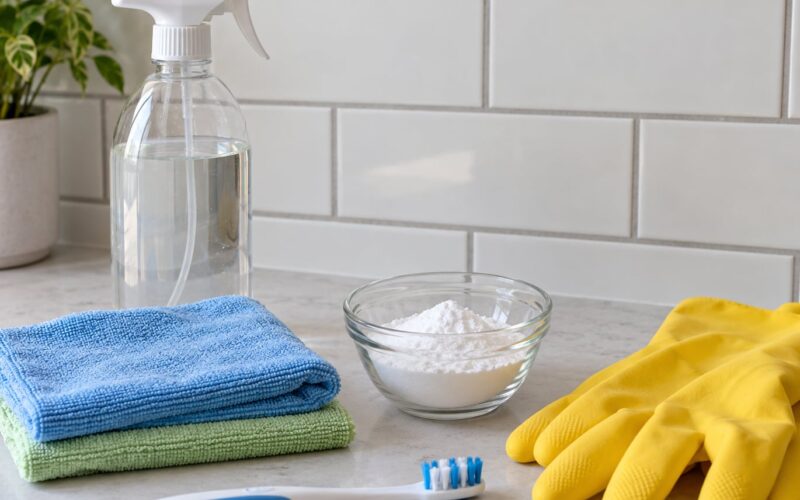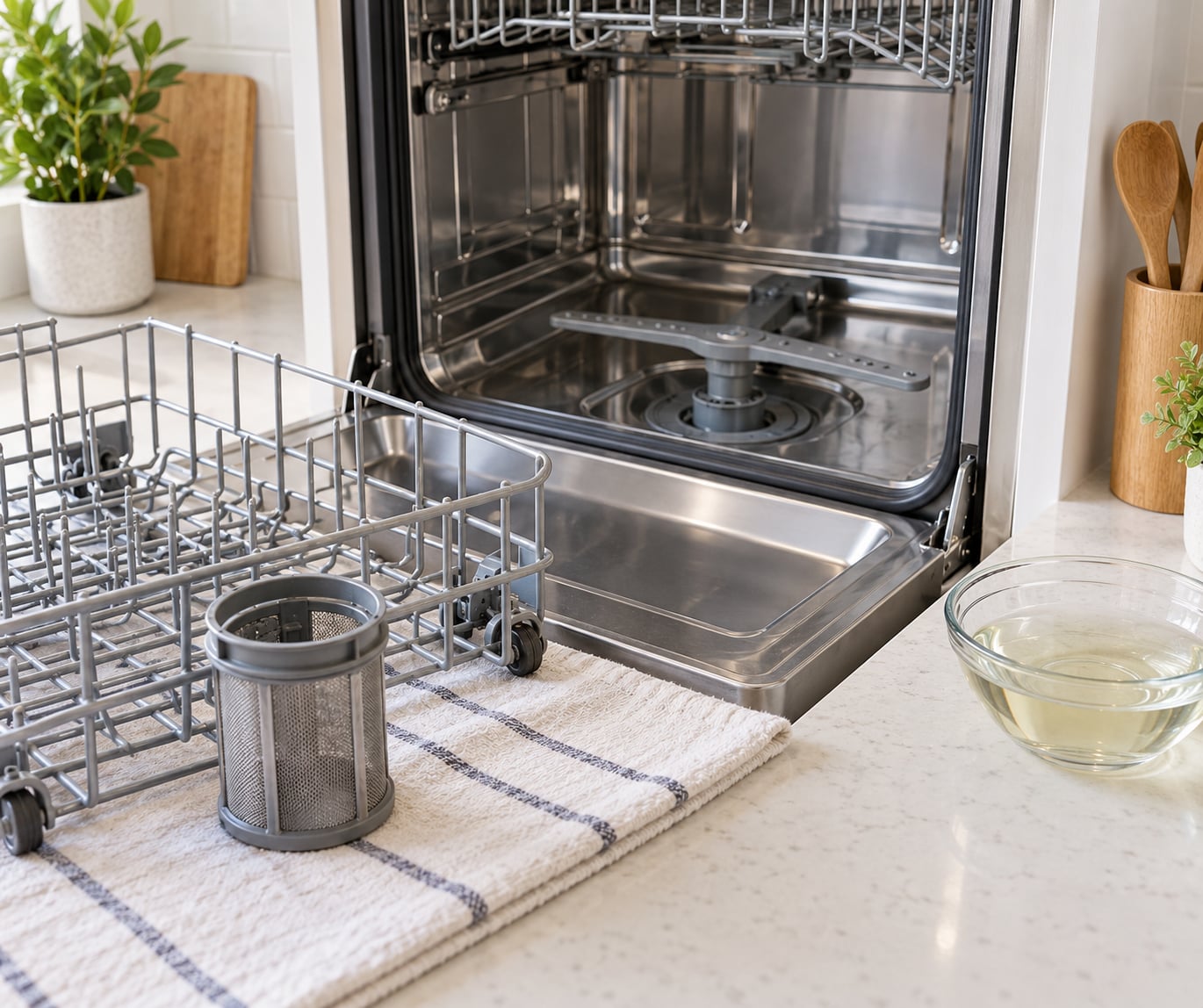
To get the smell out of a dishwasher, scrub the filter, wipe the door gasket, and run an empty hot cycle with 2 cups of white vinegar. Add a baking soda cycle afterward, then leave the door ajar so moisture escapes. Most bad smells trace back to one of three parts: the filter, the rubber seal, or standing water in the tub.
The whole job takes about 40 minutes, and almost all of it is scrubbing. You can do it with pantry staples and a soft brush.
One note before you start: never mix vinegar, baking soda, or any acidic cleaner with bleach or a chlorine-based product. The combination releases gas and can damage the machine and your lungs. Work on one cleaner at a time, and if your dishwasher has a chlorine tablet dispenser, leave it empty during this clean.
Table of Contents
- 1What You Need
- 2Step-by-Step: How to Clean a Dishwasher That Smells
- 31. Empty the dishwasher and find what’s causing the smell
- 42. Clean the dishwasher filter, the single biggest fix for a dishwasher that smells
- 53. Wipe the interior, door gasket, and spray arms
- 64. Run a deodorizing cycle
- 75. Prevent the smell from returning
- 8Common Mistakes
- 9Frequently Asked Questions
- 10Can I use vinegar to clean my dishwasher?
- 11How often should I clean my dishwasher?
- 12How do I deep clean a dishwasher without vinegar?
- 13What is the best dishwasher deodorizer?
- 14Can I put bleach in a dishwasher to get rid of the smell?
- 15Why does my dishwasher smell like sewage, and when should I call a plumber?
What You Need
Most people already have everything. The full list:
- White vinegar — 2 cups for the deodorizing cycle. Distilled is nice but plain white grocery-store vinegar works.
- Baking soda — about 1 cup for a follow-up cycle, plus a spoonful mixed with warm water for scrubbing.
- Soft-bristled toothbrush or small brush — for filter mesh, gasket folds, and spray arm holes.
- Microfiber cloth or non-scratch sponge — for the gasket and interior walls.
- Dishwasher-safe bowl or measuring cup — to hold the vinegar upright on the bottom rack.
- Dish soap — a drop for the sink when you wash the filter by hand.
- Clean dry towel — for the gasket, so moisture does not sit in the folds.
- A small flashlight — optional, but it makes the underside of the spray arm much easier to see.
- Rubber gloves — optional. The tub floor is grimy even on machines that look clean from the top.
Citric acid powder is a reasonable stand-in for vinegar if you prefer a neutral pH, and a paste of baking soda and water replaces most commercial sprays. Skip the scented powders and essential oils — they mask odor for a cycle or two and then give you a different smell on top of the first one.
Step-by-Step: How to Clean a Dishwasher That Smells
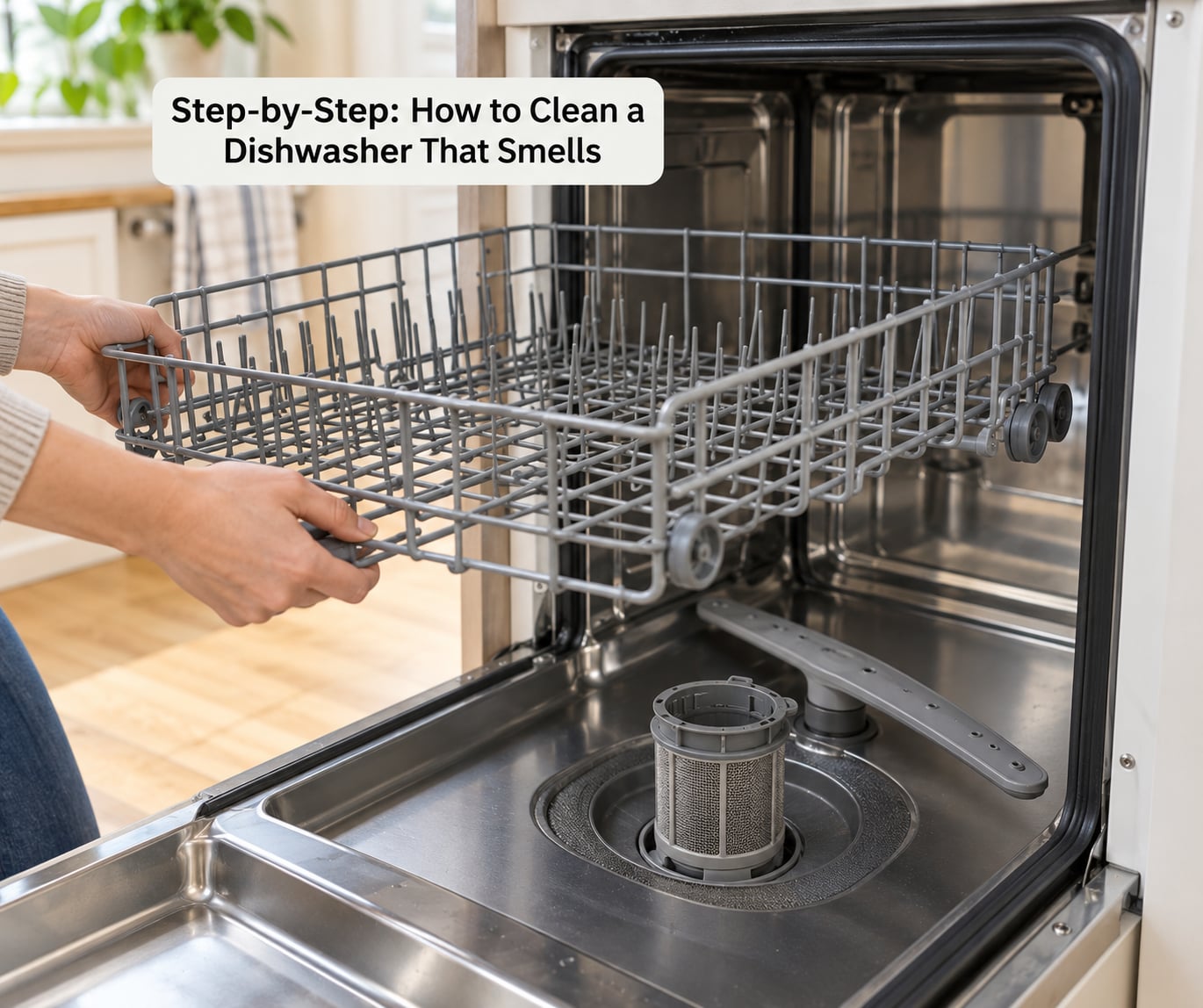
The order matters. Work from the biggest source of trapped food outward, then finish with the hot cycle that kills what the scrubbing loosened.
1. Empty the dishwasher and find what’s causing the smell
Pull both racks out and scrape everything into the trash. Food that has sat for days in a warm, wet tub is the most obvious cause of a dishwasher that smells like a landfill.
Take the racks to the sink and rinse them. While you are there, look up into the tub. You will usually find a haze of dried food on the ceiling and the back wall, plus a layer of grit on the tub floor around the spray arm. Wipe the ceiling and walls with a wet cloth before you go any further.
Check the water in the bottom of the tub. A shallow puddle, roughly a quarter inch, is normal — it is residual water sitting in the drain hose, not a leak. If the water reaches the edge of the filter housing or reappears immediately after you wring out a sponge, that is a different problem.
Here is how the smell usually maps back to a part:
- Sour, like old milk or spoiled food — food residue trapped in the filter and the sump beneath it. Check the filter, the flatware basket, and the tub floor first.
- Musty or damp-closet — standing water and detergent residue in a cool tub. Look at the tub floor, the drain hose, and the pump area.
- Poochy mildew, often after a few days idle — mold growing in the folds of the door gasket and around the detergent door. Start with the gasket and the rinse aid cap.
- Rotten eggs or raw sewage — sewer gas backing up through a failed check valve in the drain hose. Go to the hose connection under the sink.
- Sharp vinegar tang — concentrated vinegar left in the machine too many times. Check the gasket, seals, and detergent compartment.
- Fishy or stale — dried dairy, fish sauce, or salad dressing burned onto racks and arms. Inspect the lower rack and the spray arm holes.
2. Clean the dishwasher filter, the single biggest fix for a dishwasher that smells
Cleaning the filter alone can hold the smell off for a few days, and then it comes back. That is the most common report from people who stay stuck. When a clean filter and a vinegar cycle do not hold for more than a few days, the residue is somewhere else — usually the drain hose.
Find your filter first, because where it lives depends on the model:
- Top-mount, removable — a flat round mesh disc in the center of the tub floor, usually with a handle or a twist ring. Common on Whirlpool, Kenmore, Maytag, and many Frigidaire models. Twist counterclockwise, then lift.
- Basket-style — a cylindrical mesh cup you lift straight up. Common on Bosch, Siemens, and Thermador.
- Built-in fine filter — a mesh cylinder recessed in the pump housing, usually reached by removing the lower rack and unscrewing a flat cap plate. Common on Bosch.
- Non-removable, self-cleaning — many modern machines have no filter at all. If you find a flat mesh panel under a twist plate, that is your filter.
Take a photo before you lift it out so you know the angle it goes back in. Rinse it under hot water and scrub the mesh with a toothbrush and a drop of dish soap. Food turns the mesh into a fine gray felt, and that felt is the smell.
Check the filter housing underneath too. Lift the coarse strainer out of the sump and you will usually find a second cup of sludge underneath it. Rinse the housing with hot water, run a cloth or toothbrush around the inside wall, and make sure the small drain opening in the base is clear.
Reinstall in the reverse order and press down firmly until it locks. A filter that sits at an angle will not seal, and water will carry residue straight back over it.
3. Wipe the interior, door gasket, and spray arms
Mix about a tablespoon of baking soda with a cup of warm water. Dip a soft cloth or non-scratch sponge in it and wipe the gasket fold, the inside of the door panel, the detergent dispenser, the sides of the tub, and the tub floor.
The gasket is the part most people skip. It is a rubber fold at the bottom of the door that stays wet every single cycle, and you will usually find black or green specks in the bottom crease. Work the cloth into that crease in short strokes, then dry it with the clean towel. If the rubber feels slimy after wiping and drying, run a toothbrush along the fold and dry it again.
Now do the spray arms. Lift the lower rack and lift the arm off its hub — most models just pull straight up. Wash it in the sink and poke each hole clear with a toothpick or the tip of a dry toothbrush. A clogged spray arm does not cause the smell, but it leaves food on the dishes, and food on dishes goes back into the machine.
Do the upper spray arm the same way. On many models it unscrews or pops off from the top of the tub.
Stay away from abrasive cleaners, bleach, and anything with ammonia on the gasket or interior. Never use steel wool. You will scuff the finish, and you can strip the surface the mold is clinging to, which gives it a better place to grow next time.
4. Run a deodorizing cycle
Once the machine is empty, put a dishwasher-safe bowl on the bottom rack facing up and fill it with 2 cups of white vinegar. Some people use a single cup and a short cycle. Either works; the fuller bowl holds more acid on a long hot run, and the short cycle and small cup is a fine shortcut when the machine is only mildly stale.
Pick the hottest cycle your machine offers — heavy, sanitize, or the longest program. Add a normal scoop of detergent if the tub is greasy, or skip it if you just cleaned. Choose the heated dry or air-dry option if your machine has one, and let the machine run the full cycle.
Then run a second, separate cycle with 1 cup of baking soda poured into the bottom of the empty tub. Baking soda neutralizes what vinegar left behind and takes care of the faint vinegar tang that vinegar cleaning can cause.
Use vinegar and baking soda separately, never together. The most-argued point on appliance forums is that combining them in one cycle does nothing useful — the acid and base neutralize each other into water and carbon dioxide, so you get foam and no cleaning. Vinegar in one cycle, baking soda in the next, then done.
Worth knowing: an eco or energy-saving cycle often runs too cool to kill the bacteria and mold behind the smell. That is fine for daily dishes and useless for deodorizing. Once a month, run the hottest cycle you have.
Another useful protocol for an appliance that has been sitting unused for months is two cups of vinegar and half a box of baking soda, then leave the door open for a few days to air out. Heavy dose, then ventilation.
5. Prevent the smell from returning
Scrape before you load. Not a quick shake — actually scrape plates and scrape the bowl of leftovers into the trash or compost. Food that rinses off easily still leaves a film in a hot machine.
Rinse heavily soiled items. A casserole baked for an hour, a bowl with dried cheese, or a can of fish goes in with a quick rinse under the tap, not straight onto the rack.
Do not overstuff. Leave space between items so water reaches every surface. A packed dishwasher recirculates dirty water over dishes that are already carrying food residue.
Clean the filter every month. Put a reminder in your phone for the first Saturday of the month. This one habit prevents most repeat episodes, because the filter is where residue goes before it turns into odor.
Leave the door ajar after every cycle. Open the door and the detergent door after the machine finishes so the interior dries out. A dishwasher that is sealed shut and damp is an incubator.
Run the machine regularly. If you use it once every few weeks, or not at all during a long absence, the standing water is enough to restart the smell cycle. A short hot cycle on an empty machine, once a month, keeps it from going dormant.
Common Mistakes
Almost every smelly dishwasher comes down to one of these.
- Vinegar and baking soda in the same cycle. They neutralize each other. Run them as two separate cycles instead.
- Cleaning the filter once and assuming you are done. If the odor is back within days, the source is the sump, the tub floor, or the drain hose, not the filter.
- Leaving the door shut and damp. Open it after every load, including the detergent door.
- Loading smelly foods. Fish, dairy, tomato sauce, and curry do not stop smelling the moment the door closes. Rinse them first.
- Using more detergent than you need. Excess detergent and rinse aid collect in the sump and give bacteria and mold something to feed on. Use the least amount that gets dishes clean.
- Relying on eco cycles for deodorizing. They are too cool to do it. Use the hot or sanitize cycle.
- Pouring bleach in with the dishes. Dangerous next to vinegar, and it does not fix a residue problem.
A few remedies get recommended constantly and are worth being honest about. Lemon peels smell nice for an afternoon and do not remove residue. Washing soda cleans well but rinses straight through the machine. Dry dishwasher deodorizer powders sit in a dispenser and are useless unless your machine actually heats the powder. Powdered citric acid works, but only if it lands somewhere hot and wet — sprinkled into an empty machine, the pre-wash rinses it away, so put it in a dishwasher-safe cup on the bottom rack if you want it to do something.
One more check: if the smell comes back every single cycle even with a clean filter, an empty machine, and a vinegar cycle, suspect the drain hose. Where the dishwasher hose connects under the sink, look for a kinked loop, a clogged air gap, or a cracked hose clamp. Make sure the hose is looped up in a high arc and secured under the counter, so the drain line stays sealed off from the tub and sewer gas cannot travel back into it. If it still smells like sewage after that, or if the tub keeps refilling with water after a cycle, stop and call a plumber. That is a drain or check-valve failure, and no amount of scrubbing touches it.
Frequently Asked Questions
Can I use vinegar to clean my dishwasher?
Yes, and it is the most reliable deodorizing step there is. Put 2 cups of white vinegar in a dishwasher-safe bowl on the bottom rack, run the machine empty on its hottest or sanitize cycle, and let it finish with the dry cycle. Do not add detergent on the same run, and never combine vinegar with bleach or chlorine.
How often should I clean my dishwasher?
Clean the filter about once a month, and wipe the door gasket while you are in there. Run one empty hot cycle a month as well, especially if you mainly use the eco setting. If the dishwasher is not empty for a couple of days at a time, clean the filter every two weeks, because the residue builds up faster.
How do I deep clean a dishwasher without vinegar?
Run the empty machine on its hottest cycle with 1 cup of baking soda poured into the bottom of the tub, which neutralizes odors without any acid. Citric acid powder works too, but put it in a dishwasher-safe cup on the bottom rack so the pre-wash does not rinse it away before it dissolves. Finish with a hot cycle and leave the door open.
What is the best dishwasher deodorizer?
Plain white vinegar for a real deep clean, baking soda for a monthly maintenance cycle. A dishwasher cleaning tablet is worth it if you have hard water and limescale, since vinegar and soda do nothing for scale. Scented powders and essential oils only mask the smell for a cycle and leave a new one behind.
Can I put bleach in a dishwasher to get rid of the smell?
Do not. Bleach does not remove trapped food residue, which is what causes almost all dishwasher odors, and never combine it with vinegar or any other cleaner because the mixture releases toxic gas. If your machine has a chlorine tablet dispenser, leave it empty while you clean. Use detergent or a cleaning tablet made for dishwashers instead.
Why does my dishwasher smell like sewage, and when should I call a plumber?
A rotten-egg or sewage smell usually comes from the drain hose, not the machine. A blocked air gap, a kinked hose, or a failed check valve lets sewer gas back through the pump. Check the hose under the sink and raise it into a high loop. If the odor persists or the tub keeps refilling with water, call a plumber.
Start with the filter tonight. Take it out, scrub the mesh with a toothbrush and dish soap, rinse the housing, and put it back. That single step fixes most smelly dishwashers, and it takes ten minutes. If the odor is still there a few days later, run 2 cups of vinegar in a bowl on the bottom rack through a hot cycle, then a baking soda cycle, then check the drain hose under the sink.