Last updated October 2026
To wash pillows so they stay fluffy, wash them in cool or lukewarm water on a gentle or bulky cycle with a small amount of mild detergent, then dry them fully on low heat with dryer balls or clean tennis balls tossed in to break up clumps. Skip bleach and fabric softener. Washing removes the dirt. Drying is what rebuilds the loft, and it is the step most people rush.
There is a second thing worth knowing up front: not every pillow goes in the machine. Memory foam, latex, and most decorative throw pillows should never be machine washed, because the agitation and the soak destroys the fill. The care label decides that, every time.
This guide covers all the fills you are likely to own — down, feather, down alternative, memory foam, latex, and throw pillows — plus what to do when a pillow comes out flat, lumpy, musty, or yellow.
Table of Contents
- 1What You Need
- 2Step-by-Step: How to Wash Pillows So They Stay Fluffy
- 3Check the Care Label and Choose the Right Method
- 4Remove the Cover and Pretreat Any Stains
- 5How to Wash the Pillow Without Flattening It
- 6Rinse Thoroughly and Dry Completely
- 7Common Mistakes That Make Pillows Lose Fluff
- 8How to Keep Pillows Fluffy Between Washings
- 9Frequently Asked Questions
- 10How often should you wash pillows to keep them fluffy?
- 11Can you wash memory foam pillows in a washing machine?
- 12How should I wash a down pillow without making it flat?
- 13What is the best way to dry a pillow so it stays fluffy?
- 14Can baking soda remove odors from a pillow?
- 15Is washing the pillowcase enough to keep a pillow clean?
- 16Conclusion
What You Need
The list is short, and most of it you already own. Gathering it first means you are not opening a wet pillow and then hunting for the thing you need.
- A washer with room to move. A front-loader or an agitator-free top-loader is best. Two standard pillows filling roughly half the drum is the sweet spot.
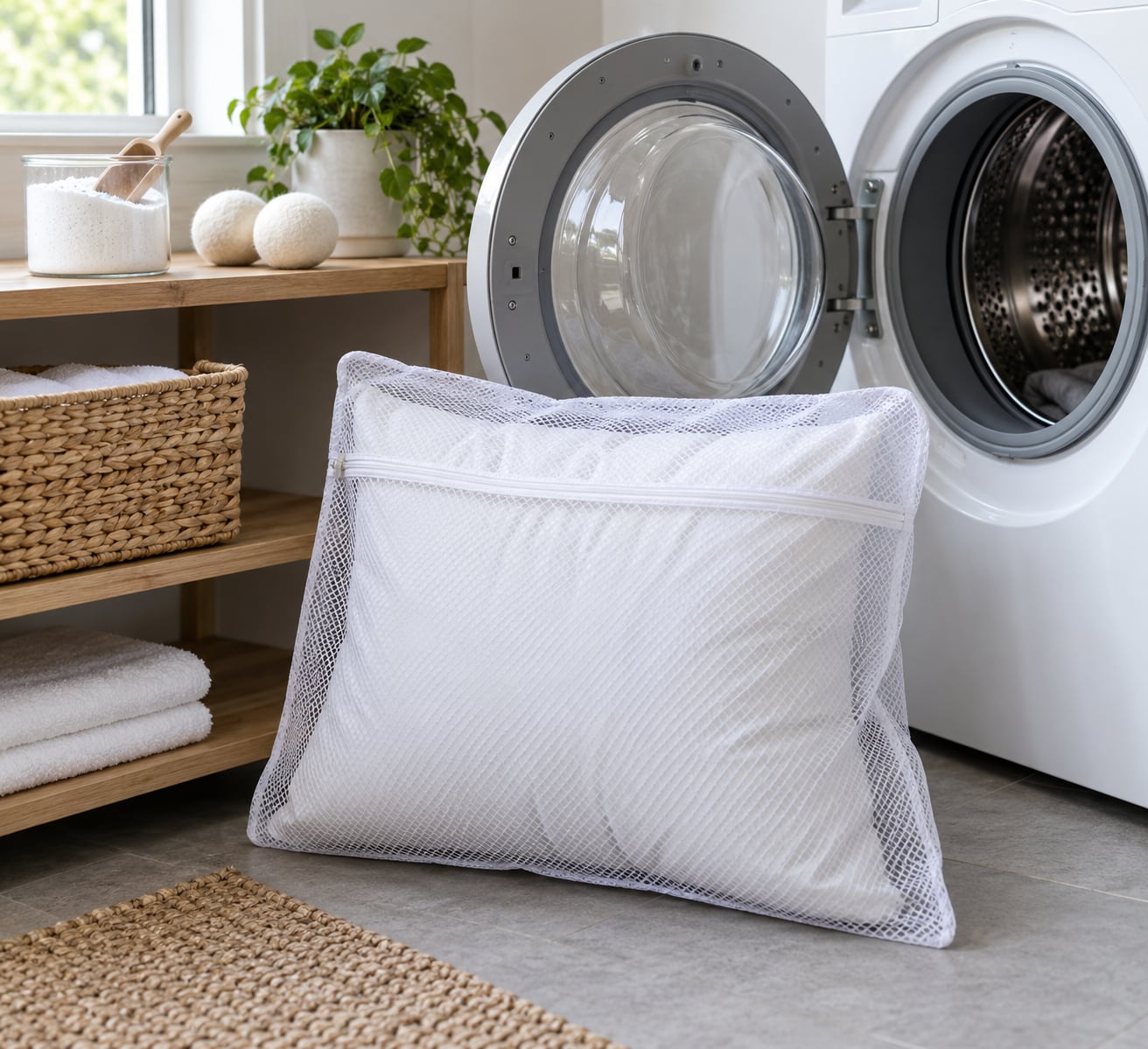
- A mesh laundry bag, or a clean pillowcase. Either one keeps a torn seam from scattering fill across the drum.
- Mild, low-sudsing detergent. A small dose is plenty. More is what causes stiffness.
- Dryer access. Air drying works, but it takes 24 to 48 hours and needs a rack, a fan, and space.
- Dryer balls, tennis balls, or a substitute. Wool dryer balls are the gentlest; clean tennis balls work well; rolled towels bound with rubber bands also break up clumps.
- Two clean towels. For pressing out water without wringing.
- Baking soda. Useful if the pillow smells musty or holds a greasy residue.
Step-by-Step: How to Wash Pillows So They Stay Fluffy
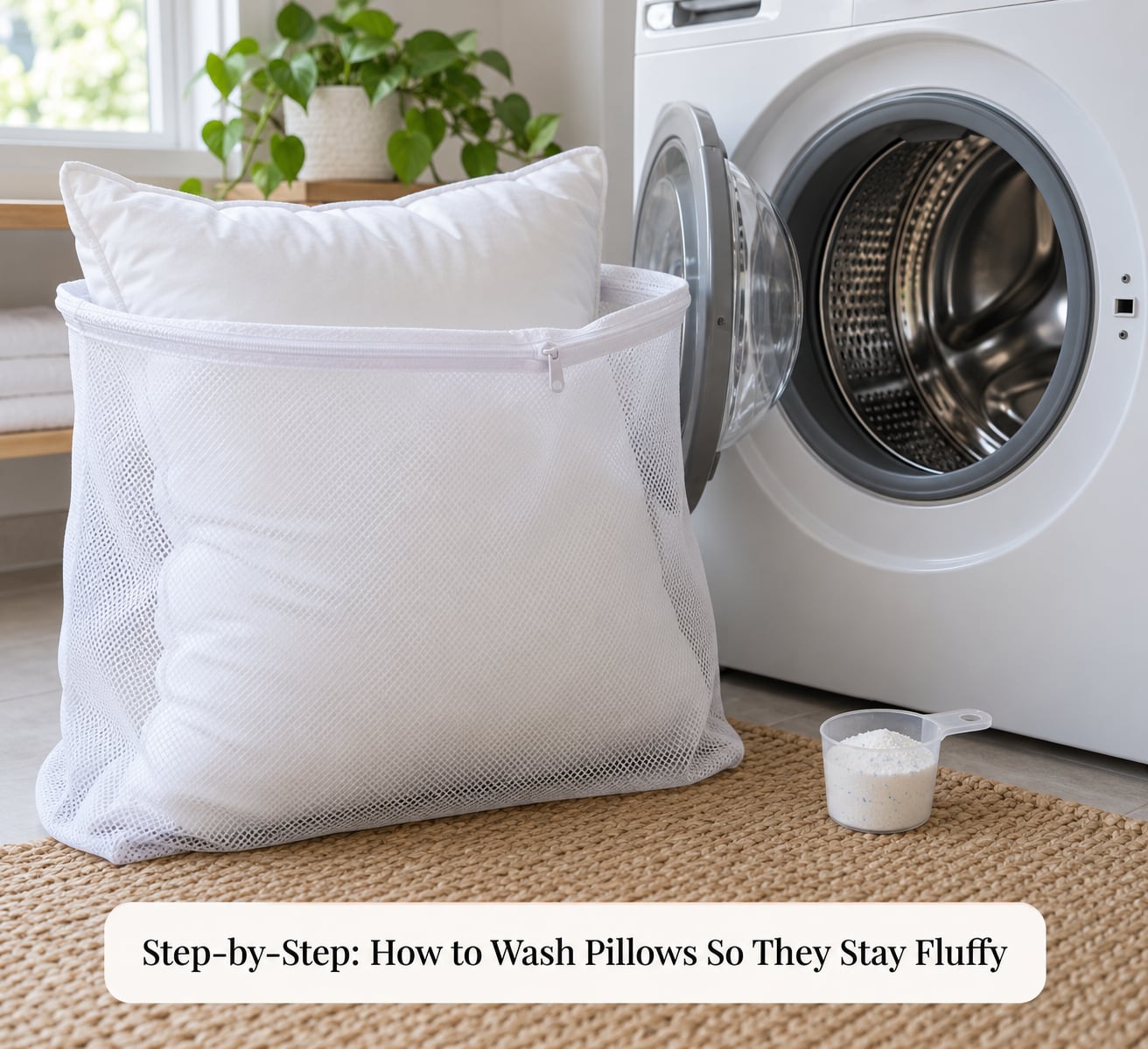
Eight steps, in this order. Most pillows that come out lumpy skipped step six or rushed step seven.
Check the Care Label and Choose the Right Method
Read the label before anything else, because it overrides every tip in this article. A wash tub symbol with a line under it means machine washable, gentle cycle only; a crossed-out tub means spot clean only; a circle means dry clean only. Down and feather pillows almost always permit a gentle machine wash. Memory foam and latex pillows almost never do — water gets into the open-cell foam and does not come back out. If the label is missing or faded, treat an open-cell foam pillow as hand-wash only, and a clustered or fiber pillow as machine washable on gentle.
Remove the Cover and Pretreat Any Stains
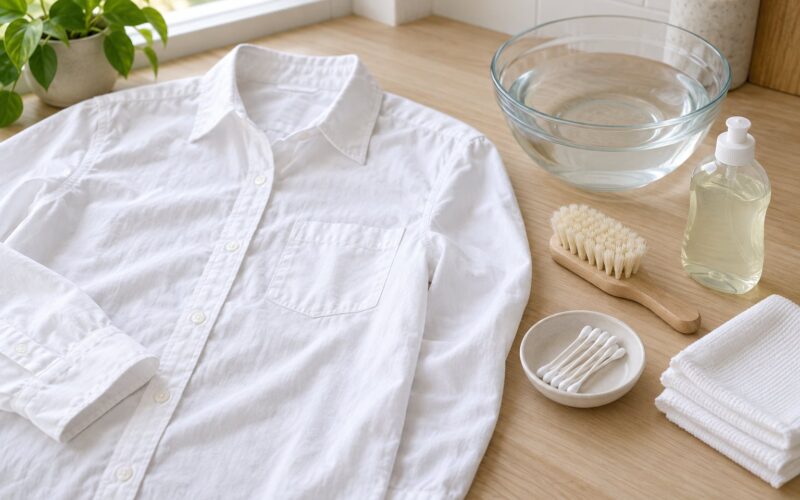
Take the pillowcase and any zippered pillow protector off and wash them on their own, on a normal cycle. They are the only layers your face touches, so they can take more heat and more detergent than the pillow itself. While the cover is off, look at the pillow. Yellowing usually shows as a broad tea-colored cast across the whole fabric, and dark marks often turn out to be makeup or skincare oil rather than dirt.
For those spots, work a small amount of mild liquid detergent into the fabric with your fingers and leave it for ten minutes. Rub it gently rather than scrubbing, which damages the casing threads and lets fill leak. Skip chlorine bleach — it weakens the shell fabric and yellowing gets worse over the following months.
How to Wash the Pillow Without Flattening It
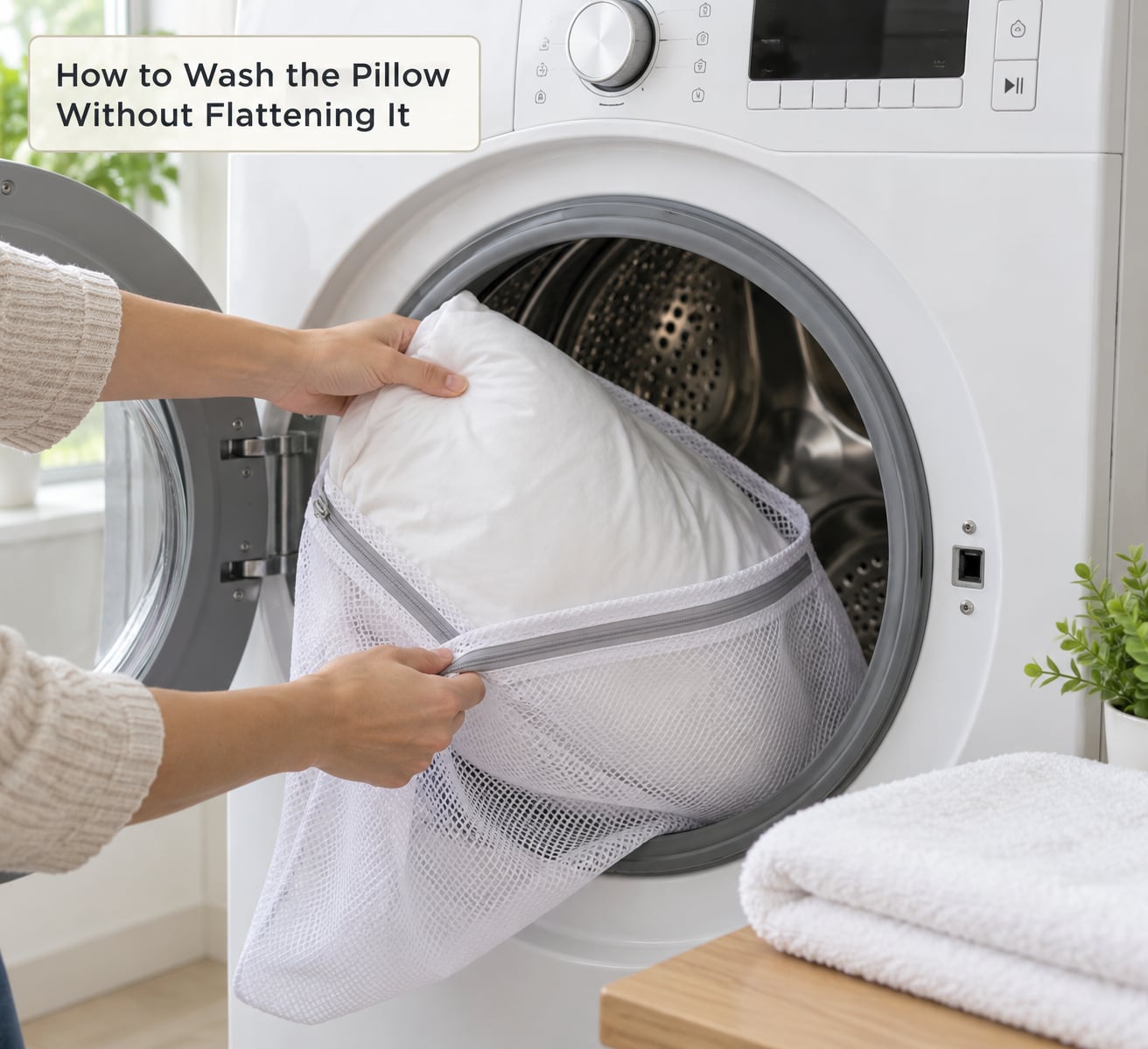
Put two pillows in together to balance the drum. One pillow alone will slop around and refuse to spin, and it ends up unwashed at one end and lumpy at the other. Choose a front-loader or an agitator-free top-loader; a top-loader with a central agitator will beat a down or feather pillow until the seam gives and fill leaks into the drum. Fill the machine no more than halfway.
Set it to gentle or bulky with cool to lukewarm water, and use a low spin — under 400 rpm if your machine lets you set it. Add roughly a quarter of the detergent you would use for a full load, or a down-wash detergent if you own it. Gel and liquid detergents dissolve in cool water better than powder, which can leave a fine residue in the fill and leave the pillow stiff even after a second wash.
Never add fabric softener, dryer sheets, or scented anything. Softener coats the fibers and blocks whatever loft you spent the dryer rebuilding.
Rinse Thoroughly and Dry Completely
Run an extra rinse cycle, and if your machine has one, run a second. Detergent left in the fill is the single most common reason a clean pillow comes out stiff and clumpy. A useful check: press the wet pillow firmly against your palm and look for foam or a slippery film. Squeaky or slippery means detergent is still in there, so rinse again.
Then the part that actually makes pillows fluffy. Tumble dry on low heat with two or three dryer balls or clean tennis balls, for two to three cycles of 30 to 45 minutes. Pause between cycles, pull the pillow out, and squeeze and redistribute the fill by hand so clumps break apart. High heat is what mats down clusters and fuses synthetic fibers into permanent lumps, so keep it low even if the dryer feels slow.
Do not trust the automatic dry sensor. It reads surface moisture, so the outside feels dry while the core is still soaking, and that damp core turns musty within days and invites mildew. Test the middle of the pillow: press deep into the centre with your palm and feel for coolness. Cool means wet, so run another cycle. Warm and weightless means done.
Common Mistakes That Make Pillows Lose Fluff
Almost every flat pillow traces back to one of these. The left column is what you see, the right column is what to change.
| What you see | Why it happened | What to change |
|---|---|---|
| Pillow is stiff after washing | Too much detergent or residue left in the fill | Use a quarter dose next time and run two rinse cycles |
| Hard lumps that will not separate | High heat drying, or not pausing to redistribute | Tumble low with dryer balls and break lumps apart by hand each cycle |
| Wet in the middle, musty smell within days | Dryer auto sensor stopped too early | Check the core by hand and run extra low cycles until it feels warm |
| Shrunken and stiff after one wash | Hot water and high spin | Cool or lukewarm water, low spin, gentle cycle |
| Fill leaking into the drum | Agitator, or a seam that was already weak | Use a mesh bag, a pillowcase, or an agitator-free machine |
| Yellow cast that washing did not remove | Sweat, drool, and skincare oils built up over time | Oxygen brightener or a diluted hydrogen peroxide soak, then sun |
| Flat and will not loft back up | Fill itself is broken down and past its lifespan | A no-heat dryer refresh may help; if not, replace it |
Two more worth calling out. Washing a memory foam pillow in a machine is the fastest way to ruin one, and it is common because nobody was told. And if your pillow only needs fluffing rather than cleaning, skip the wash entirely: ten to fifteen minutes in the dryer on no heat with a couple of balls will fluff a pillow that is simply flat. That is the most useful trick in this whole guide, and it costs nothing.
How to Keep Pillows Fluffy Between Washings
Fluff your pillows by hand every morning, press the filling back into shape, and flip or rotate them so the fill does not spend all its life compressed in one spot. Washable pillow protectors are worth using on a breathable cotton shell — they keep oil and sweat out of the fill so the pillow can go longer between full washes, and they are the layer you wash most often.
Give your bedroom airflow. Pillows hold dust mites and skin debris even when they look clean, so stand them near an open window on a dry day, or run them through the dryer on a no-heat air-only cycle for a few minutes. Direct sun helps with a musty smell but fades colors, so keep it to a couple of hours on the shell, not on the fill.
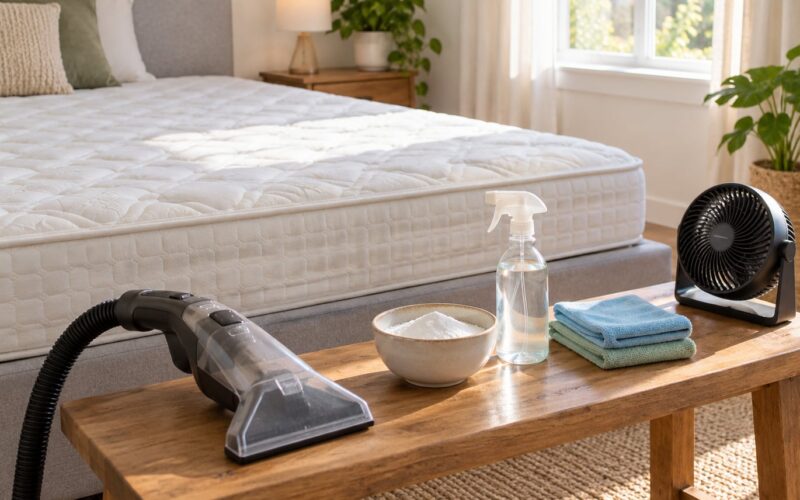
On frequency, match the wash to your habits. Twice a year suits most people who sleep cool and do not have pets. Every three to four months makes sense if you sweat heavily, eat in bed, or share the bed with an animal. Anyone dealing with allergies or asthma benefits from washing at that cadence too, since dust mites thrive in the fill. Memory foam and latex never go in the machine at all — clean those with a vacuum over a nylon mesh and a hand-wiped surface instead.
If you have no washing machine, a bathtub works. Soak the pillow in cool water with a small amount of mild detergent for an hour, work the water through the fill gently, drain, and rinse until the water runs clear. Press out the water between towels, never wringing or twisting, which tears down clusters. Air drying on a rack with a fan pointed at it takes one to two days.
Frequently Asked Questions
How often should you wash pillows to keep them fluffy?
Most pillows need washing twice a year. Every three to four months is a better cadence if you sweat at night, eat in bed, share the bed with a pet, or deal with allergies or asthma, since dust mites settle in the fill. Always wash the pillowcase and protector more often than the pillow itself, and follow whatever interval the care label states.
Can you wash memory foam pillows in a washing machine?
No. Memory foam is open-cell polyurethane that absorbs water and holds it inside the foam, so machine washing can leave the core saturated for weeks, flattened beyond repair, and prone to mold. Vacuum the pillow through a mesh, wipe the surface with a damp cloth and a small amount of mild detergent, and refresh it in the dryer on a no-heat air-only cycle. Latex pillows are similar.
How should I wash a down pillow without making it flat?
Use cool to lukewarm water, a gentle or bulky cycle, a low spin, and roughly a quarter dose of mild detergent. Wash two pillows together so the drum stays balanced, and skip any top-loader with a central agitator. The fill will look flat and alarming in the water, and that is normal. It is the low-heat dryer cycle with dryer balls that brings the loft back.
What is the best way to dry a pillow so it stays fluffy?
Low heat, plus something in the drum that keeps the fill moving. Two or three dryer balls, wool dryer balls, or clean tennis balls work well, as do rolled towels bound with rubber bands. Run two or three cycles of 30 to 45 minutes and pause between each one to squeeze and redistribute the fill by hand. Air drying takes one to two days and needs a fan.
Can baking soda remove odors from a pillow?
Yes, for light musty or greasy smells. Work a couple of tablespoons of baking soda into a cool bath with mild detergent and soak the washable pillow for an hour, rinse thoroughly, then dry it fully in the sun. Baking soda absorbs odor rather than killing it, so the pillow still has to be washed properly afterward. A white vinegar rinse in the final rinse cycle also helps neutralize residue.
Is washing the pillowcase enough to keep a pillow clean?
No. The pillowcase is only the outer layer. Dead skin cells, sweat, body oils, and dust mites build up inside the fill where nothing reaches them, and that is what makes a pillow smell even when its case is clean. Wash the case and protector every week or two, and wash the pillow itself twice a year, or quarterly if you sweat heavily or have allergies.
Conclusion
Start by reading the care label. That one check tells you whether the pillow goes in the machine at all, and it overrides anything else you read today. If it is washable, use cool water, a gentle cycle, a quarter dose of mild detergent, and two rinses.
Then give the dryer the attention it deserves: low heat, dryer balls, two or three cycles, a pause in between to work the lumps apart, and a hand check in the middle of the pillow before you put the cover back on. Washing gets a pillow clean. Drying is what makes it fluffy — that second half of how to wash pillows so they stay fluffy is the one most people skip. Fluff it by hand each morning, wash the case often, and the pillow should hold its loft for years.