Knowing how to brush a dog that hates brushing comes down to patience and tiny steps, not force. You rebuild the association between the brush and something good, one short session at a time, and you stop while your dog is still relaxed rather than when it is already upset. Expect to work on it for a few weeks, not one afternoon.
If you want the short version before you read further, here is the plan in five moves:
- Put the brush down where your dog can see it and walk away. No touching.
- Reward any look at the brush, then reward a sniff or a step toward it.
- Touch the brush to your dog’s back for one second, then give a treat. That is the whole session.
- Repeat daily, adding one second or one stroke at a time.
- Stay on the areas your dog enjoys being touched, and leave belly, ears and feet for last.
Table of Contents
- 1Why Does My Dog Hate Being Brushed?
- 2When the brush itself is the trigger
- 3When the aversion is actually pain
- 4Four failure modes, four different fixes
- 5What You Need
- 6Matching the brush to the coat
- 7The rest of the setup
- 8What to use when you have no brush
- 9Step-by-Step: How to Brush a Dog That Hates Being Brushed
- 101. Check the coat and choose the right brush
- 112. Start with a calm introduction
- 123. Brush in short, low-stress sessions
- 134. Use treats and a predictable routine
- 145. Handle sensitive areas without forcing
- 156. Finish quietly and practise regularly
- 16The six-week desensitization calendar
- 17Common Mistakes
- 18Holding your dog still or calling in help to pin him
- 19Brushing when the dog is already tired or wired
- 20Sessions that get longer as the dog gets more upset
- 21Using a rake or a pin brush on a coat full of knots
- 22Punishing the fear
- 23Skipping the coat entirely
- 24Adjustments for Puppies, Seniors and Tricky Coats
- 25Frequently Asked Questions
- 26Why does my dog hate being brushed?
- 27What can I use to brush my dog if I don’t have a brush?
- 28How long should a brushing session be for a nervous dog?
- 29Should I hold my dog still or get help to restrain him?
- 30Should I use a muzzle to brush an anxious dog?
- 31When should I take my dog to a groomer or a vet?
- 32Conclusion
Why Does My Dog Hate Being Brushed?
Most dogs who resist brushing are not being defiant. Something got linked to the brush, usually an unpleasant experience, and now the sight of it alone is enough to trigger avoidance. Three things cause it: an early experience that went badly, a tool that hurts or pulls, or pain the dog does not understand as pain. Until you know which one you are dealing with, every technique is a guess.
Then work out whether it is the object or the sensation. If your dog leaves the room the moment the brush comes out of the cupboard, the trigger is the object, and the fix is pure desensitization. If your dog relaxes around the brush but tenses the instant the bristles touch, the trigger is the sensation, and the tool is the problem.
When the brush itself is the trigger
Fear conditioning is the usual culprit. Dogs that were groomed by force, held down, or handled by someone rushing through it keep the memory long after the coat is clean. The introduction that owners most often report as working is deliberately boring: bring the brush out, let the dog see it, give a treat, and only then touch. The boring part is the point, because boring is safe.
A Cavapoo whose tail stayed low and whose breathing visibly changed at every brushing attempt is not being stubborn. That is a dog whose body had already decided the brush was trouble, and no amount of coaxing gets past that in one afternoon.
When the aversion is actually pain
Mats pull hair out from the skin and tug at it every time the coat moves. A dog who has learned that brushing pulls is right to object. Book a vet visit if your dog flinches at touch in places they used to tolerate, yelps during grooming, has a new sore, lick at one spot constantly, shows hair loss or a crusty patch, limps, or has suddenly lost tolerance for handling they used to accept. A sudden change in a dog who always liked being touched is the detail vets care about most.
Four failure modes, four different fixes
| What your dog does | What it means | What to do first |
|---|---|---|
| Fights: lunges, swats, growls, tries to grab the brush | The brush predicts restraint or pain | Drop the brush entirely for a few days. Work only on touching your dog calmly while feeding, then reintroduce the brush at a distance |
| Flees: leaves, hides under furniture, bolts at the door | Escape has worked before, so it gets tried again | Chase makes it worse and trains the dog that brushing means a chase. Sit down, ignore the dog, and let them come to you |
| Freezes: goes rigid, stares, stops moving | Shutdown behaviour, not obedience | Stop touching immediately and release. A frozen dog is not tolerating, and she cannot tell you the limit |
| Chomps: takes the brush into her mouth and chews it | Play, avoidance, or an attempt to end the event | Do not tug it away, and never take the brush back harshly. Slide a treat into that side of the mouth and let go, then end on a good note |
Growling deserves its own line. A growl is information, not defiance. The correct response is to back off and lower the difficulty, not to punish or to push through. Training that punishes a growl teaches the dog to skip the warning and go straight to a bite.
What You Need
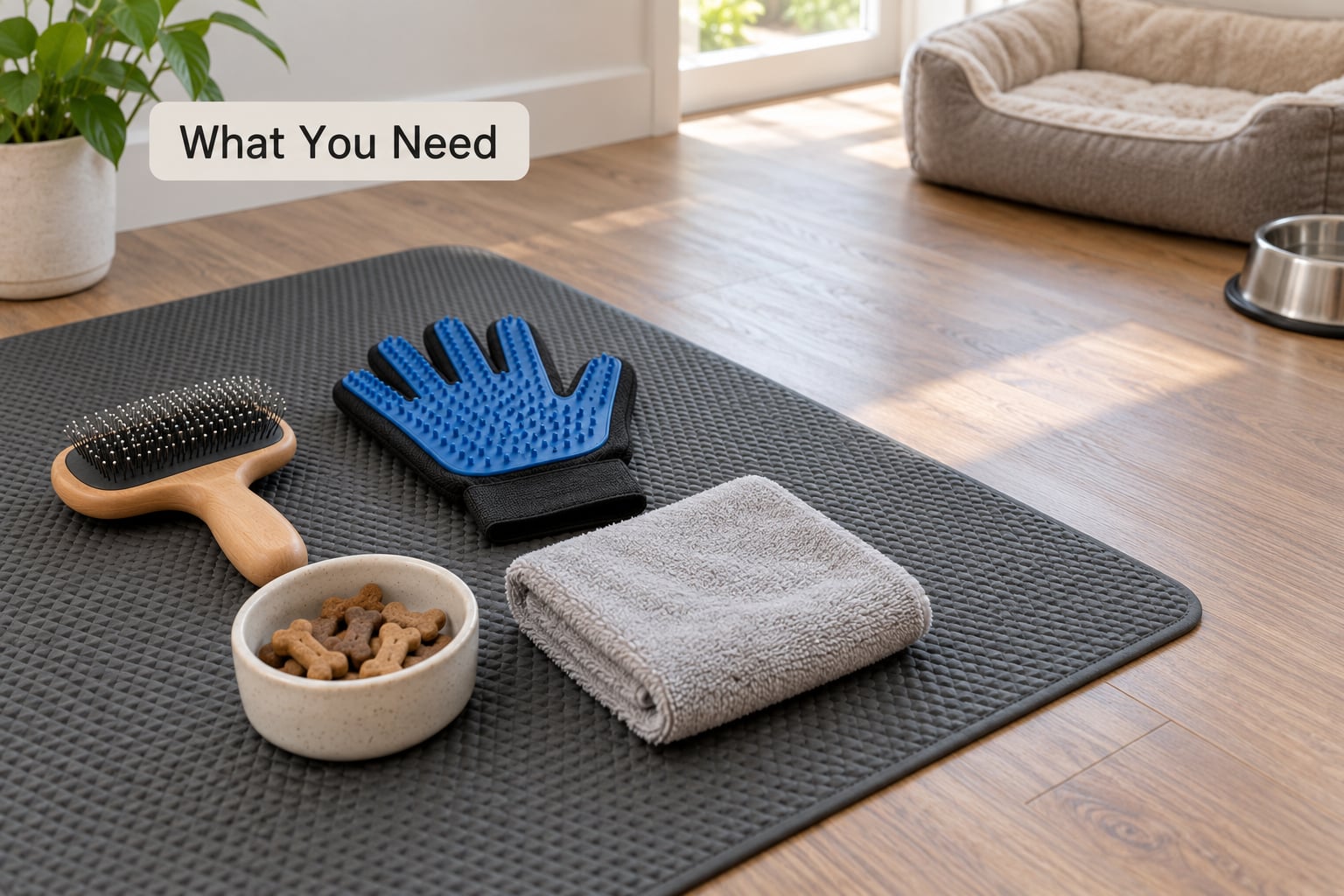
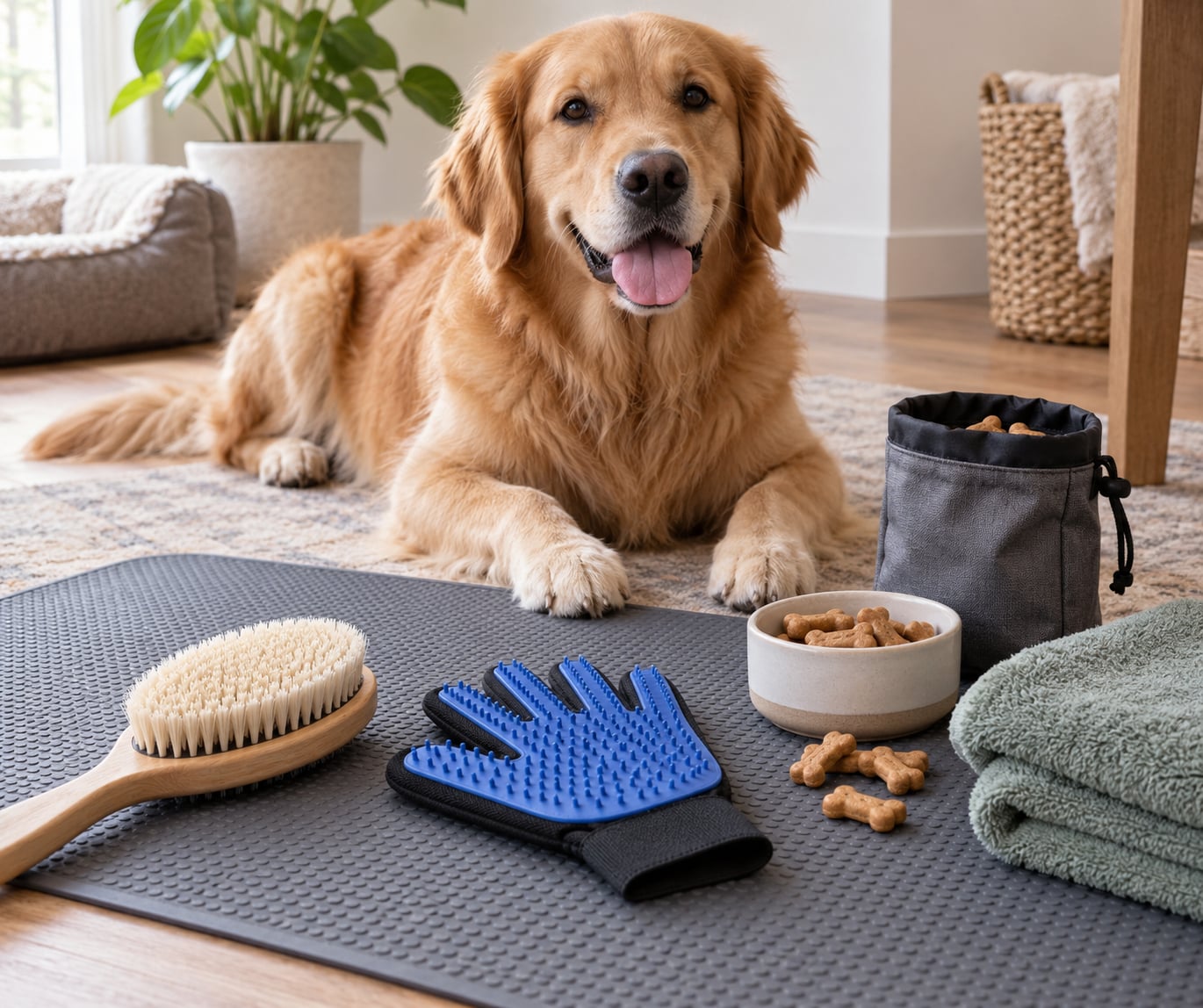
Tools matter less than people expect here. A cheap, gentle brush, something good to eat, and fifteen seconds of quiet will take you further than an expensive gadget used in a hurry.
Matching the brush to the coat
| Brush | Best for | For a nervous dog |
|---|---|---|
| Slicker brush | Curly and wavy coats, doodles, loose hair, light mats | Good, but only if the pressure is light. Many nervous dogs accept a slicker used slowly on the back and refuse it anywhere else |
| Pin brush | Long-haired and double-coated dogs for finishing and fluff | Good. Rounded pins feel more like a hand than metal does |
| Rake or undercoat tool | Dense undercoats and heavy shedding, especially double coats | Risky. It pulls. Only introduce it once brushing is already calm |
| Dematting comb, wide tooth | Small tangles and knots | Good. Tearing through a knot with fingers is worse than a comb |
| Rubber grooming glove | Short coats and light shedding; a good first tool | Excellent. Low pressure and no noise, and it doubles as a massage |
| Soft bristle brush | Puppies, short coats, sensitive skin, finishing | Best first choice. Nothing about it feels like a threat |
The rest of the setup
- High-value treats. Use something unusual enough to be interesting. Keep some in a treat pouch worn on your belt or over your shoulder so your hands stay free for the dog, and keep a few in your actual hand as a backup.
- A lick mat. Peanut butter or wet food smeared on it keeps a dog’s mouth busy for minutes instead of seconds, which solves the problem owners hit constantly: the treat is gone before the brushing starts.
- A nonslip mat. A dog who slips while being groomed learns to associate the brush with falling.
- A small towel. For dogs who have been bathed recently and are used to the sound.
- A quiet room. Not the middle of a busy kitchen.
What to use when you have no brush
This comes up more than it should. Your damp hands work on short coats: wet your fingers or palms, run them gently through the fur with the coat grain, and part the hair with your fingertips to check the skin. A rubber grooming glove does the same job without needing water. For tangles, a wide-tooth comb or even a plastic card can be more comfortable than a brush. And for a dog who will not tolerate anything near his coat yet, simply touching him while he eats builds the same association.
Step-by-Step: How to Brush a Dog That Hates Being Brushed
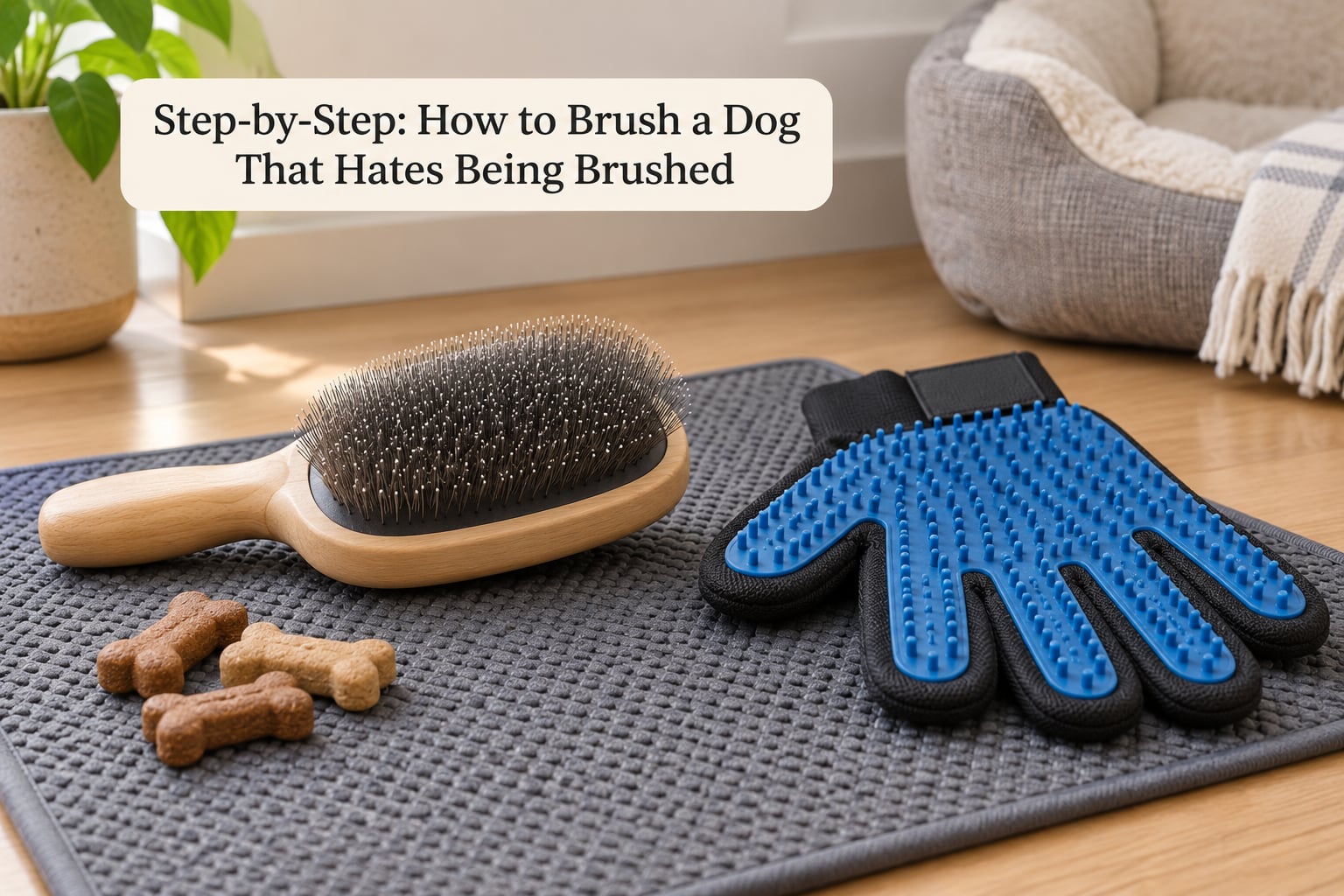
Six steps, spread over days rather than minutes. Move on only when the current step feels boring.
1. Check the coat and choose the right brush
Run your hands through the coat before you bring out any tool. Feel for mats behind the ears, in the armpits, under the collar and around the tail base, where tangles start and hide. Part the fur with your fingers and look at the skin.
If the coat mats tightly, do not brush it out. Pulling a mat removes hair and hurts, and scissors near matted fur risk cutting skin. Most salons clip mats out with guarded clippers, so book a groomer or a vet visit first. Do not bathe a heavily matted coat either, since water tightens mats and makes them worse.
2. Start with a calm introduction
Pick a moment when your dog is already settled, such as after a walk or a nap. Hold the brush at arm’s length, let him look at it, and put it on the floor. Walk away and come back a minute later. If he sniffs it or looks at it, mark the moment quietly and give a treat on the floor.
Some dogs need several days at this stage and nothing more. That is not going nowhere. Owners who succeed tend to keep the introduction deliberately dull for far longer than feels reasonable, and it works because nothing ever happens.
3. Brush in short, low-stress sessions
When he approaches the brush calmly, touch it to his back for one second, take it away, and treat. One stroke and one treat, then stop. The goal of the first month is that the brush becomes boring.
Thirty to sixty seconds is a full session at the start, once or twice a day. Watch for the amber signals in the table below and stop before you hit red. Add one second, or one more stroke, only after several sessions have felt uneventful.
4. Use treats and a predictable routine
The reward has to arrive while the brush is still touching him, not afterwards, because afterwards he has already decided the brushing part was the bad bit. A lick mat with peanut butter does the same job on a longer timer and keeps your hands free.
Say one short cue word before you reach for the brush, such as “brush time”, then brush, then treat. Owners using a fixed cue report faster progress because the dog stops having to guess what is coming.
5. Handle sensitive areas without forcing
Stay on the shoulders, chest and back for as long as it takes. The belly, inner thighs, feet, ears and tail base have thinner skin and more nerve endings, so most dogs need those last and some never tolerate them at home.
To approach a sensitive area, touch your dog there with your hand, treat, and stop. Then add the brush to your hand for one stroke. Repeat the same step ten times before you try again. If your dog skips meals, hides from you, or the reaction gets worse across a week, stop and talk to a vet or a certified behaviorist rather than pushing through.
6. Finish quietly and practise regularly
End while he is still relaxed. Say “all done”, give a treat, put the brush away where he can see you put it, and go do something boring. Never end a session by taking something away, and never punish.
Then come back the next day. Owners who try once a week for an hour mostly train a dog to dread the weekly event. Two minutes daily beats an hour every Sunday.
| Signal | What you are seeing | What to do |
|---|---|---|
| Green | Loose body, neutral or wagging tail, taking treats, leaning in or lying down | Carry on and build the session by a few seconds |
| Amber | Lip licking, yawning, ears pinned or back, tail low or tucked, glancing away, slowing down | Stop brushing. Treat, pause, and only continue if he relaxes within a few seconds |
| Red | Freezing rigid, snapping or lunging, growling, barking, fleeing, panting hard, whale eye | Put the brush down immediately and release him. Lower the difficulty at the next session |
The six-week desensitization calendar
Most dogs need somewhere between two weeks and several months. Six weeks is a realistic spread, not a promise, and slipping back a stage is normal.
| Week | Goal | What success looks like |
|---|---|---|
| 1 | Brush exists, no touching | He walks past it without leaving the room |
| 2 | Brush on the floor and touched by you | Sniffs it, maybe pawing at it, still eating normally |
| 3 | Brush touches the back for one second | One stroke and a treat, with no tension |
| 4 | Sessions of 30 to 60 seconds on shoulders and back | He can be brushed and stop at the word “all done” |
| 5 | Longer sessions and a second area | Side and chest added; tail base still untouched |
| 6 | Handle larger areas of the coat | Whole-body brushing with breaks, belly maybe still off limits |
Common Mistakes
Holding your dog still or calling in help to pin him
This is the most common failure and the one that costs the most time to undo. A dog held down for brushing learns that the brush means being trapped, and next time the resistance comes earlier and harder. Cooperative care, the approach groomers and behaviorists use, means the dog opts in and can opt out at any moment, which is why it produces a dog you can actually brush later.
If you need physical control for safety in the short term, use it for one short session only, and pair the whole thing with food so the memory being written is not purely bad. Then go back to step two and start over properly.
Brushing when the dog is already tired or wired
Do not brush right before a meal, right after a meal, or in the middle of a walk when the dog is still wound up. Pick a calm window, ideally after exercise and a settle, and keep the same time each day.
Sessions that get longer as the dog gets more upset
The instinct is to push through the difficult part. Do the opposite. If your dog is tolerating a minute and starts to tense, stop at the last calm moment, not the worst moment. Ending early is what makes tomorrow possible.
Using a rake or a pin brush on a coat full of knots
Wrong tool, wrong result, and pain at the end. Use a slicker on loose hair, a wide-tooth dematting comb on small tangles, and a groomer for anything tight to the skin.
Punishing the fear
No scolding, no grabbing the muzzle, no turning the brush into a game of tug. All of it teaches the dog that your presence makes the thing worse. If you are at the point of shouting, end the session and start again tomorrow with less ambition.
Skipping the coat entirely
Long stretches without brushing are what turn a manageable dog into a matted one. If you are stuck, keep doing the small things: your damp hands, the glove, or a quick finger check for knots in the areas your dog tolerates. That is still maintenance.
Adjustments for Puppies, Seniors and Tricky Coats
Puppies. Two minutes of brushing on a habit they have not outgrown yet is worth more than a long session later. Handle paws, ears and feet in tiny steps even when they are young, because that is where adult dogs tend to have trouble.
Seniors. A stiff or arthritic dog may flinch at contact for reasons that have nothing to do with the brush. Keep to the back and sides, use a soft bristle brush, and check with your vet if the flinch is new.
Double-coated dogs. Huskies, malamutes and similar dogs shed their undercoat twice a year and need more brushing than usual in that window. Rakes pull, so introduce one only after brushing is already calm.
Doodles, poodles and other curly coats. These mats hide behind the ears and in the armpits and they tighten when you brush the top layer over them. Check those spots by hand weekly, use a slicker only on small tangles and less sensitive areas, and do not try to brush a mat out because it hurts.
Frequently Asked Questions
Why does my dog hate being brushed?
Usually because something got linked to the brush. That might be an early experience that was rushed or forced, a tool that pulls the coat, or genuine pain from mats the dog does not understand as pain. Work out whether the trigger is the object or the sensation. If he leaves the room when the brush appears, it is the object. If he relaxes near it but tenses on contact, check the tool and check for knots.
What can I use to brush my dog if I don’t have a brush?
Damp hands or fingers work well on short and medium coats: wet them, run gently through the fur with the coat grain, and part the hair to check the skin. A rubber grooming glove does the same without water. For tangles, a wide-tooth comb or a plastic card is more comfortable than fingers. If your dog will not accept any tool yet, touching him gently while he eats builds the same good association.
How long should a brushing session be for a nervous dog?
Thirty to sixty seconds is plenty at the start, once or twice a day. One stroke and one treat counts as a session. Build only in small increments, adding a second or an extra stroke after several uneventful sessions rather than in the same week. Owners who try an hour once a week tend to train a dog to dread the weekly event, while two calm minutes daily builds tolerance far faster.
Should I hold my dog still or get help to restrain him?
No. A dog held down for brushing learns that the brush means being trapped, and the resistance gets earlier and harder next time. Cooperative care, where the dog opts in and can opt out, is slower for a week and far faster for a year. If you need physical control for safety once, keep it very short and feed through the whole session, then restart from the introduction stage.
Should I use a muzzle to brush an anxious dog?
A muzzle is a safety tool for trained handlers and professionals, never a way to get through grooming faster, and it is never a punishment. If your dog is showing hard mouth behaviour around the brush, book a vet visit and ask about a referral to a certified behaviorist or a Fear Free trained professional. Forcing grooming with equipment on usually teaches the dog that the equipment predicts restraint.
When should I take my dog to a groomer or a vet?
See a vet if your dog flinches at touch they used to tolerate, yelps during grooming, has a new sore, licks one spot constantly, shows hair loss or a crusty patch, limps, or has suddenly lost tolerance for handling. See a groomer if the coat has tight mats close to the skin, because brushing them out pulls hair and hurts, and scissors near matted fur can cut skin.
Conclusion
Do one thing today: pick the gentlest tool you own, a rubber glove or soft bristle brush will do, put it on the floor where your dog can see it, and walk away. Reward him for coming near it. When he is relaxed about the object itself, add a single stroke on his back and a treat, then stop. That is how to brush a dog that hates brushing, one uneventful moment at a time.