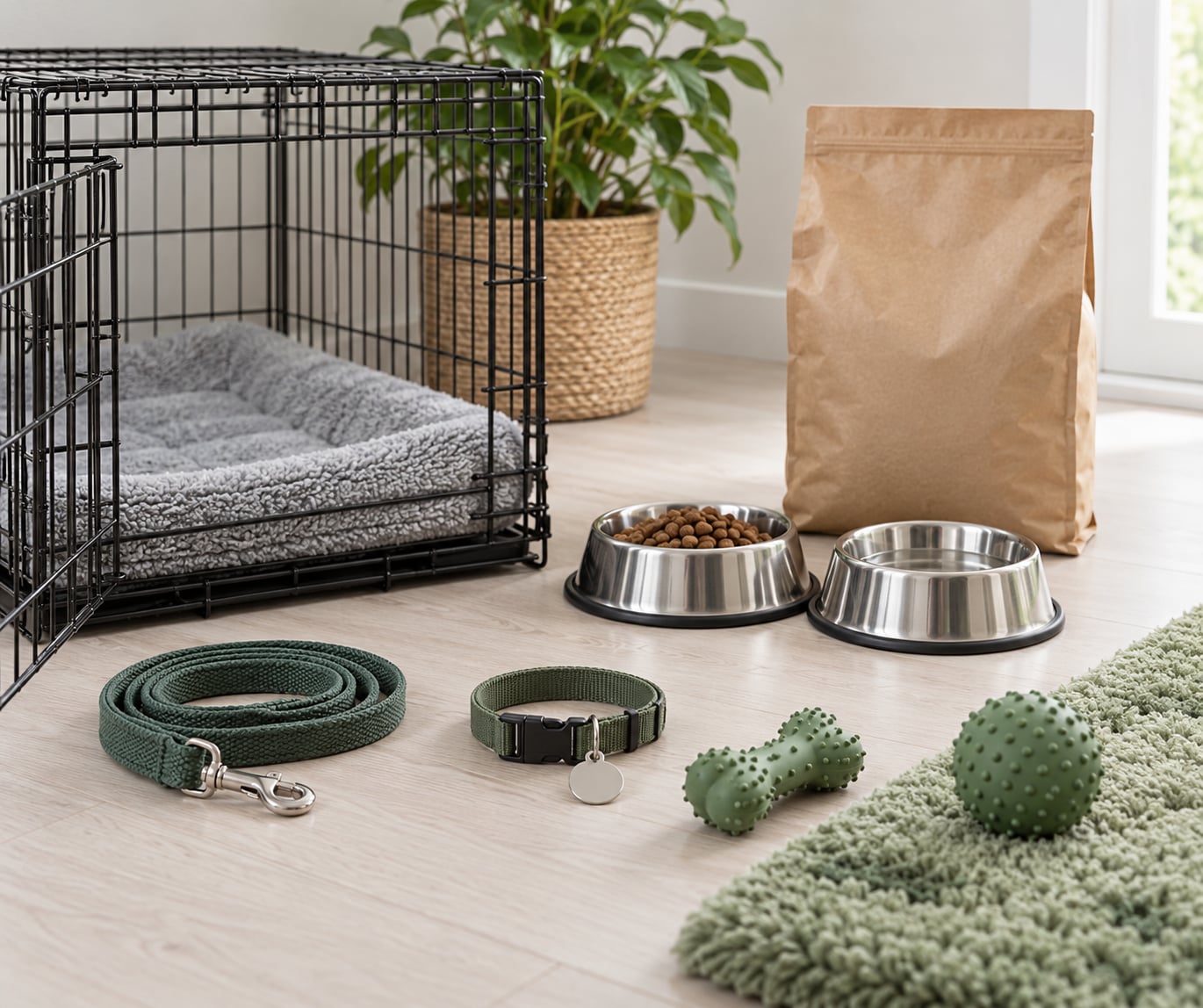
What to buy before bringing home a puppy comes down to six categories: food, bowls, a properly sized crate or playpen, a bed, a collar and leash with identification, and safe chew toys. Add training treats, cleaning supplies and a grooming kit and you have a complete starter kit. Most of it fits in one afternoon of shopping.
The reason to shop early is that a puppy arriving at eight weeks has no manners, no vaccination record in hand and a mouthful of teething pain. Missing gear on day one means chewed cords, soaked floors and an unidentified dog slipping out a door. Getting ahead of it takes a few hours, not a fortune.
One more thing to do before pickup day: book the first veterinary appointment. Shelters and breeders will often tell you which vaccines your puppy already has, so you can schedule the visit that completes the series rather than duplicating it.
Table of Contents
- 1What to Buy Before Bringing Home a Puppy at a Glance
- 21. Puppy Food
- 32. Puppy Bowls
- 43. A Properly Sized Crate or Playpen
- 54. Puppy Bed
- 65. Leash, Collar, and Identification
- 76. Puppy Chews and Safe Toys
- 87. Training Supplies
- 98. Puppy-Safe Cleaning Supplies
- 109. A Grooming Kit
- 1110. Puppy Records and Safety Essentials
- 12Frequently Asked Questions
- 13What should I buy first for a new puppy?
- 14Do I need a crate before bringing my puppy home?
- 15How much puppy food should I buy at first?
- 16Should a puppy sleep in a crate or on a bed?
- 17What toys are safe for a new puppy?
- 18How soon should a puppy see a veterinarian?
- 19Conclusion
What to Buy Before Bringing Home a Puppy at a Glance
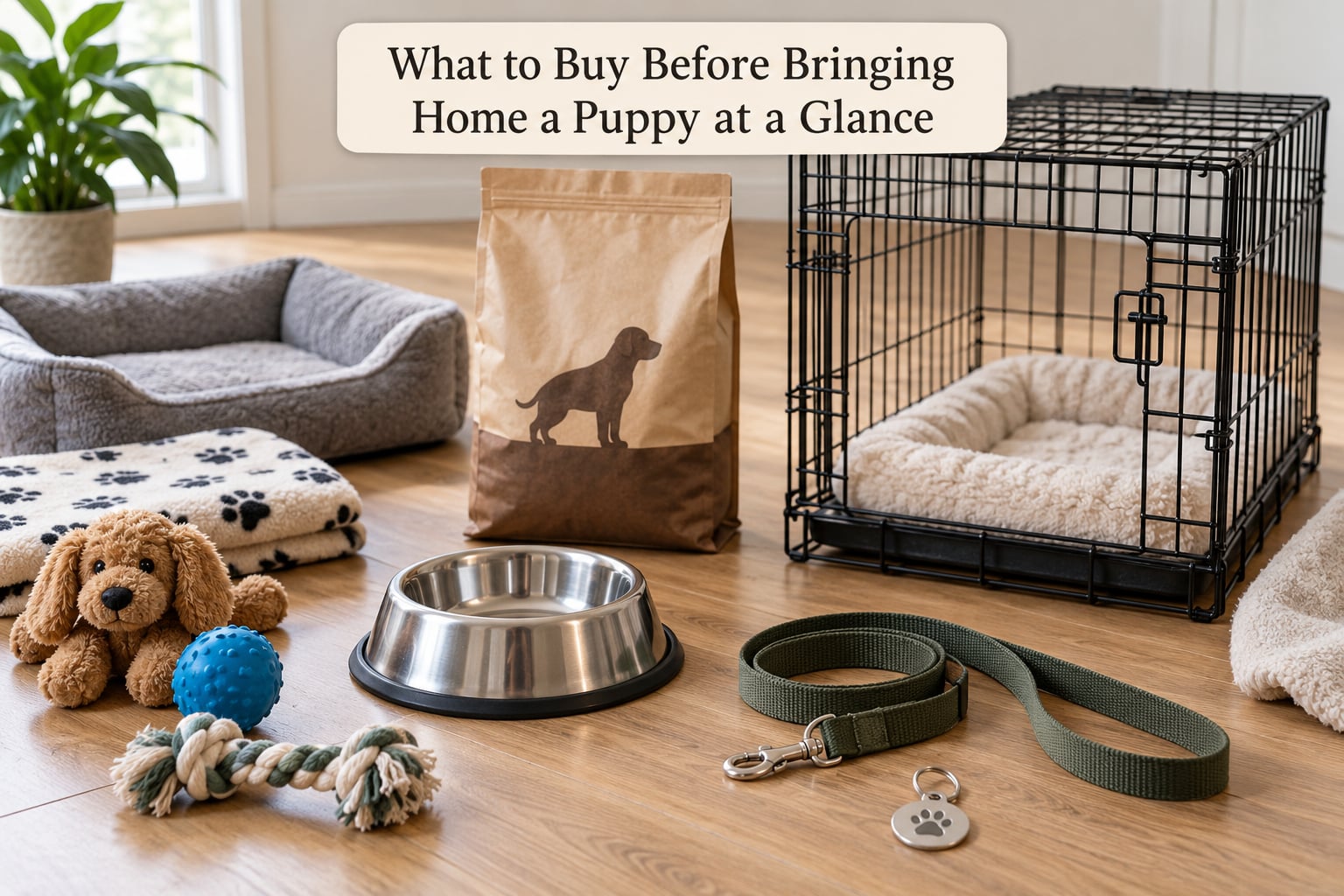
Here is the short version, with the timing that actually matters. Anything marked for day one should be in the house before the puppy arrives. Everything in the third column can wait until you know your dog.
| Supply | What it does | When you need it |
|---|---|---|
| Puppy food | Nutrition for growth; ideally the breeder’s or shelter’s exact food | Day one |
| Food and water bowls | Shallow, wide, non-slip so nothing tips or rubs a muzzle | Day one |
| Crate or playpen | Safe sleeping spot, toilet-training aid, decompression zone | Day one |
| Bed or crate pad | Comfortable sleep surface in her own scent | Day one |
| Collar, leash, ID tag | Walking gear plus identification if she gets out | Day one |
| Chew toys and puzzle toys | Teething relief and mental work | Day one |
| Treats and clicker | Rewards for name response, housetraining, leash manners | Day one |
| Enzyme cleaner | Removes urine scent so accidents do not repeat | First week |
| Grooming kit | Brush, clippers, tear-free shampoo, toothbrush | First week |
| Baby gates and long line | Block stairs and rooms; recall training on walks | First week |
1. Puppy Food
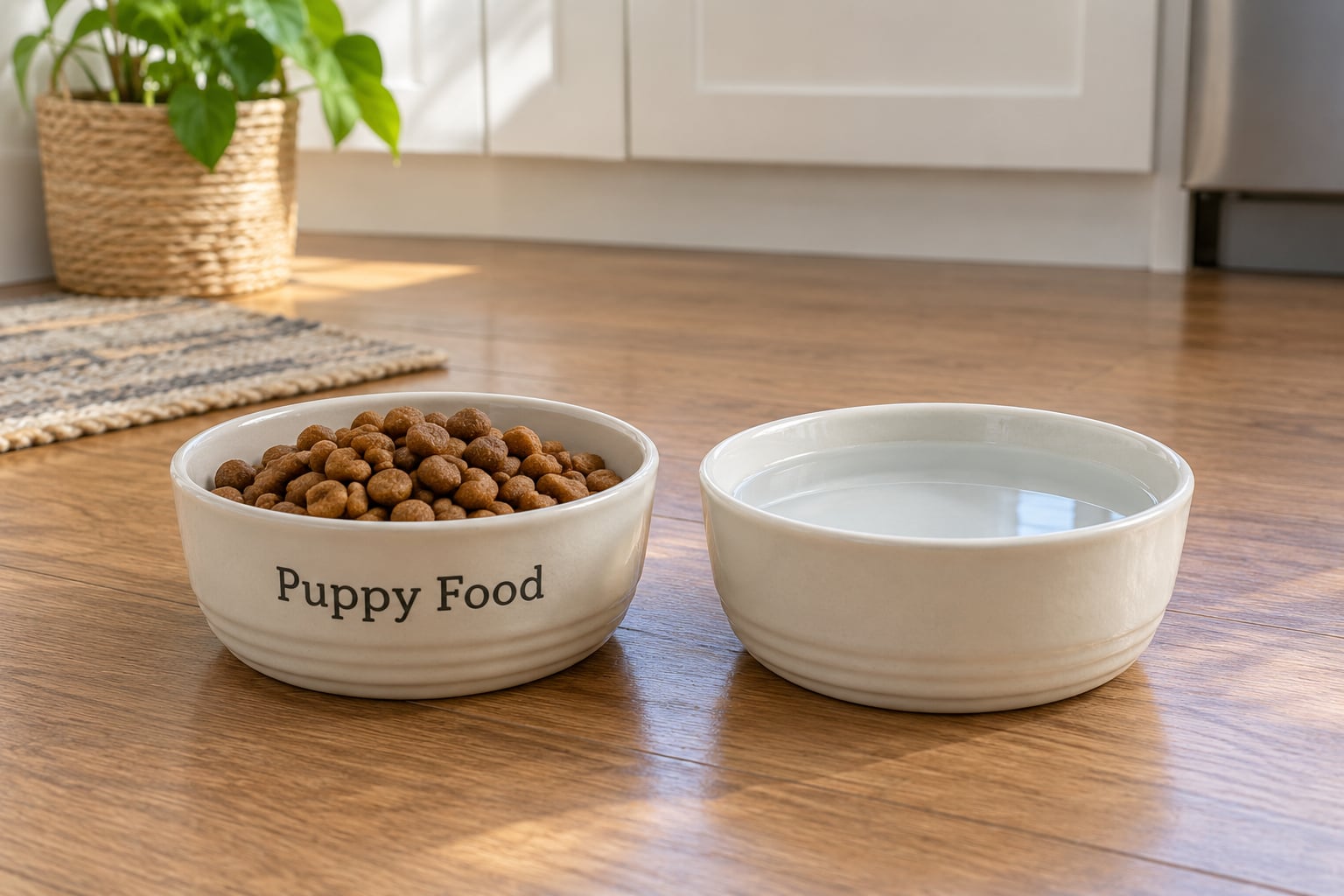
Buy the food the breeder or shelter is already feeding, in a small bag, before you switch anything. Puppies often refuse an unfamiliar bowl for a day or two, and a rushed food change is the fastest route to loose stools. This is the single most common stumble in the first week.
Once your puppy has settled, change food gradually over roughly seven days, mixing a little of the new food in at each meal and increasing the ratio. Choose a food labelled complete and balanced for growth, which means it is formulated to feed a puppy on its own. Ask your veterinarian about portion sizes, because growth rates vary enormously by expected adult size.
Do not buy specialty diets, grain-free food or supplements unless your veterinarian recommends them. What you do need is a measuring cup or kitchen scale, because free-feeding makes it impossible to know whether she is eating enough.
2. Puppy Bowls
Pick bowls that are shallow and wide rather than deep and narrow. Puppies eat with their noses down, and a deep bowl presses food against the roof of the mouth, which makes messy eating and can contribute to bloat in breeds prone to it. A wide, shallow dish keeps food level and slows the gulp.
Stainless steel is the most practical material because it does not hold scent and survives a dishwasher. Ceramic works well for slow eaters, though it can chip. Add a rubber non-slip mat underneath, since bowls that slide across a kitchen floor teach a puppy that food comes from moving targets.
Breed matters more than most people expect. Flat-faced breeds like bulldogs and pugs need bowls with a raised or angled rim so they can breathe while eating. Long-eared breeds like spaniels and setters need bowls with a raised centre to keep ears out of the food. Toy breeds need very small bowls. Skip pedestal feeders and elevated bowls for now; they add height without adding function.
3. A Properly Sized Crate or Playpen
This is where most first-time owners overspend and then have a problem on night one. Buy a crate sized for the puppy now, not the dog she will become at eighteen months. The sizing rule is simple: enough room to stand up without crouching, turn around and lie down comfortably, but not so much space that she can potty in one corner.
Wire crates usually come with a divider panel, which solves this neatly. Set the panel for her current length and move it up as she grows, so one crate covers a full year. Buy the adult size if you can, but check that the divider is included.
Not every home needs a crate. An exercise pen with a washable pad, sometimes called a playpen, is a good alternative, particularly in small apartments or when you work long shifts. Breed communities often recommend running both together, with the crate open inside a sectioned pen. Keep the crate in a calm area of the home, not in a laundry room or the middle of the kitchen.
What you should not buy yet is a giant adult crate with no divider. Owners on puppy forums describe the same outcome repeatedly: a puppy that soils the far corner of a huge crate, and an owner who blames the puppy.
4. Puppy Bed
A crate pad or a low-profile dog bed works best for a young puppy. Low is the important word: bolsters, raised edges and deep foam are for adult dogs, and a puppy that cannot climb out will soil the bed rather than the pad you placed nearby.
Choose something washable in a hot cycle, because a puppy bed will not survive the first month without it. Skip foam stuffing and loose fill that could be chewed and swallowed. A flat washable mat you can toss in the washing machine is the most practical choice.
Two things help a new puppy settle. Place something with your scent on the bed, an unwashed t-shirt works well, and keep the bed in the room where she will sleep rather than moving it around the house for the first few weeks.
5. Leash, Collar, and Identification
Start with a martingale or adjustable breakaway collar and a 4 to 6 foot leash. The fit rule is two fingers between the collar and her neck: snug enough that you cannot slide it over her head, loose enough that you can push two fingers underneath. Check the fit every couple of weeks, because puppies grow fast and collars do not have to be replaced as often as they have to be loosened.
A breakaway collar matters in a house with other dogs, since a snag in a play fight can be serious. Skip martingales in that case and use a well-fitted harness instead.
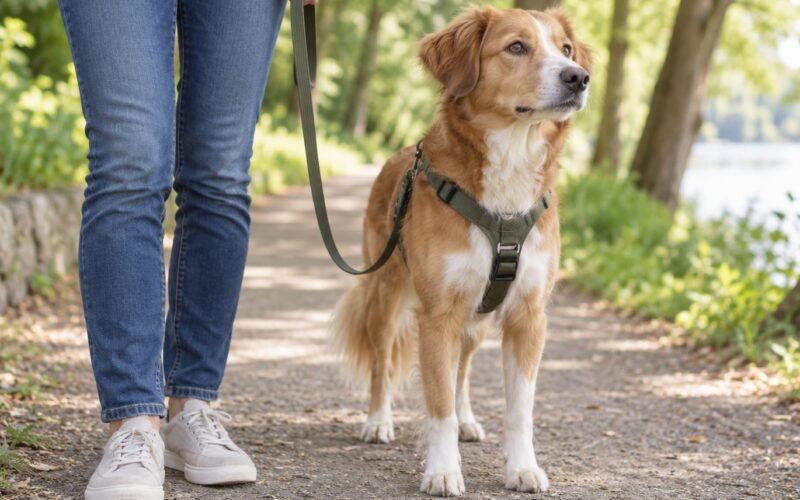
For an eight-week-old with a delicate neck, a lightweight harness is a reasonable first choice and many owners prefer it. The trade-off is that it distributes pressure across the chest rather than the throat, which helps with brachycephalic and neck-sensitive dogs but gives you less control with a strong puller. Fit the harness snugly with no twisting of the straps. Measure across the widest part of the chest, add a little room for growth, and check that two fingers fit underneath the straps.
Identification is not optional. Get a tag engraved with your phone number, and ask the shelter or breeder whether the puppy is already microchipped. If not, book the microchip at your first vet visit and register it with your contact details, because an unregistered chip is only useful to find the dog.
6. Puppy Chews and Safe Toys
A puppy between eight weeks and five months is teething, and the drive to chew is constant. Buy several durable chews sized larger than her mouth so she cannot swallow the whole thing, plus one or two toys that dispense food and keep her busy when you cannot supervise. A stuffed toy is fine for supervised play, but not for leaving alone, because the stuffing and squeaker are choking hazards.
Match the toy to the breed. Short-nosed dogs cannot grip a tall treat stick easily, and power chewers will destroy soft rubber in an afternoon. Rotate two or three toys rather than setting out the whole basket, which teaches your puppy that new things appear when you come home.
Two rules keep everyone safe. Supervise every chew, especially in the first weeks, and throw away anything with torn, cracked or missing pieces. That includes chew toys that have been gnawed down to a size she can swallow whole.
7. Training Supplies
You do not need a training kit. You need small soft treats, a clicker and a treat pouch, and that is the whole list. A clicker costs almost nothing and marks the exact moment of the behaviour you want; a marker pen held in your teeth works too if clicks bother your puppy. Keep training sessions to two or three minutes.
Positive reinforcement is the method veterinary behaviour guidance recommends, and it works with puppies because you are dealing with an animal with no idea what a marker means yet. Reward the name, the eye contact, sitting on request and stepping onto a different floor. Puppy-pad training supplies also belong in this category: a pack of pads, the enzyme cleaner from item eight, and a schedule.
Household logistics count as training supplies too. A baby gate at the top of the stairs is the single most useful safety purchase in a house with stairs. A long training line, 10 to 20 feet, lets you work on recall in an open field before the collar and leash are trusted outdoors.
On house-training frequency: an eight-week-old puppy typically needs a potty break every two to three hours, and after meals, naps and play. That schedule sets how long she can be safely left alone, and it is a short answer at that.
8. Puppy-Safe Cleaning Supplies
Accidents are normal for the first few weeks. What matters is removing the scent, because if any trace of urine remains, she will return to the same spot. An enzyme-based cleaner made for pet urine does this; household bleach and ammonia-based products do not, and for a puppy they add a harsh smell to an already stressful situation.
Keep the kit small: the enzyme cleaner, a stack of old towels, rubber gloves and a handheld vacuum for solid accidents. Soak the area, leave the cleaner sitting for the time printed on the label, then blot with towels. A wet-dry vacuum makes the job faster, and owners generally find it worth the money in the first month.
9. A Grooming Kit
Match the tools to the coat. A short-coated puppy needs a rubber grooming brush and little else. A double-coated breed needs a slicker brush and a deshedding tool, though careful handling around the neck and tail where mats form. Long-eared breeds need weekly checks, because trapped moisture in the ear canal turns into an infection quickly.
The rest is standard: nail clippers or a grinder sized for small nails, tear-free puppy shampoo, a soft towel, and a toothbrush with dog toothpaste. Puppy toothpaste is not a minty human one; the xylitol in many human toothpastes is dangerous for dogs.
The real reason to buy grooming tools early is habituation. Sit with a treat and touch one paw for five seconds, reward, stop. Do the same with ears and feet a few days apart. A puppy who has been handled calmly since week one is far easier to clip than one who first meets clippers at the grooming table. You can start that in week one with no equipment at all.
10. Puppy Records and Safety Essentials
Ask the breeder or shelter for the written vaccination record before you leave, plus the name and phone number of their veterinarian. Some dogs come with only one or two doses, given at six or eight weeks, which means your puppy is not protected against parvovirus until the series is finished. Keep the paperwork in a folder you will actually find, and book that first appointment now rather than in three weeks.
For travel home, use a travel crate or a secured seat belt harness, not a loose dog in the back seat. Bring a leash for the walk from the car, because the first thing a puppy does outdoors is pee, and you do not want her relieving herself in the car.
Now the puppy-proofing, which belongs in the same conversation as buying. Go room by room before pickup day, and it takes an afternoon.
- Kitchen and counters: put away cleaning products, dishwasher tablets, medications, chocolate and anything containing xylitol such as sugar-free gum. Keep the trash lidded.
- Living room: move shoes, socks, children’s toys, remote controls and charging cables out of reach. Cords along baseboards go into cable covers.
- Houseplants: research your specific plants against a veterinary toxic plant list. Lilies are lethal to cats, and several common houseplants irritate or poison dogs.
- Bathroom: store all medicines in a closed cabinet. Human medication is a leading cause of poisoning in dogs, and a single tablet can be serious.
- Bins and closets: secure plastic bags, rubber bands, hair ties, screws and small hardware. Anything small enough to fit in a pocket is a choking risk.
- Doors, gates and stairs: install the baby gate before the puppy arrives, not after the first escape.
If your puppy does get into something, take the packaging with you and call a veterinarian or an animal poison control service. Do not induce vomiting unless a professional tells you to.
Finally, agree on the household rules before pickup day. Everyone in the house should know who feeds, who does the morning potty break, and whether the puppy is allowed on the bed. The first week goes smoothly or badly depending on how consistently the humans behave, not on how the puppy behaves.
Frequently Asked Questions
What should I buy first for a new puppy?
Before pickup day, get puppy food, shallow non-slip bowls, a correctly sized crate or playpen with a washable pad, a collar and leash, an identification tag, a few chew toys, and small training treats. Book the veterinary appointment at the same time. That covers feeding, sleeping, identification and training, which is everything a puppy needs in the first seventy-two hours.
Do I need a crate before bringing my puppy home?
You need a safe small-area setup, and a crate is the most common choice. Buy one sized for your puppy now, not the adult dog, using a divider panel so you can enlarge it over the year. If your puppy whines, that is not the crate being cruel; it is usually a young puppy needing a toilet break or more contact. An exercise pen works as an alternative.
How much puppy food should I buy at first?
Buy a small bag of whatever the breeder or shelter is feeding, enough for about a week. Ask the shelter or breeder for a bag to take home, since it removes the guessing entirely. Only change food after your puppy is eating reliably, then mix the new food in gradually over about seven days. Large-breed puppies need more food than small ones, so check portions with your veterinarian.
Should a puppy sleep in a crate or on a bed?
For the first few weeks, most people keep the puppy in a crate or playpen beside their bed, so she is close enough to hear and smell you but cannot roam the house at night. Many trainers like the puppy to sleep in your bedroom to reduce separation anxiety. Either works. Keep the surface washable and expect accidents until housetraining sticks.
What toys are safe for a new puppy?
Safe toys are sized larger than her mouth so they cannot be swallowed whole, with no sharp edges, loose parts, squeakers or shreddable stuffing. Food-dispensing toys are the most useful because they keep a puppy occupied when you cannot supervise. Remove anything chewed down, cracked or torn. Never leave a new puppy alone with a toy until you have watched how she handles it.
How soon should a puppy see a veterinarian?
Arrange a first visit within the first week of arrival, or sooner if the puppy has not been vaccinated or seems unwell. The visit usually completes the vaccine series, checks for parasites and gives you a chance to ask about food and portion sizes. Bring the breeder’s or shelter’s vaccination paperwork so your vet does not repeat doses your puppy already has.
Conclusion
If you only manage four things before pickup day, make them food, safe containment, identification and a booked veterinary appointment. That is the kit that keeps a puppy fed, contained, findable and protected.
Everything else on this list can be picked up during the first week, and quite a lot of it depends on what your individual puppy turns out to be. Ask your veterinarian about food portions, vaccination timing and anything breed-specific, since they will know the details that matter for your dog’s size and health.