If you have been wondering how to house train a dog in an apartment without wrecking your carpet, it comes down to three things: a strict bathroom schedule, constant supervision, and one designated elimination spot. Take your dog to that same spot after waking, eating, drinking and playing, reward him within seconds, and confine him to a small area whenever you cannot watch. Apartments make this harder than a house with a yard, but the rules stay the same.
Most apartment accidents are not defiance. They are a dog who held it too long, or a spot you never clearly designated. Updated for 2026, this guide covers the routine, the gear, the indoor options, and what to do when progress stalls.
Table of Contents
- 1What You Need
- 2How to House Train a Dog in an Apartment, Step by Step
- 31. Choose one bathroom location
- 42. Set a regular bathroom schedule
- 53. Reward elimination immediately
- 64. Use pee pads indoors when house training a dog in an apartment without a yard
- 75. Clean accidents thoroughly
- 86. Gradually increase unsupervised time
- 9Common Mistakes
- 10Using harsh punishment or scolding
- 11Changing the elimination location too often
- 12Leaving the dog unattended too soon
- 13Failing to remove scent traces
- 14Frequently Asked Questions
- 15How long does it take to house train a dog in an apartment?
- 16How often should an apartment dog go outside to potty?
- 17Are pee pads a good way to house train a dog in an apartment?
- 18How can I stop my dog from peeing in the apartment at night?
- 19What should I do if my dog was house trained and suddenly has accidents?
- 20Conclusion
What You Need
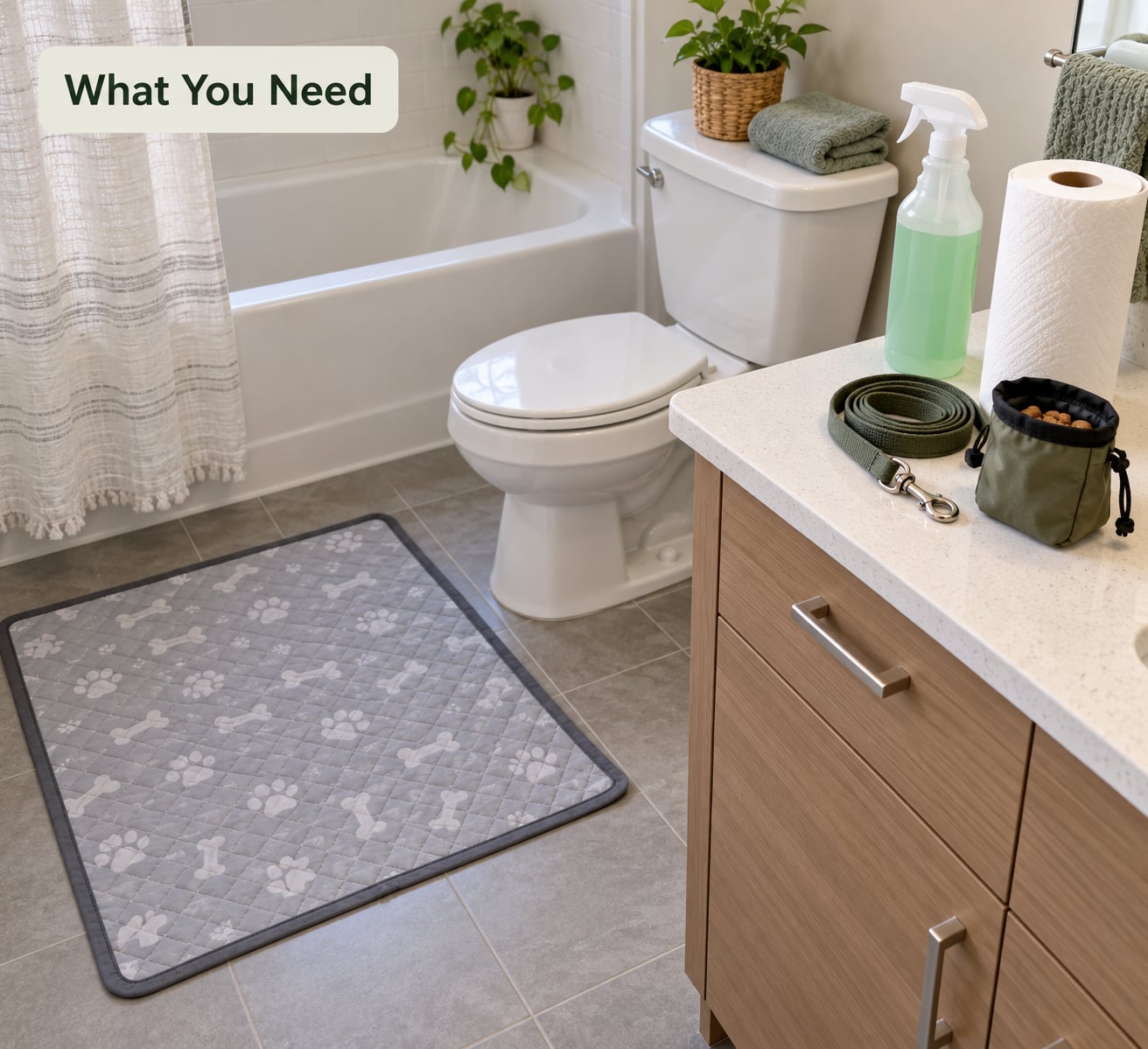
You can house train a dog in an apartment with less gear than most people expect to buy. What matters is that the setup is small, clean and consistent.
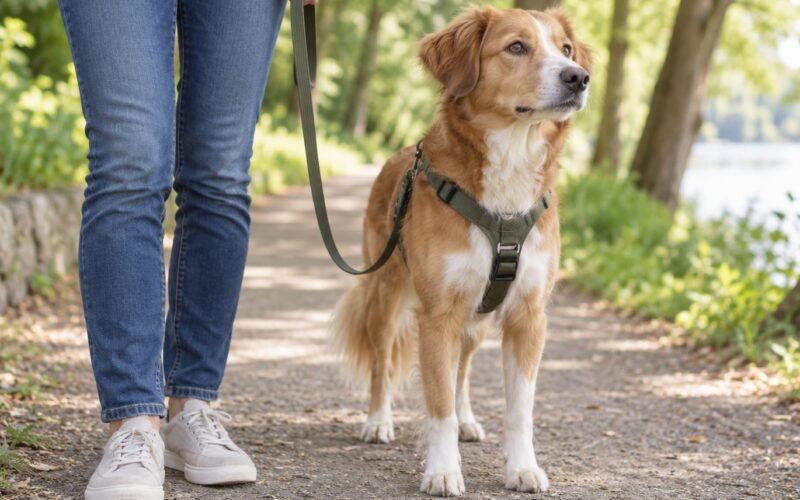
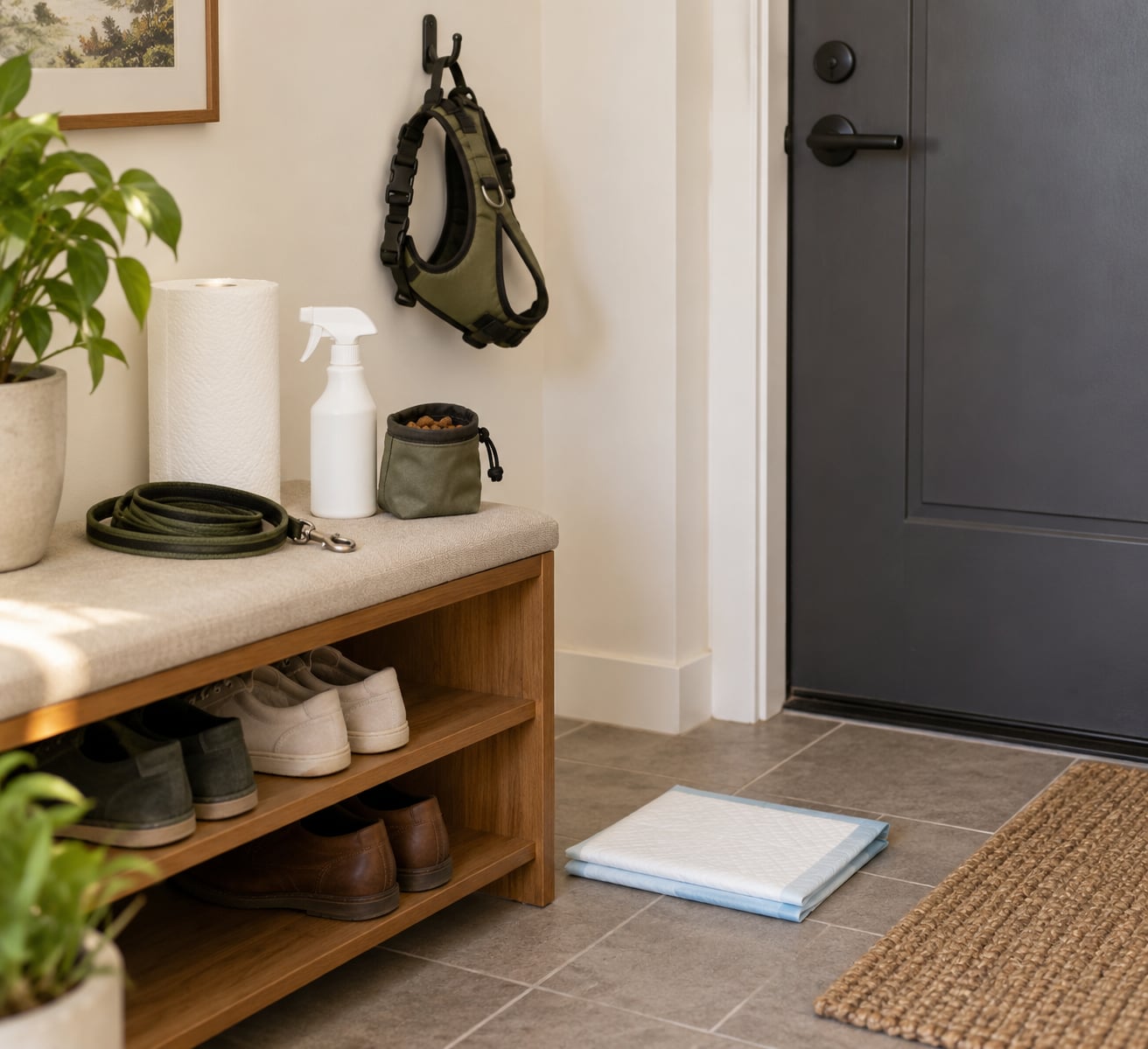
- A leash you can keep on indoors. Clip it to your belt loop so the dog stays within reach and you catch the warning signs fast.
- Small treats kept in a pouch or a treat jar in the elimination area. You want one hand free to open a door, not a bag of food spilling in a hallway.
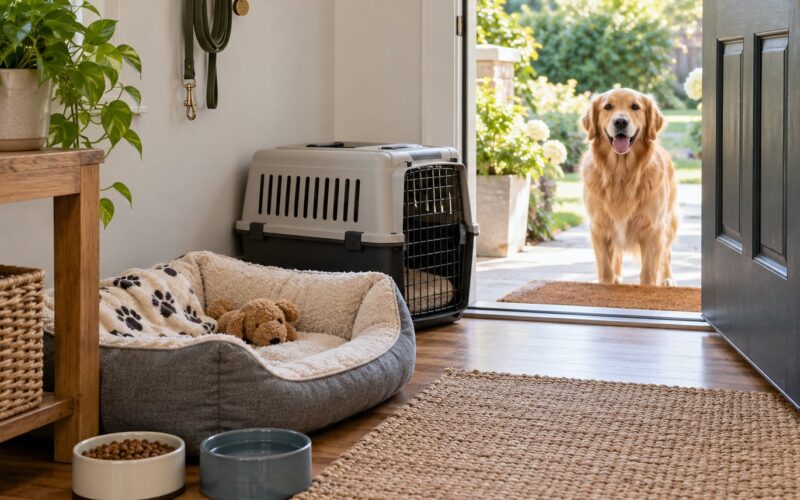
- A crate, playpen, or gated bathroom for the hours you cannot supervise. A crate should be big enough for the dog to stand up, turn around and lie down comfortably, but not much more. A crate with extra room invites corner accidents.
- Pads or an indoor potty if you are not using outdoors full time. See step 4 for when these help and when they hurt.
- Enzyme-based cleaner and paper towels. Not ammonia, not diluted dish soap.
- A written schedule on the fridge, with the clock times filled in. Memory is the weak point in the first two weeks.
- A baby gate if your bathroom is small enough to be the confinement room. This is often the most practical spot in an apartment, because the floor is already wipe-clean.
Skip the diffuser-style pheromone products for now. They are not a substitute for supervision, and most dogs learn faster when the schedule is doing the work.
How to House Train a Dog in an Apartment, Step by Step
1. Choose one bathroom location
Pick the spot before you start and do not move it for at least a month. The most reliable option is the same patch of ground on every trip, chosen for how quickly you can get there and whether other dogs use it. If a communal relief area is ten minutes away, that ten minutes is ten minutes your dog may not be able to hold.
For a high-rise with a balcony, a balcony spot works when the weather cooperates, but you should think hard before relying on it alone. Urine odor concentrates in an enclosed space and gets into the concrete and the railing, and a lightweight pad can blow off the edge in a gust. If you go the balcony route, use something heavy with a sealed base.
Where you can reach the ground quickly, the outdoors still wins. Apartment dog owners on forums say the deciding factor is speed of access, not preference: the dog can only learn to hold if the trip is shorter than the time it takes to become desperate.
2. Set a regular bathroom schedule
Trips happen on triggers, not on vibes. Take your dog out right after waking, within 15 to 30 minutes after every meal, after drinking water, after a play session, and after waking from a nap. On top of those, set a timer for regular intervals through the day.
How long a dog can hold depends mostly on age. The widely used rule of thumb is roughly one hour of bladder control per month of age, and the table below is the schedule most people end up running:
| Dog’s age | Hours between breaks | Notes |
|---|---|---|
| 2 months | 1 hour | Frequent breaks, carry the puppy to the spot if you can |
| 3 months | 2 hours | Add a break after every nap and every meal |
| 4 months | 3 hours | Nighttime accidents still normal |
| 5 months | 4 hours | Most dogs start holding overnight here |
| 6 months | 5 hours | Add a mid-day break for working owners |
| 8 months | 6 hours | Approaching a full workday between breaks |
| 10 months and up | 7 to 8 hours | Two shorter breaks beat one long stretch |
Small breeds need more frequent breaks than large ones for the same age. A Chihuahua at six months often needs the same interval as a Labrador at ten.
If you work nine hours away from home, that schedule is not achievable for a puppy under about six months. Options are a walker or dog-walking app, a roommate on rotation, a second person with a key, or a camera so you can send someone in when you see warning signs. What does not work is hoping.
3. Reward elimination immediately
Timing is everything. The praise and the treat have to land within a second or two of finishing, while the dog is still at the spot. If you reward on the walk back, the lesson you are teaching is that the hallway is where the good things happen.
Use a cue word. Say something short like “potty” or “go out,” then stay quiet. The silence matters: talking, playing fetch or letting the dog chew on a toy turns the trip into playtime, and a dog that is having fun forgets to finish. Wait until the job is done, then mark it with calm praise and one small treat.
You will also want to catch the pre-potty signals. Owners who keep the leash on indoors report that they catch circling, sudden sniffing at the floor, pacing and rapid licking much more often than owners who let the dog wander. The moment you see the signal, go. Do not finish your phone call first.
4. Use pee pads indoors when house training a dog in an apartment without a yard
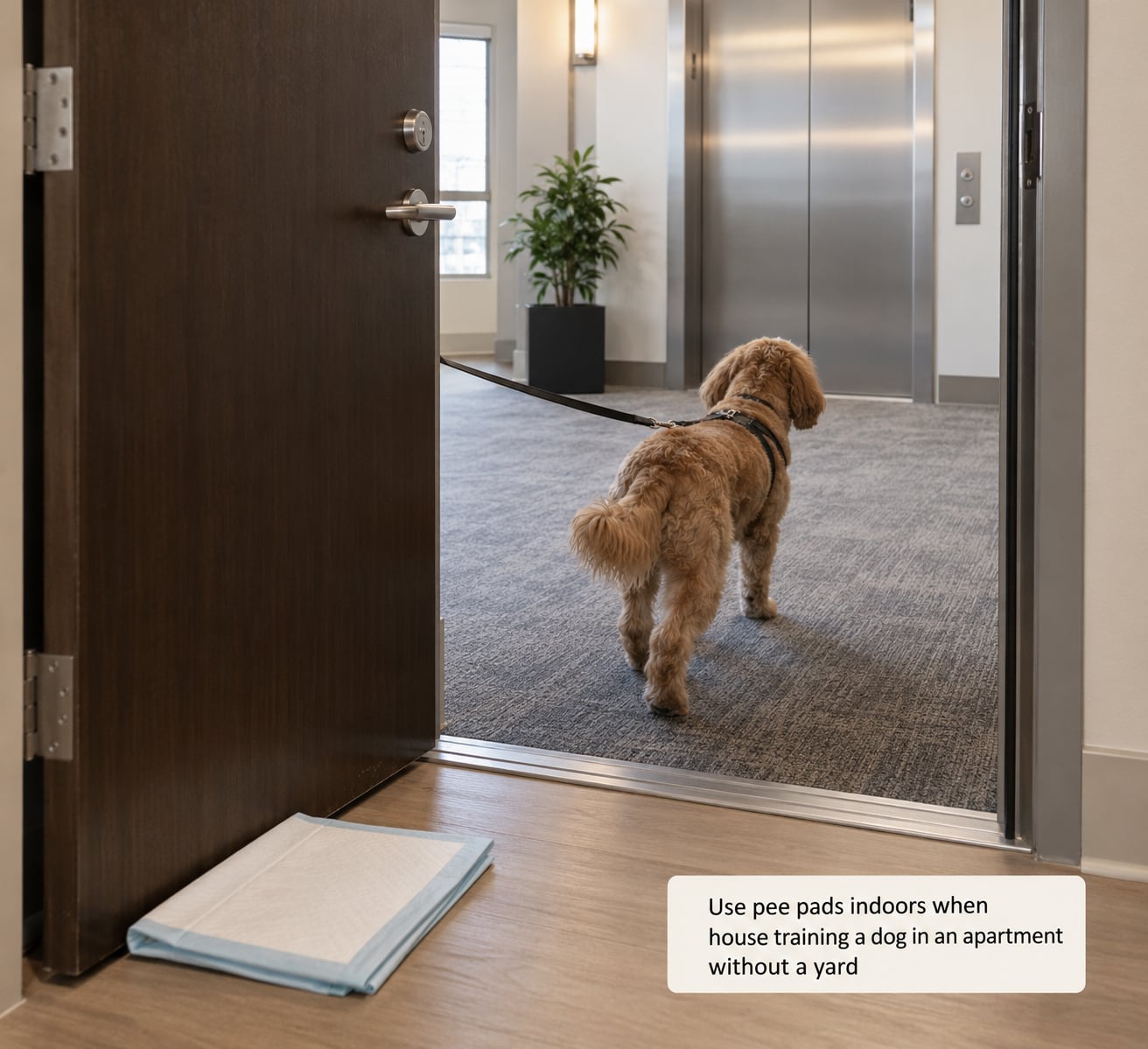
Pads make sense in a few specific situations: a puppy not yet fully vaccinated, a building with no safe ground-level access, a senior or arthritic dog, and a dog who is genuinely afraid of thunderstorms or snow. Outside those situations, they are a compromise with a real cost.
That cost is texture. Dogs learn surfaces as well as places, and a dog trained on pads indoors can develop a lasting preference for eliminating on soft indoor surfaces. It is the single most common complaint from owners whose dogs regressed at six months old after months of perfect pad training. Best Friends Animal Society warns about the same risk, and it is worth taking seriously even though the training works in the short term.
When you do use pads, the setup matters. Put them on the opposite end of the crate or pen from the bed and water. Keep the dog on the correct side, reward on the pad and not just off it, and remove soiled pads immediately. Then reduce the number of pads over weeks, so that each one has to work harder, and pair every successful outdoor trip with a reward at the door.
One thing to avoid: a balcony grass patch that becomes a toy. Forum owners report this repeatedly. The fix is supervision on every single use. If the dog plays with it, say nothing, remove it from the session, and try again tomorrow. Three consistent sessions beat ten distracted ones.
5. Clean accidents thoroughly
Clean up within minutes, while you are still calm, and with an enzyme cleaner rather than ammonia. Bleach and ammonia-based products mask smell to your nose but leave the residue that dogs can detect, so your dog keeps returning to the same square of carpet. Enzymatic cleaners break the residue down.
Blot first with paper towels, then soak, then let it dry fully. If the spot is soft flooring, block the dog’s access to it until you are sure the cleaner has dried. Many repeat “accidents” are not new behavior at all; they are old spots the dog can still smell.
Never scold, and never rub a nose in it. The dog cannot connect your reaction to the elimination several minutes or hours earlier, and the message most dogs take away is that the owner is unpredictable and that going near the toilet is dangerous. Owners on training forums describe this making things noticeably worse, not better.
6. Gradually increase unsupervised time
When your dog has gone two weeks without a single accident during the day, you can start lengthening the gaps. Move from hourly breaks to breaks every two hours, then three, and watch closely for a few days at each stage. If a gap fails, drop back one step. Going back is not failure; it is how you find the real limit.
Expand the space in the same order you expand the time. Start with a gated bathroom, then add the hallway and one living area with the leash on, then the bedroom, then the whole apartment. Keep water, a bed and the elimination spot in the same place the whole time, so the layout never changes underneath him.
The hallway trip deserves its own attention, because it is where most apartment dogs fail. If your route involves a stairwell, carry the puppy rather than letting him walk down and lose focus halfway. With an elevator, wait inside until the doors close, keep the leash short, and stand between the dog and the door gap. Many people keep a spare pad in the car for exactly this window.
One safety note for young puppies: communal grass and dog parks are not good elimination spots before vaccinations are complete, because the risk comes from other dogs, not from the ground. If yours is not fully vaccinated, work on a private patch of ground away from other dogs, or use indoor training until your vet clears you. That is a conversation for your vet, not a training question.
Common Mistakes
Almost every stalled apartment house-training effort comes down to one of these four, and all four are fixable.
Using harsh punishment or scolding
Scolding after the fact does not teach elimination behavior. It teaches nothing at best, and at worst it teaches your dog to hide when the need happens, which adds accidents in closets, behind couches and in corners where you cannot see them. The fix is a step back in supervision plus going back to a stricter break schedule, not a louder voice.
Changing the elimination location too often
Rotating between a balcony, a grass strip, a pee pad and a corner of the hallway gives your dog four half-learned lessons instead of one. Choose one location and hold it for at least a month of consistent success before you consider adding a backup. Most dogs do not need a backup; they need a longer stay at the original.
Leaving the dog unattended too soon
Success on a good day is not a reliable pattern. Keep a written log of the last fourteen days and if there is more than one accident in that window, you are not ready to expand. Confine to a gated bathroom, a playpen or a crate sized so he can stand and turn but not stretch out, and shorten the interval between breaks until accidents stop.
Failing to remove scent traces
When the same spot keeps getting used, the usual cause is odor you cannot detect. Enzyme cleaner, full drying time, and closing off access to the spot until it is clean is the whole fix. If a spot has soaked through into a subfloor or a concrete balcony, expect to keep managing odor with more frequent cleaning and better ventilation, and consider whether that spot is the right elimination location at all.
One more situation deserves a separate note. If a dog that was fully trained suddenly starts having accidents, and no schedule or environment change explains it, call your vet. Urinary and kidney problems show up exactly this way, and a vet can rule those out quickly. Moving apartments, a new work schedule or a new dog in the building are the more common causes, but check the medical side first.
Frequently Asked Questions
How long does it take to house train a dog in an apartment?
A young puppy usually needs two to eight weeks of consistent schedule-following, and adult rescues often settle within a few days to two weeks. Apartments add time because trips depend on elevators, stairs and weather. A realistic sign of progress is a full week without a daytime accident, not a specific calendar date. Puppies under four months will still have overnight accidents, and most of that resolves by six months.
How often should an apartment dog go outside to potty?
Follow the trigger points: right after waking, 15 to 30 minutes after every meal, after drinking, after play, and after waking from a nap. Between those, set intervals based on age, starting around one hour for a two-month-old puppy and stretching toward six to eight hours by ten months. Small breeds need more frequent breaks than large breeds at the same age.
Are pee pads a good way to house train a dog in an apartment?
They work well as a temporary bridge when your puppy is not fully vaccinated, your building has no safe ground access, or your dog is elderly or afraid of bad weather. Used long term, they teach a soft indoor surface preference that many dogs keep into adulthood. If you use them, place them away from bedding and water, remove soiled pads quickly, and reduce the number over a few weeks while building the outdoor routine.
How can I stop my dog from peeing in the apartment at night?
Limit water after the last evening trip, take your dog out right before bed, and be ready for one or two additional breaks overnight until he is reliably dry. If he is under four months, overnight control is not expected yet. Keep his sleeping spot in a small room rather than giving him the whole apartment. Once he has a full week of dry nights, gradually add back the space he usually has.
What should I do if my dog was house trained and suddenly has accidents?
Look first for an environmental change: a move, a new work schedule, a new dog in the building, a change in feeding, or a spot that started smelling like another dog marked it. Revert to the old routine and re-establish the original elimination spot and break schedule for two weeks. If there is no obvious change, call your vet, because urinary and kidney problems can cause exactly this and are easy to check.
Conclusion
Four things to do first, today, before anything else. Choose one elimination spot and commit to it. Write out a break schedule with clock times and set the alarms. Reward at the spot within a couple of seconds of the job getting done. And keep a small confinement area ready for every hour you are not watching.
Everything else in this guide is a fix for one of those four not working. The accidents that frustrate people in apartments usually trace back to a location that drifted, a schedule that slipped, or a spot the dog can still smell, and each of those is straightforward to correct once you know which one it is.