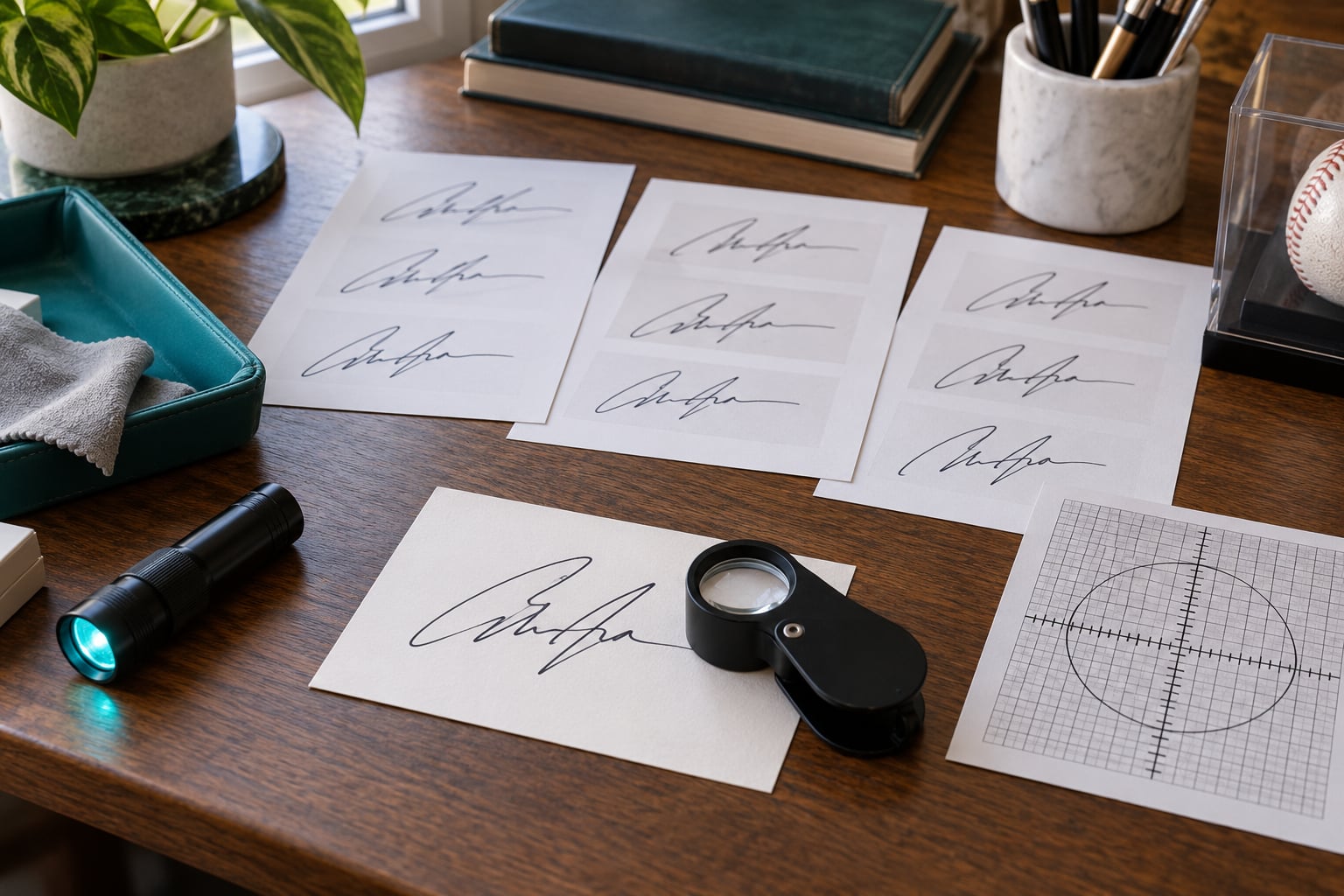
Most people searching how to spot fake autographs are holding one item and about ten minutes. A careful visual screen catches the easy fakes: traced signatures, printed facsimiles, machine autopens and forged certificates. Anything harder needs comparison against same-era genuine examples, a provenance check, and for anything valuable, a paid third opinion.
There are only three ways a fake gets made. Someone traces the signature by hand, someone runs it through an autopen or similar machine, or someone prints a facsimile image of it. Knowing which of the three you are looking at tells you where to look for evidence.
Here is the short scan. If several of these hit at once, stop and get it professionally examined.
- Line weight is identical from the first stroke to the last
- Blunt starts and stops, with no taper at the ends
- Hesitation dots, doubled lines or ink blots where a pen paused
- Signature sits on top of a glossy surface with no ink break
- A writing tool that did not exist in the claimed era
- Two supposedly different signatures that match stroke for stroke
- Fresh ink bleeding into paper that should not absorb it
- A certificate number nobody at the issuing company can look up
- A price far below what that signer and item normally command
Table of Contents
- 1What You Need
- 2How to Spot Fake Autographs Step by Step
- 3Confirm the Signer, Item, and Expected Signature
- 4How to Spot Fake Autographs by Comparing the Ink and Stroke
- 5Examine Pressure, Speed, and Pen Lift
- 6Check Proportions Against Known Authentic Signatures
- 7Look for Signs of Tracing, Copying, or Mechanical Reproduction
- 8Review the Certificate and Chain of Custody
- 9Inspect the Item and Signing Context
- 10Ask a Reputable Independent Authenticator
- 11Common Mistakes
- 12Frequently Asked Questions
- 13Can you tell if an autograph is fake just by looking at it?
- 14Do online autograph authentication services guarantee a signature is genuine?
- 15What details make an autograph certificate of authenticity trustworthy?
- 16Can a traced autograph be fixed or make it look genuine?
- 17How much should I pay for independent autograph authentication?
- 18Genuine vs Counterfeit: What Separates Them
- 19Which Authenticator Should You Use?
- 20Buying Signed Items Online: Seller Red Flags
- 21Conclusion
What You Need
None of this needs a laboratory. It needs a quiet table and about six things, most of which you already own.
A 10x loupe or jeweller’s magnifier is the single most useful tool. Cheap ones suffice. Most tells are visible at ten times and invisible to the naked eye, particularly ink dots, stroke edges and printed halftone patterns.
A plain, even background helps more than people expect. Put the item on white or light grey card under steady, indirect light. Patterned tablecloths and warm bulbs invent features that are not there.
Raking light is simply a lamp held low and to one side, almost flat across the surface. It throws tiny shadows off every stroke, which is how engraved outlines, mechanical grooves and raised ink give themselves away. A cheap UV torch is a bonus, useful for showing up surface treatments and optical brighteners in the paper.
You also need known authentic examples of that exact signer, ideally from the same decade and the same medium. Three genuine references are a working minimum. Below that you are guessing rather than comparing.
Provenance paperwork means whatever exists: receipts, correspondence, event programmes, family notes, photographs of the signer holding a similar item. Even a scrap of this outweighs a certificate with no issuer behind it.
Handle paper with clean, dry hands, or nitrile gloves for photographs and encapsulated pieces. Cotton gloves snag fibres on glossy surfaces. A certificate of authenticity is worth checking only if it names an issuer you can contact.
One tool needs a warning label. A cotton swab with rubbing alcohol will confirm that ink is wet or dye-based, but it can lift dye from the item and permanently damage value. Never run it on anything you hope to sell or on anything mounted.
How to Spot Fake Autographs Step by Step
Work through these in order. The whole routine takes 10 to 20 minutes for a single item, and each step tells you what the next one should be looking at.
Confirm the Signer, Item, and Expected Signature
Before touching the ink, check whether this person should logically have signed this thing. The most reliable early filter is connection, not craftsmanship.
A signature on an item with no link to the signer’s life deserves immediate suspicion. A politician signing a film prop, a retired athlete signing memorabilia from a team they never played for, an actor signing a hockey stick at a fan convention. These are not always fraudulent, but they are exactly the scenarios forgers pick because nobody questions them.
Then establish what the signature should look like. People do not sign their own full legal name consistently. Look for how they handle initials, whether they use a middle initial, whether they sign one first name or two, and how long the whole thing runs relative to the width of the item.
Finally, be honest about your reference material. If you cannot find three genuine examples of this signer from the relevant period and medium, stop here and gather them. Comparison without a baseline is not analysis.
How to Spot Fake Autographs by Comparing the Ink and Stroke
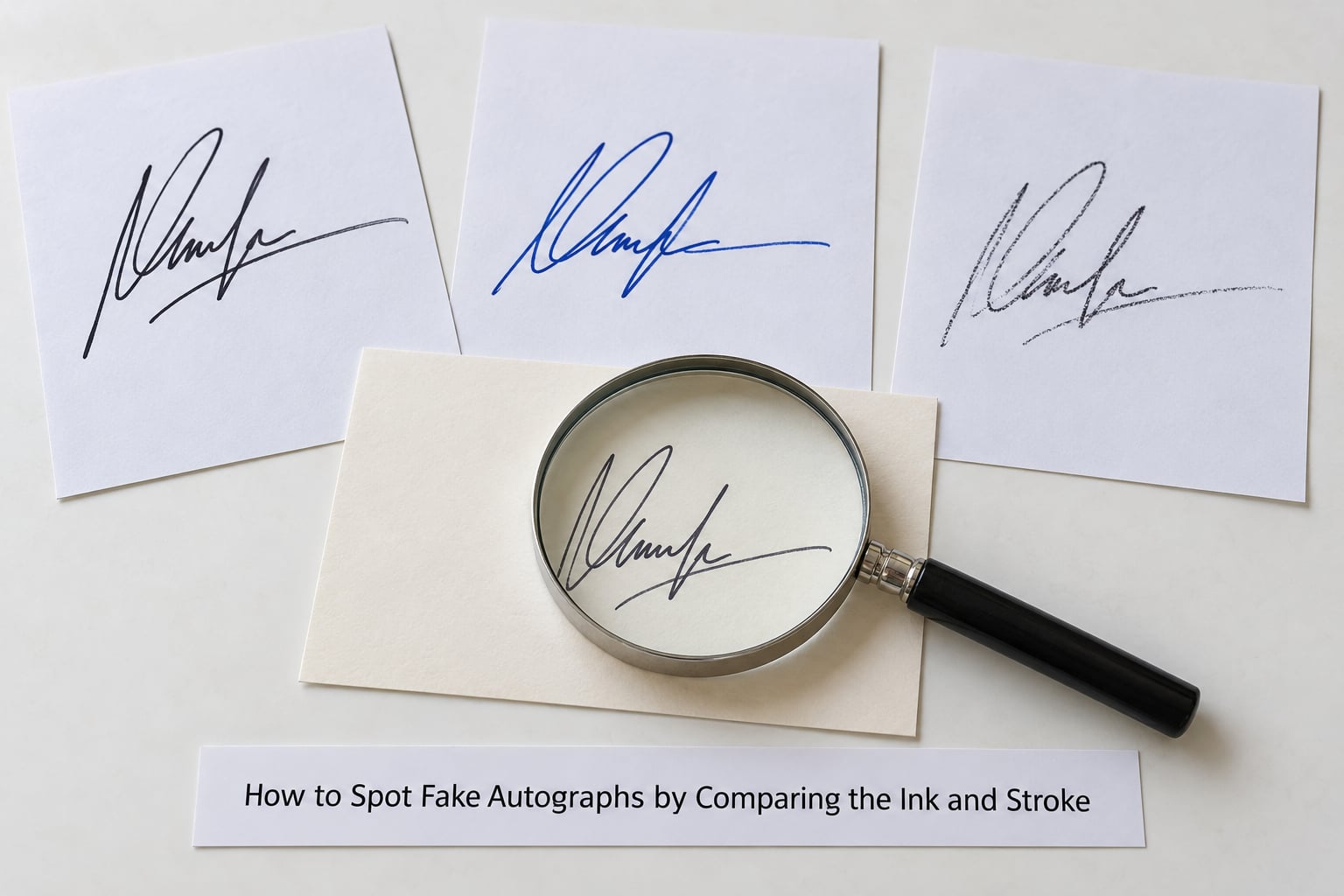
Compare ink colour, sheen, line width and how the ink sits in the paper. A felt-tip marker leaves a glossier, heavier line with visible edges. A ballpoint sits differently again, and a fountain pen usually shows a fine hairline entry that thickens as pressure builds.
Look for feathering at stroke ends, where ink dries faster than the hand moves, and for pooling in dots and pauses. Genuine ink is not perfectly even. It thickens where the hand paused and thins where the nib sped up.
Paper absorbency gives you a dating check that costs nothing. Machine-made papers from before roughly 1945 were notably less absorbent than modern stock. A signature on a 1920s letter that bleeds heavily into the page suggests a modern ink was used, because period ink sat on the surface instead.
Two limits matter here. Ink cannot be dated reliably by eye; collectors constantly see genuinely old items with newer ink added during a later signing session. And fresh-looking ink is not evidence of forgery on its own. Treat it as a reason to look closer, not as a verdict.
Examine Pressure, Speed, and Pen Lift
Genuine signatures show line weight that changes with direction. Curves are heavier than vertical strokes, because the hand presses differently turning a corner than pulling a straight line down. Where the hand moved quickly, the line thins.
Traced signatures behave differently. The line often stays flat, the pen hesitates at corners, and small ink dots appear where the tracer lifted or restarted. Blunt starts and blunt stops are common because the tracer started from an outline rather than from a gesture.
Pressure is the hardest tell to judge and the easiest to overclaim. Genuine deep signing often indents the sheet, and you may be able to feel or see that impression on the reverse. But if the item is mounted, framed or sealed in an acrylic holder, you cannot reach the paper, and the impression may be hidden entirely.
So use what you can see and stop where the evidence stops. A photo cannot tell you pressure. A slab in front of you cannot tell you pressure. Judging pressure through a plastic window is guessing, and collectors get into trouble by pretending otherwise.
Check Proportions Against Known Authentic Signatures
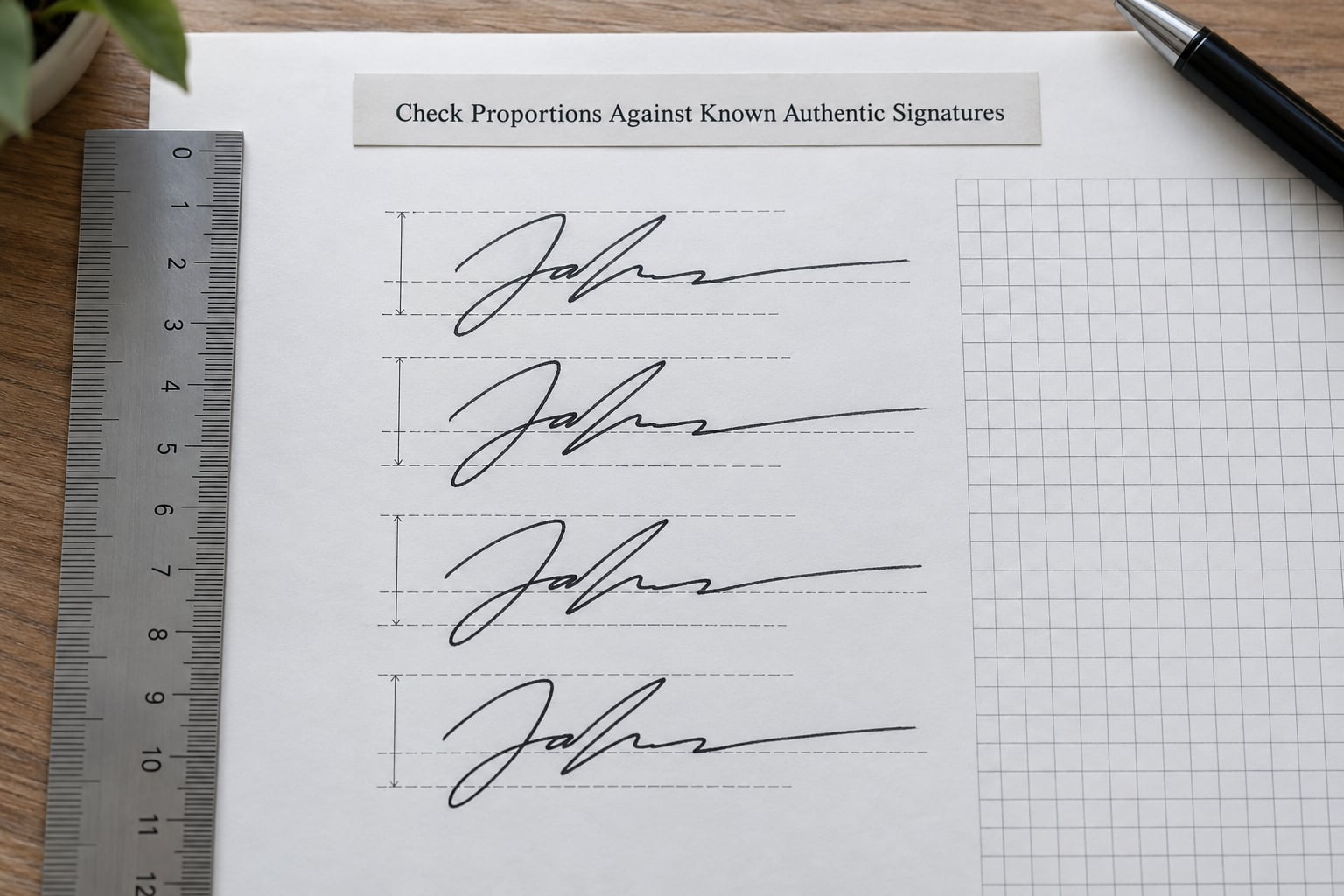
Measure rather than squint. Lay a ruler or a printed grid next to the signature and check baseline angle, letter height, spacing between letters, overall length, slant, and the relative size of any initials.
Genuine signatures are consistent in proportion even when they are not identical. A forger copying a shape often gets the outline right and the internal rhythm wrong: letters too evenly spaced, initials that should be large and are small, a baseline that drifts upward on an autograph that always slants down.
Now the honest part. Signatures change. A person’s style shifts across decades, across pen types and across contexts. Autograph size on a birthday card is not comparable to autograph size on a contract. Comparing a 1970s example against a 1990s one and calling the mismatch a fake is one of the most common errors new collectors make.
Match the period. Match the medium. A signing at a fan convention on a glossy photo board and a signing at a formal event on a card are different jobs, and a signer treats them differently.
Look for Signs of Tracing, Copying, or Mechanical Reproduction
Tracing leaves physical evidence. Under magnification you may find faint graphite or pencil guide lines running under the ink, doubled lines where the pen went over the same path twice, and small ink deposits at direction changes. Look for a dot placed mid-character, which is a classic restart point.
Artificial pen lifts are the giveaway. They appear where the hand has no reason to stop, and they cluster around corners. A dot at the end of every single stroke is another pattern, because a person lifting a pen cleanly does not usually leave a bead of ink at each exit.
For mechanical reproduction, raking light is decisive. A printed or stamped mark has uniform depth and often a consistent V-shaped channel where the tool pressed. Hand ink sits on fibre, varies in depth along a single stroke, and never repeats the same groove twice.
Printed facsimiles have their own tells. They look flat. Under a magnifier you can find halftone dots, which a pen never makes. They sit on top of glossy surfaces without the ink break you would expect, and they leave no indentation on the reverse.
The autopen test is the one most people remember. An autopen follows a fixed path, so every signature it produces is effectively identical. Two autographs on two different items by the same signer that match letter for letter, dot for dot, are not proof of authenticity. They are the strongest single sign of machine reproduction you can get.
Review the Certificate and Chain of Custody
A certificate of authenticity proves one thing: that the issuer says it is real. That is only worth something when the issuer is real, reachable and has something to lose.
Check four things. Is there a named institution with a working website and a way to contact them? Is there a unique certification number you can look up on that institution’s own site? Does the label look tamper-evident, such as a PSA/DNA or JSA label or the oval BAS label Beckett uses with its number printed on it? And do the claims on the certificate match what you can see, with no dates that contradict the item?
Hologram stickers and certificates are sold online in bulk, unbranded and by the sheet. Collectors on autograph forums and marketplace communities keep reporting the same thing: certificate forgery is now a bigger problem than signature forgery. A shiny label proves somebody bought a label.
Then trace the chain of custody. Who held this item, and when? Receipts, dated correspondence, event programmes, a photograph of the signer holding a matching item, a witness who saw it signed. Strongest of all is a witnessed in-person signing, where someone you trust watched the pen move.
Watch for circular opinions. A certificate written by the dealer you are buying from, then examined by another dealer who relies on the first dealer’s file, tells you nothing. Verify with the issuer directly.
Inspect the Item and Signing Context
Context catches what pixels do not. Did the item exist when the signer was active, and in the place the story claims? A dated inscription naming a team, venue or event the signer could not have attended is a hard stop.
Look at placement. Signatures that sit awkwardly over a printed caption, half on gloss and half off it, or jammed into a corner to fit often indicate an afterthought rather than a signing. Genuine signers usually have space provided for them.
Check the physical integrity of the piece. A replaced page in an album, a mismatched mount, a photo whose edges do not align with its backing, undisclosed restoration in a frame, all of these raise the question of whether the signature is original to the object at all.
One more complication collectors argue about honestly: assistants. Some signers had staff or family members sign items in their name, sometimes openly, sometimes not. An autograph can be physically genuine and still not have been signed by the person named. Ask what the market currently accepts, and be suspicious of anyone selling dozens of identical examples as personal signings.
Ask a Reputable Independent Authenticator
Self-checking has a ceiling, and knowing where it is saves money. Stop screening yourself when the item is valuable, when the era is uncertain, or when your comparison against same-era examples is ambiguous. Ambiguity is a result, not a failure.
The recognised third-party authenticators in this field are PSA/DNA, JSA (James Spence Authentication) and Beckett Authentication. Each compares the submitted signature against a reference file of known genuine examples for that signer, then issues a certification number that anyone can look up. Beckett submission availability has fluctuated, so check current status before sending anything.
Submit good material. Sharp photographs of both sides, raking light shots, close-ups of the signature, the mounting, any labels, and every document that came with it. Incomplete submissions are the most common reason a piece fails.
Set expectations on cost and outcome before you pay. Fees vary by service level and turnaround, and trade commentary regularly puts rejection rates above half for lower-tier submissions. A “not authentic” result usually means not enough evidence to support the claim, not proof the piece is forged, so ask whether a review or second-opinion option exists before you are done with it.
What about apps and AI? They help with triage, not truth. Image models are good at spotting gross anomalies, repeated autopen patterns and obviously wrong proportions, and useless in the cases that matter: a well-executed traced forgery, ink chemistry, paper age, provenance. Treat any app verdict as a screening opinion, never as evidence, and never let it stand in for a professional opinion on a high-value piece.
Common Mistakes
Nearly every avoidable loss I see traces back to one of these. Each has a straightforward correction.
Judging from a single listing photo. Photos are edited, cropped and shot under flattering light. Decide from the item, or from photographs the seller takes in response to your specific questions. Stock imagery of a different piece tells you nothing about the one for sale.
Assuming every signature by that person looks the same. Real signatures vary by era, pen, medium and mood. If your only comparison is from a different decade, you have no conclusion.
Overvaluing a fancy certificate. Holograms and heavy card stock are cheap to produce and prove nothing. What matters is a named issuer and a number that checks out on their own site.
Reading luxury ink as a good sign. Someone can buy a fountain pen. Ink quality tells you about the pen, not the hand.
Buying before checking the return policy. For a high-value signed item, an explicit returns policy is part of the authentication. If the seller refuses returns, ask what they are hiding.
Confusing value with authenticity. These are separate questions. A genuine signature can be worth very little, and a worthless-looking piece can be both genuine and valuable. Price never verifies anything.
Trusting an app’s verdict. Screening tools flag obvious problems. They do not verify, and their confidence is not evidence.
Over-reading natural variation. This cuts both ways. Because real signatures vary, people excuse real forgeries. If a signature looks nothing like the reference, variation is not an explanation.
Before you pay, run this checklist:
- Signer and item are genuinely connected
- You hold at least three genuine references from the same period
- Proportions and stroke weight line up with those references
- No tracing marks, no uniform line weight, no repeated autopen pattern
- Writing tool and paper are era-appropriate
- Certificate issuer is named and the number verifies on their site
- Provenance is written down, even if the answer is thin
- Returns are offered in writing
- Price sits inside the normal market range for that signer and item
- You know which authenticator you will use if doubts remain
Frequently Asked Questions
Can you tell if an autograph is fake just by looking at it?
You can catch a large share of fakes visually, especially printed facsimiles, machine signatures and traced copies. What you cannot do from appearance alone is confirm authenticity. Serious examination needs comparison against genuine examples, checks on ink, paper and signing context, and documentation. Treat your own inspection as screening that decides whether to spend money on professional authentication.
Do online autograph authentication services guarantee a signature is genuine?
No service can guarantee a result in advance. Authenticators like PSA/DNA, JSA and Beckett compare submissions against reference files of known genuine signatures and issue a certification number that can be verified afterward. Their opinions carry weight in the market, but a low-tier rejection often means insufficient evidence rather than proof of forgery. Understand the appeals or review options before you submit.
What details make an autograph certificate of authenticity trustworthy?
Look for a named institution with contact details, a unique certification number you can look up on that institution’s own website, and tamper-evident labelling appropriate to the issuer. The certificate’s claims should match the item without date or context contradictions. Hologram stickers and blank certificates are sold online in bulk, so a label alone proves only that somebody purchased one.
Can a traced autograph be fixed or make it look genuine?
Partly. A skilled tracer can remove visible pencil outlines and adjust pen pressure to pass a casual look. They cannot fully hide the doubled lines, ink deposits at direction changes, unusual pen lifts or proportions that drift from the reference. Those traces survive magnification and raking light, which is why experts treat tracing as strong evidence even when the surface looks clean.
How much should I pay for independent autograph authentication?
Fees vary widely by service level, turnaround and what you submit, so check current pricing with the authenticator rather than relying on old figures. Higher tiers cost more and are worth it for valuable pieces. Set a budget before submitting, expect that lower-tier submissions are rejected at a high rate, and ask what a rejection means for your options before you spend.
Genuine vs Counterfeit: What Separates Them
Here is the comparison most collectors find useful. None of these rows is proof on its own. Read several rows together, and always against a reference from the same period.
| Feature | Genuine hand-signed | Likely counterfeit |
|---|---|---|
| Line weight | Varies with direction and speed | Flat and identical throughout |
| Stroke ends | Tapers, sometimes with a natural lift | Blunt start and stop, often with an ink bead |
| Paper impression | May indent the sheet | No indentation, no pressure change |
| Ink on gloss | Breaks over texture, skips in gaps | Sits on top, uniform and flat |
| Under magnification | Feathering, pooling, fibre penetration | Halftone dots, engraved outline, doubled lines |
| Writing tool | Era-appropriate, varying between examples | Tool that postdates the claimed era |
| Proportions | Stable baseline, spacing and initials | Letter proportions drift between examples |
| Repetition | Each signature differs slightly | Two signatures match stroke for stroke |
One row deserves extra weight. Repetition is the clearest signal on the list, because a hand cannot produce the same line twice and a machine can.
Which Authenticator Should You Use?
Three names cover most of the market. They differ more in process and cost than in credibility.
| Authenticator | How it works | Best fit |
|---|---|---|
| PSA/DNA | Compares against a reference file, issues a certification number and a tamper-evident label | Broad coverage across music, sports and entertainment |
| JSA | Review process with a 3D hologram label tied to its record | Cases where the signer or item type suits their specialty |
| Beckett | Issues an oval BAS label with a unique certification number | Sports-heavy collections; check current submission availability |
Where the job sits beyond routine signature review, a forensic document examiner is the specialist to look for. They work from questioned documents, which means they can examine inks, paper and pressure properly, usually for high-value legal or estate matters.
Buying Signed Items Online: Seller Red Flags
Most forgery problems start as an online purchase, so it deserves its own pass. These apply on eBay, Etsy and in auction listings alike.
- Professional-looking certificates that nobody at the issuer can confirm
- Listings priced far below the market for that signer and item
- Stock imagery or photographs of the item taken by someone else
- Vague descriptions with no year, no medium and no context
- No returns, or returns limited to a window of a few days
- A single seller offering several near-identical signatures of the same person
- Listing text that argues against scrutiny rather than answering questions
On marketplaces, a seller history and feedback score carry some weight, but they measure transactions rather than authenticity. Plenty of forgeries come from accounts with long, clean histories. Marketplace guarantees cover condition and delivery, not whether a signature is real.
If a listing turns out to be a forgery, report it on documented facts: the signature failed comparison with known genuine examples, or the certificate issuer could not verify the number. Stick to what you can evidence. Naming people and making accusations is how reports get dismissed.
The emotional version matters too. If this was a gift, or part of an inherited collection, a bad result lands harder than the money. Find out early, and ask someone experienced to look with you. Most autograph forums will take a photo request seriously, and a second set of eyes costs nothing.
Conclusion
Learning how to spot fake autographs comes down to four habits. Confirm the signer and the item belong together. Compare against several genuine examples from the same period rather than any example you can find. Write down where the item came from, even when the answer is thin. And treat your own inspection as screening that decides whether to submit, not as a verdict you can sell on.
Start with the short scan at the top. If nothing trips and the value is modest, you may be done. If several flags appear, or the piece matters to you, spend the money on a professional opinion from PSA/DNA, JSA or Beckett. That is the moment to stop checking yourself.