Partly. A movie trailer tells you the genre, the tone, the cast and the basic premise honestly, and it hides almost everything else you need to know, including whether the script is any good. So learning how to tell if a movie is worth watching from the trailer is less about finding a magic clue and more about knowing which four signals are real and which five are marketing.
That gap is exactly why people get burned. On AVForums, one poster described a trailer that “actually contained all the exciting bits” so that the trailer was more exciting than the movie. On r/movies, the recurring note is trailer fatigue: several self-described trailer-watchers could not remember the last trailer that made them think they must see the film.
Here is the process I use. It takes about a minute per trailer, and it ends with a check outside the trailer, because the trailer’s job is finished before it starts.
Table of Contents
- 1What You Need
- 2Step-by-Step: How to Tell If a Movie Is Worth Watching From the Trailer
- 3Check Whether the Premise Is Specific
- 4Look for Character Goals and Obstacles
- 5Read the Trailer’s Tone and Pacing
- 6Separate Story Clues from Selling Points
- 7Do a Quick Check Before Buying Tickets
- 8Common Mistakes When Judging a Movie by Its Trailer
- 9Judging by hype instead of evidence
- 10Confusing a famous actor with a good role
- 11Assuming every laugh or jump scare means quality
- 12Overvaluing visual effects
- 13Treating a generic trailer as evidence of a bad film
- 14Letting franchise recognition do the thinking
- 15Frequently Asked Questions
- 16What is the 20 minute rule for movies?
- 17What is the 2.5 rule for movies?
- 18How many minutes of trailers should I watch before a film?
- 19How can I tell if a movie is good before watching it?
- 20Do movie trailers use scenes that were cut from the final film?
- 21Conclusion
What You Need
You do not need anything expensive. You need five things, and three of them are free.
- The trailer itself, ideally the main theatrical one, not a 20-second TV spot or a fan edit on YouTube.
- The one-sentence premise, from the studio’s own listing. If the studio cannot write one clear sentence, that is already information.
- Runtime and age rating. Runtime matters because the trailer tells you nothing about whether the film earns those minutes. A 95-minute film and a 165-minute one can carry identical trailers.
- The director’s last two or three films, and whether you liked them. For most people this is a stronger predictor than anything in the trailer.
- One outside verdict from a critic or a viewer with a pattern of taste similar to yours.
Notice what is not on that list: the number of likes on the trailer, the franchise, and the cast’s name recognition. Those drive ticket sales and they are close to useless for the actual decision.
Step-by-Step: How to Tell If a Movie Is Worth Watching From the Trailer
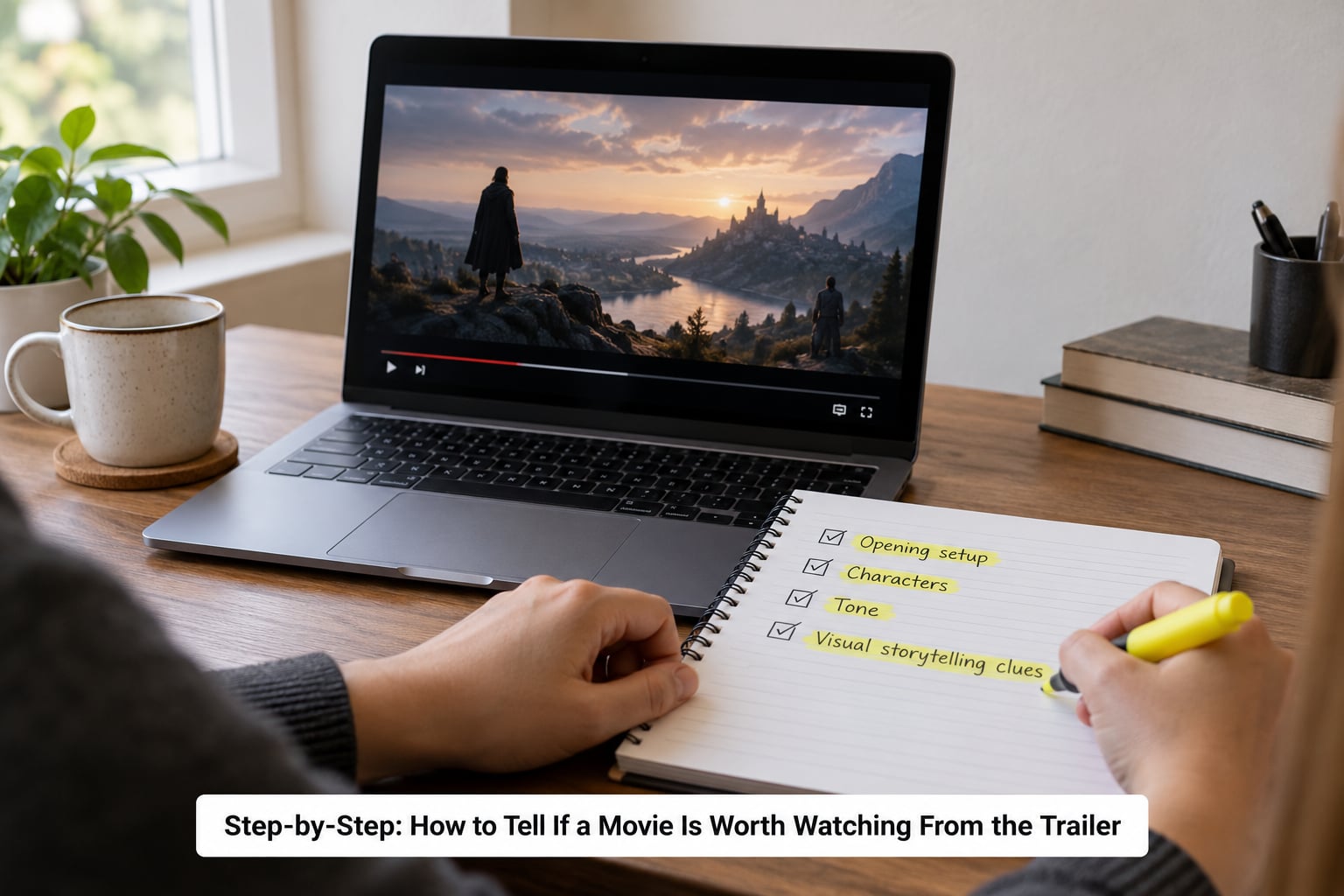
Work through these in order. Each step has a version that looks convincing and a version that is a sales tactic, and telling them apart is most of the skill.
Check Whether the Premise Is Specific
Specific means there is a question the movie is going to answer. Her sister disappeared and the police are not helping. The company is failing and one bad quarter ends it. A marriage is about to end over a single weekend. Those are premises.
Watch for vagueness instead. If after 45 seconds you still cannot say what the problem is, that is a red flag, not a mystery. Multiple forum posters describe the pattern: a confusing trailer sends people to read the plot summary, not to the cinema. Marketing teams hide the conflict deliberately, because a stated conflict invites comparison with films you have already seen and enjoyed.
How to tell it worked: you can say the central problem out loud in one sentence, and it is a problem, not a mood. If the trailer only tells you the world is dangerous or someone is angry, you have a poster, not a plot.
Look for Character Goals and Obstacles
A good trailer shows someone wanting something specific and something standing in the way. The wanting and the blocking are both visible. In a weak trailer, you see faces reacting, objects exploding and slow-motion walking, but nobody in the clip is clearly trying to do anything.
The distinction matters because character drive is what survives a bad marketing edit. Studios can rearrange shots, drop the real dialogue, recut a scene to a music cue and swap the score. They cannot invent a character who wants something, because that has to be in the film. If you can name a goal, you have real material. If you cannot, you are watching a mood board with sound design.
How to tell it worked: at least one character does something deliberate on screen, and you can guess what they are trying to achieve. A character only being grabbed at, chased, or stared at means the trailer is working entirely off reaction shots.
Read the Trailer’s Tone and Pacing
This is the most reliable thing a trailer gives you, and people underrate it. Music, editing speed, colour grade, dialogue and performance all tell you what the experience will feel like. A trailer cut at one beat per line with low strings and wide shots is a measured, patient film. A trailer of 2-second cuts on every drum hit is telling you the film is relentlessly busy, whether or not that is enjoyable for 100 minutes.
The trap is the music. Trailers almost always use a bespoke promotional cue, frequently with a completely different composer and instrumentation from the actual score. AVForums posters have described finding trailer music that was electronic and dance-driven for a film that turned out to be fully orchestral, and read it as the marketing team not knowing its audience. The music tells you about the campaign, not the composer. Judge tone from the performances and the editing, and treat the music as decoration.
How to tell it worked: you can name the feeling in one word, such as grim, buoyant, patient, or manic, and that word matches films you already know you enjoy. Also check the dialogue. Trailers that replace real lines with a voiceover narrator are usually hiding unmemorable or poor writing underneath.
Separate Story Clues from Selling Points
Some trailer beats are evidence and some are sales. The evidence version shows a scene with a beginning, a middle and an implied consequence. The sales version is a montage of highlights with no causal thread: slow-motion, a score swell, a tagline, a logo, a release date.
Count the beats. A two-hour film usually has a trailer that shows maybe 90 seconds of usable material, and a good one can be read as a rough beat map. A trailer that delivers thirty disconnected fragments has handed you nothing except atmosphere. That is a marketing asset, and it is fine for its job, but it is weak evidence for your two hours.
The other sales signal is the trailer-only set piece. That one big sequence that never appears in the film is common and it is worth naming out loud as a warning. On r/movies, the standard complaint is waiting for a scene the trailer sold and discovering it was an outtake. Cut footage has happened often enough that forum users now treat it as a category, not a surprise.
Do a Quick Check Before Buying Tickets
How to tell if a movie is worth watching from the trailer ends here, because the trailer is finished as evidence. Spend two minutes outside it.
- Read the plot summary, not a review. If the summary reveals a central problem the trailer refused to show, you now have the honest version.
- Check the director’s recent work and your own reaction to it. Consistency of quality with a specific filmmaker beats any trailer signal.
- Look for content and tone information before you take a child, a group or a nervous partner into it. Trailers actively understate horror content, which is worth knowing before the cinema, not after.
- Read two audience reactions, not the critic average. Critic scores and audience scores often disagree, and the audience score tracks closer to your own evening.
- Decide cinema now or streaming later. A film you are only curious about is usually worth waiting for. A film you actively want to see the first hour of is worth the trip.
That last step is the real decision most people are making. Plenty of viewers reported on r/Cinema and AVForums that the trailer settles when to watch, and reviews settle whether to.
Common Mistakes When Judging a Movie by Its Trailer

Almost every bad call traces back to one of six habits.
| Green flag in the trailer | Red flag in the trailer |
|---|---|
| A stated problem with a deadline or an obstacle | Atmosphere only, no conflict, after 45 seconds |
| A character doing something deliberate | Reaction shots, poses and slow-motion walking |
| Steady editing that matches the film’s actual pace | Beat-perfect cuts every two seconds on the music |
| Two or three complete little scenes | Thirty disconnected fragments, then a tagline |
| Honest performance, real dialogue used sparingly | A voiceover narrating over everything |
| The studio names a clear release and format | Terrifying silence about cast, or footage labelled as a teaser |
Judging by hype instead of evidence
Hype is volume, not quality. A film can trend for weeks because of a casting rumour and still be forgettable. The correction is simple: convert every bit of excitement into a factual question, such as who directed it, what it is about, and what the director did last time. If the excitement survives those questions, it was interest. If it evaporates, it was noise.
Confusing a famous actor with a good role
Cast lists are the easiest thing for a trailer to sell and the least informative. Actors appear in good films and bad ones at similar rates, and trailers put a familiar face in the first three seconds precisely because recognition is cheap. The correction: ask whether the trailer shows that actor doing something character-specific, or just arriving in a location and looking concerned.
Assuming every laugh or jump scare means quality
Comedy trailers routinely give away the joke, which is the single most common trailer failure forum users complain about. Horror trailers do the opposite and avoid the scare almost entirely, selling atmosphere and a noise. Both are conventions, not evidence. A trailer that makes you laugh at the marketing is not a comedy that will make you laugh for 95 minutes.
Overvaluing visual effects
VFX-heavy trailers are often the films most dependent on the VFX in the marketing. Watch the editing instead: is there a shot with two characters in it, arguing or deciding something? Films made of spectacle usually have surprisingly few of those, and that is a reliable warning about the screenplay.
Treating a generic trailer as evidence of a bad film
The opposite error happens too. A quiet, slow trailer gets dismissed and then the film delivers. Some of the best-loved films in the past decade had trailers that undersold them badly. A trailer that reveals little is not proof of weakness; it may just be a studio that trusted the audience. The counterexample is why you should never let a trailer cancel out a strong director and a premise you want.
Letting franchise recognition do the thinking
Recognising the logo, the characters or the previous instalment produces a feeling rather than a judgement. Franchise films in particular are marketing products, and the trailer is the most polished part of the campaign. Ask the plain question: if you had never seen the previous films, would this premise make you buy a ticket? The honest answer settles it more often than not.
A few habits that help more than any single trick. Watch the trailer muted once, because you learn the actual editing and stop borrowing emotion from the music. Watch it twice, since a trailer designed to be seen once is usually hiding a beat. Skip fan and AI-made trailers, which have no relationship to the finished film and regularly get mistaken for the real thing. And read reviews last, so the trailer does not rewrite them for you.
Frequently Asked Questions
What is the 20 minute rule for movies?
The 20 minute rule is a viewing heuristic: a film should hold your attention through roughly its first 20 minutes. If you have checked the clock twice in that stretch and felt nothing, the film rarely recovers, because most scripts front-load their best material. It is a rough guide rather than a law, and slower films often take 30 minutes to arrive, so treat a slow open as a warning, not a verdict.
What is the 2.5 rule for movies?
The 2.5 rule is the mirror image of the 20 minute rule and it is mostly about runtime. It holds that a film worth your evening is still interesting somewhere around the two-and-a-half-hour mark, close to the point where you could reasonably skip ahead. For a long film, watch where the third act starts, because that is where a lot of films stop being about anything and start being about the clock.
How many minutes of trailers should I watch before a film?
Two to three minutes of official trailer material is plenty, and you can stop early. If the first 30 seconds has not shown you a character with a goal and a problem to solve, another two minutes rarely rescues it. Skip TV spots and character spots entirely, since they are built for a six-second attention span. If a trailer is inconclusive after one viewing, the answer is not more trailer, it is reviews and a plot summary.
How can I tell if a movie is good before watching it?
Use outside evidence rather than the trailer. Read a one-sentence plot summary so you know the real conflict, check the director’s recent films against your own taste, and read two audience reactions instead of the critic average. The trailer only confirms genre, tone, cast and premise, all of which are easy to fake or easy to hide. Runtime, director and audience verdict are the three signals that carry real information.
Do movie trailers use scenes that were cut from the final film?
Yes, more often than most viewers expect. Cut or outtake footage is a known trailer habit, and forum users describe the pattern plainly: the big sequence in the trailer turns out not to exist in the film, usually because reshoots or a tighter runtime removed it. Watchers on r/movies have learned to treat a trailer-only set piece as a warning sign, since nothing in the marketing tells you it was dropped.
Conclusion
Start with the conflict. If a trailer cannot tell you what the central problem is in one sentence, that is your first and clearest signal. Then check the tone and the characters against films you already know you enjoy, and treat every atmosphere-only shot, voiceover and beat-perfect cut as a sales decision rather than evidence.
Finally, verify the trailer’s strongest promise outside it. Read the plot summary, look at the director’s recent work, and decide whether this is a cinema night or a streaming night. The trailer should tell you whether to press play, and about two minutes of everything else should tell you whether to press play at all.