Movie special effects are made in two broad ways: physically on the set with props, costumes, miniatures and controlled stunts, or digitally in post-production by building, animating and compositing 3D elements into the filmed footage. The best shots usually use both, with a camera move and a sound design pass doing as much work as the effect itself.
Here is the honest version. An effect has to convince you that a real camera recorded something that never happened, and the crew gets there through planning, set work, a digital pipeline, and a pile of small matching details most viewers never notice.
Table of Contents
- 1How Movie Special Effects Are Made from Start to Finish
- 2What Is the Difference Between Practical and Visual Effects?
- 3How Are Practical Movie Effects Made?
- 4How Are CGI and Digital Visual Effects Made?
- 5How Do Filmmakers Make Different Effects Look Believable?
- 6Which Movie Special Effects Are the Hardest to Make?
- 7How Much Does It Cost to Make Movie Special Effects?
- 8Where AI Fits Into Movie Special Effects
- 9Frequently Asked Questions
- 10What do special-effects artists do on a movie?
- 11How are movie special effects made with CGI?
- 12How do filmmakers choose between practical effects and digital effects?
- 13How long does it take to make special effects for a movie?
- 14Can viewers tell whether a movie effect is practical or CGI?
- 15Conclusion: Start with the Effect the Shot Needs
How Movie Special Effects Are Made from Start to Finish
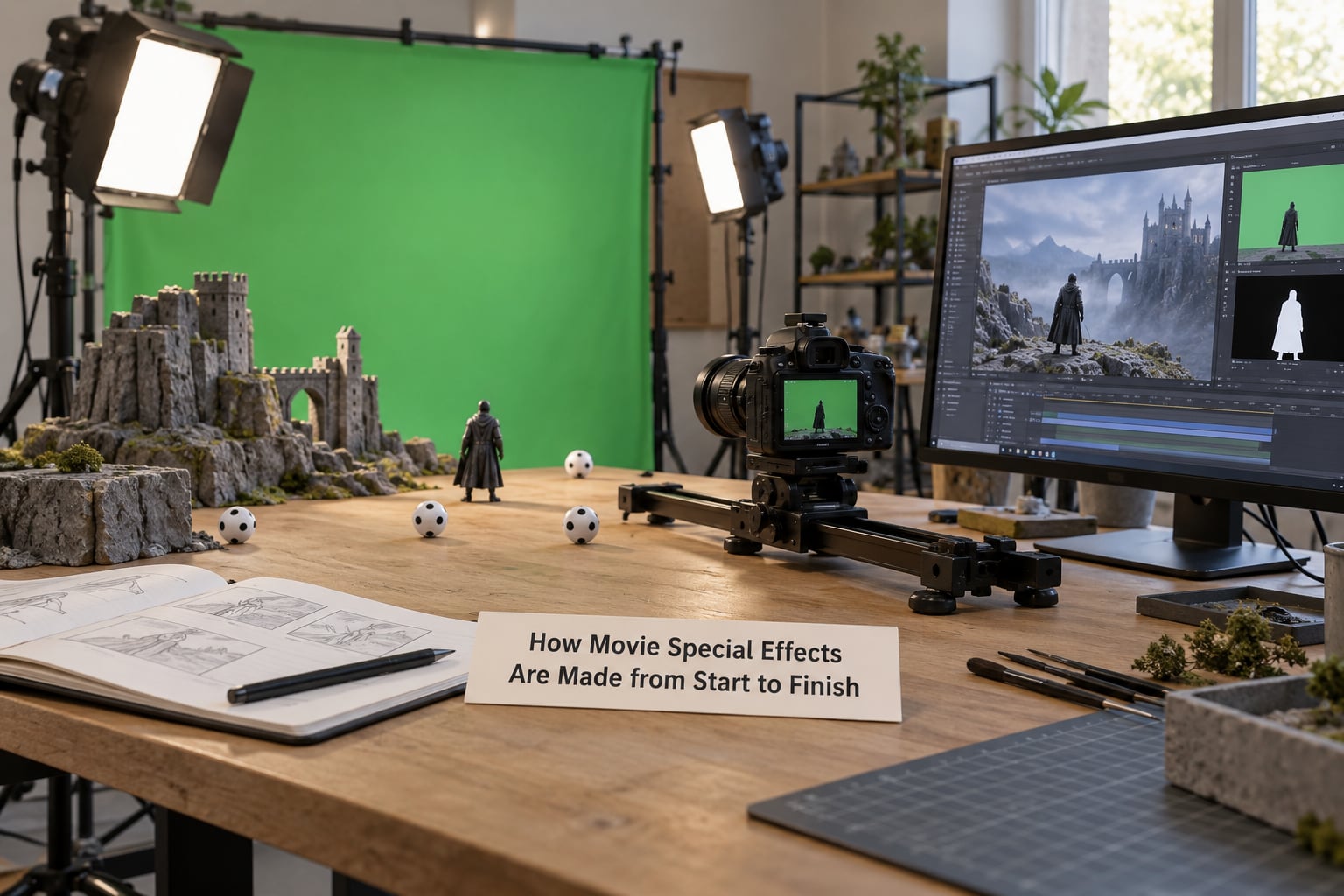
Every effect starts as a written requirement in the script and becomes a shot list, then a plan, then a set day or a department of computer work, then a composite that a colorist and sound mixer finish. The sequence matters because each stage feeds the next one.
Broadly, effects fall into four buckets, and every shot you have ever praised uses at least one of them.
| Effect type | How it is produced | Movie-style example |
|---|---|---|
| Practical or in-camera | Real physical elements filmed on set: props, sets, stunt work, prosthetics, weather | A car rolling down a staircase built to break apart on cue |
| Mechanical | Practical creatures, rigs and miniatures filmed frame by frame or in real time | An animatronic creature operated by a crew in matching black suits |
| Visual effects (VFX) | Computer-generated elements built, simulated and composited after the shoot | A digital city extended behind an actor filmed on a stage |
| Sound effects | Recorded or designed audio layered under the picture to sell impact and space | Layered debris impacts and low rumble under a building collapse |
Sound is in that table for a reason. A shot of a collapsing tower with a thin, clean crack reads as fake no matter how detailed the debris, because audio carries more of the illusion than most people expect.
What Is the Difference Between Practical and Visual Effects?
Practical effects are made by real objects doing real work in front of a real camera, and the result is captured during filming. Visual effects are created in post-production, either by filming something and altering it, or by generating imagery digitally.
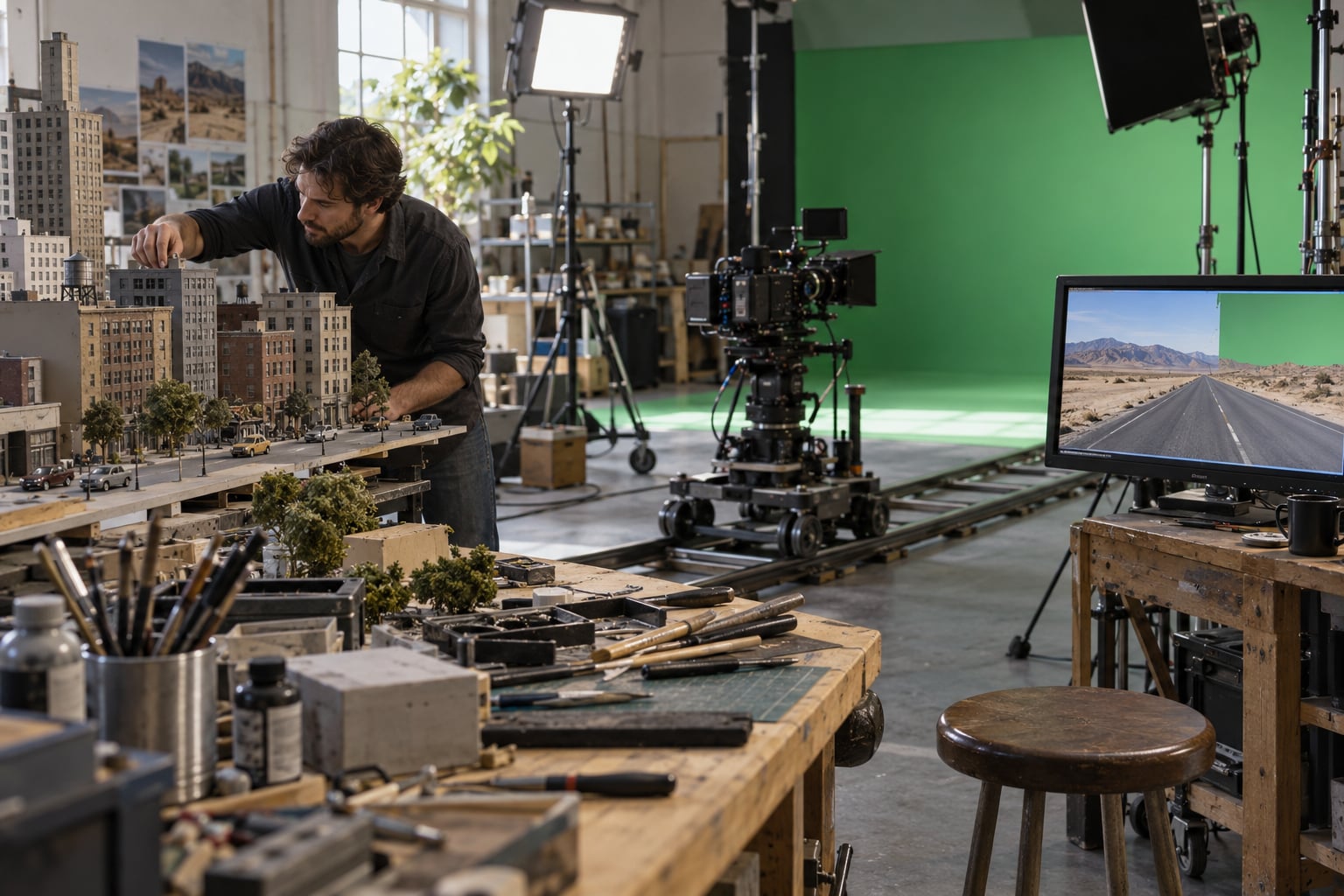
The line gets blurry fast. Filming an actor against a green screen is a practical set technique that exists to serve a digital effect, and a stop-motion model shot on a table is a physical effect by any reasonable definition.
Crews choose a technique based on the shot and the production. A real stunt car crash carries weight that no render fully matches, so a director will often ask for a practical pass and use digital cleanup to extend or hide it. A creature that needs to speak, or travel through a whole sequence without breaking, is far cheaper and more controllable as VFX.
Working artists on forums like r/vfx talk about the pipeline as a dependency chain rather than a checklist, and that mindset explains the choice: once one stage changes, everything downstream changes with it.
How Are Practical Movie Effects Made?
Stunts and fall work come first, and the safety side is not optional. Rigging inspections, harnesses, spotters, medical standby and rehearsed timings are part of the effect itself, because a stunt that gets hurt does not finish the shot.
Prosthetics and special effects makeup come next. Artists build foam latex appliances, silicone pieces and appliances painted directly on skin, then blend edges with a succession of thin layers. A creature suit works the same way at body scale, with the actor performing inside something lightweight and tight enough to photograph cleanly.
Props and breakaways are engineered for one specific take. A glass, a table or a car is built from sugar, resin or thin shells, and a release mechanism is hidden so it can be broken on a precise cue without slicing anyone nearby.
Miniatures and scale models are shot with wide lenses from a short distance so the depth of field and perspective match a larger set. Filmmakers have relied on them since long before computers, and the technique still turns up in modern films when a physical build is faster than a render.
Pyrotechnics, rain and snow machines, and atmospheric effects are handled by licensed crews working to strict safety distances. Explosions on set are usually a combination of controlled fuel elements, debris, camera effects and a much louder audio layer than the visible one.
Stop-motion is the other classic: physical models moved in tiny increments between frames, lit and filmed one exposure at a time. Animatronic creatures blend the two, with mechanical motion inside a sculpted body operated by a crew member in frame or just out of it.
How Are CGI and Digital Visual Effects Made?
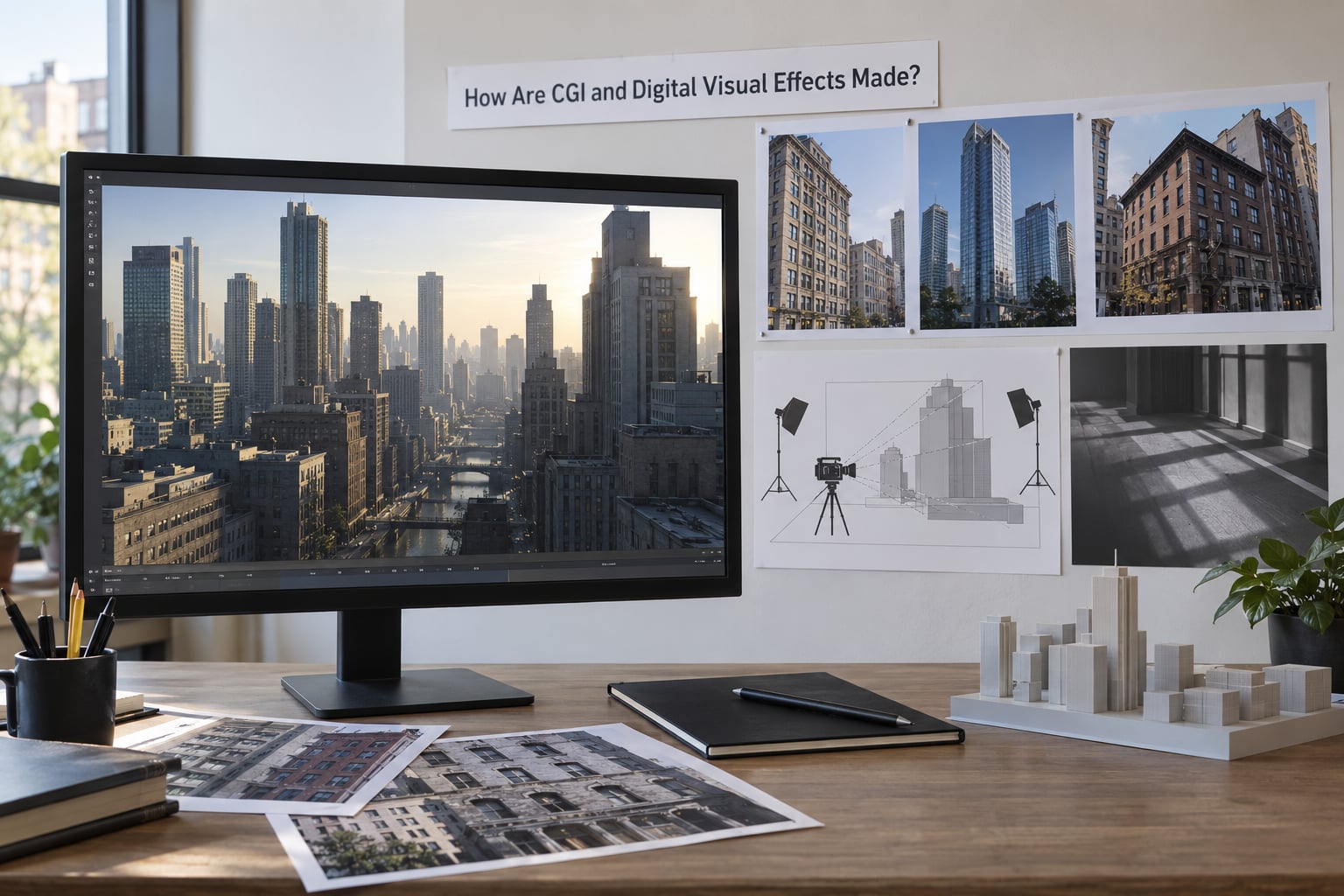
A digital effect is built by a pipeline of departments, and each stage hands structured data to the next one. The shot starts in previsualization, a rough 3D layout of camera and movement assembled before shooting so the director can judge the idea cheaply.
On the day, a VFX supervisor places tracking markers on the set, records lens and camera settings, photographs set measurements, and captures reference data. This step is the one a crew cannot redo. Artists on r/Filmmakers and r/vfx repeat it constantly: forget the markers and you never get that data back.
After the shoot, match-move solves the camera. The software reads the markers and reconstructs the real camera movement, focal length and lens distortion in 3D, which is why a shot recorded on a bumpy handheld camera can still host a stable digital element.
Layout places the digital assets into that solved camera. Modeling creates the geometry, texturing and look development give it surface qualities such as roughness and reflectivity, and rigging prepares it to move.
Animation performs the asset, and simulation handles what an animator would not survive hand-keying: fire, smoke, dust, water, cloth, debris and destruction. Lighting then matches the real lighting on set, and rendering produces separate image passes rather than a single flat frame.
Those passes matter. A render usually includes beauty, diffuse, specular, motion vectors, depth, and normal information, each isolated so a compositor can adjust one element without touching the rest. Compositing then merges the render with the clean plate, the original footage with the effect removed, and adds the grain, glow, lens dirt and motion blur that make the whole thing sit in one photograph.
The main tools are Houdini from SideFX for simulation, Autodesk Maya for modeling and animation, Foundry Nuke for compositing, Adobe After Effects for motion graphics and cleanup, Blackmagic Design DaVinci Resolve for finishing, and Blender as a free option that covers much of the same ground.
How Do Filmmakers Make Different Effects Look Believable?
Believability comes from a dozen small matches, not one big one. The single giveaway of a digital element is usually a detail nobody thought about.
Camera and lens come first. Artists reproduce lens distortion and vignetting from the actual lens used, and they match depth of field so a digital background blurs exactly like the actor in the foreground.
Motion blur and frame rate are the next pair. A rendered shot with crisp edges while everything around it smears during a fast move reads as pasted on instantly, so motion vectors are used to blur the digital element by the same amount.
Lighting and shadows are matched to the physical set, including a real shadow catcher surface under an actor so a digital sun falls across the actor’s face and the ground together.
Color and grain are last and they seal the shot. If the digital footage skips the grain structure, contrast range or black level of the plate, the difference shows even in a dim scene. This is the specific failure artists on cinematography.com forums describe as CGI that looks pasted in, and it has nothing to do with how detailed the model is.
Editing and sound finish the illusion. Cutting on motion, matching eyelines, and layering weight, texture and distance into the audio do the rest of the persuasion.
Which Movie Special Effects Are the Hardest to Make?
Difficulty comes from interaction, not size. A single enormous object in empty space is often easier than a modest object doing three things at once.
Water is the classic hard case. It is transparent, it refracts light, it interacts with everything it touches, and it changes shape in ways artists can simulate but never fully predict, so ocean work still relies on hybrid approaches.
Crowds are hard for a different reason. Thousands of individually animated people must react, cast shadows and stay consistent across dozens of shots, and performers reacting to nothing on set is a known problem that shooting a crowd plate often solves.
Creatures with faces and eyes carry the same burden as performance, since audiences read emotion instantly and forgive almost nothing.
Destruction sequences demand internal consistency: the same building has to break the same way from every angle the camera visits it, and a reversed or re-cut angle can invalidate hours of simulation. Invisible effects and character transformations the audience never notices are hard for the opposite reason, since the viewer has no visual reference for what the digital element is sitting inside.
Transitions between two worlds are the hardest of all, because every element on screen has to hand off smoothly.
How Much Does It Cost to Make Movie Special Effects?
There is no universal figure, and anyone quoting a fixed number for a single effect is guessing. Budgets vary by orders of magnitude between a small independent film and a large franchise film, and no two shots on the same picture cost the same.
The main drivers are understandable. Shot complexity pushes cost up fast, because a shot with a creature, water, destruction and a camera move needs every department at full effort. Screen time matters, since a sequence visible for two seconds is cheaper than one that holds for two minutes.
The number of effects shots in a film is a bigger factor than any one shot. Location work, on-set data capture and supervision, talent, software, computing time for rendering and simulation, storage for large image sequences, and the length of the post-production schedule all add up.
Reshoots are the quiet one. If a plate cannot be tracked, has no clean version, or was shot without data, the answer is often to go back and film it again, which costs far more than the original effect would have.
Practical versus digital is genuinely a budget decision, and productions mix them because the practical pass and the digital cleanup are often cheaper together than either approach alone. A physical effect that goes wrong is retaken; a digital effect that goes wrong is re-simulated, re-rendered and re-composited.
Where AI Fits Into Movie Special Effects
AI tools currently help with the slow, repetitive parts of the pipeline: isolating a subject from a background, denoising renders, filling gaps and generating rough reference material. Machine-learning rotoscoping can turn a task that took a full day into an hour of review and correction.
For hero shots that involve camera matching, physics and continuity across a whole sequence, artists still work by hand, and the reason is consistency rather than image quality. AI still tends to change a result each time you ask, which is difficult when a character has to look identical in forty shots.
The honest read, and the one working artists tend to give, is that these tools change how fast routine work gets done. Nobody is handing a department the schedule over 2026.
Frequently Asked Questions
What do special-effects artists do on a movie?
They turn a written idea into a finished shot. On set that means designing props, prosthetics, animatronics and stunts, then supervising safety. In post it means building and animating digital assets, simulating effects like fire and debris, lighting them to match filmed footage, and compositing the result into the plate. Most artists specialize in one stage rather than all of them.
How are movie special effects made with CGI?
A VFX supervisor places tracking markers on set and records lens, camera and lighting reference. Artists then solve the camera in 3D, model and texture digital assets, animate and simulate them, light them to match the real set, and render them as separate image passes. A compositor merges those passes with the clean plate and adds grain, blur and color to match the footage.
How do filmmakers choose between practical effects and digital effects?
They weigh what the shot needs against what the shot costs. Real stunts, breakaways and physical destruction carry weight that renders rarely match, so those are often filmed for real. Anything needing dialogue, a full location change, or consistency across many angles is usually digital. Plenty of shots combine both, with a practical pass finished and extended digitally.
How long does it take to make special effects for a movie?
It varies from a few days for a simple cleanup to many months for a hero creature or destruction sequence. Time is lost upstream: a change to animation forces new simulation, new lighting and a fresh render, and the whole chain waits behind it. Films with thousands of effects shots run parallel departments and trim the schedule by simplifying the work that is hardest to see.
Can viewers tell whether a movie effect is practical or CGI?
Most viewers cannot, especially in finished work, and that is the point. The usual tells are mismatched motion blur, missing grain, wrong depth of field, shadows that do not agree with the light, and a digital element that moves slightly too smoothly for a real camera. These days the comparison most viewers notice is between a well-made practical effect and a lazy digital one.
Conclusion: Start with the Effect the Shot Needs
Successful effects begin with a storytelling goal, then combine the simplest practical technique that will work with digital finishing, camera work, editing, color and sound. The illusion lives in the accumulation of small matches, not in any single technique.
When you watch a scene now, ask what the shot needed first, then which parts were physical and which were digital, and finally which detail sold it. Grain, blur, shadow and a good sound mix are usually the answer.