Picking the wrong first character costs you months of work you never get to wear. How to pick your first cosplay character comes down to one order of operations: start with the character you are genuinely excited about, then filter that choice against three practical limits, meaning how hard the costume is to build, what it costs, and how much time you have before your event. Get that order right and the decision takes an evening. Get it backwards and you can spend four months on a project you never get to wear. Here is the process I would walk a friend through.
Most beginners already know the answer. They have a character on mind, or three, and the real problem is that nobody has shown them how to compare them. Reddit threads fill up with people asking exactly that, and the honest answer is that there is no universally easy first character. There is only a first character that matches your skills, your wallet and your deadline.
Table of Contents
- 1What You Need Before You Choose
- 2How to Pick Your First Cosplay Character Step by Step
- 3Start With the Version You Recognize
- 4Compare Comfort, Cost, and Crafting Difficulty
- 5Check the Character Against Your Interests
- 6Look for Reference and Costume Resources
- 7Test the Choice Before You Commit
- 8How to Pick Your First Cosplay Character by Event Type
- 9Choose a Backup or Simplified Costume
- 10Make the Final Decision
- 11Common Mistakes
- 12Frequently Asked Questions
- 13Is cosplaying an expensive hobby?
- 14Which characters are good for beginners?
- 15Am I too old, too short, or too out of shape to cosplay?
- 16Should I buy, commission or build my first costume?
- 17What are good closet cosplay ideas?
- 18What if my costume is not finished by the event?
- 19Conclusion
What You Need Before You Choose
Before you compare anything, get these four things clear in your head. Comparing characters before you know them is how people end up six weeks into a build they cannot finish.
- An honest budget number. What you can spend this season, including fabric, wigs, makeup, shoes, props and convention admission. Beginning cosplay on a tight budget usually means thrifting and modifying, not buying ready-made.
- A date, or a decision that there is no date. Cosplay-first people choose the character and find an event later. Con-first people book a convention and pick a character they can finish in time. The second group has an easier time, because a deadline does the narrowing for you.
- A craft comfort level. Be honest about whether you own a sewing machine, whether you have used one, and whether you have done heat press, EVA foam, thermoplastic or wig styling before. That tells you which characters are realistic right now.
- A backup pair of hands. Wig styling and makeup are the two skills beginners find hardest, and both are far easier when someone else is in the room. Line that person up before you pick, not the night before.
Also decide whether this is a casual, wearable costume or a convention-ready one. Everyday wear needs to be comfortable and washable. Convention wear needs to survive a long day of standing, and often needs to read clearly from ten feet away.
How to Pick Your First Cosplay Character Step by Step
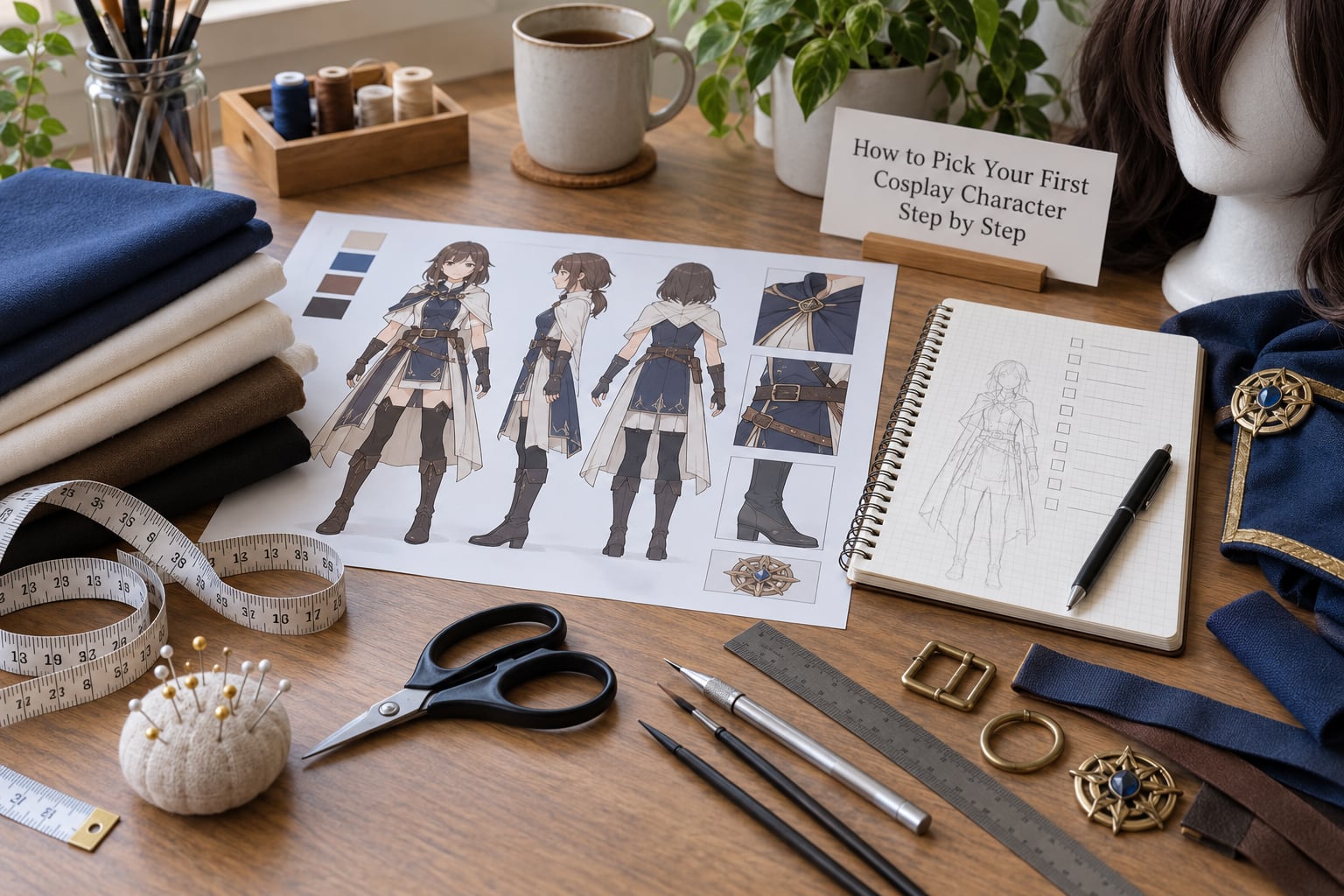
Start With the Version You Recognize
Decide which version you are portraying before you look at a single costume. Anime characters often have a casual outfit and an iconic outfit, comics have decades of costume changes, and games frequently ship several outfits for the same person. Searching without deciding means you will spend an evening collecting conflicting reference images and end up with a costume that mixes two eras.
Write the version down like this: name, series, specific form. “Winston from Overwatch, Defenders skin” or “Hermione, Yule Ball robes” gives you one clear target. Iconic versions are usually the most recognizable and also the most work, so choosing deliberately is the point.
Compare Comfort, Cost, and Crafting Difficulty
This is where most choices fall apart. Difficulty is not one thing. Break a candidate costume into separate skills and rate each one honestly: sewing, tailoring, painting or dyeing, foam or thermoplastic props, wig work, prosthetic makeup, and coloured contacts.
Some elements are beginner-friendly. Modifying a thrifted blazer with fabric paint is a good weekend project. A full ball gown with a structured bodice, boning and a floor-length skirt is a different order of work entirely, and it is where first-timers burn out.
Use this scorecard to put two or three candidates side by side. One to three means low effort, five means serious work. Empty cells mean you have not researched it yet, and that is itself useful information.
| Candidate | Build difficulty | Sourcing route | Hours needed | Props | Wig |
|---|---|---|---|---|---|
| Character A | 2 of 5 | Thrift and modify | 8 | 0 | No |
| Character B | 4 of 5 | Mixed, some made | 30 | 2 | Yes |
| Character C | 1 of 5 | Mostly closet | 3 | 0 | No |
Comfort deserves its own filter because it is easy to forget. Conventions run long, and a costume with a stiff collar, a cinched bodice or a heavy prop is misery after hour three. If you plan to stand for a full con day, ask whether the design actually works for that.
Check the Character Against Your Interests
Enthusiasm is not decoration in this decision, it is the engine. Cosplayers say again and again that the ones who finish their first costume are the ones who genuinely love the character, even when the costume was objectively harder than something easier.
Ask whether you like the personality, the story, the abilities, or just the visual design. That answer tells you whether you will still want to pose with it, learn the lore, or wear it for a six-hour day. A character you find visually interesting but feel nothing about tends to become the project on the abandoned pile.
Look for Reference and Costume Resources
Good references turn a vague idea into a buildable one. Use official art and promotional shots as your base, then screen captures and game footage for the back and side views that promo art never shows. Fan photography is the best source for how a finished costume actually sits on a real body in motion.
Learn the vocabulary too. Searching “purple asymmetrical coat” gets you nothing, while searching for the base garment name gets you thrift stores, cosplay shops and pattern drafts. People on beginner forums complain constantly about not knowing what to call a piece, and that is a solvable problem in ten minutes of looking.
Test the Choice Before You Commit
Do a dress rehearsal before you spend anything significant. Put on the clothing you already have, style a borrowed or cheap wig roughly as you plan to, attempt the makeup, and then sit, walk, climb stairs and stand for twenty minutes.
Photograph the result in good light and in a mirror. A photo exposes proportion problems that a mirror hides, and it also tells you whether the character reads from a distance. Note every adjustment now, while it costs you nothing to make.
How to Pick Your First Cosplay Character by Event Type
Where you wear it changes the answer more than people expect.
- Convention debut. Pick something recognizable from ten feet away with fewer than three props. Bring a change of clothes and plan for a long day on your feet.
- Cosplay competition. Do not start here. Judging rewards construction quality and accuracy, both of which take practice you do not have yet.
- Photo shoot. Accuracy and silhouette matter most because you control the angles and can reshoot. This is the friendliest format for a first costume.
- School, work or community event. Check any dress or prop policy before you commit. Keep it comfortable and modest enough for the setting.
- Home cosplay. Nothing here is a dress code. Do the ambitious version and wear it on your own terms.
Many first-timers are relieved to learn that cons are friendly. People report being recognised and welcomed almost immediately, and that the fear of being judged turns out to be much worse than the reality of a weekend.
Choose a Backup or Simplified Costume
Simplifying a difficult character is a deliberate strategy, not settling for less. The recurring piece of advice on beginner forums is to do the cheap, simple version first and chase accuracy once you know what you enjoy.
Ways to scale a hard character down: use the street outfit instead of the battle version, cut the prop down to one strong accessory, skip the wig and style your own hair with products, or drop the coloured lenses and bodypaint. A well-styled simplified version reads instantly in a photo and costs a fraction of the screen-accurate one.
Keep it wearable afterwards if you can. People describe wearing a first cosplay out in everyday settings as the most confidence-building part of the whole hobby.
Make the Final Decision
Score each candidate out of five on six things: how much you want to wear it, how recognizable it is, how comfortable it will be, cost, crafting difficulty, and fit with your event. Weight enjoyment highest, because it is the one factor that predicts whether you finish.
Pick the highest total that still excites you. If two candidates tie, choose the one you can complete in the least time and wear again. Confidence comes from wearing something, not from wearing the hardest thing you could find.
Common Mistakes
Choosing only because the character is popular. Fix: check the costume’s actual complexity on cosplay social accounts before committing. A convention full of that character also means less fun for you.
Copying a professional costume exactly. Fix: pick two features that carry the recognition, like the silhouette and one signature colour, and simplify the rest.
Ignoring comfort. Fix: do the twenty-minute standing test in the dress rehearsal and treat any pinching or heavy load as a design problem.
Starting too late. Fix: count backwards from your event date. Leave four to six weeks for a first build with shipping included, and set the project aside for a future year if the maths does not work.
Using unreliable references. Fix: cross-check any image that contradicts what you know against official art or the source material. Bad reference images waste entire evenings.
Committing to advanced props. Fix: learn from foam carving and thermoplastic later. For a first build, hollow cardboard and painted craft foam usually read the same in a photo.
Two last tips. If a friend is already cosplaying from a shared fandom, coordinate with them, because a group cosplay is the easiest way to get started and the group pressure-tests the choice for you. And if you change your mind halfway through, that is normal. Cosplay projects get abandoned and restarted every season, and the pieces are usually reusable.
Frequently Asked Questions
Is cosplaying an expensive hobby?
No. A first cosplay can cost nothing but your time if you build from thrifted clothing. Typical first projects land somewhere between the cost of a few meals out and the cost of a commission, which is where costs jump sharply. Thrifting and modifying keeps costs low and also teaches you skills that matter later, so it is the usual recommendation for a first build.
Which characters are good for beginners?
Beginner-friendly characters usually have simple outfits, few separate garments, minimal props and either no wig or a basic style. Look for designs built from ordinary street clothing, like a school uniform, a sports outfit or a plain jacket-and-trouser combination. Avoid anything needing screen-accurate armour, sculpting or heavy prosthetic work on your first attempt.
Am I too old, too short, or too out of shape to cosplay?
No. Height, age, body type and gender are not disqualifiers, and cosplaying a character who does not match you is normal and common. Nobody will measure you in the hallway. If accuracy matters to you, adjust with footwear, tailoring or posture, and if it does not, wear the version of the character that you enjoy most.
Should I buy, commission or build my first costume?
Build or modify it yourself if you want to learn and you have time; beginners consistently say this is the route they recommend for a first project. Buy ready-made if you have a tight deadline or the character is widely available. Commission if you want high accuracy and cannot make it yourself, but expect long lead times and a much higher total cost.
What are good closet cosplay ideas?
Closet cosplay means mapping a character onto clothes you already own, then buying or making one or two pieces to finish the look. Start from what you have: a white button-up, a striped tee, a long coat, a school skirt. Characters whose outfits are built from ordinary garments are the easiest to pull off this weekend without a sewing machine.
What if my costume is not finished by the event?
Decide your fallback early rather than the night before, because panic produces rushed work. Simplify: drop the prop, skip the wig and style your hair, or wear a partial version with the one strong accessory that carries recognition. Showing up in a simplified costume beats skipping the event entirely, and a meetup or local group is a forgiving first venue.
Conclusion
The whole method comes down to one move: choose from passion, then filter for reality. List three characters you love, score each on enjoyment, recognizability, comfort, cost, complexity and event fit, and let the highest balanced score win. Then dress-rehearse the winner in borrowed pieces before you spend real money on it. Knowing how to pick your first cosplay character is not about finding the easiest one on paper. It is about finding the one you will actually finish and wear again. Start with the simple version of that character, wear it somewhere forgiving, and build the accurate one when you already know you want to keep going.
Updated for 2026.