If you are stuck on how to price a collection you want to sell, it comes down to one number: the median price identical pieces actually sold for in recent months, minus the platform fees, commission, postage, packaging, and the discount buyers expect on bulk lots. Most owners get the first part right and stop there, then wonder why the offers come in low. Budget a weekend for a few hundred items, longer if you are documenting hundreds of pieces one at a time.
The method below is deliberately unglamorous. You research what things sold for, you write down what condition they were in when they sold, you subtract what selling costs you, and then you set a number you are willing to accept. Everything else is negotiation around that number.
Table of Contents
- 1What You Need to Price a Collection Properly
- 2Which pricing tools actually help
- 3Step-by-Step: How to Price a Collection You Want to Sell
- 41. Start by separating what you are actually selling
- 52. Identify each item and record its condition
- 63. Compare recent sold prices, not asking prices
- 74. Adjust for rarity, demand, and what it costs to sell
- 85. Set a pricing range and choose a selling format
- 96. Test the price and adjust the listing
- 10Common Mistakes That Distort a Collection’s Value
- 11Frequently Asked Questions
- 12How do I find out what my collection is worth?
- 13Should I use active listings or sold listings to price a collection?
- 14How do I price a collection when some items are missing?
- 15Is it better to sell a collection as one lot or item by item?
- 16Do I need an expert to value a collection before I sell it?
- 17Conclusion
What You Need to Price a Collection Properly
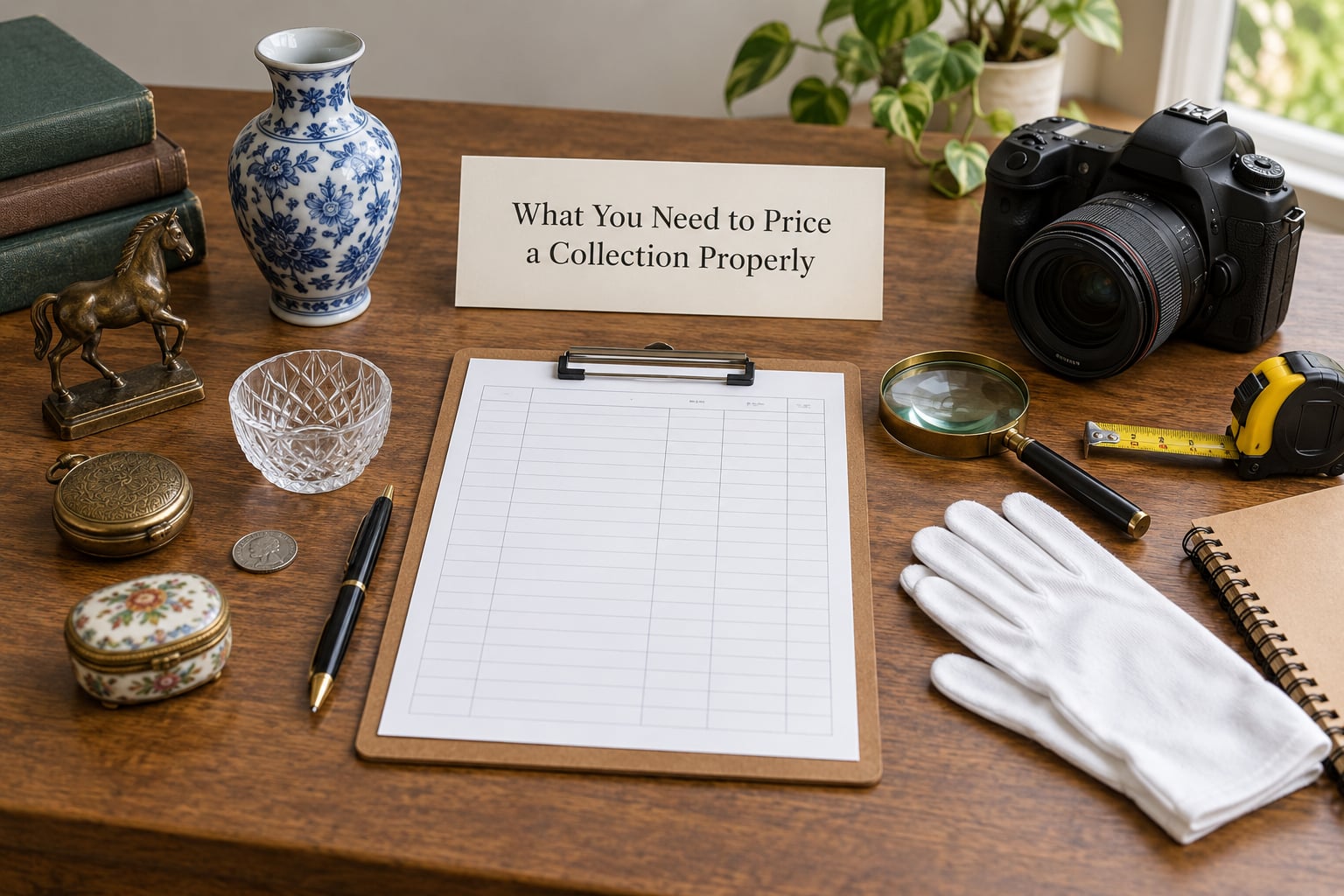
You need six things before you touch a price, and none of them are expensive. Start with a written inventory. A spreadsheet with one row per item is the difference between pricing a collection and guessing at it, because it lets you sort, filter, and total without re-counting shoeboxes at midnight.
- An inventory sheet. Columns for description, category, condition, quantity, your asking price, and what it sold for once it does.
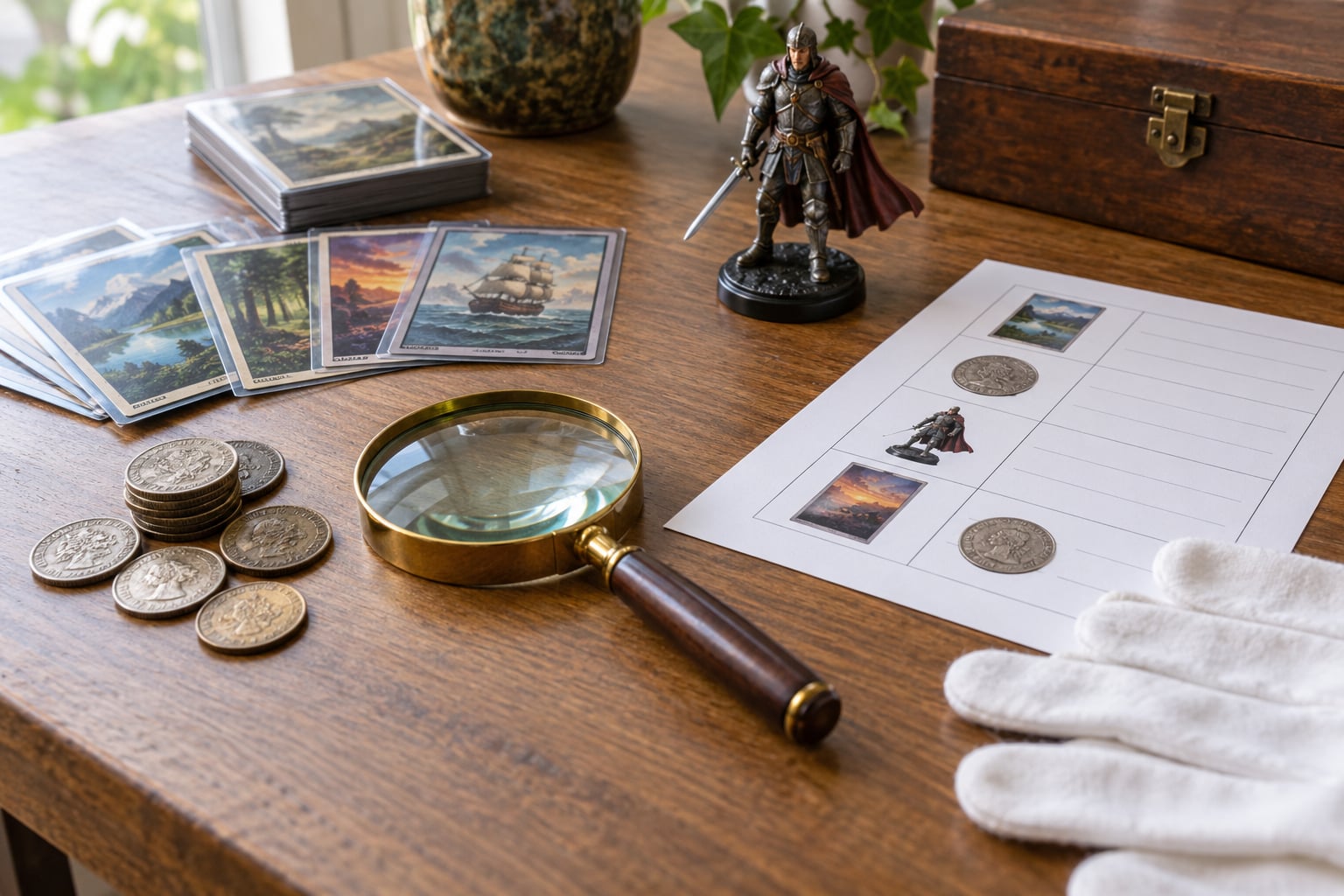
- Identification help. A magnifying glass or loupe for stamps, coins, and small markings, plus your phone camera for anything you cannot hold up to a window.
- Condition supplies. Cotton gloves, a soft brush, lint-free cloths, and a neutral background. Never clean a valuable piece with water or household cleaner before you know what it is.
- A tape measure and a scale. Dimensions and weight decide which parcels you can combine and which need their own box.
- Access to sold listings. Not the search results page. The sold and completed filters inside eBay, plus archive sites like WorthPoint and Pricecharting for categories with thinner trading history.
- Current fee schedules. Write down what each channel takes before money reaches you. These change, so check the live listings rather than trusting a number you remember.
A plain camera also does more work than people expect. Photos taken on a plain background with even light are what let a buyer trust your condition notes, and they are what an appraiser or auction house asks for before they will quote a sale estimate.
Which pricing tools actually help
Sold-listing data is the foundation, and every other tool either speeds up identification or covers a category with thin trading history. Each one has a clear limit.
| Tool | What it gives you | Where it stops |
|---|---|---|
| Sold listings on eBay | Real prices buyers paid, with dates and condition notes in the descriptions | Thin for categories that barely trade there; some sellers list optimistic numbers and the price is never met |
| WorthPoint | Archive of completed sales going back years, useful for older pieces | Dealer listings are mixed in with collector-to-collector sales, so read who the seller is |
| Pricecharting | Price history and a bulk sell-your-collection feature for video games, cards, and comics | Conventions and sealed product differ wildly from loose single items |
| Google Lens and similar image search | Fast identification of an unfamiliar object from a photo | Suggests candidates, never confirms one. You still have to verify the maker’s mark yourself |
| Grading services such as PSA and CGC | A third-party opinion that buyers trust, and a slabbed item often sells for more than raw | Fees plus postage can exceed the item’s value. Grade first only when the piece is genuinely near the top of its grade distribution |
| Auction house valuation | Many regional houses give a free estimate after you send photographs | An estimate is an opinion, not a guarantee, and it is often the house’s interest rather than yours |
Step-by-Step: How to Price a Collection You Want to Sell
1. Start by separating what you are actually selling
Sorting comes first because a collection is usually several collections in one cupboard. Break it into categories: trading cards, coins, comics, vintage toys, watches, tools, stamps, whatever yours happens to be. Then count each group and write the counts down.
Inside each group, find the pieces that are genuinely different from the rest. A handful of items usually holds most of the value, and those are the ones that deserve individual research, individual photographs, and individual listings. Pull out anything you are not willing to sell, including the sentimental pieces, before any numbers get discussed with anyone.
Result of this step: a category list with counts, a shortlist of standout items, and a clean boundary around what is for sale. Anyone who offers to buy “the whole lot” can now be compared against your own categories rather than against a vague total.
2. Identify each item and record its condition
Precise identification is what lets you compare like with like. For each item record the maker or publisher, the date or era, the material, the dimensions, any serial number, and any accessories that came with it. Original boxes, inserts, and manuals raise realized prices on anything from vintage toys to console games, so note what you have rather than what you assume.
Condition gets described in language buyers already understand. Near mint, excellent, very good, good, and fair cover most graded categories, and jewellery, coins, and toys have their own conventions. The important part is describing what a buyer can see: corner wear, spine ticks, fading, chips, missing parts, battery corrosion. If you say “great for its age” without detail, buyers assume the worst and price accordingly.
Photograph everything as you go: full view, close-ups of wear, any marks or stamps, and the accessories. Provenance matters too. Receipts, old photographs, and a note about where the piece came from all support the price, and for anything inherited or high value they are worth more than a generic certificate.
One caution for inherited collections. Reproduction pieces are everywhere, and pricing them at original value is the most common way owners talk themselves into a loss. Check the maker’s marks and hallmarks against known originals, and where a piece carries real money, get a specialist to confirm before you promise anyone anything.
3. Compare recent sold prices, not asking prices
Sold listings are completed transactions, meaning what buyers actually paid rather than what sellers hope to get. Active listings are aspirations, and the gap between the two is where most sellers get their expectations wrong. On eBay the path is simple: run the search, then switch the results filter from active to sold items or completed items, and set the date range to the last 90 days.
Then read the descriptions rather than the headline numbers. A sold listing that says “as is, box damaged” is not a comparable for your near-mint example. Keep the ones that match on item, condition, edition, and completeness, discard the rest, and note at least three of them per item.
Use the median rather than the average. One expensive sale in a small sample will drag an average up and tell you your collection is worth more than it is. Where you have plenty of data, look at the recent trend too, since categories rise and fall and a sale from four years ago tells you very little about the market in 2026.
Two more references are worth your time. Past auction results at houses that handle your category tell you what a specialist buyer paid for a described group of lots. Dealer asking prices tell you what a dealer needs to charge to make money reselling, which is a ceiling, not a market value.
4. Adjust for rarity, demand, and what it costs to sell
Your gross number is the median of matching sold prices. Your real number is what survives the deductions, and the formula is short enough to memorize:
Net expected price = (median sold comparable x 0.9) minus fees, commission, shipping and packaging, and the cost of time.
The 0.9 factor is a habit, not a law. It gives you a little room below the market so your asking price sits where buyers actually transact rather than above it. Adjust upward only when condition, authenticity, or completeness genuinely beats the comps you found, and adjust downward when you have a thin sample.
Rarity moves value only when buyers can verify it and want it. A scarce item in an unpopular category rarely earns a premium, while an ordinary item from a category with steady demand holds its price well. Completeness matters more than rarity: a set with one piece missing is a different product from a complete set, and it belongs in a separate search.
Deductions work like this. Marketplace platforms take a listing fee plus a percentage of the sale plus payment processing. Consignment shops take a commission on the final price and usually want the item sold before they pay out. Auction houses take a commission from the hammer price and add a buyer’s premium on top, which the buyer pays. Dealers and estate buyers take the largest cut of all, but they take it in exchange for speed, certainty, and no work on your side.
Two costs that get forgotten. Add postage, packing materials, and insurance for the parcels, and remember that a sale in 2026 may create a taxable gain against what you originally paid. Rules differ by country and by state, so talk to an accountant if the total is meaningful rather than guessing. Most home policies also cap collectibles well below a collection’s real value, so confirm coverage before you part with anything.
5. Set a pricing range and choose a selling format
You now have gross market value. Decide whether you are pricing for the highest dollar or for speed, because those are different numbers. Fair market value is the median of your sold comps. A fast-sale number sits meaningfully below it, and the discount you accept is really a price on your time and your remaining storage space.
A worked example on a simple scale makes the arithmetic concrete. Take a group whose median sold comparable is 100 points. Apply the 0.9 factor and you are asking at 90. Marketplace fees and payment processing take roughly 15 points of the sale, leaving about 76. Postage, packing, and insurance across the parcels come to about 4 points, leaving roughly 72. If you price for a quick sale instead of the top of the range, say 15 points lower, you are at about 57 net. Same collection, very different outcome, and the second figure is the one most owners are actually choosing when they want the cupboard empty this month.
Now choose the format. Individual listings recover more per item but cost you time, photographs, fees, and postage on every single sale. Lots and bundles are faster and simpler, and buyers price them accordingly. Working out the crossover is worth five minutes: if one parcel costs you 8 points to send and fees take roughly 15 percent of the sale, an item priced below about 25 points leaves you with almost nothing after postage. Those items belong in a lot or a bundle with a combined shipping discount, not on their own listing.
For anything high value, a timed auction with a reserve often beats a fixed price, because bidding finds the buyer who genuinely wants the piece. A fixed price sells faster at a higher price and works well for pieces where you already know the market.
6. Test the price and adjust the listing
The tiered approach works better than picking one strategy for everything. Sell the top tenth of your collection, by value, individually with proper photography and full descriptions. Group the middle into themed lots of a dozen or so pieces that a buyer can actually picture owning. Lot the cheap tail together, or hand it to a dealer who values speed over margin.
Watch for meaningful activity rather than noise. Genuine signals are watchers, sold listings that ended without a sale, offers that cluster below your number, and questions about a specific item. Ignore the first two days of views, the single low offer, and the message asking you to ship before payment clears.
Give the listing a fair test window, around three weeks, then decide from the data. Steady watchers and no offers usually means your price sits above the market, so trim it by 10 percent and relist. No interest at all in an item that should sell fast usually means the photos, the title, or the description are doing the damage rather than the number. Write down your walk-away price now, while you are calm, so that when an eager buyer appears you already know the floor.
Common Mistakes That Distort a Collection’s Value
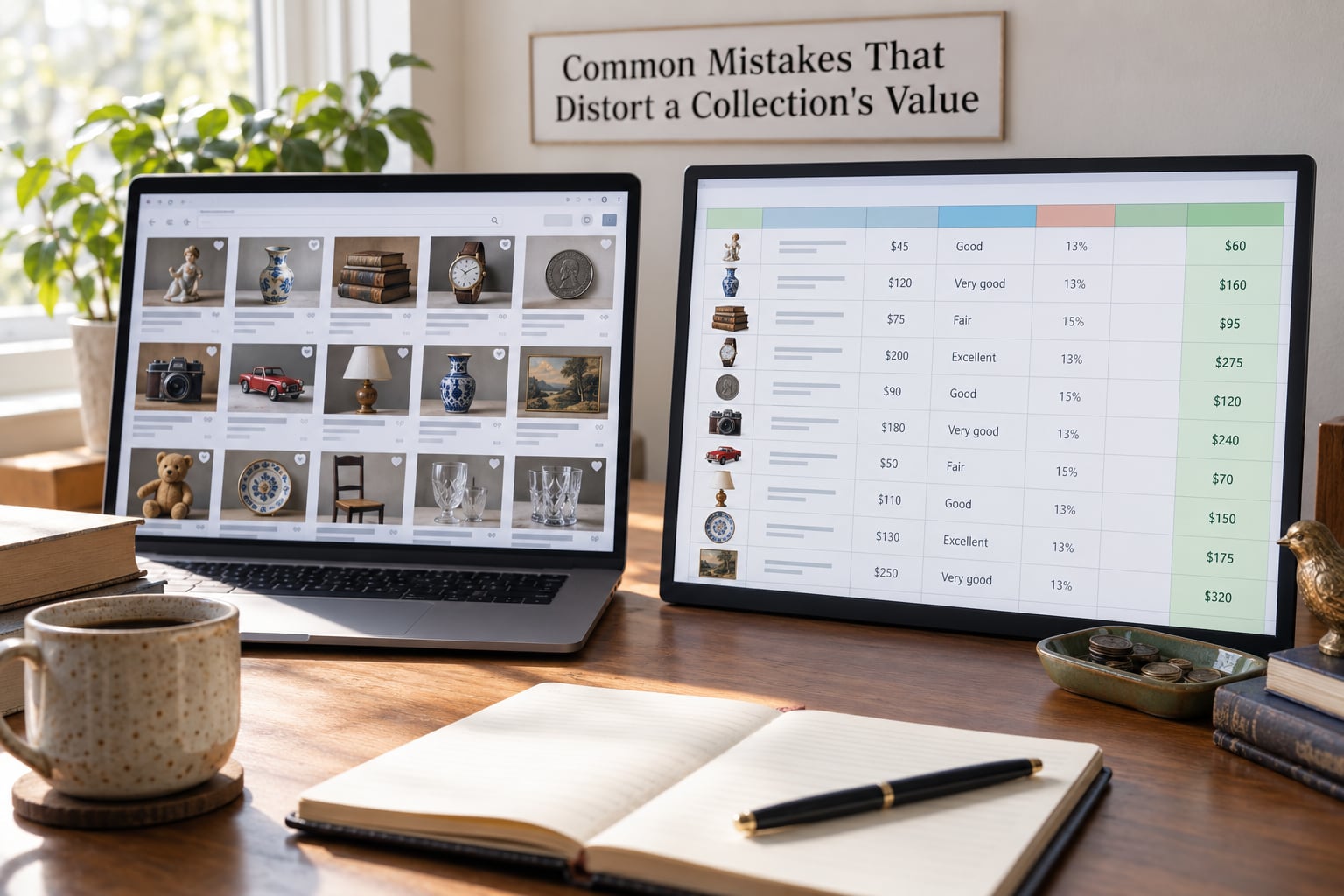
Pricing from active listings. Asking prices tell you what sellers wish, not what buyers pay. Switch the filter to sold items and redo the research.
Ignoring condition. A piece with a worn corner, a faded spine, or a missing part is a different product. Describe wear precisely and compare against sold listings in the same grade.
Pricing without doing the research at all. A valuation based on memory, hope, or a single dealer visit is a guess with confidence attached. Three matching sold comps will beat it every time.
Treating every rarity as valuable. Scarcity only earns money when buyers want the item. Demand does the work, rarity just stops the supply growing.
Forgetting the deductions. Fees, commission, postage, packing, and insurance can take a quarter or more of the gross number. Subtract them before you fall in love with the total, not after.
Pricing the whole collection as one lot by default. One price for everything forces the same percentage onto pieces worth a fortune and pieces worth almost nothing. Split into tiers.
Accepting the first collection offer. Dealers buying collections make a fast, certain, lower number in exchange for doing all the work. It is a legitimate price for a quick sale, not evidence your things are worthless. Compare it to the realistic net figure from your own research before you sign.
Frequently Asked Questions
How do I find out what my collection is worth?
Identify each item as specifically as you can, then document condition, completeness, dimensions, and any provenance. Search recently sold examples of the same item rather than relying on active asking prices, keep three or four genuine matches, and take the median. Add up the results, then subtract fees, commission, postage, and a bulk discount to reach the figure that will actually reach you.
Should I use active listings or sold listings to price a collection?
Sold listings are usually more useful because they show prices buyers actually paid, although completed sales take time to build up and can be uneven. Active listings are still worth reading for seller expectations and for spotting items that are overpriced and never selling. Use active prices as a sanity check and sold prices as your baseline.
How do I price a collection when some items are missing?
Treat an incomplete set as a different product from a complete one. List exactly which pieces are absent, then search for sold examples of that same incomplete set, because collectors regularly buy gaps cheaply. Do not apply a simple percentage haircut and do not assume the complete-set price still applies. Accessories, boxes, and manuals count as parts of the set too.
Is it better to sell a collection as one lot or item by item?
A single lot is faster and suits a large themed collection full of similar, lower-value pieces, but buyers discount lots heavily to cover their own workload. Selling item by item usually recovers more and creates more chances to reach the right buyer, at the cost of time, fees, and postage on every sale. Most collections do best with a tiered mix of both.
Do I need an expert to value a collection before I sell it?
For most collections, your own sold-comparable research is enough. Get an independent appraisal when a single item carries real money, when provenance matters, when you suspect reproductions, when the total is large enough that tax treatment matters, or when a sale needs an insurer or estate document. Ask about the appraiser’s credentials and make sure the report is written for your purpose.
Conclusion
Start by identifying every item in the collection and writing down its condition, because you cannot price what you cannot name. Then find several recent sold examples of the same pieces, take the median, and subtract the fees, postage, and discount that will apply to your sale. Set your asking number from what survives those deductions, choose individual listings for the top tier and lots for the rest, and review the result after a fair three weeks of data. Once you have run the loop a single time, working out how to price a collection you want to sell takes a fraction of the effort the next time round.