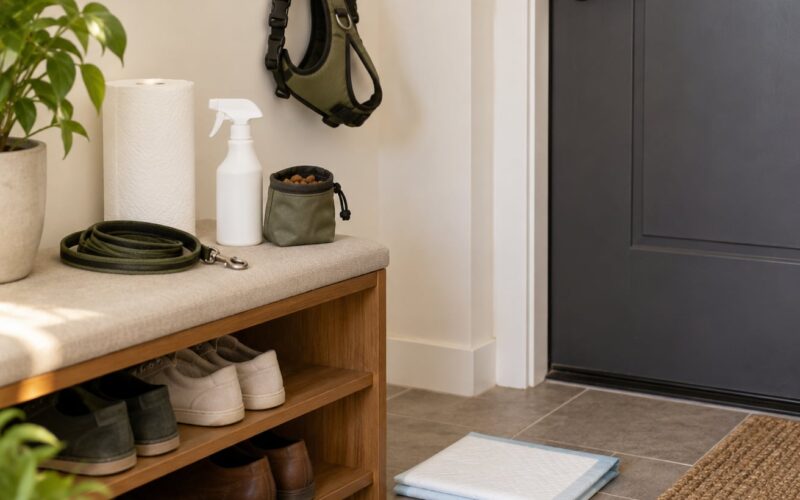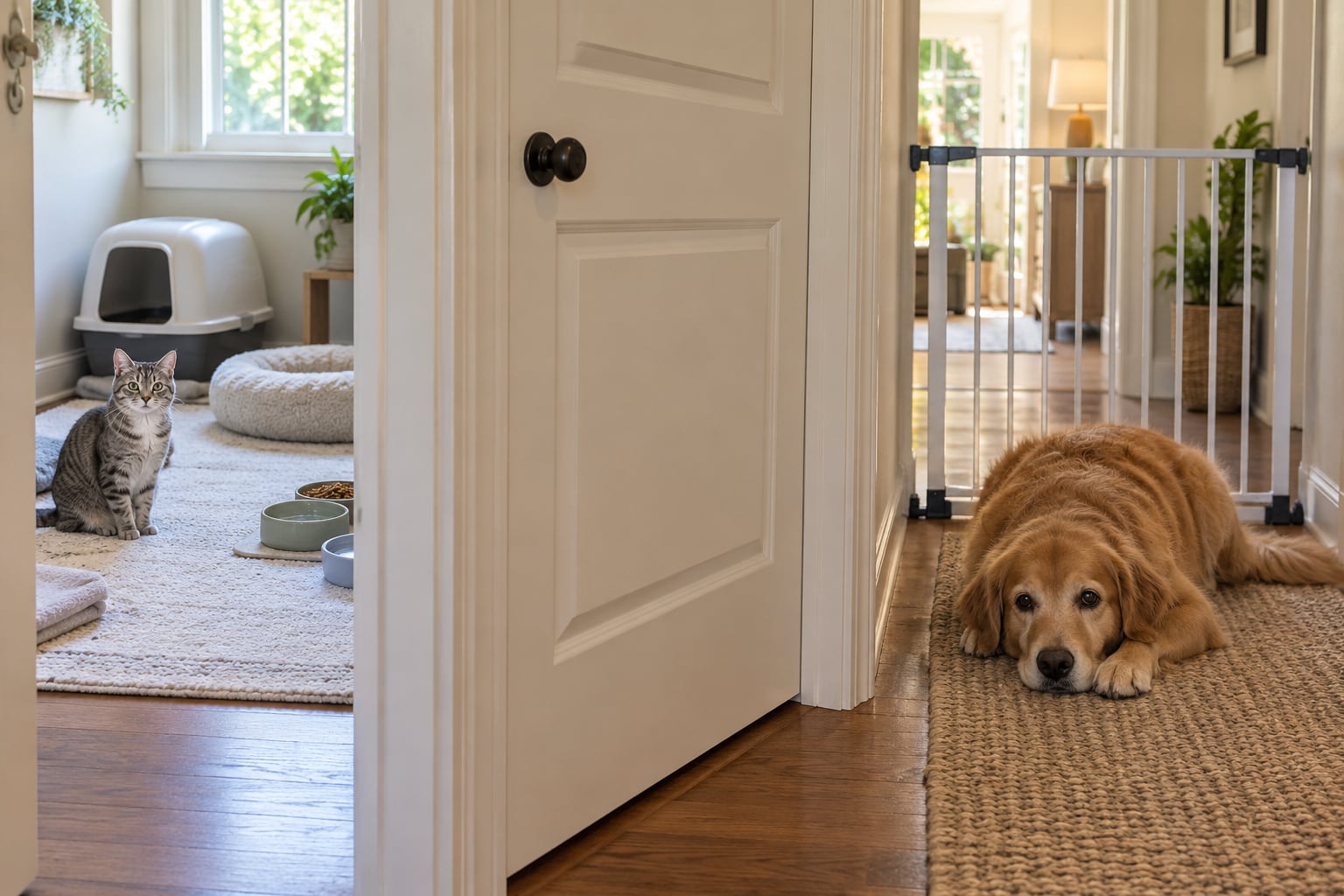
The short answer: introduce a new cat to a dog through scent swapping, a visual barrier, and short controlled meetings on a leash, in that order. Cats identify each other by smell long before they care to look at each other, so let the scent arrive first. Most introductions take three to six weeks, and the speed is set by the more nervous animal, not by a calendar.
Rushing is the single mistake that ruins these introductions. A cat pushed into a room too early can turn permanently skittish, and a dog with strong prey drive may react in a way that ends badly in seconds. Slow is the safe route.
Here is the sequence that works, roughly the way certified behaviorists and shelter staff describe it, with the timeline for each stage and the signs that tell you to keep going or to back up.
Table of Contents
- 1What You Need
- 2Step-by-Step: How to Introduce a New Cat to a Dog
- 31. Create Separate Safe Spaces
- 42. Let the Cat Settle Before Beginning
- 53. Start With Scent Swapping
- 64. Add Visual Contact
- 75. Use Leashes and Controlled Contact
- 86. Gradually Increase Face-to-Face Time
- 97. Practice Calm, Unsupervised Coexistence
- 10Common Mistakes
- 11Frequently Asked Questions
- 12How long does it take to introduce a cat to a dog?
- 13Is it normal for my cat to hide for days after the dog notices her?
- 14How do I introduce a cat to a dog with strong prey drive?
- 15Should I feed the cat and the dog at the same time?
- 16When should I call a veterinarian or a behavior professional?
- 17Conclusion
What You Need
Most of the work happens before the animals meet, and almost all of it is gear. Gather these before the cat comes home.
- A safe room for the cat. A spare bedroom, bathroom, or laundry room with a door that closes. No shared space, no exceptions.
- A secure carrier. Not a cardboard box. You may need to move the cat without being nipped or dropped.
- Bedding and clothing for scent swapping. Two soft blankets, a worn t-shirt of yours, and a dog toy or blanket with the dog’s scent on it. Washers and dryer sheets kill the smell, so skip the laundry for these.
- Treats for both animals. Two separate kinds, so the dog doesn’t decide the cat’s treats are worth a chase. Use small, soft pieces the dog can’t swallow quickly.
- A barrier. A baby gate tall enough that the dog can’t jump it, a screen door, or a doorstop with the door partly open. In a small home, a baby gate in a hallway can do the job of a whole door.
- An extra litter box. One more than the number of cats you have, in a spot the dog cannot reach.
- High places and escape routes. A cat tree, top shelf, or cleared counter the cat can reach but the dog cannot, plus at least one route out of every room.
- Cleaning supplies. Enzyme cleaner, for accidents that happen in the first days.
- Paperwork and history. Vet records for both pets, vaccination dates, and any known behavior history, especially a dog with a history of cat aggression.
Have your dog’s obedience foundation ready too. Sit, stay, down, leave it, and a reliable “place” or “mat” cue are what let you interrupt a developing chase. If the dog does not already know those, spend the first week teaching them.
Step-by-Step: How to Introduce a New Cat to a Dog
1. Create Separate Safe Spaces
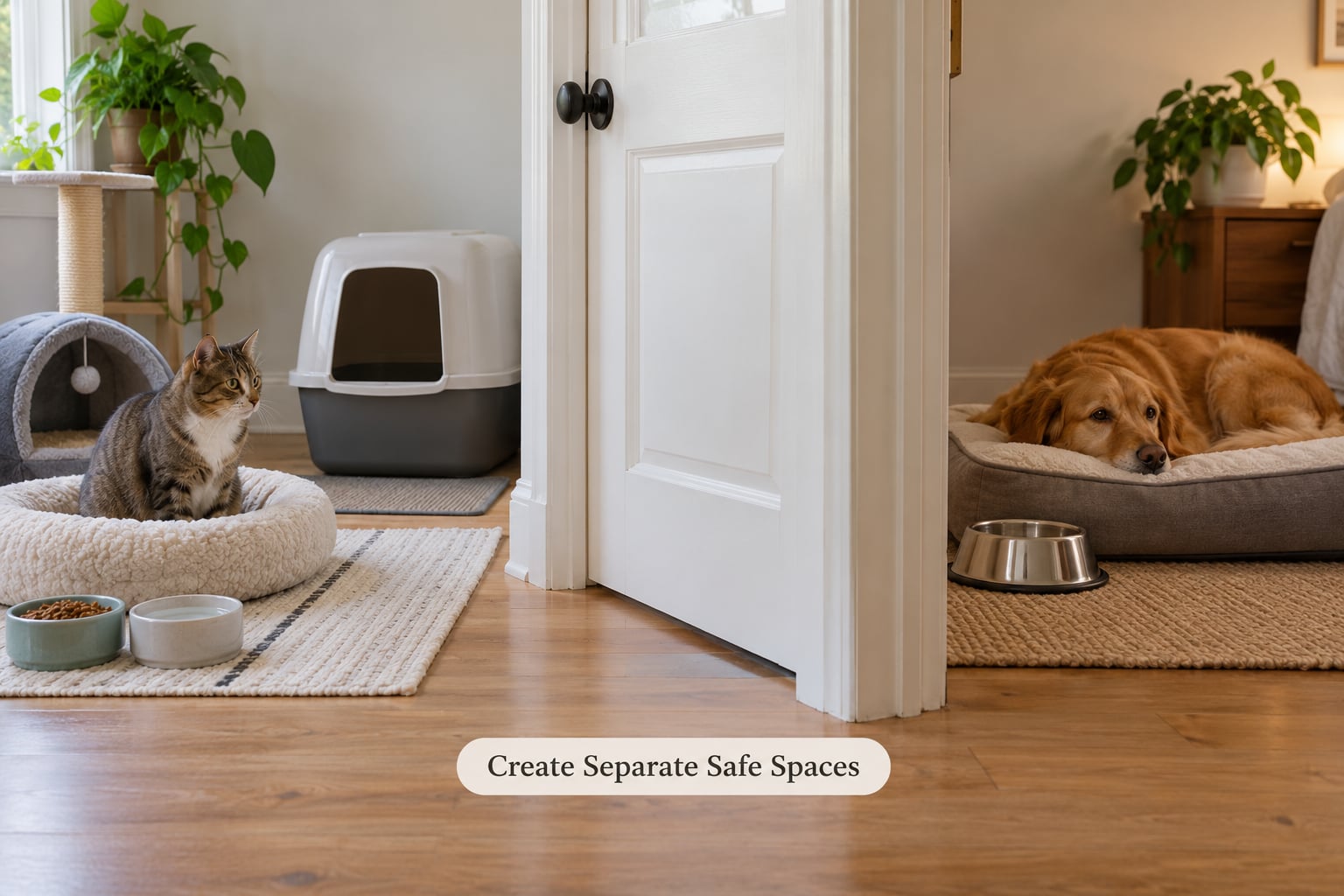
The cat’s safe room is a refuge the dog can never enter, at any hour, for any reason. Set it up before the cat arrives, with food and water, the litter box in a corner the cat won’t feel trapped in, a bed, and somewhere to hide that isn’t the space under the bed where you can’t reach them.
On the dog’s side, pick the area they are allowed to use while the cat is in the safe room, and give the dog something to do there, a chew, a filled food puzzle, a bed in a spot where they can watch the door.
Give the cat high spots and vertical space from day one. A cat that can watch the dog from above feels far safer than one trapped at floor level, and that head start matters for the whole introduction.
2. Let the Cat Settle Before Beginning
Keep the two apart for the first three to four days at minimum. Many shelters recommend a full week when the dog is a terrier type, a husky, a cattle dog, or has any history of chasing cats. This is decompression time, and rushing it is the most common cause of a failed introduction.
Expect the cat to hide, eat less, and use the bathroom at odd hours. Hiding for a few days is normal and usually passes in three to seven days. Warning signs that go beyond that, refusing to eat for more than a day, open-mouth breathing, or repeated vomiting, are a vet call.
Do not start anything while the cat is still hiding. Instead, keep the dog’s routine unchanged and predictable: same walk times, same meals, same bed. Predictability is what keeps the dog’s arousal down during the weeks ahead.
Here is a realistic view of how the stages stack up. Durations are ranges from real households, not guarantees, and the success signal matters more than the calendar.
| Stage | Typical length | You’re ready to advance when |
|---|---|---|
| Full separation | 3 to 7 days | The cat eats, naps, and uses the litter box normally |
| Scent swapping | 2 to 5 days | The dog investigates the cat’s items calmly and the cat no longer startles at them |
| Closed-door feeding | 3 to 10 days | Both pets finish their meals with the other nearby |
| Visual contact | 3 to 14 days | They see each other and both stay in place, relaxed |
| Leashed contact | 1 to 3 weeks | Dog can look away and respond to a cue mid-session |
| Supervised loose time | 2 to 4 weeks | Several calm hours together with no chasing |
Owners following a three-three-three style approach often reference it loosely as the three to three rule: three days of separate rooms, three weeks of eating near each other, three weeks of supervised interaction. It was written for cats meeting cats, but the shape of it works for a cat meeting a dog.
3. Start With Scent Swapping
Put the cat in the safe room with a carrier open and a towel over it. Sit nearby and let the cat come out on its own terms. In the same trip, bring a worn t-shirt or a dog toy and place it with the cat so it absorbs the dog’s scent, and leave a cat blanket in the dog’s bed in return.
Don’t rush the cat out. Owners on pet forums consistently say the ride home is the moment worth doing this, and they also say a cat that emerges on its own is far easier to work with than one forced out by a person reaching in.
Then swap for real. Put the cat’s used blanket on the dog’s bed and the dog’s toy near the cat’s spot. Reward the dog for calm sniffing, and move the object away if the dog starts calling, whining, or refusing to eat. Never leave a scent-swapped item where it could become a toy and be dragged around.
The goal is for the dog’s smell to become boring and the cat’s smell to become ordinary, before either animal has to look at the other.
4. Add Visual Contact

Once the dog ignores the cat’s scent, let them see each other without touching. A baby gate, a screen door, or a doorstopped door all work. The cat must be able to walk away and be completely out of sight whenever they choose.
Start with thirty seconds. Feed the dog on one side of the barrier and the cat on the other, so both animals link the sight of each other with something good. A third bowl on the barrier itself helps some households. Watch for calm behavior and reward it, and end the session while both are still relaxed rather than pushing to the point of hissing.
Three or four one-minute sessions a day beats one long one. You are building a positive association, and long sessions just give the nervous cat more time to work up to fear.
5. Use Leashes and Controlled Contact
Put the cat in a harness, not a collar, and let the cat choose whether to approach. Clip the dog’s leash to a harness or a head collar, not a neck collar, and hold the leash short. If you can step on the loose end of the leash, you can stop a chase instantly, which is the whole point.
Walk the dog first, until he is calm and thinking about something else. A dog worked up by a walk around the block will ignore every cue you give him once he sees the cat.
Bring the dog in on leash, let him look at the cat for a few seconds, then reward looking away or disengaging. Let the cat approach and retreat on its own terms, and keep sessions to one to three minutes. Watch for the signals below, and end the session the moment you see them.
Never pick the cat up during a meeting. A cat held in the air has no escape route, and dogs read the movement of a struggling cat as a chase trigger. This is the most important safety rule in the whole process.
6. Gradually Increase Face-to-Face Time
Add a minute at a time, and only when the previous session was calm. The goal is not time, it is repetition of a good experience. Two minutes of relaxed contact for five days beats twenty minutes of tension.
Use this table to decide what to do with what you see. Some hissing early on is normal and not the same thing as a serious attack.
| What you see | What it usually means | What to do |
|---|---|---|
| Cat: slow blink, ears forward, tail relaxed | Comfortable and interested | Keep going, reward calm |
| Cat: tail flicks, ears sideways, skin twitches on the back | Mild stress, over-stimulation | End the session, resume a step earlier |
| Cat: crouching, tucked tail, dilated pupils | Fear | Back up immediately, add distance |
| Dog: turning head away, licking lips, yawning | Discomfort signal, not aggression | Add distance and reward disengaging |
| Dog: stiff body, hard stare, no blinking | Predatory focus | End the session, shorten the leash |
| Dog: play bow, bouncing forward | Often predatory interest, not friendship | Barrier immediately, redirect to a toy |
| Either: a single quiet growl or hiss | Warning, not the start of a fight | Let the cat escape, end the session |
Resetting is not failure. If a session goes badly, go back one step for several days and rebuild from there. Owners who treat a bad session as a reason to start over rather than push through are the ones who end up with two calm animals.
7. Practice Calm, Unsupervised Coexistence
Once your dog can ignore the cat and respond to a cue while they’re in the same room, you can widen access. Keep feeding them in separate rooms for good. Keep the litter box out of reach. Give the cat escape routes that work in every room, and only let them be loose together when you are present and paying attention.
In a small apartment, where a separate safe room is hard to arrange, use a bathroom or closet with the litter box inside it and a door that stays open only when the dog is outside. Gates at two or three doorways create more distance than one closed door. Elevated feeders for the cat, on a shelf the dog cannot jump to, cut off access to both food and the resting spot.
Set realistic expectations here. Many cats and dogs settle into mutual tolerance and coexist happily, without ever loving each other. Some adult cats never accept a dog at all. Aim for a home where both animals feel safe, not for a friendship, and never leave them alone together until the dog has proven reliable over weeks, not days.
If your dog has high prey drive, treat that as a permanent management condition rather than something the introduction fixes. No free access, no unsupervised time in the same room, and consider working with a certified behavior professional before you start.
Common Mistakes
Putting the cat and dog in a room together on day one. This is the mistake behind nearly every failed introduction. A cat that is cornered on arrival may never feel safe in that room again.
Holding the cat in your arms while the dog is present. No escape, no control, and a struggling body that some dogs read as prey. Let the cat come and go freely.
Using the cat as a treat lure. Bringing a treat to a hiding cat teaches her that people appear when something good happens and the dog is nearby. Feed first, then approach with the treat already in your hand, so the cat is never baited toward him.
Sharing food, bowls, or the litter box. The dog eats the meal or the litter, the cat loses its safe spot, and the resource guarding starts on day one. Two separate feeding stations and one more litter box than you think you need.
Reading a play bow as friendly. Dogs bounce and bow toward cats because they are excited about something that moves like prey. The cat sees a stalker closing in. Treat it as a signal to break things up.
Pushing through a session after hissing. Ending early is always better. A quiet hiss at five minutes is cheap; the same situation at five minutes with a cornered cat is how people end up at an emergency clinic.
Not training the dog. Cue work is your control system. A dog who reliably sits, lies down, and drops on “leave it” gives you a way to interrupt a chase before it starts.
Ignoring the timeline. Progress by calendar rather than by behavior is why owners rush. Judge every stage on how the animals actually behave on that day, not on how many days have passed.
Frequently Asked Questions
How long does it take to introduce a cat to a dog?
Most cats and dogs need three to six weeks for a calm introduction, and some pairs take longer. Early scent swapping and closed-door feeding usually take under two weeks, while leashed contact and supervised loose time take as long as they take. Advance a stage only when both animals are visibly relaxed, not when a certain number of days have passed. A senior cat or a high-prey-drive dog usually needs more time and more careful management.
Is it normal for my cat to hide for days after the dog notices her?
Yes, hiding for a few days is normal and usually passes within three to seven days. Keep the cat in the safe room, avoid pulling her out, and keep the dog’s routine predictable. If she refuses to eat for more than a day, breathes with an open mouth, or vomits repeatedly, call your veterinarian. Never let the dog near the hiding spot to coax her out.
How do I introduce a cat to a dog with strong prey drive?
Treat high prey drive as a management condition, not something the introduction will fix. Keep the two physically separated for longer, work through a baby gate or screen, and keep the dog on leash with the cat free to leave every single time. No unsupervised access at any point. Terriers, huskies, and cattle dogs respond poorly to gradual introductions, so a certified behavior professional is worth the money before you start.
Should I feed the cat and the dog at the same time?
Feed them at the same time but in separate places, with a closed door or a barrier between them. Same-time meals build the positive association between the other animal and food, which is what makes the process move forward. Keep the cat’s food in a separate room or on an elevated feeder the dog cannot reach, and never let the dog approach an eating cat, which is the most common trigger for resource guarding.
When should I call a veterinarian or a behavior professional?
Call your vet if the cat stops eating, has open-mouth breathing, or hides far beyond a week, or if either animal seems to be in pain. Call a certified behaviorist or shelter behavior team if the dog shows a hard stare, stalking, or repeated lunging, if the cat stays crouched and hiding after several weeks, or if a fight happens and you cannot separate them safely. Never step between animals that are actually fighting.
Conclusion
Start with two things tomorrow: set up the cat’s safe room with a door that closes, and order a worn t-shirt to leave with the cat on the trip home. Nothing else happens until the cat is eating and settling normally in that room.
From there, work up on behavior rather than on the calendar. Scent first, sight second, controlled contact third, and go back one step any time you see fear. Most households end up with calm coexistence, and a few slow weeks now is a fair price for that.