Do security cameras deter burglars? Partly. A visible camera makes a home look watched and recorded, so many opportunistic burglars skip it and pick an easier target, but cameras do not stop a determined offender on their own. They work best as one layer alongside good locks, exterior lighting and an alarm.
A deterrent is simply anything that makes an offender decide not to attempt the crime. That distinction matters, because a camera does three separate jobs and readers usually mix them up. It deters (some burglars never approach), it detects (you find out it happened), and it provides evidence (police can use the footage). Only the first job stops a break-in, and only when the burglar knows the camera is there.
The honest summary: cameras are one of the better burglary-prevention tools available to a homeowner, and the evidence behind them is stronger than most vendor blogs admit. It is also not a magic force field. This guide covers what the research actually found, which features carry real weight, where to mount cameras, and what to add so your setup does not depend on a single device.
Table of Contents
- 1Do Security Cameras Deter Burglars?
- 2How Security Cameras Affect Burglar Decisions
- 3What Research Says About Visible Cameras
- 4Do security cameras deter burglars more than alarms?
- 5Where the evidence runs out
- 6Which Security Camera Features Help Most
- 7Where Should You Place Cameras to Deter Burglars?
- 8Do Security Cameras Work Better Alone or With Other Security Measures?
- 9How to Choose a Camera for Deterrence and Evidence
- 10Legal and Privacy Considerations
- 11Frequently Asked Questions
- 12What is the number one deterrent for burglars?
- 13Should security cameras be visible or hidden?
- 14How do burglars defeat security cameras?
- 15Do fake or dummy security cameras deter burglars?
- 16Is a camera enough, or do I need an alarm?
- 17How many security cameras does a house need?
- 18Conclusion
Do Security Cameras Deter Burglars?
Yes, visible security cameras deter a meaningful share of burglars, mostly by changing how risky a house looks rather than by physically stopping anyone. The strongest evidence comes from a 2012 University of North Carolina at Charlotte survey of 422 incarcerated burglars, where about 83% said they look for an alarm before picking a target and roughly 60% said they would choose a different home if they spotted a security system.
That is a large effect, but it is not a guarantee. Burglars who break into occupied homes on a planned basis, or who check for cameras and decide the payoff is still worth it, are barely affected by anything you mount on the wall. Cameras also do nothing to stop someone who arrives after a camera has been covered, unplugged or removed.
So if you are deciding whether a camera is worth installing: yes, especially a visible one at a real entry point. Just do not treat it as the thing standing between your family and a loss.
How Security Cameras Affect Burglar Decisions
Burglars are usually making a quick, opportunistic calculation rather than a considered one. A camera changes the terms of that calculation in four ways.
- Fear of identification. A visible camera signals that a recording exists, and a face or vehicle on footage is what turns a crime into a prosecution.
- Target switching. When a house reads as watched, the person casing the street simply moves to the next one. This is the single most common way deterrence shows up in practice.
- Real-time response. A camera that alerts your phone while an intruder is still inside gives you or your monitoring service a chance to call police during the burglary, not afterwards.
- Evidence after the fact. Footage that identifies a person, a vehicle or a license plate is what makes recovery and arrest possible. This does not deter, but it is where most of the value lands.
Two habits in the same thread shape how people read these numbers. In r/homesecurity, the consistent advice is that cameras only deter when they are highly visible, because a camera nobody notices is only useful after the break-in. In r/changemyview, the counterpoint gets made just as often: a crime that was planned in advance happens whether or not a camera exists.
Both are describing different populations, and that is the whole story. Cameras work well against the opportunistic passer-by. They do much less against the prepared offender.
What Research Says About Visible Cameras
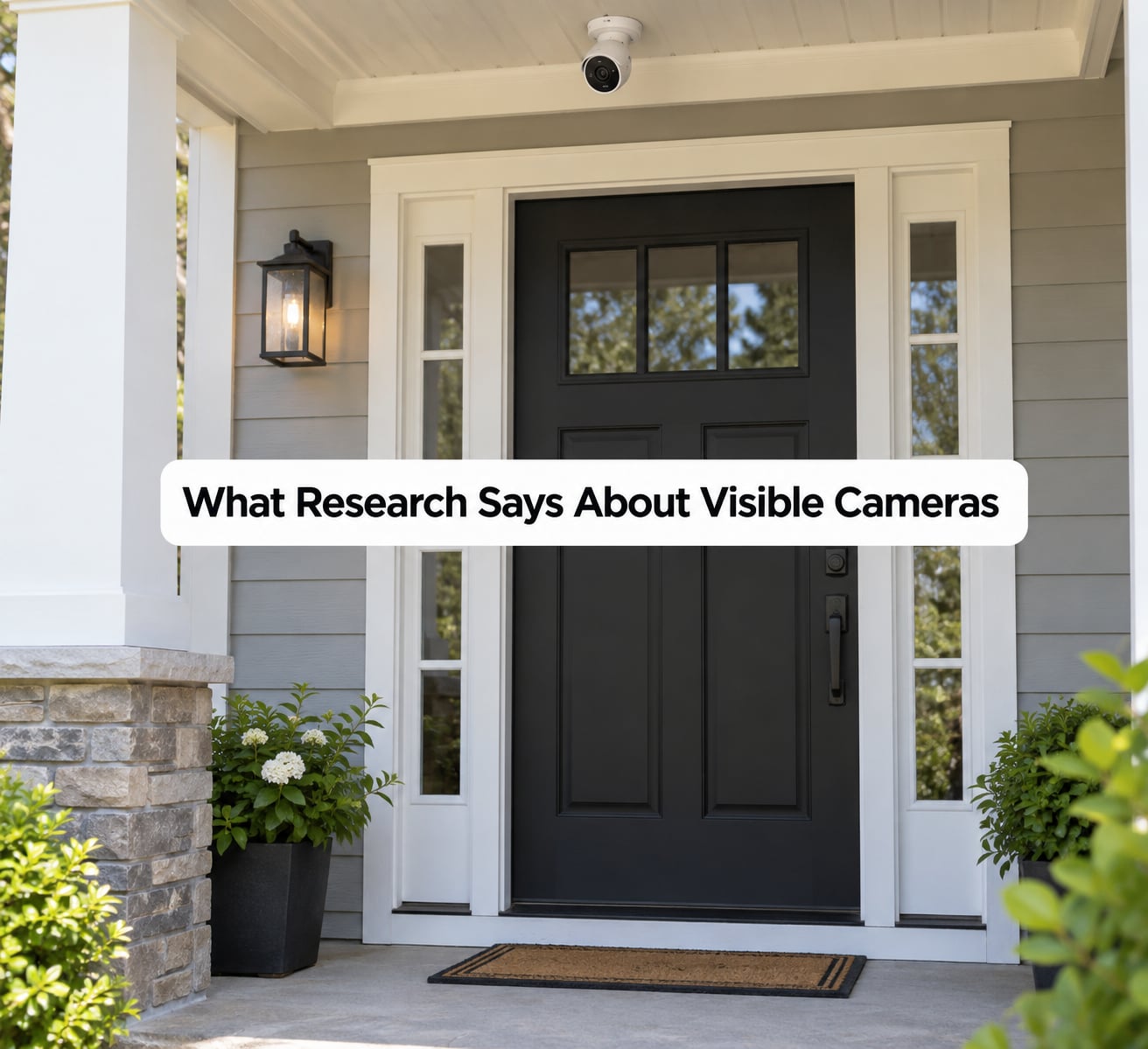
The research base is smaller than the marketing suggests, but the best-known study is unusually good for this question because it asked offenders directly rather than counting crime before and after cameras went up.
| Study or source | Year | Sample | What it found | What it means for your home |
|---|---|---|---|---|
| Kuhnz, University of North Carolina at Charlotte | 2012 | 422 incarcerated burglars | 83% check for an alarm before selecting a target; about 60% would choose a different target if they saw a security system | Appearance of a security system pushes opportunistic burglars elsewhere |
| Urban Institute research on public-space CCTV | 2000s | City-level crime and camera data | Camera effects on street crime are mixed; outcomes depend heavily on placement, monitoring and lighting | Coverage quality matters more than the number of cameras |
| Industry research on security signage | Reported 2026 | Varies by vendor study | Signage is credited with deterring roughly an additional 25% of intruders at properties with cameras | A window decal and a sign are cheap incremental gains |
| Police and insurer guidance on burglary prevention | Ongoing | Qualitative | Occupancy signals, strong locks, exterior lighting and alarm response rank ahead of cameras | Layers beat any single device |
Read that table carefully and one thing jumps out. The UNC Charlotte figures are high, and they are also the figures most often quoted out of context. The 83% figure is about alarms, not cameras. Cameras were part of what the remaining respondents treated as a security system, but the alarm and the camera were measured together, which is exactly how most people buy them anyway.
Do security cameras deter burglars more than alarms?
No study cleanly separates the two, and the research points to occupancy and police proximity as the strongest deterrents in the list, with alarms and cameras following behind. If someone believes a house is occupied, or thinks a patrol car is nearby, the calculus changes before any device gets considered. That is also why a camera at an occupied home outperforms an identical camera at a house that is dark for nine months a year.
Where the evidence runs out
None of this research tells you how to handle a determined offender, a masked intruder, or someone who has already decided your house is the target. It also does not measure residential systems specifically; most public-space CCTV research covers commercial and public areas where cameras are watched by staff, not by a homeowner checking an app. Treat the percentages as evidence of a real effect on opportunistic crime, not as a prediction about your specific house.
Which Security Camera Features Help Most
Some features do more for deterrence than others, and the ordering is not what most product pages suggest.
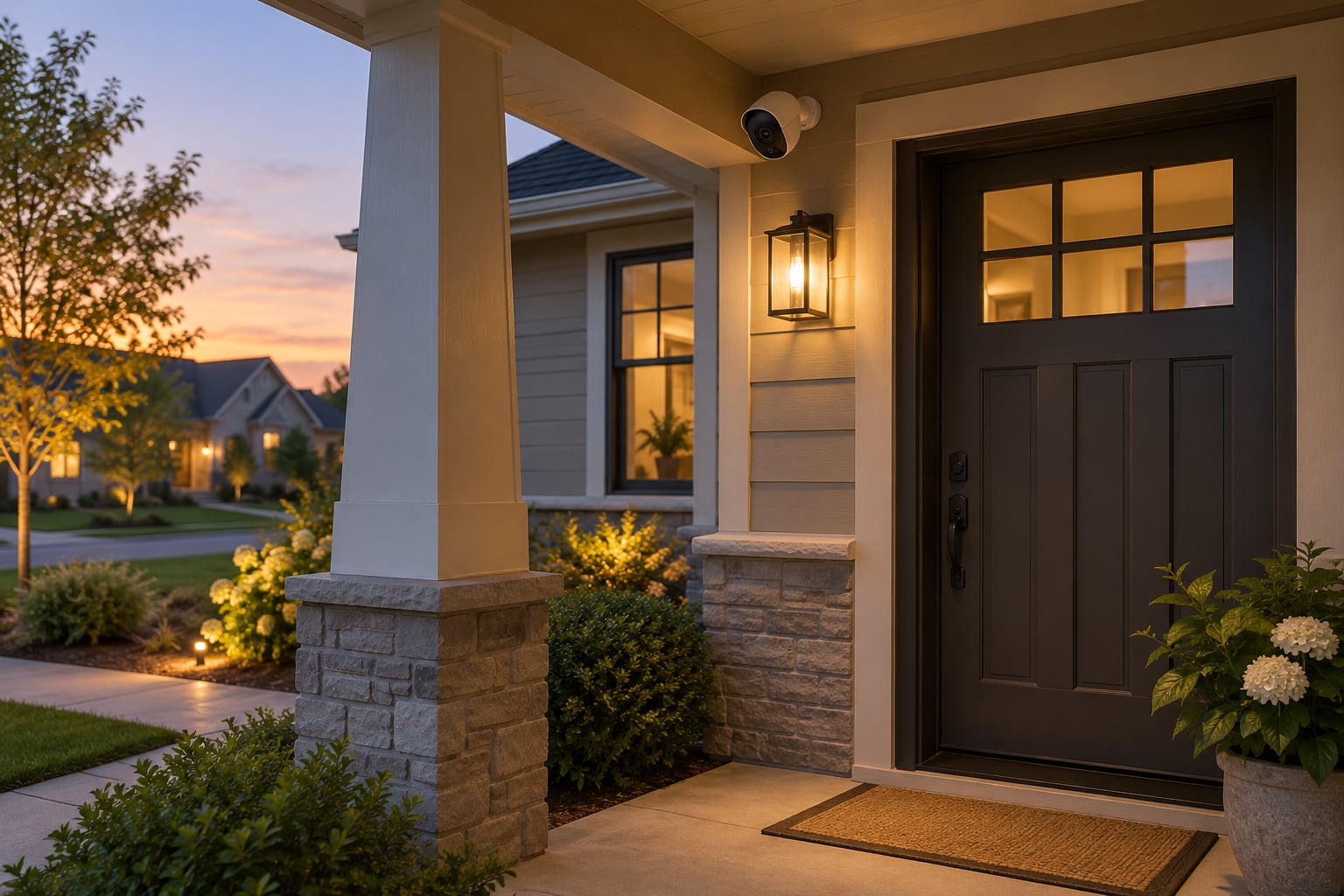
- Visibility. The single most important feature. A camera tucked under an eave where nobody notices it records fine and deters nothing.
- Night vision and low-light performance. Most burglaries happen after dark, when poor footage is worthless for evidence. Check that the lens produces usable images under a porch light, not just in daylight.
- Field of view. Wide enough to cover the approach, the door and the path to it. A tight crop of the door handle misses the person walking up.
- Motion detection with real-time alerts. This is what turns a camera into a detection tool instead of a passive recorder, and it is the feature that can get a patrol out mid-burglary.
- Person and vehicle alerts. Filtering out moving trees and shadows means you actually look at the notification, which defeats the most common failure mode of camera alerts.
- Two-way audio. Useful mainly for package theft, where a voice telling someone they are on camera often ends the interaction in seconds.
- Reliable storage. Local recording on an SD card or NVR survives a disrupted Wi-Fi connection, which is a real tactic for disabling cloud-only systems.
- Visible signage. A window decal or a yard sign telling people the property is monitored. Cheap, and the research credits it with an extra slice of deterrence.
Resolution matters for evidence, but a 4K sensor pointed at a wall in the dark produces worse footage than a modest camera with good low-light performance aimed at a lit door. Prioritize usable night images over headline pixel counts.
Where Should You Place Cameras to Deter Burglars?
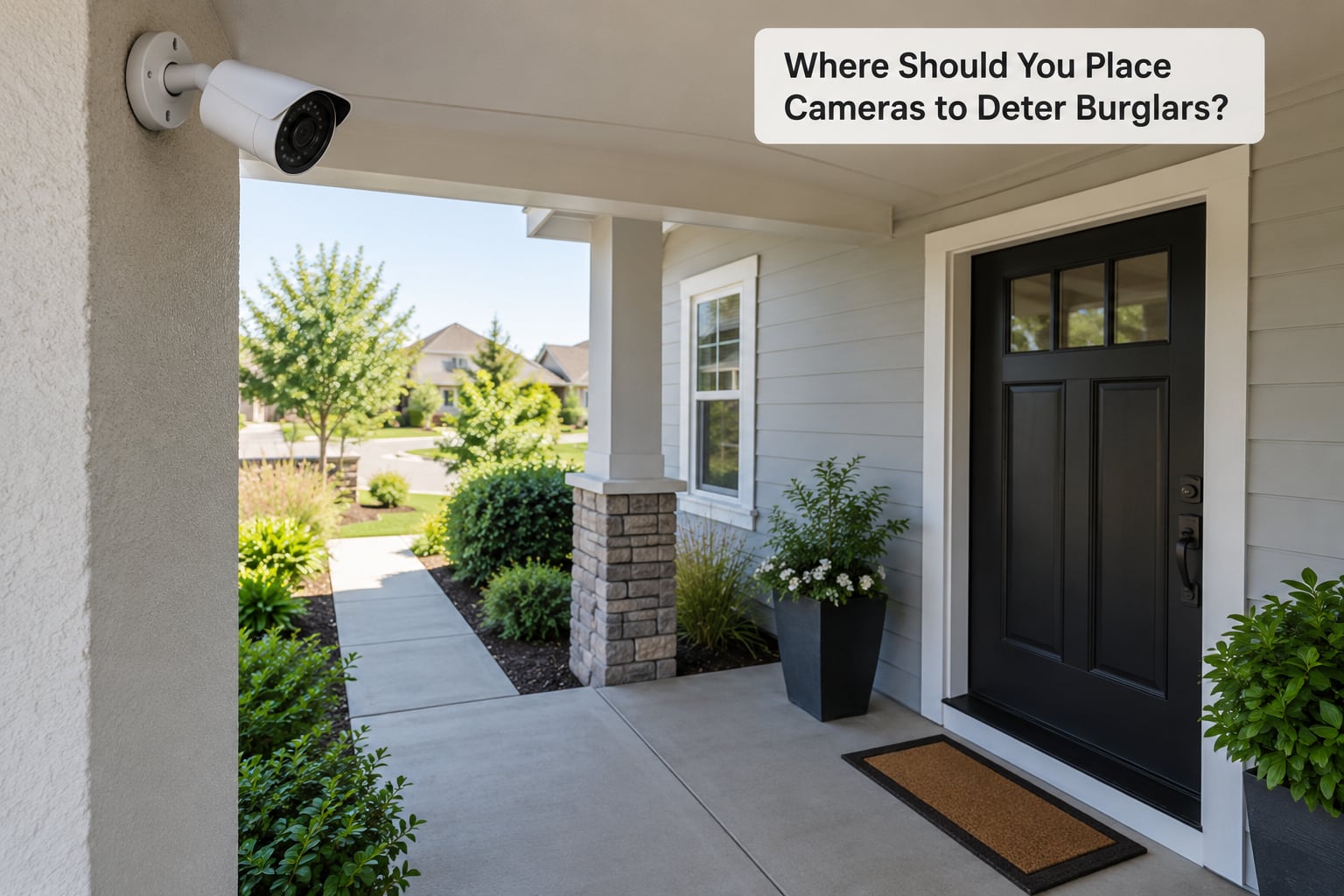
Placement decides more than the camera you buy. Cover the points where a burglar has to approach or leave, mount cameras high enough that they cannot be reached or swung at, and confirm the view is not blocked by a door frame, a window screen or a vehicle parked in the driveway.
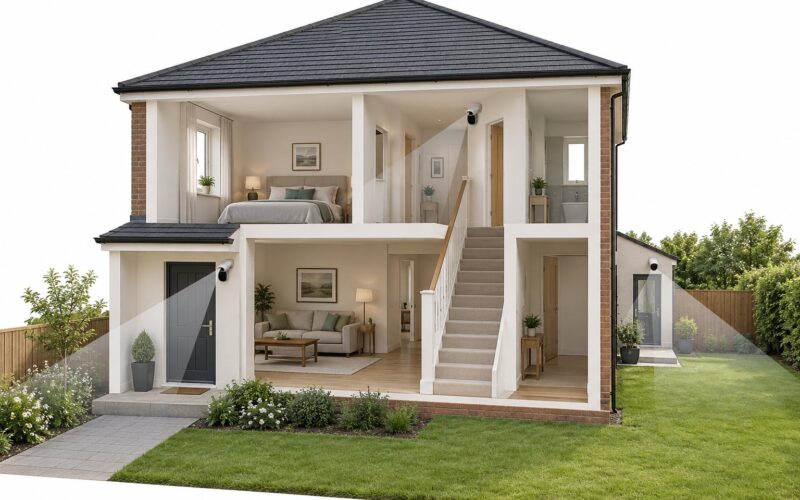
- Front and back doors. The two highest-value views on almost every property. One camera at the front door also captures the approach, which is often the moment a target gets ruled out.
- Side doors and garage entry points. Frequently the first thing tried because they are less visible from the street, which means a camera there is doing more work than one on the main entrance.
- Driveway and street-facing view. Useful for capturing a vehicle or license plate. Angle it so the camera sees the street, not just your own car.
- Back entrances, gates and windows. Especially on homes with fences, where the fence hides the entry point from anyone standing at the front.
- Hallways and indoor entry points. An indoor camera in a hallway or stairwell captures a clear face indoors, where night vision works better than it does outside.
On height, somewhere around eight to ten feet keeps most cameras out of reach while still catching faces. Mount them where a light source sits nearby, and use a contrasting wall or soffit behind the camera so it reads as a camera to someone walking past.
Two placement mistakes are worth calling out. Pointing cameras only at your own property wastes most of the frame and gives an intruder no reason to believe anything is recording. And covering a door with a wide-angle lens so the whole approach fits often produces a small, distorted figure rather than a usable one.
Keep cameras out of private indoor spaces you do not control, and avoid views into a neighbor’s windows, yard or doorway. Beyond the annoyance, those angles can create problems depending on where you live.
Do Security Cameras Work Better Alone or With Other Security Measures?
Better, by a wide margin. A camera on its own is one layer, and the research repeatedly points at occupancy, locks, lighting and alarm response as the stronger layers. Here is how the common measures compare.
| Measure | Deterrent strength | Detection value | Evidence value | Notes |
|---|---|---|---|---|
| Visible security camera | Moderate to strong against opportunistic burglary | Good with alerts and monitoring | Strong | Weak on its own |
| Audible alarm | Strong, especially if monitored | Excellent | Weak on its own | Ranked above cameras in offender surveys |
| Solid locks, reinforced strike plates, propped-free doors and windows | Strong | None | None | The cheapest layer there is |
| Motion-activated exterior lighting | Strong | Moderate | Good, if the camera is lit | Makes an approach uncomfortable and unlit |
| Neighborhood awareness and police non-emergency line | Moderate | Good during an event | Weak | Often the fastest real-world response |
Homeowners on r/homesecurity and r/homedefense rarely recommend a camera alone. The pattern that comes up again and again is a doorbell camera at the front, motion lights on the sides, solid locks on every door, and an alarm if the budget stretches that far. Each layer covers a different failure mode of the last one.
The reverse point deserves attention too. Some people worry that advertising cameras and alarms tells a burglar exactly what is worth stealing. The forum consensus is that this concern is backwards. A camera tells them the house is monitored and recorded, which is information about risk, not about your contents.
How to Choose a Camera for Deterrence and Evidence
Start by deciding which job you are buying for. If the goal is deterrence and evidence, you need visibility and usable night footage. If the goal is response, you need alerts that reach your phone fast and a monitoring option if you travel often or work long hours.
On hardware, look at low-light performance first and resolution second, then check the field of view against the area you actually need covered. Weather resistance matters for anything mounted outside, and a wide dynamic range helps when a doorway is brighter than the street in front of it.
On the software side, decide where footage lives. Cloud storage is convenient and easier to hand to police, but it depends on a working internet connection and usually carries a subscription. Local storage on an SD card or a network video recorder keeps recording even if someone knocks the router offline, and removes a recurring fee.
Check the privacy features too. Local or encrypted storage, two-factor authentication on the account, and a way to disable the microphone if you do not need audio all reduce the risk of someone accessing your feed. A long video-retention window matters too, because most burglars are filmed on footage nobody watches for a month.
Finally, weigh professional monitoring against self-monitoring. Monitoring catches an alarm and a verified response while you are asleep or away, which is the scenario where a camera alone does nothing. It costs more per month, and for many households the honest answer is that solid locks, lighting and a good camera cover the real risk without another recurring bill.
Legal and Privacy Considerations
Recording video of people outside your home is broadly accepted in the United States, but the rules are not uniform. Audio recording is where it gets complicated, because several states require one party’s consent for recording a conversation, and that includes conversations captured by a doorbell camera outside your own door.
Neighbor privacy is a practical issue before it is a legal one. A camera aimed across the street or into an adjoining yard can create a dispute even when nothing has gone wrong, and homeowners associations and local ordinances sometimes restrict where cameras can point.
Rules around workplace monitoring, employee areas, and cameras in common areas of apartment buildings add another layer. Requirements vary by state, county and municipality, and they change, so treat this as a flag to check locally rather than as settled guidance. For anything involving a neighbor dispute, an apartment building or a camera pointed at public space, get advice from a qualified local professional.
Frequently Asked Questions
What is the number one deterrent for burglars?
Occupancy comes first, followed by locks, exterior lighting and alarm response. In the 2012 University of North Carolina at Charlotte survey of 422 incarcerated burglars, about 83% looked for an alarm before choosing a target and roughly 60% would pick a different home on seeing a security system. No single device outranks making a house look lived-in and hard to enter quickly.
Should security cameras be visible or hidden?
Visible, if your main goal is deterrence. A camera nobody notices records well but deters nothing, which is the consistent advice in homeowner security forums. Hidden cameras still have a place for evidence and indoor coverage, so many owners run a mix: obvious cameras at entry points and one less visible camera covering a hallway or side door.
How do burglars defeat security cameras?
The common tactics are covering the lens with spray, a glove or an object, knocking the camera off its mount, unplugging the power or cutting the feed, and walking in behind its blind spot. Some will go after the recorder or delete footage if the system is not password-protected. High mounting, local storage, two-factor authentication and overlapping camera angles make all of this harder.
Do fake or dummy security cameras deter burglars?
They deter opportunistic burglars who glance up and move on, and almost nothing else. Signs of a fake are easy to spot: a dark lens, no status light, no mounting bracket, no cable, and a housing that looks like a prop. A fake camera paired with visible real ones, signage and good lighting can be a cheap supplement, but a lone dummy at an entry point is mostly theatre.
Is a camera enough, or do I need an alarm?
A camera is enough only if your main concern is recording evidence after a break-in. An alarm adds what a camera cannot: an audible trigger that wakes people inside, pushes neighbors to react, and reaches a monitoring center that can send police mid-burglary. Alarms rank above cameras in offender surveys, so if you can afford one layer, most homeowners should start with locks and lighting first.
How many security cameras does a house need?
Most homes are covered well with two or three: one at the front door covering the approach, one covering a side door or garage, and one at the back. Add a driveway camera if you want vehicle or license plate detail, and a hallway camera if you need a clear face indoors, where night vision performs better. More cameras rarely help if the view is blocked or dark.
Conclusion
Do security cameras deter burglars? Yes, against the opportunistic break-ins and package thefts that make up most home crime, and only when the camera is obvious and the footage is usable. Against someone who has already chosen your house, cameras are evidence-gathering tools, not barriers.
Start with the cheap layers. Walk your property and list every way in, then fix the doors, strike plates and windows that give way fastest. Add motion-activated lighting on the sides and back, where most people never look.
Then install two or three visible cameras at the highest-traffic entry points, mounted high enough that they cannot be reached and aimed so the approach is in frame. Turn on person alerts, use two-factor authentication, and decide now whether your footage lives in the cloud or on local storage. A sign at the door finishes the job. If you travel often or work nights, monitored alarm response is the layer that covers the hours nobody is watching.