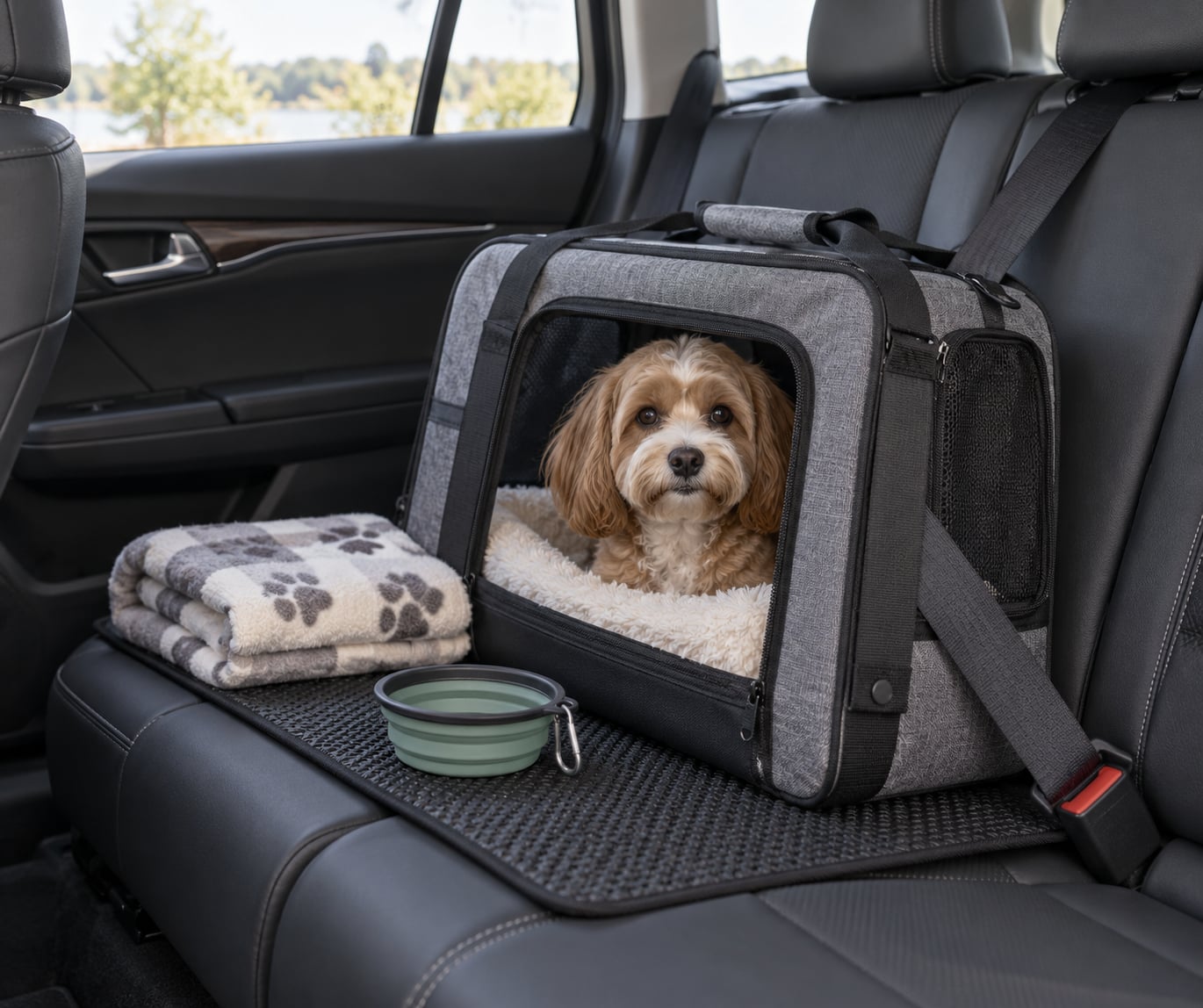
To travel with a cat in a car, keep your cat inside a well-ventilated carrier in the back seat for the whole drive, secure that carrier so it cannot slide, and plan rest stops every two to three hours. Most of the work happens days before you leave: a health check, carrier training, and a light or skipped meal the morning of travel.
Is it cruel? No. A cat that is prepared, contained and left alone inside a closed carrier fares better than most people expect. Owners regularly report three-hour drives that end with a sleepy cat rather than a stressed one.
The trips that go wrong are the improvised ones. A loose cat, a full meal before departure and a carrier nobody has ever opened at home are the three ingredients for a nine-hour misery. Fix those and the rest is logistics.
This guide covers a single drive of roughly two to ten hours. For much longer, split the trip over two days or leave the cat with a sitter.
Table of Contents
- 1What You Need
- 2How to Travel With a Cat in a Car: Step-by-Step
- 3Step 1: Check Whether Your Cat Is Ready to Travel
- 4Step 2: Choose and Introduce the Carrier
- 5Step 3: Pack for the Drive
- 6Step 4: Secure the Cat and Protect the Car
- 7Step 5: Drive Slowly and Plan Comfortable Breaks
- 8Step 6: Handle Feeding, Motion Sickness, and Stress
- 9Step 7: Arrive and Settle the Cat Safely
- 10Common Mistakes
- 11Frequently Asked Questions
- 12Can a cat be in a car for 4 hours?
- 13Where should a cat carrier go in a car?
- 14Should I feed my cat before a car trip?
- 15How often should I stop on a long drive with a cat?
- 16Can I give my cat gabapentin or a motion sickness tablet before driving?
- 17Conclusion
What You Need
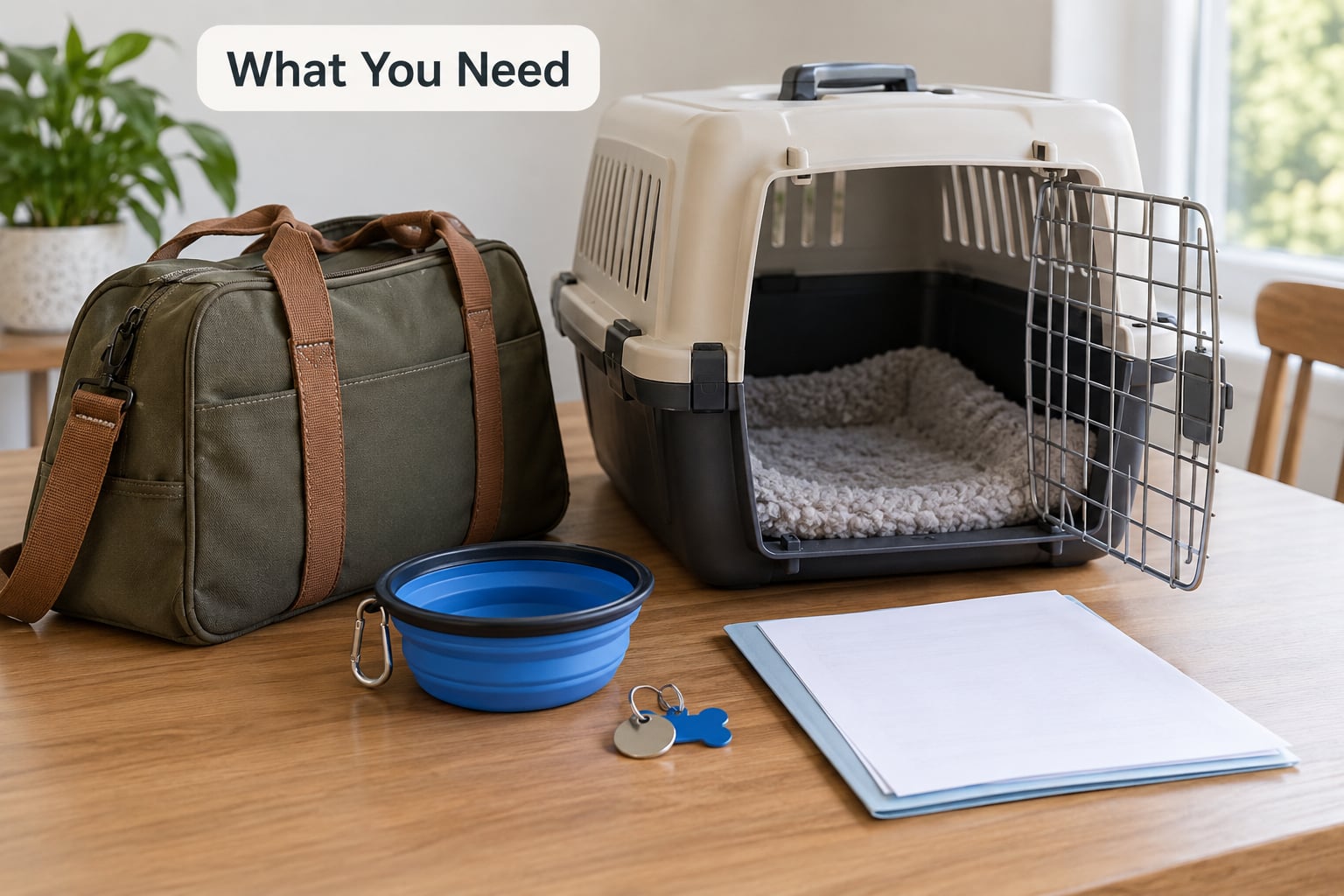
Gather everything before the day of travel, because the morning of a departure is a bad time to hunt for a spare collar tag.
- A carrier your cat already accepts. It needs enough room to stand up, turn around and lie down without crouching. Soft-sided carriers suit short trips, hard-sided crates suit long ones, and anything unfamiliar needs weeks of practice first.
- Absorbent pads or a washable liner. Line the bottom of the carrier. Experienced owners do this every single time, and it turns an accident into a five-second fix.
- Familiar bedding. A towel or blanket your cat already sleeps on carries scent into an unfamiliar space.
- A collapsible water bowl and a small food container. Bowls that fold flat fit in the door pocket.
- Identification. A breakaway collar with a tag carrying your phone number, plus a registered microchip. Check the registration is current before you leave.
- Paperwork. Vet records, vaccination certificates, and any prescription details. Photograph them onto your phone as a backup.
- Waste bags and a scoop. Litter scatters, and a scoop saves you from handling soiled material with bare hands at a petrol station.
- A non-slip mat or old towel. A carrier that slides under braking is a carrier that can end up in the footwell or, worse, in the aisle.
Leave the litter box behind unless you are overnighting. Owners report that cats frequently refuse to use a portable box in an unfamiliar setting, and a soiled pad is far easier to manage.
How to Travel With a Cat in a Car: Step-by-Step
Step 1: Check Whether Your Cat Is Ready to Travel
Skip the trip, or postpone it, if your cat has been vomiting, refusing food, coughing or showing signs of illness in the days beforehand. Moving a sick animal is how a minor problem becomes an emergency vet visit in a town you have never visited.
Book a vet visit in the week before departure, even for a short trip. Ask about motion sickness, travel anxiety and any stress-related nausea, and get advice on a calming aid that suits your cat. Anything prescribed goes in the bag with the label and the dosing note, and the vet decides that, not an article. Never give human medication.
Some cats are simply not candidates. A cat that panics violently at the sound of an engine, or one with a heart or respiratory condition that makes travel hard, is safer with a sitter or at a boarding facility. That is a normal decision, not a failure.
Step 2: Choose and Introduce the Carrier
Place the carrier where the cat spends time already, such as a quiet corner of the living room, with the door open. Leave a treat inside and walk away. Repeat for several days.
Once your cat settles in, start the car. Sit in the parked car with the engine running for a few minutes, then take short drives around the block, then the driveway, then a longer loop. Reward calm behaviour and stop before your cat is overwhelmed.
If you have two cats, use two separate carriers and place them far enough apart that they cannot see each other. Co-traveling cats that are visible to each other tend to howl for hours.
Step 3: Pack for the Drive
Pack the night before and check it off: carrier, pads, bedding, bowls, identification, vet records, medication, waste bags, scoop, non-slip mat and a charged phone charger.
Keep litter in a sealed container or a small lidded box. Loose litter in the car is close to unrecoverable in the carpet. If the trip is overnight, add your cat’s usual dry food, the portable bowls and any medication in its original packaging.
Step 4: Secure the Cat and Protect the Car
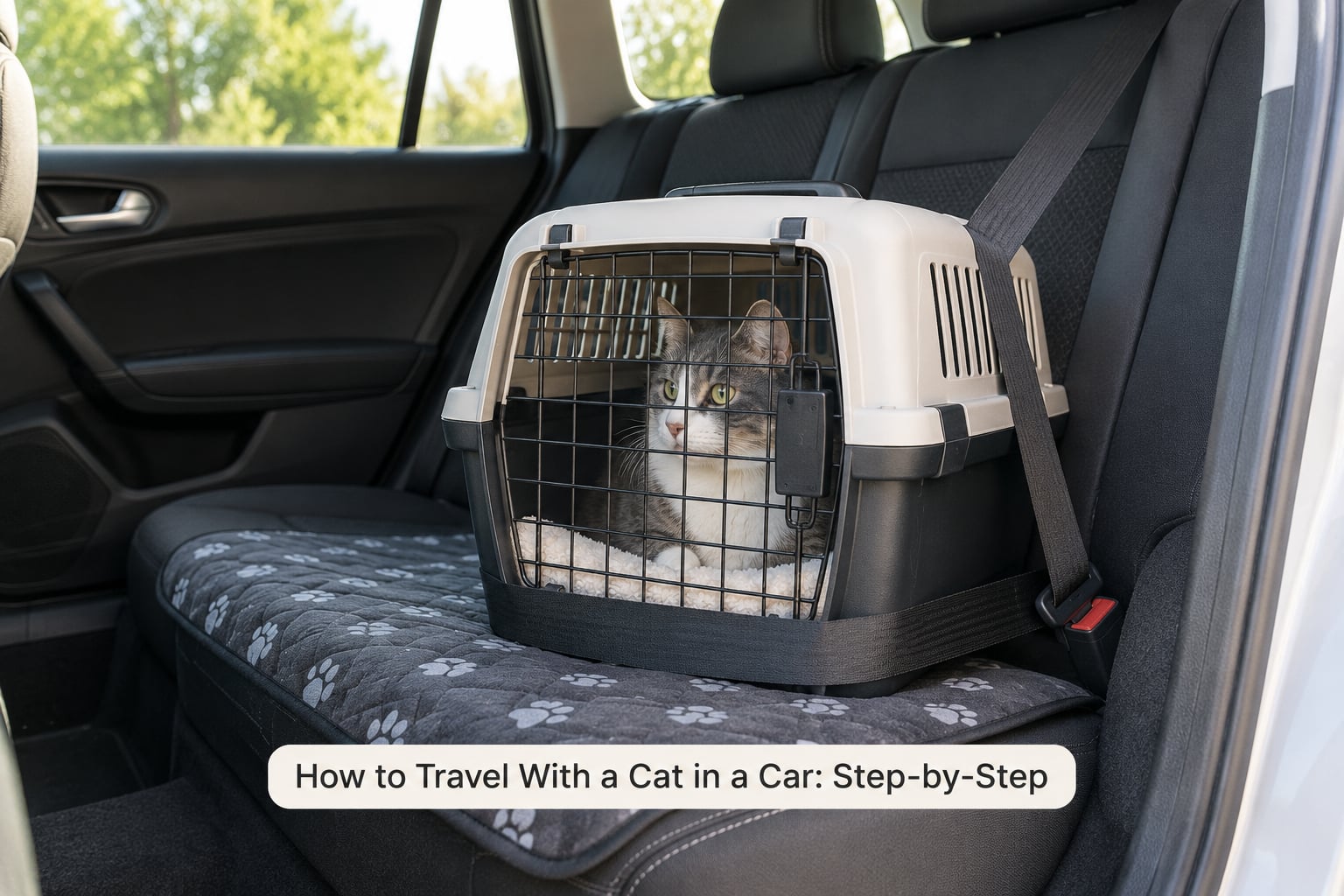
The back seat is the only safe place for a carrier, secured on the floor behind a passenger seat where it cannot move, or strapped into the seat with a seatbelt through the designated strap so it cannot tip. The front seat is worse in every respect, because of airbag deployment risk and the driver’s ability to distract the cat.
Add your non-slip mat underneath. Leave ventilation running so the carrier is not in a dead pocket of stale air, and keep the cabin cool, roughly 68 to 75°F, with the air conditioning on rather than the heater.
Two rules do not bend. Never open the carrier while the car is moving or parked at a rest stop, and never open a window or door where the cat could reach it. If you need to let the dog out, the cat stays in the carrier with you watching the door.
Never leave a cat in a parked car, in any weather, for any length of time, even with a window cracked. Cars heat up far faster than the weather outside suggests, and the failure is silent.
Step 5: Drive Slowly and Plan Comfortable Breaks
Take smooth turns, avoid sudden braking, and stop every two to three hours at a quiet spot. Put the air conditioning on before you set off rather than when the cabin gets warm.
At each stop, stay with the carrier and offer water through the mesh, or open the door a crack to reach a hand in for reassurance without ever releasing the cat. Do not take the carrier out on the pavement, because the door would have to open and every opening is a chance to bolt.
Owners often assume a long ride means several bathroom breaks. Frequently the opposite happens: stress shuts digestion down, and many cats travel several hours without needing to go. Have pads ready and stop when the cat needs it, not on a fixed schedule.
Here is how the plan changes with the length of the drive:
| Trip length | Rest stops | Carrier and packing notes |
|---|---|---|
| Up to 2 hours | One optional stop | Soft-sided carrier is fine; one day before acclimatization is usually enough |
| 2 to 4 hours | Every 2 hours | Hard-sided crate or ventilated soft carrier; line with pads, bring bowls |
| 4 to 6 hours | Every 2 to 3 hours | Two to three weeks of carrier conditioning; full vet discussion about a calming aid |
| 6 to 10 hours | Every 2 hours, longer at each stop | Two days is safer; add a collapsible litter option and full documentation |
| Overnight or more | Overnight stop planned in advance | Cat-friendly hotel that accepts cats specifically; extra food, medication and bedding |
If heat is the concern, remember that the question is not the temperature outside. It is the temperature of a seat that has been sitting in sun, and it climbs quickly.
Step 6: Handle Feeding, Motion Sickness, and Stress
Feed a normal meal the night before and keep the morning meal small or skip it entirely, depending on how long the drive runs. Most guidance suggests no food in the stomach for the first few hours of travel, because a stressed cat that vomits into its own bedding is the worst outcome of the day.
Offer water at every stop even when you are not feeding, and save the real meal for when you arrive. Never give human medication, and do not use anything medicated without your vet telling you exactly what to give and when.
The distinction most guides blur is between stress-related nausea and true vestibular motion sickness. They are different problems, and a calming aid that helps the first does nothing for the second. That is worth raising at your vet appointment rather than at a rest stop on the motorway.
For scent-based calming, spray the carrier roughly 15 to 30 minutes before departure and let it dry, never over the bedding.
Watch for open-mouth breathing or heavy panting, repeated vomiting, extreme lethargy, or wobbling. Those mean a vet, and a phone call from the roadside is more useful than another hour of driving.
Step 7: Arrive and Settle the Cat Safely
Carry the carrier in, set it in a quiet room and open it. Put down a familiar blanket, a bowl of water and one litter box, then step out and close the door.
Let the cat come out on its own. Forcing it out produces a cat wedged behind furniture it cannot be pulled from, which is the single most common hotel-room problem owners describe. Give it a few hours and do not invite the whole family in at once.
Feed the normal meal once the cat has settled, and leave the carrier open in the room rather than packing it away straight away. Many cats climb back in on their own, and that becomes the safest bed for the night.
Common Mistakes
- Letting the cat roam loose in the car. A loose cat is one unexpected stop away from the open door and into traffic. Fix: carrier in the back seat, secured, for the entire drive.
- Relying on a collar as the only restraint. Breakaway collars are designed to release. Fix: the collar is identification, the carrier is restraint.
- Feeding a full breakfast right before leaving. Fix: eat the night before, keep the morning light or skip it, feed on arrival.
- Opening the carrier at rest stops. Fix: reach in through the door or the mesh while you keep hold of the door.
- Leaving supplies at home. A ten-minute detour for a missing tag on a long drive costs far more than packing the night before.
- Packing loose litter. Fix: sealed container, scoop and waste bags together.
- Skipping the health check. Vet appointments near a moving date are often booked days out. Call early and get the answers before departure, not after.
Frequently Asked Questions
Can a cat be in a car for 4 hours?
Yes, four hours in a properly sized carrier is usually manageable. Most owners report calm trips of that length with air conditioning running, smooth driving and a stop every two hours. Skip the morning meal, line the carrier with absorbent pads, and keep the whole time quiet. Speak with your vet first if your cat has breathing or heart issues, or a history of travel nausea.
Where should a cat carrier go in a car?
In the back seat, either on the floor behind a passenger seat or strapped in place with a seatbelt so it cannot tip or slide. Put a non-slip mat underneath. Keep air conditioning running and the cabin around 68 to 75°F. Never place the carrier in the front seat, where airbags and the driver’s attention are both problems.
Should I feed my cat before a car trip?
Feed a normal meal the night before and keep the morning meal light or skip it. Most guidance leaves the first few hours of travel with nothing in the stomach, since a stressed cat that vomits in its carrier has a much worse trip than one that skipped breakfast. Offer water at every rest stop and give the real meal once you arrive.
How often should I stop on a long drive with a cat?
Every two to three hours for trips longer than four hours, and every two hours once you are past six hours. Stop somewhere quiet, stay with the carrier, offer water and reach a hand in for reassurance. Do not take the cat out of the carrier at the roadside. Trips beyond ten hours are better split over two days.
Can I give my cat gabapentin or a motion sickness tablet before driving?
Ask your veterinarian, because the answer depends on your cat. Gabapentin is used for travel stress and the stress-related nausea that comes with it, but it does not treat true vestibular motion sickness and can itself cause vomiting on an empty stomach. Never give human medication, and never guess a dose. Bring anything prescribed in its original packaging with the dosing note.
Conclusion
Four things decide whether a car trip with a cat goes well: confirm your cat is healthy and suited to travel, get the carrier accepted weeks ahead, secure it in the back seat before anyone gets in, and pack the night before. Everything else on this page is detail on top of those four.
Start with a short practice drive this weekend, even if the real trip is months away. You will learn far more from twenty minutes in a parked car than from reading another guide.