The fastest way to secure a sliding glass door is to block the bottom track so the panel cannot slide, stop it being lifted off its rollers, and replace the weak factory hook latch with a secondary lock or keyed cylinder. Most of that job is a Saturday afternoon with basic tools and no glass work.
That is the whole idea, honestly. A sliding door is strong in one direction and useless in another, so security comes from removing the directions it is weak in rather than from one expensive gadget.
If you only do three things, do these:
- Drop a dowel rod or a broom handle into the closed bottom track so the panel cannot move.
- Drive a couple of screws into the top track, set so the panel can rise about 10mm but no further.
- Fit a surface-mounted foot lock or a secondary sliding door lock at the meeting stile.
Start with inspection, though. A dirty track, a sagging roller, or a latch that no longer lines up will make every piece of hardware you add perform badly.
Table of Contents
- 1What You Need
- 2Tools and parts for most jobs
- 3Step-by-Step: How to Secure a Sliding Glass Door
- 41. Inspect the Door and Frame for Weak Points
- 52. Clean and Repair the Sliding Track
- 63. Fit a Temporary Security Bar in the Track
- 74. Replace or Upgrade a Vulnerable Handle Lock
- 85. Install a Foot or Shutter Lock Without Drilling
- 96. Stop the Panel Being Lifted Off Its Track
- 107. Test the Security and Check the Egress
- 11Common Mistakes
- 12Frequently Asked Questions
- 13What is the easiest way to secure a sliding glass door?
- 14How do I keep a sliding glass door from being opened without drilling?
- 15What type of lock is best for a sliding glass door?
- 16Can I install a security bar on any sliding glass door?
- 17How do I secure a sliding glass door in an apartment or rental?
- 18Conclusion
What You Need
Before you buy anything, work out which kind of door you have. Most patio doors are either inside-track or outside-track, and the difference decides where the blocking device goes.
On an inside-track door the rollers sit in the channel between the two jambs, so the fixed panel overlaps the sliding one when the door is shut. On an outside-track door the rollers ride in a channel on the outside face of the frame, and the sliding panel closes on the outside of the fixed panel.
You can tell with a glance: if the sliding panel is the one nearest the interior of the room when shut, it is inside-track. If it sits proud of the frame toward the patio, it is outside-track. Most newer doors are inside-track because the profile keeps water out better.
Tools and parts for most jobs
- A vacuum or shop vac and a stiff brush, for the track
- A flat-head and a Phillips screwdriver
- A cordless drill with a 3/32 inch and a 1/8 inch bit, plus a 1/4 inch bit if the track needs cleaning out
- A 3/4 inch wooden dowel rod, cut to fit, or an old broom handle
- An adjustable sliding door security bar, if you want something more permanent-looking than a dowel
- 3-inch screws for strike and jamb work, short sheet metal screws for anti-lift fittings
- A tape measure, a pencil, and a pair of safety glasses
- A surface-mounted foot lock or secondary sliding door lock
Wear eye protection when you work on the track. Old grit and dried sealant come out of those channels like gravel, and it ends up in your eyes more often than you would think.
If your door opens onto a stair, a fire escape, or a bedroom with a child in it, note that now. Anything you add has to be removable in a hurry, and that rules out some permanent options later on.
Step-by-Step: How to Secure a Sliding Glass Door
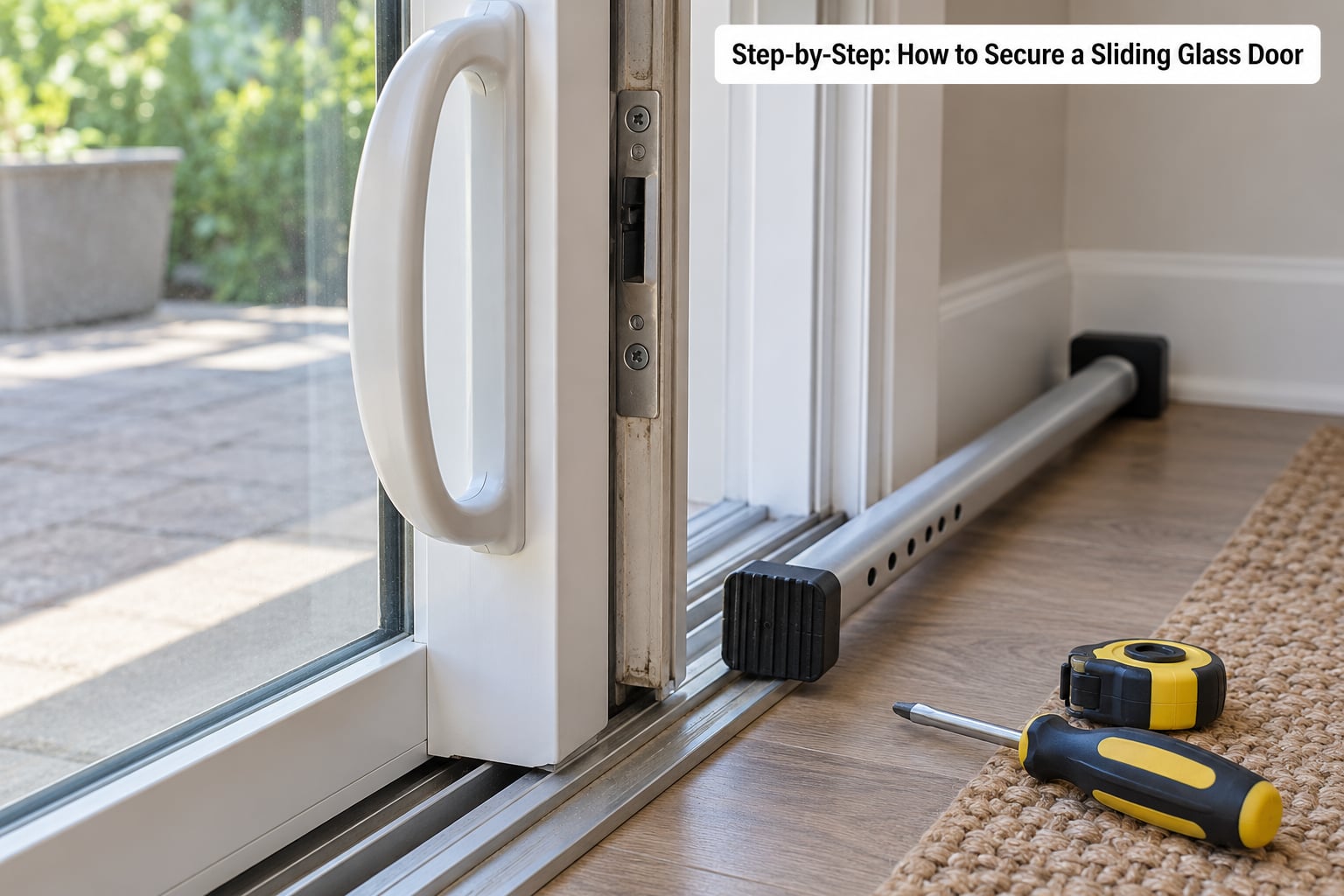
Seven steps, roughly in the order that makes physical sense. Skip step one and you end up bolting hardware onto a door that was never sitting right in the first place.
1. Inspect the Door and Frame for Weak Points
Stand at the closed door and check it by hand. Push the panel hard from the outside, then lift the handle and pull the stile sideways. Any movement beyond a few millimetres means something is loose, and the handle should not rotate without the panel moving at all.
Check the latch hook meets the strike plate squarely. Slide the door slowly closed and watch whether the hook rises into the opening or catches beside it. A hook that catches on the edge of the plate is the classic sign of a door that has dropped on its rollers, and it will never latch properly until the door sits level again.
Look at the rollers. Open the panel partway and check whether the wheels still turn freely and whether the panel sits squarely in the frame opening. Scrape a finger along the bottom of the frame to check for rot in timber sills; a soft sill is a structural problem, not a security problem, and a glazier or builder should look at it.
You also want to look for signs someone has already tried to get in. Scratches around the meeting stile, a bent latch hook, or a stripped strike screw all tell you the door has been worked on before.
If the frame itself is racked, the glass is cracked, or the panel is badly out of square, stop here and get a professional. Hardware fitted to a broken frame gives you false confidence.
2. Clean and Repair the Sliding Track
A heavy panel on a filthy track is the reason so many people give up on these doors. Vacuum the bottom channel with the door open, then brush the channel walls and the top track.
Use the vacuum nozzle between the rollers and along the jamb edges where grit packs in. Anything caught in the drainage weeps on the sill gets flushed out the same way.
For sticky spots, rub the channel with a piece of wax paper or a nylon scrub pad rather than a solvent. Solvents can swell the vinyl or weatherstripping, and then the panel rides high and binds at the top.
Stiff rollers are usually a clean and adjust problem rather than a replace problem. Rollers adjust by turning the two screws on the roller housing with a 1/4 inch driver, one at a time, while the panel is supported. Turn each about a quarter turn, close the door, and check the gap at the top. Repeat until the panel moves evenly with a fingertip-width of gap above it.
3. Fit a Temporary Security Bar in the Track
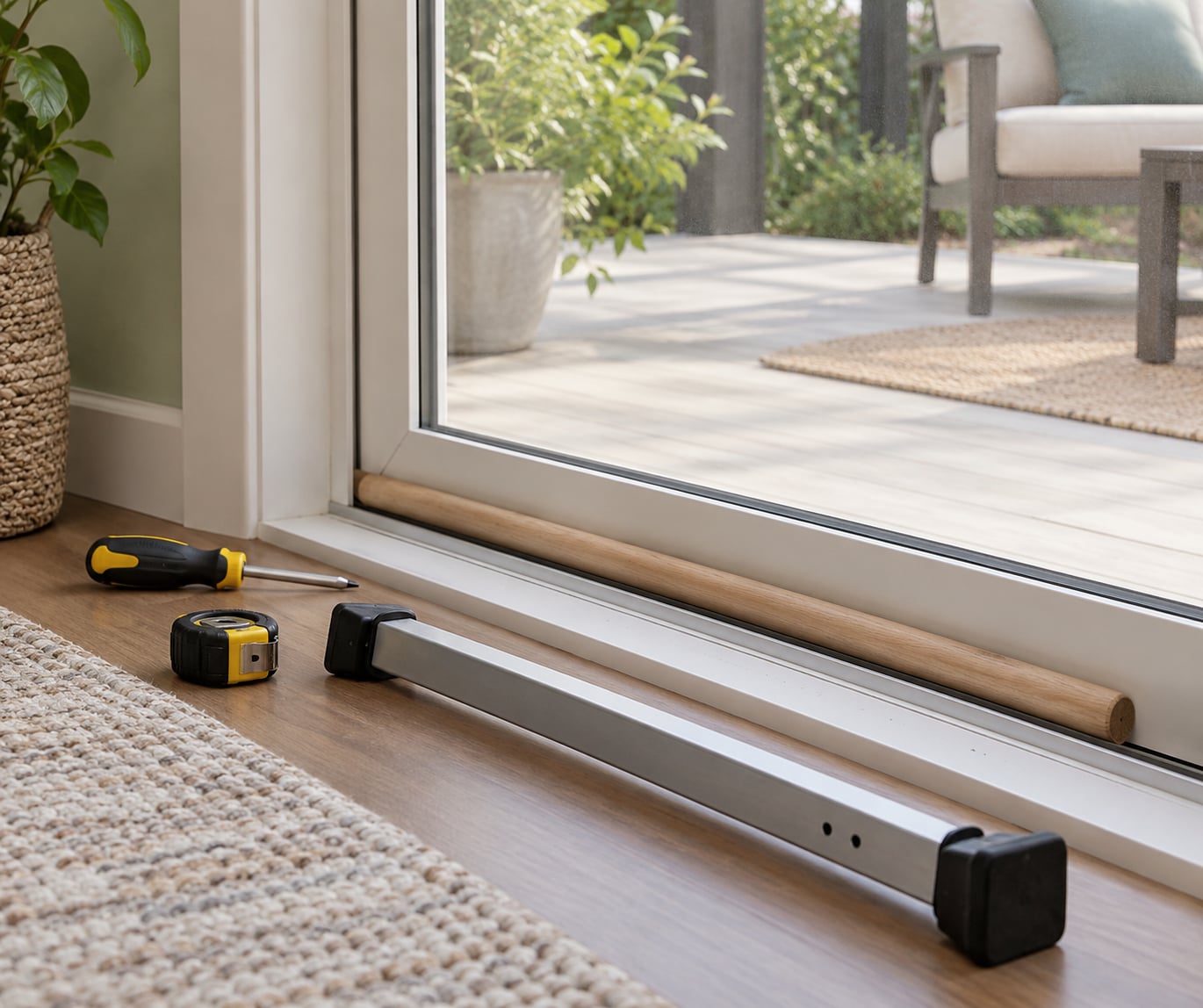
This is the cheapest effective move on the whole door. With the panel fully closed, place a 3/4 inch wooden dowel or a broom handle section in the bottom track, wedged between the fixed panel and the jamb.
The bar does one job: it takes up the length of the opening, so the sliding panel physically cannot travel. It works even if someone defeats the latch, because the latch is only one of two things holding the door shut.
Cut the dowel a few inches longer than the measured opening and test the fit dry. You want it tight but removable by hand, wedging from the interior handle side down to the frame, which is exactly the wedge described in most outside-track guides.
An adjustable security bar is the step up. It has a braced pin or a foot that hooks under the frame, so it does not rely on friction alone. Same principle, better hardware, and it looks deliberate from the patio.
Two things to keep in mind. Never wedge the bar in a way that traps somebody inside; a bar you cannot kick free in five seconds is not worth having. And if the door is your only escape route, use a bar you can pull out from inside without tools.
4. Replace or Upgrade a Vulnerable Handle Lock
The factory latch on most sliding doors is a spring hook. It keeps the panel from sliding when the wind or a bump pushes it, and that is all. It is not designed to resist force applied from the outside.
If your door has that latch only, add a secondary sliding door lock. The common type is a surface-mounted pin lock or a barrel lock that mounts to the fixed panel and the meeting stile, plus a keyed cylinder if you want to lock the door when you leave the house with nobody home.
To fit one, hold the lock body against the panel where it will not obstruct the panel sliding, mark the holes, and drill only into the aluminium or vinyl of the frame edge. Use the screws supplied, shortened if necessary so you do not pierce the glass edge.
If your latch hook has stopped aligning, fix that first. A lock cannot make a misaligned door secure, and you will blame the new hardware for the old problem.
5. Install a Foot or Shutter Lock Without Drilling
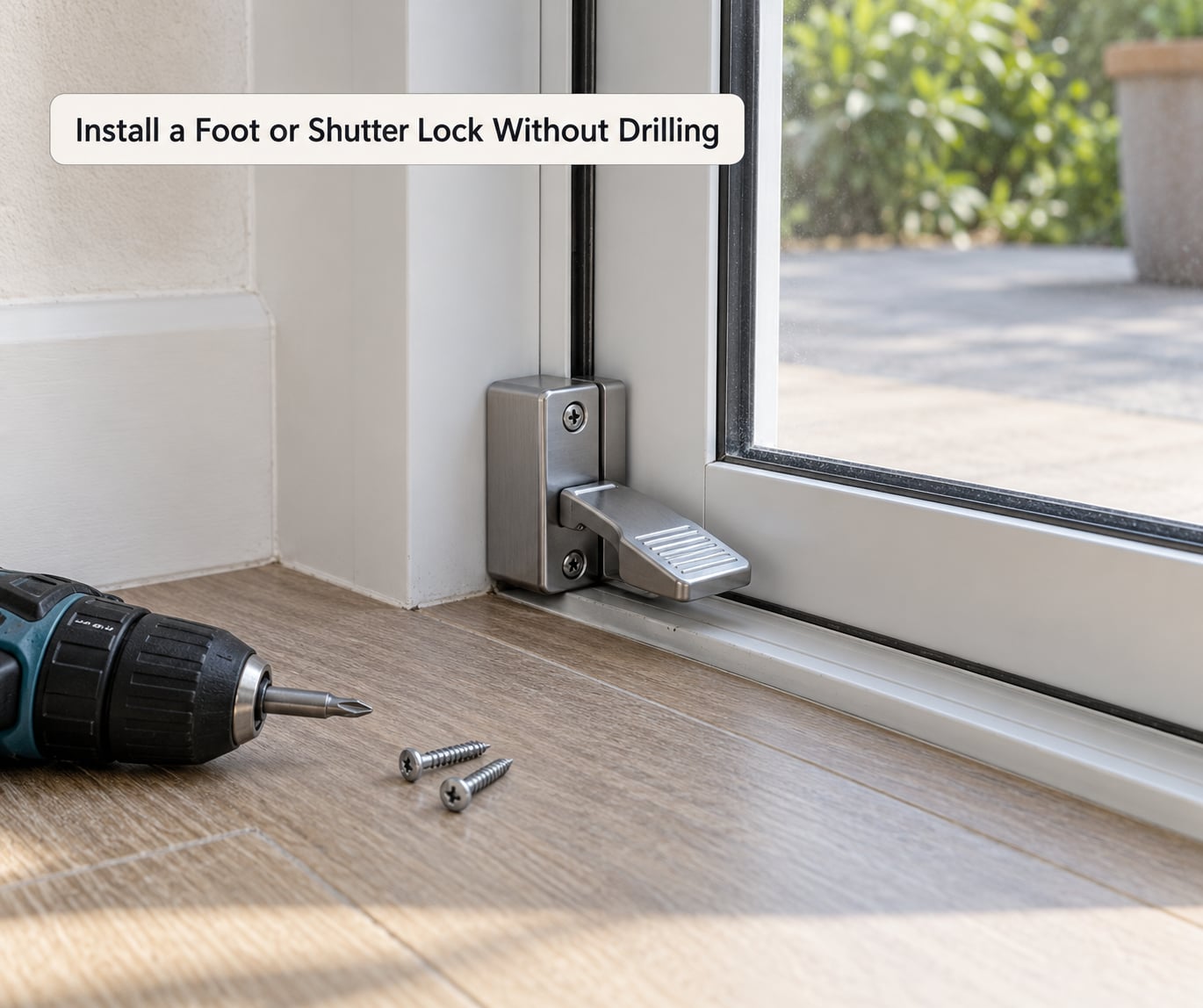
A foot-operated step lock, often called a patio door shutter, is a plate that screws to the lower frame with the arm reaching up against the fixed panel. You step on the arm with your foot to swing it out of the way.
Place it on the interior side of the frame, close to the fixed panel and low enough that you can reach it without leaning, ideally near the handle end so your body is between the lock and the panel when you step on it.
Surface-mounted locks need two screws into the frame face, which is fine for a homeowner. Renters should skip this one and use the tension-style bar from step three instead, since any screw into a rental frame is a deposit conversation.
Test it ten times before you walk away from it. A lock that takes two hands and a grunt to release gets defeated, ignored, or simply broken off eventually.
6. Stop the Panel Being Lifted Off Its Track
The one people miss. Many sliding doors can be lifted straight up and out of the top channel by the interior latch, even with the lock thrown, because the top track is an open channel and the panel has a few millimetres of play.
On an inside-track door, the fix is screws or a block in the top track above the panel. Drive two or three short sheet metal screws into the upper channel of the fixed panel, directly above where the sliding panel’s frame passes when closed. Test the door after each screw.
The target gap is about 10mm. The panel should lift slightly when you lift the handle, then stop dead. If it will not move at all you have screwed into the top of the frame and will bind the rollers; if it still lifts out free, go one more screw or move it a little closer to the panel.
On an outside-track door, the channel sits on the outside face, so you cannot get a screwdriver to it from indoors. Use a hardened steel security pin or a long bolt through the overlapping fixed and sliding frames, or fit a purpose-made outside-track anti-lift bar. Drilling from the interior side and angling the hole slightly downward, as some DIYers do, works but leaves a fix that is hard to justify if you ever sell the house.
7. Test the Security and Check the Egress
Stand outside. Push the panel with your bodyweight, pull the handle, and try to lift the bottom edge. Then check the fit of everything you added: no sharp edges exposed at hand height, no hardware that fouls the panel as it slides, no screw heads sticking into the walking path.
Now test the escape route. Open the panel from inside with one hand, in the dark, in under five seconds. The bar, the pin and the foot lock all have to clear that test.
Write down what you changed and the date. Roller adjustment and anti-lift screws drift as the door settles and as the seasons move the frame, so a quick check every three months keeps a system that worked from becoming one that does not.
Common Mistakes
Drilling into the glass. The edge of a tempered pane cannot be drilled or notched without replacing it, and the edge is the most fragile part of the whole panel. Fix on the frame or the meeting stile, drill with a bit for the screw you actually have, and stop before you break through the outer skin of the frame.
Overtightening anti-lift screws. Screw them until the panel will not lift at all and you have a door that binds, wears its rollers, and sounds broken to visitors. Aim for about 10mm of play and test the glide every time.
Using a bar on a door you still need to walk through. A security bar across a sliding door at the end of a hallway is a trap. If the door is your primary escape route, use a removable tension bar and keep it staged within reach.
Adding a stronger lock to a misaligned door. Before spending on hardware, close the panel slowly and watch the hook enter the strike. A hook that scrapes instead of seating needs the rollers adjusted, not a second lock bolted on beside it.
Assuming a security bar protects the glass. The bar stops the panel sliding. It does nothing about a broken pane. Security film and layered glass are separate problems.
Confusing privacy film with security film. Static-cling privacy film is a light-blocking adhesive sheet for neighbours. Security film is a thicker polyester or laminate designed to hold a shattered pane together. Check the mil rating and the maker’s impact claim before you buy.
Frequently Asked Questions
What is the easiest way to secure a sliding glass door?
Wedge a dowel rod or broom handle into the closed bottom track so the panel cannot slide, then add screws in the top track to stop it lifting out. Together those two moves defeat both the weakness of the factory latch and the lift-out trick, take under an hour, and need no drilling into glass. A tension-style security bar does the same job more neatly.
How do I keep a sliding glass door from being opened without drilling?
Use a tension-mounted security bar in the closed bottom track, a removable pin that drops into aligned holes, or a hook that catches the handle and frame from inside. All three grip or wedge rather than fasten, so they can be removed for painting, deep cleaning, or moving out. Keep the device inside the room if the door is a fire escape route.
What type of lock is best for a sliding glass door?
A surface-mounted secondary lock with a hardened pin or barrel is the best balance of strength and reversibility, and a keyed cylinder adds the ability to lock the door when you are out. For a hooked latch that keeps missing, replace or adjust it first. Skip interior thumb-turn-only hardware if you want the door locked from outside at all.
Can I install a security bar on any sliding glass door?
Most can. A bar needs a fixed panel or jamb to brace against and enough closed track length to seat the pin or foot, which nearly every sliding patio door has. It does not work on pocket doors, on a door with a permanently fixed threshold, or on a sliding door that opens onto a required escape route unless the bar releases by hand.
How do I secure a sliding glass door in an apartment or rental?
Stay deposit-safe: a tension security bar, a removable pin, and privacy film with a static-cling backing all leave the frame untouched. Ask the landlord in writing before adding any screw-in hardware, since many leases treat the frame as part of the building. Glass-break and contact sensors are another option, though they alert rather than deter.
Conclusion
Do the inspection first. A clean track, level rollers, and a latch that actually seats will do more for your sliding glass door than any new device, and it is the step most people skip.
After that, block the bottom track, cap the top channel with anti-lift screws set to about 10mm, and add a secondary lock or foot lock. Three cheap layers take a door that opens with a firm pull and turns it into one that takes real effort.
Call a glazier or a locksmith when the frame is racked, the glass is cracked, or you need the anti-lift fix done on an outside-track door. That one is awkward rather than difficult, and it is worth paying someone who has done it before.