You can return something without a receipt by bringing a government-issued photo ID plus something that ties you to the transaction, such as the card you paid with, your account order history, or a bank statement line showing the charge. Most retailers will run a lookup and refund you. The catch is what they refund you with, which is usually store credit rather than the money you paid.
The reason a receiptless return gets refused is rarely the item. It is that nobody at the counter can match you to a purchase, and a return desk is a fraud target. Give them something to look up and the conversation changes.
Policies last verified in October 2026. Every chain changes its fine print, and cashiers apply limits that are not written down anywhere, so treat what follows as the strongest version of the rules rather than a promise.
Table of Contents
- 1What You Need
- 2Step-by-Step: How to Return Something Without a Receipt
- 3Check the Store’s No-Receipt Policy Online
- 4Gather Proof of Purchase
- 5Contact Customer Service Before Visiting
- 6Ask for the Best Available Resolution
- 7Keep Records and Follow Up
- 8Common Mistakes
- 9Frequently Asked Questions
- 10What can I do if I lost my receipt?
- 11Can I legally return an item without a receipt?
- 12Can I exchange an item if I lost the receipt?
- 13Can I get a cash refund without a receipt?
- 14Is proof of purchase required for a faulty item?
- 15What if the retailer refuses the return?
- 16Conclusion
What You Need
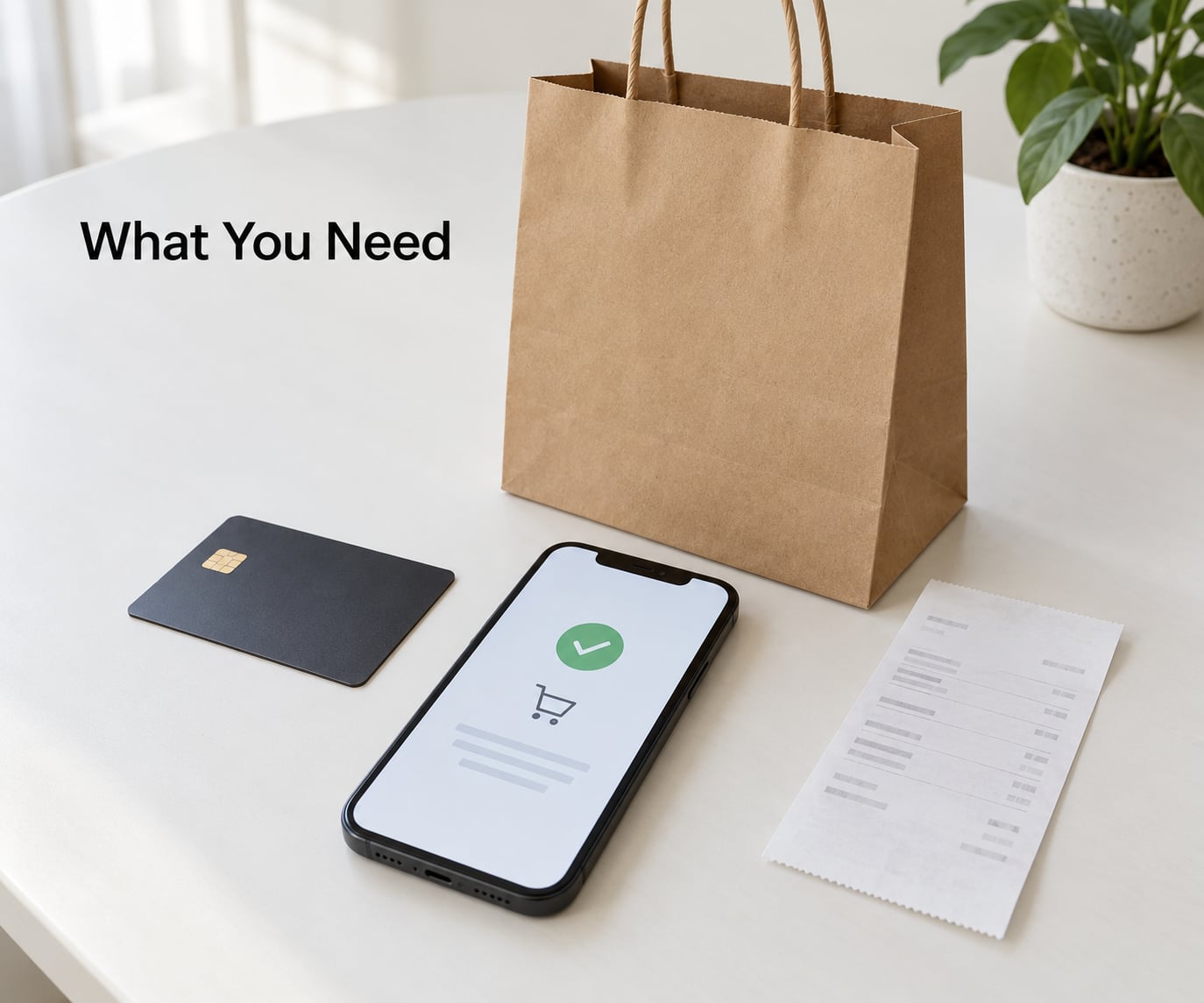
Bring as many independent pieces of evidence as you can gather. Two weak signals beat one strong one, because staff often need to satisfy a manager before they override a missing receipt.
- Government-issued photo ID. A driver licence, state ID, passport or military ID. This is the one item nobody returns without. Staff scan it because the transaction record may only show a partial name.
- The original payment card. Bring the physical debit or credit card you used. A swipe or a keyed-in card number with matching billing details is often enough on its own.
- Account access on your phone. Log in before you walk in. An order history page or a past order confirmation email proves the purchase date and the store or warehouse it shipped from.
- A loyalty or membership number. Membership stores index most purchases to the member account, which can be a faster lookup than any paper record.
- A statement line. A bank, credit card or digital-wallet statement showing the merchant, date and amount. Many retailers will accept a printed or on-screen copy when the card itself is gone.
- Serial numbers and tags. Photograph the serial number, barcode or UPC before you remove anything. Leave tags, packaging and accessories on the item, because an opened or unbarcoded item is the fastest way to get refused.
Step-by-Step: How to Return Something Without a Receipt
Check the Store’s No-Receipt Policy Online
Search the retailer’s help section for a no-receipt or proof-of-purchase policy before you load the item in the car. Most chains publish their cash limit, their required ID and whether they refund to the original payment method or to store credit, and that answer decides whether the trip is worth making.
Read the exclusions while you are there. Final sale items, clearance, opened cosmetics, opened software, perishable goods and items bought with a gift card usually cannot be returned at all, with or without a receipt.
Gather Proof of Purchase
Pull everything you can in one sitting before you go. Search your inbox for the retailer name, then your card statements for the exact amount, then your retailer account for the order number.
Where a paper receipt was emailed, it sits in the same place as the order confirmation, and opening it takes seconds. Where you paid cash, there is no card record, which makes the bank statement line, the store’s own serial-number lookup or a manager’s discretion your only options.
Contact Customer Service Before Visiting
A short phone call or chat saves an afternoon in line and sets the tone before anyone touches your item. Give them the store, the date, the item, how you paid and that you have no receipt, then ask what they need and what form the refund would take.
Requests that go through chat or phone are also logged, so if the counter cashier says no you have a case number to quote. Ask for the name or number of the representative who took your request.
Ask for the Best Available Resolution
Ask what the refund options are rather than demanding a cash refund. That phrasing gives the rep room to work, and the realistic menu usually runs from refund to the original card, down to an even exchange, a merchandise return card, a gift card at current price, or store credit at the item’s lowest recent selling price.
If a card is the answer you want, be specific about it: ask the representative to try the card lookup on their register before settling. Many reps will try once when asked directly and will not offer it unprompted.
For a faulty item, say the word defect rather than the word receipt. A product that does not work is a warranty question, and manufacturers and retailers handle those under different and usually more generous rules.
Keep Records and Follow Up
Photograph your ID’s back and front at the counter, keep every email and chat transcript, and note the date, the rep’s name and the case number. If a refund was promised as store credit, check that the credit actually posted to your account before you leave.
If the answer changes later, escalate calmly by asking for a manager and then writing to the retailer’s customer service email with your case number attached. Follow-up in writing leaves a record, and a card issuer dispute is a last resort for card purchases, not a first move.
Common Mistakes
Deleting the order email. That confirmation is often the strongest proof you have, and it is the first thing to go when you clear storage space. Search for it now.
Going without the card that paid for it. A bank statement is a fallback, not a substitute. The physical card lookup is faster and rarely gets refused.
Missing the window. Return windows usually run 30, 90 or 180 days, and receiptless returns sit at the stricter end of that. Once the window closes, staff have nothing to override, and store credit often expires too.
Stripping tags or packaging. Retailers routinely refuse opened items they cannot resell, and an unbarcoded item cannot even be priced.
Arguing at the register. Cashiers set the refund form and the cap, and they escalate when pressed. Calmly asking what options exist gets further than restating the policy back at them.
Saying it was a gift when it wasn’t. Gift framing is a well-known tactic that produces store credit at face value at best and a call to security at worst. If someone gave it to you, say so plainly, because a gift receipt, gift card or account history usually exists and is better proof than any story.
Waiting until the holiday rush. Late December returns are slower, queues are longer, and the same rules apply with less patience on both sides.
Two habits remove the problem next time. Photograph every receipt before you discard it, and keep one dedicated email folder for order confirmations so a search by retailer name pulls the record in seconds.
Frequently Asked Questions
What can I do if I lost my receipt?
Contact the retailer before you go and explain that you bought the item, when and how you paid. Bring a government-issued photo ID plus the original payment card, your account order history, an emailed order confirmation, or a statement line showing the charge. Staff can usually look the transaction up by any one of those. If the lookup fails, expect store credit rather than a refund to your card.
Can I legally return an item without a receipt?
There is no general US law that requires a store to accept a receiptless return, so the retailer sets the terms through its posted policy. Two things are different. A defective product is covered by the manufacturer’s warranty and by state consumer-protection rules, and those rights do not disappear because you cannot find a receipt. Also, the lack of a legal duty to accept a return is why a no-receipt policy is worth reading rather than assuming.
Can I exchange an item if I lost the receipt?
Yes, and an exchange is often easier to get than money back. The cashier needs to verify the purchase, and once they do, an even exchange for the same item usually works on the same terms as any other return. What varies is the refund value they attach to it, since some stores value the item at the lowest price it sold for in the recent past rather than at what you paid.
Can I get a cash refund without a receipt?
Sometimes, and the outcome depends on how the store identifies the transaction. A successful card or account lookup usually refunds the original payment method, including cash back to a card. When the store cannot match the purchase, most retailers pay out in store credit, a merchandise return card, or a gift card at the item’s current or lowest recent selling price, and cash is the option they offer least often.
Is proof of purchase required for a faulty item?
A receipt is usually what triggers the warranty claim, but it is not the only way a defect is established. Retailers and manufacturers accept photos of the fault, the serial number, the order confirmation, or a card statement in many cases. Describe the defect rather than the missing receipt when you contact them, ask for a claim number, and keep the item with its packaging until the claim closes.
What if the retailer refuses the return?
Ask for the reason in writing and for a manager, then follow up through the retailer’s customer service email with your case number. Card purchases give you a chargeback route with your card issuer as a last resort, and a genuine defect moves the matter from a discretionary return into a warranty claim. Going back without a case number, without a copy of your ID and without a record of who spoke to you is what turns one refusal into several wasted trips.
Conclusion
Start with the retailer’s no-receipt policy, gather digital or financial proof, and contact customer service before you drive to the store. Bring photo ID every time, keep the item untouched, and ask what refund options exist rather than insisting on cash. Most receiptless returns succeed because a card or account lookup matched the purchase.