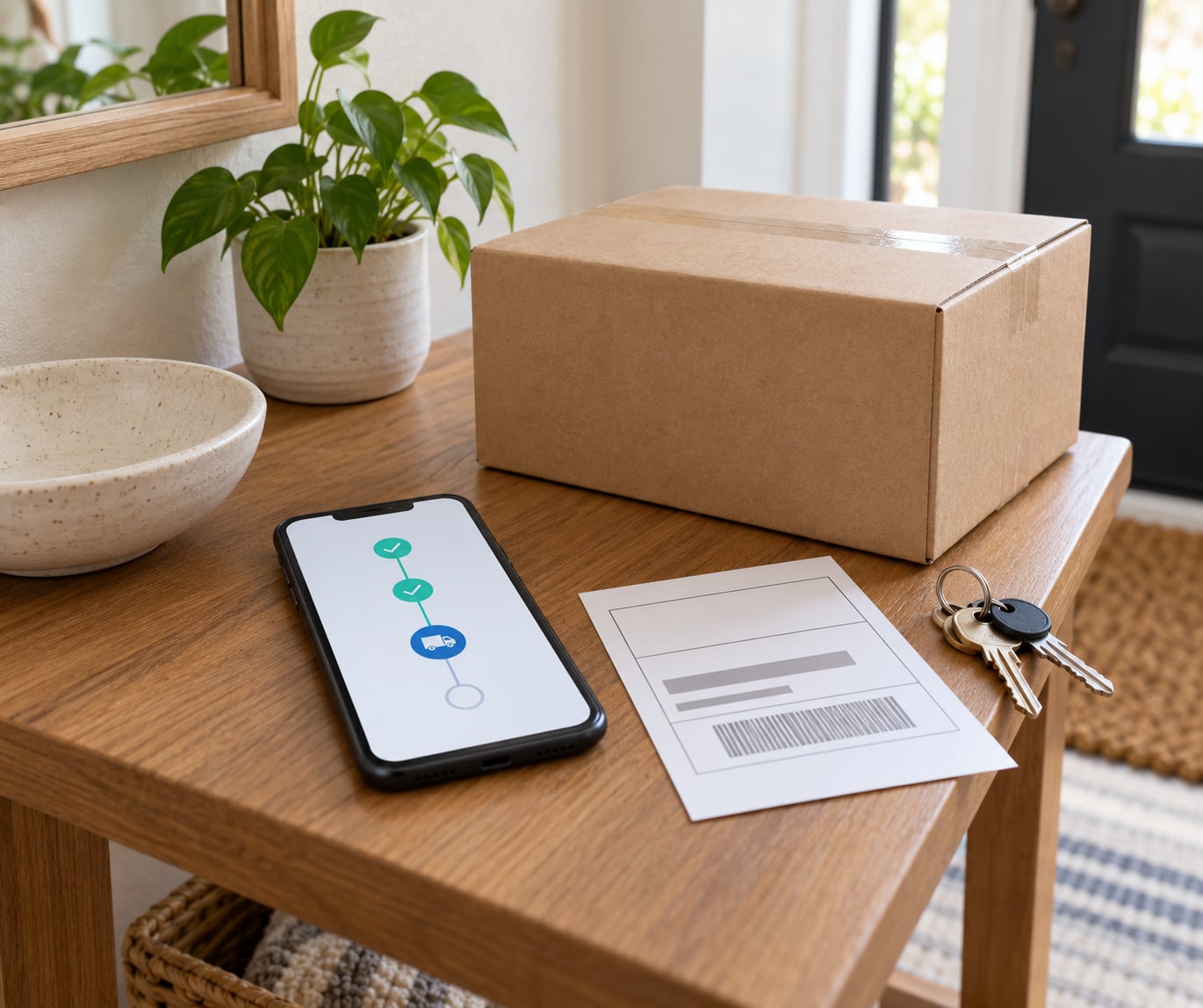
Tracking that says delivered only means a carrier scanned your parcel with a handheld device. It is a scan record, not proof the box is in your hands. To track a package that says delivered, read the scan details, search the exact spot the carrier names, and document the empty space before you file anything.
Most of these resolve in under an hour, and a surprising share of them turn out to be a neighbour hold, a front-desk parcel, or a driver who came back an hour later with the box in hand. This guide was updated for October 2026; carrier procedures change, so treat the deadlines below as the current published windows rather than fixed law.
Table of Contents
- 1What You Need
- 2Step-by-Step: How to Track a Package That Says Delivered
- 31. Open the official carrier tracking page
- 42. Check the delivery details and scan history
- 53. Look around the likely delivery locations
- 64. Ask neighbors, household members, or building staff
- 75. Contact the retailer or carrier promptly
- 8Where each carrier’s process starts
- 9Common Mistakes
- 10How long to wait before you escalate
- 11Frequently Asked Questions
- 12Why does tracking say delivered when the package is not here?
- 13How long should I wait before filing a missing package claim?
- 14How do I find out exactly where the carrier scanned the package?
- 15Who is responsible when a package is delivered but never received?
- 16Does the delivery photo prove the package reached me?
- 17How do I track a package if I lost the tracking number?
- 18Conclusion
What You Need
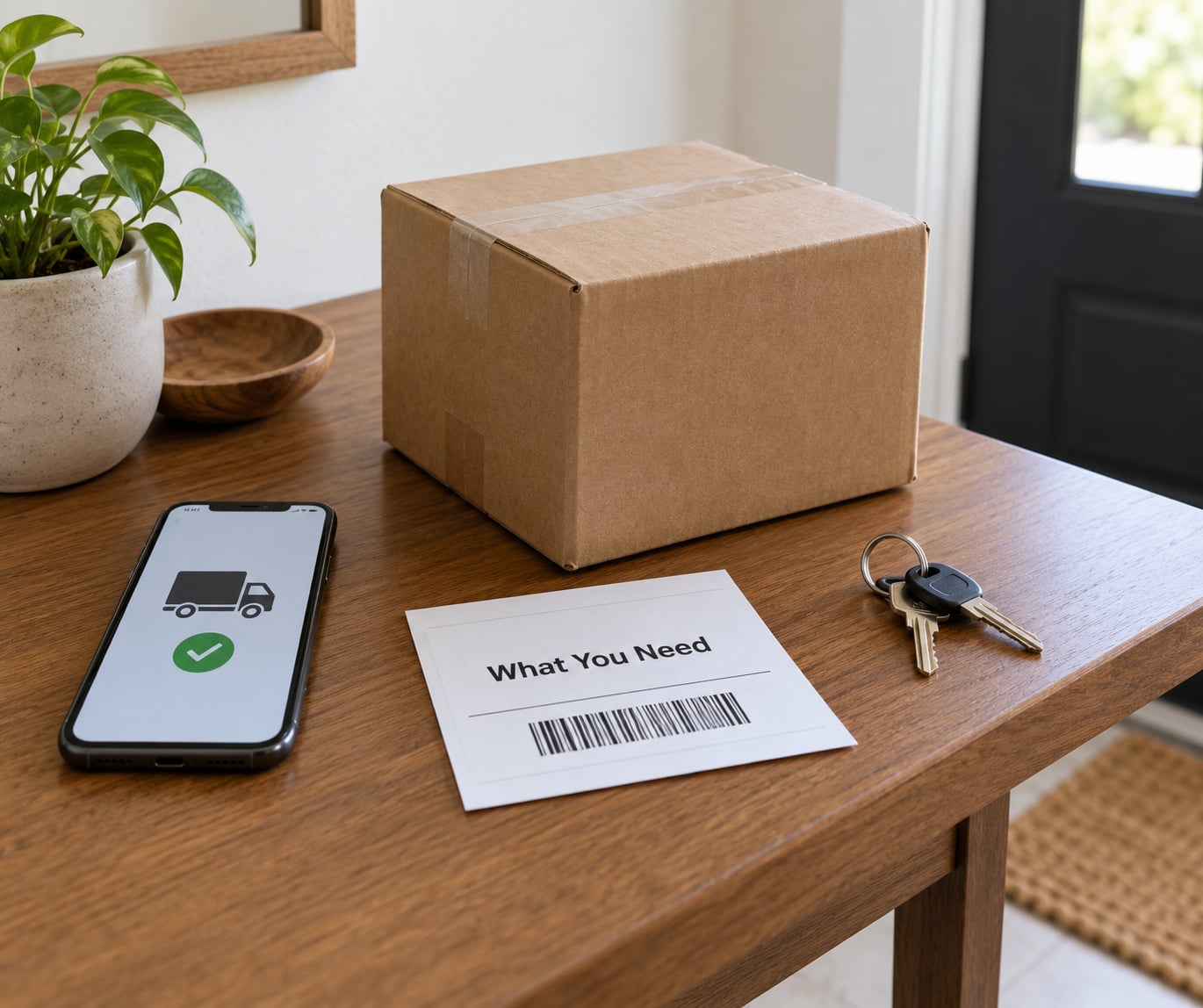
Gather these before you start, because every carrier form asks for some of them and hunting them down mid-claim wastes days.
- The tracking number, found in the retailer order confirmation or the carrier notification email.
- The delivery notification, including the time stamp and any photo the carrier took.
- The carrier’s own site or app, not a third-party tracker. Scans and delivery photos show up on the official page first.
- Your order confirmation with the shipping address you entered, so you can compare it against the scan.
- Proof of purchase and proof of value, meaning the receipt or invoice showing what the item cost. A claim filed without it is usually rejected.
- A way to document the empty spot, ideally a photo of the porch, door, or mailbox with nothing on it, plus a screenshot of the tracking page.
If you live in an apartment or condo, add the unit number, the building’s parcel room rules, and the front desk or concierge hours. Half of apartment delivery problems end at that desk.
Step-by-Step: How to Track a Package That Says Delivered
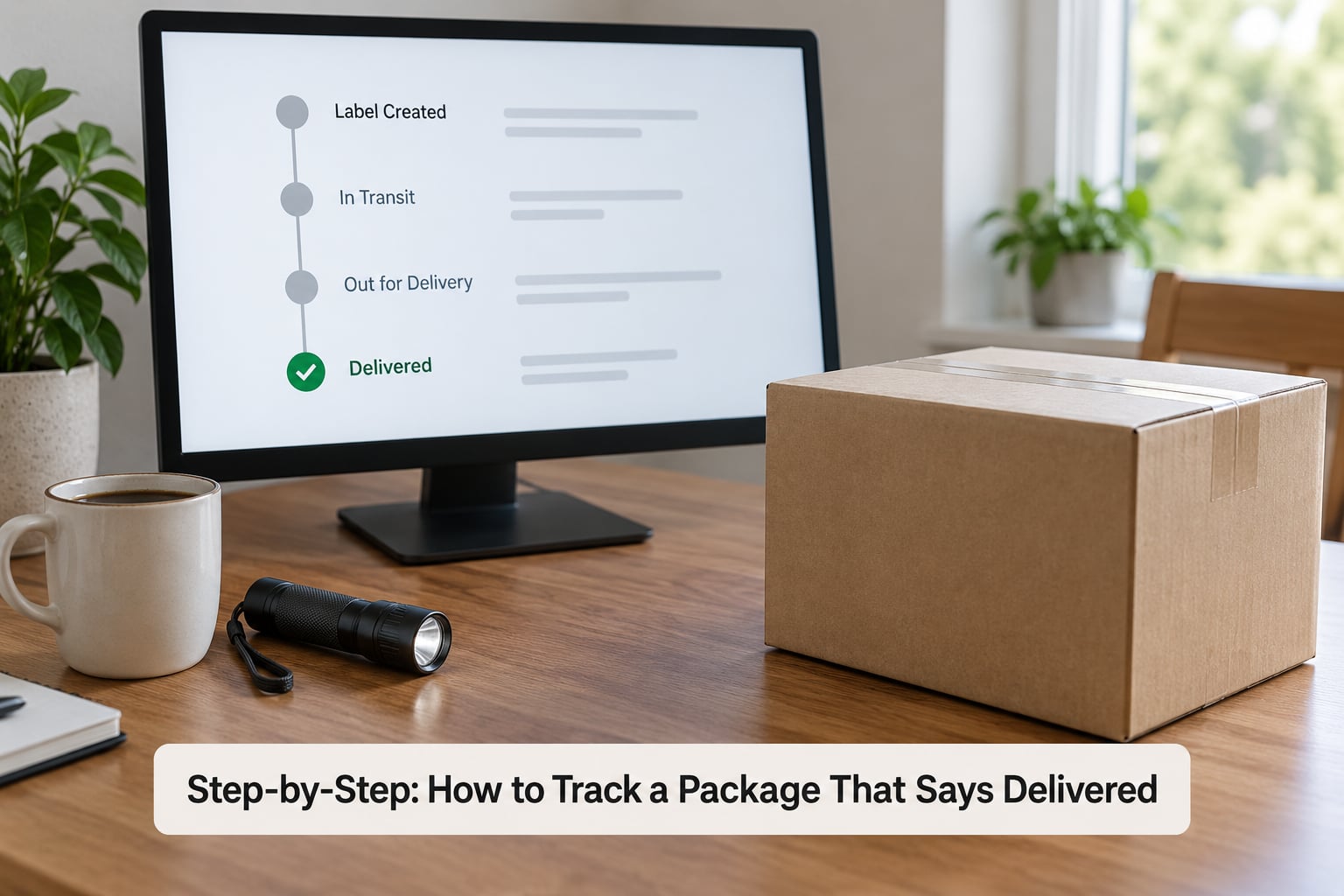
1. Open the official carrier tracking page
Go straight to the carrier named on your shipping label. A delivered scan recorded on a random tracker site is often stale or scraped from a cached page, which sends people chasing a status that was updated weeks ago.
Enter the tracking number, then wait for the full history to load. You are looking for four things: the date and time of the final scan, the scan location, whether a signature was required, and whether a delivery photo exists. If the page asks you to sign in, use the retailer’s account rather than guessing at carrier account credentials.
2. Check the delivery details and scan history
Read the scan line itself, not just the green delivered bar. Carriers often add a note describing exactly where they put the parcel: front door, side door, back porch, mailbox, neighbour, front desk, or parcel locker. That note narrows your search to a few square feet.
Check the geography too. If your post office serves a different town than your address, or the last scan happened at a sorting facility hours before the delivery window, that points to an early or mis-scanned delivery rather than a lost package. On USPS, the Informed Delivery preview shows a grayscale image of your mail and packages from the morning of delivery, which is often enough to confirm the box existed and where it was set down.
You will know this step worked when you can state, in one sentence, where and when the parcel was scanned.
3. Look around the likely delivery locations
Work this list in order, and do not skip ahead. People find parcels at step three constantly.
- The spot named in the scan note, first and foremost.
- Front door, porch floor, and the mat or step where a driver would step over a sign.
- Side door, back porch, and any gate or side entrance a driver can reach from the street.
- Your mailbox, the mailbox key, and any parcel lockbox or wall-mounted carrier box.
- The building entrance, mailroom, parcel room, package locker, reception desk, or concierge stand.
- A neighbour’s door or porch, especially if your unit has a spot a driver can reach without an access code.
Look at ground level. A parcel kicked under a shrub or wedged behind a planter is more common than a theft. A bright flashlight helps more than expected on a porch after dark.
4. Ask neighbors, household members, or building staff
Neighbors and building staff resolve a real share of these cases. Posters in the r/UPS and r/USPS threads often end with the driver returning a few hours after the original scan, or a neighbor confirming they took the parcel in for someone down the hall.
Ask specific, narrow questions rather than “did you see a package”. Try: did a delivery come for this door today, and did the driver mark anything as delivered to another unit? At a front desk, give the unit number, the carrier, and the tracking number, and ask them to check the parcel room log before you leave.
Keep screenshots of your search as you go. If the parcel turns up, you will not need them. If it does not, they become the evidence for the carrier and the retailer.
5. Contact the retailer or carrier promptly
Contact the retailer you bought from first, and separately the carrier that made the scan. They are two different claims with two different outcomes, and confusing them is the single biggest reason people give up.
What to provide: the tracking number, the order number, the delivery date, the address on the order, the scan note and location, and photos of the empty delivery spot. If you bought through a marketplace, the seller is usually the one who can open a carrier claim, because the shipping label is in their name.
If a retailer replies that tracking shows delivered and nothing more can be done, the most useful reply is a short one: you have not received the package, the final scan lists a specific location, you have searched that location and photographed the empty spot, and you are asking them to open a carrier investigation or issue a refund or replacement. Ask for a supervisor if the first reply is a canned script.
Where each carrier’s process starts
| Carrier | Where to start | What to ask for | Useful detail |
|---|---|---|---|
| USPS | Your local post office counter, or the Missing Mail help request on usps.com | A missing mail inquiry, and the delivery supervisor rather than the counter clerk | A search can be opened about 7 days after mailing, a claim about 15 days after, and must generally be filed within 60 days, with around 30 days to appeal a denial |
| UPS | ups.com tracking page, then the number on the delivery notice; UPS My Choice for delivery details | A delivery supervisor request and a formal claim through the carrier site | A signature name and the delivery photo on the tracking page are the fastest way to confirm who took the parcel |
| FedEx | fedex.com tracking page, then FedEx Delivery Manager and the number on your shipping confirmation | A delivery trace and, if the parcel is high value, a claim with proof of value | Delivery Manager will hold or redirect a shipment for a short window, which only helps while the parcel is still moving |
At a USPS counter, ask specifically for the Postmaster or a delivery supervisor. Clerks behind the window generally cannot look into a shipment, and being told to come back tomorrow by someone who cannot help is a waste of a trip.
Common Mistakes
Trusting an old scan. Tracking pages cache. Pull up the official carrier page rather than a screenshot from three days ago, and read the full scan history rather than the top-line status.
Treating delivered as received. The scan happens in a lot of places before anyone knocks: a courier scanning a batch on the truck, a hand-held device firing at the door before the driver sets the box down, or a mis-scan on a route the driver has never driven. Early and mis-scans are routine, not suspicious.
Searching only the front door. Side doors, back porches, lockboxes, and front desks catch most deliveries. Expand the search before you decide anything happened.
Waiting far too long to report it. The longer a parcel sits unclaimed, the harder it is to trace. Report within a few days even if you are still hoping it turns up.
Posting your tracking number publicly. Full tracking numbers plus a name and address are enough for someone to build a convincing fake delivery notice aimed at you. Redact the number if you post a screenshot.
Paying a recovery service. No legitimate company will find your parcel in exchange for card details, a fee, or a remote access request. Carrier and retailer support are free, and a real carrier will never ask for your card to trace a parcel.
How long to wait before you escalate
| Stage | How long | What it gets you |
|---|---|---|
| Wait after the delivered scan | 24 to 48 hours | Time for a neighbour, a household member, or a driver returning to finish the drop |
| Open a search or missing mail inquiry | About 7 days after mailing | An internal search of sorting facilities and recovery centres |
| File a formal claim | About 15 days after mailing | Review for replacement, refund, or reimbursement against proof of value |
| Claim filing deadline | Generally within 60 days | Miss it and most remedies close |
| Appeal a denied claim | About 30 days | A second review with better documentation |
These are the commonly published USPS windows and the shape most other carriers follow. If your retailer offers a refund or replacement sooner, take that route first, because a carrier claim pays you, not the retailer.
Two prevention habits save most of this hassle. Add delivery instructions that name a safe spot, a gate code, or a pickup point, and turn on delivery alerts so a front-desk hold reaches you the same day. Signature confirmation on expensive items also gives you a name to chase.
Frequently Asked Questions
Why does tracking say delivered when the package is not here?
A delivered status is a barcode scan record, not a receipt in your hands. Drivers scan batches on the truck, scan at the door before setting the box down, or mis-scan when a route or handheld device misbehaves. Contractor-carrier substitutions add more chances for the scan and the physical drop to disagree. In apartment buildings, the parcel is often scanned to a front desk or parcel room rather than your door.
How long should I wait before filing a missing package claim?
Give it 24 to 48 hours after the delivered scan, then open a search or missing mail inquiry once you are past roughly 7 days from mailing. Most published claim windows sit around 15 days, with filing required within about 60 days and about 30 days to appeal a denial. If the parcel is high value, start the report early and keep documenting the empty spot.
How do I find out exactly where the carrier scanned the package?
Open the tracking page on the carrier’s own site and read the final scan line, which often names the location such as front door, side door, mailbox, neighbour, or front desk. Postal carriers can also pull the scan details for your route when you ask the Postmaster or a delivery supervisor. The delivery photo and the Informed Delivery preview may show more than the scan text does. Nobody outside the carrier can retrieve that data for you.
Who is responsible when a package is delivered but never received?
Legally the answer depends on how the shipment was paid for, but practically it comes down to two separate claims. The carrier handles loss or misdelivery, and the retailer handles your money through a refund or replacement. A seller on a marketplace files the carrier claim because the label is in their name, while you pursue the refund with them. If a card dispute becomes the last resort, most issuers give you a limited window to open it.
Does the delivery photo prove the package reached me?
It is useful but not conclusive. Many photos are taken at arm’s length and show only ground, a mat, or a door handle, and some images are captured before the driver actually sets the box down. A photo showing your full address, your name in the signature field, or your unit number is much stronger evidence. Save the image, and take your own photo of the empty spot at the same time for a direct comparison.
How do I track a package if I lost the tracking number?
Start in your retailer account, where the order history keeps the tracking link and the carrier name. The carrier itself can often match a shipment using your name, the destination address, and the mailing date range, so calling or visiting with those three details usually works. USPS can also search by name and address through its mail recovery tools. Avoid third-party sites that ask for personal details before showing any scan data.
Conclusion
Start with the final scan line on the carrier’s own page, because it usually names the drop point. Search that spot, then the side door, mailbox, lockbox, and front desk, and photograph whatever you find. If nothing turns up, contact the retailer and the carrier within a couple of days with the tracking number, the scan details, and your photos, and ask for a missing mail inquiry rather than a canned reply.