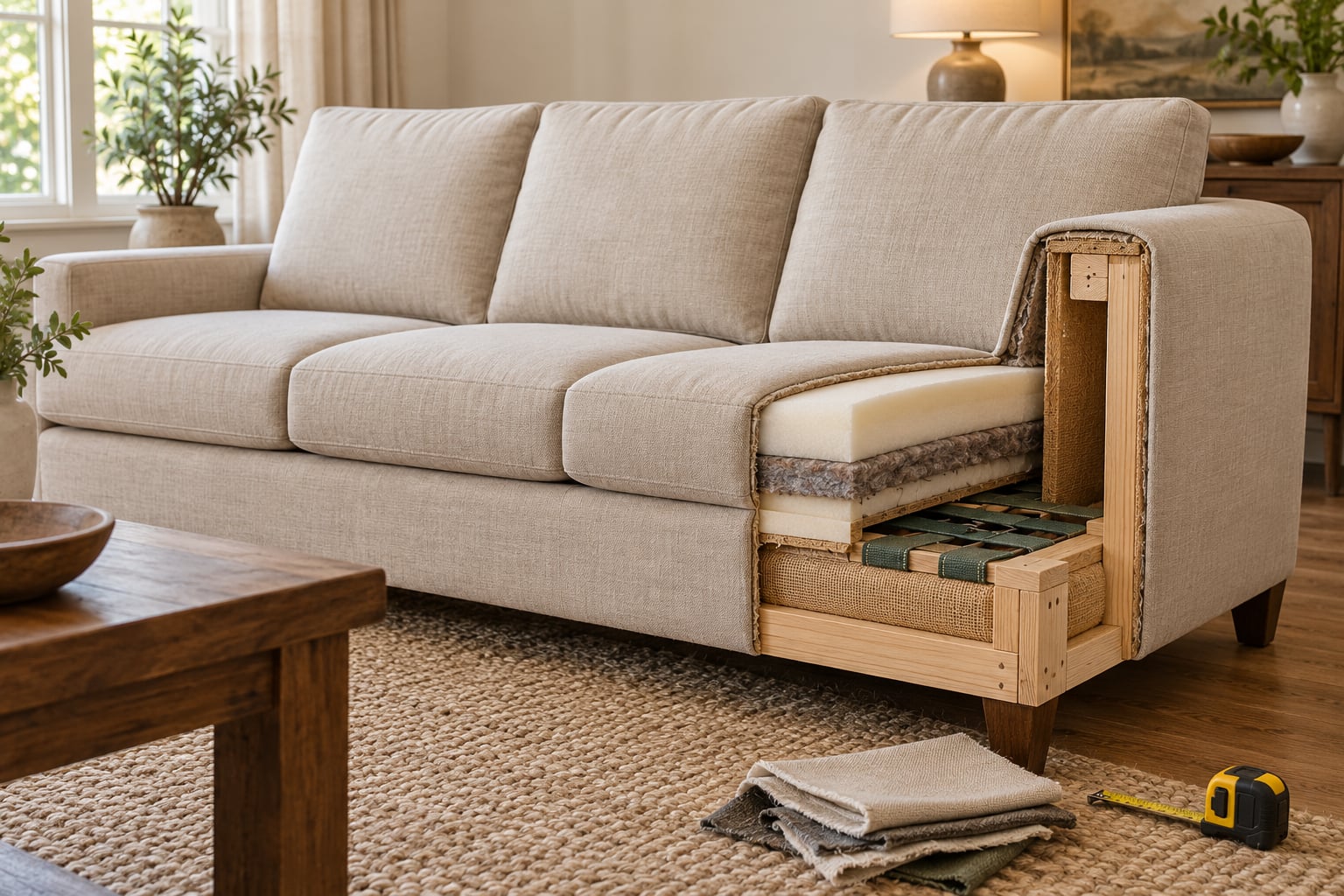
How to choose a sofa that lasts comes down to four parts you can verify in the store, plus two you have to think about before you shop: a kiln-dried hardwood or multi-ply frame joined with dowels and corner blocks, a real spring suspension, high-resiliency foam at 2.0 to 2.5 pounds per cubic foot, and upholstery rated above 15,000 double rubs. Then check that it fits your room and your delivery route, and that the warranty covers the frame for life. Everything else on the tag is negotiable.
I have watched people get this wrong in both directions: paying top dollar for a beautiful frame that a cat shredded in a year, and buying a bargain sofa that sagged before the warranty paperwork was filed. The showroom is where the decision gets made, usually in twenty minutes, usually while someone else is talking.
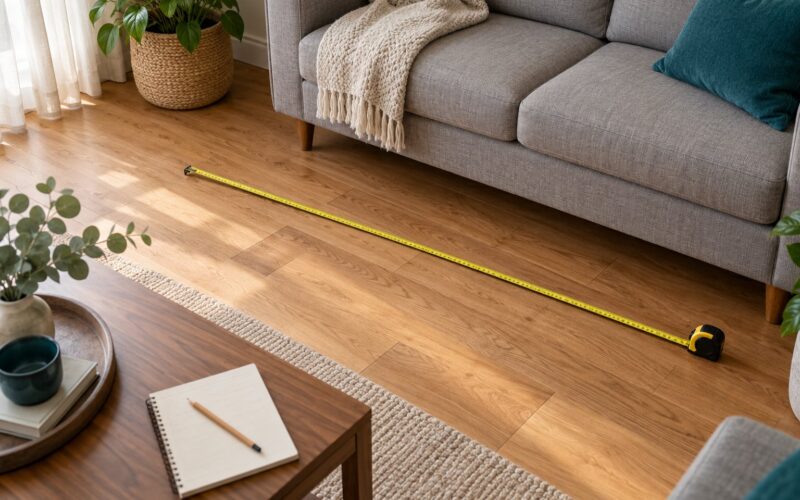
This guide gives you the seven checks to run, in order, plus the specific numbers worth asking for. Bring a tape measure and your phone.
Table of Contents
- 1What You Need
- 2Step-by-Step: How to Choose a Sofa That Lasts
- 31. Measure Your Room and Every Doorway
- 42. Check the Frame and Joinery
- 53. Test the Suspension System
- 64. Inspect the Cushions and Foam
- 75. Evaluate the Upholstery for Your Lifestyle
- 86. Look for Repairable, Replaceable Parts
- 97. Read the Warranty and Test Before Buying
- 10Common Mistakes
- 11Frequently Asked Questions
- 12What type of sofa frame lasts the longest?
- 13Is a solid wood sofa frame always better than plywood?
- 14How do I know if a sofa will sag?
- 15What sofa upholstery is most durable for homes with pets?
- 16Should I buy a sofa with a ten-year warranty?
- 17What is the most important thing to test in a furniture store?
- 18Conclusion
What You Need
Most of the information you need already exists, but nobody hands it to you unless you ask in a specific way. Gather this first and the comparisons get much faster.
- Room dimensions. Wall length, and where the door, windows and outlets sit. Photograph the wall so you can picture the sofa at home.
- Every measurement between the store and the room. Front door width and height, hallway widths, stair turns, elevator interior height and diagonal, and any tight corner.
- Painter’s tape. For a footprint test on the showroom floor. This is the fastest way to catch an oversized sofa.
- A tape measure and your phone for photos of the frame tag, the care label and the foam stamp.
- An honest description of daily use. How many people sit there nightly, whether there are pets or kids, whether anyone naps on it, whether the room gets direct afternoon sun.
- Fabric swatches in at least two colors, taken home. Showroom lighting flatters everything.
- Questions about warranty terms, which I list at the end of step 7.
Bring the swatches home and hold them against your floor, your curtains and your wall for a full day. Colors shift dramatically between a north-facing showroom and a sunlit living room.
Step-by-Step: How to Choose a Sofa That Lasts
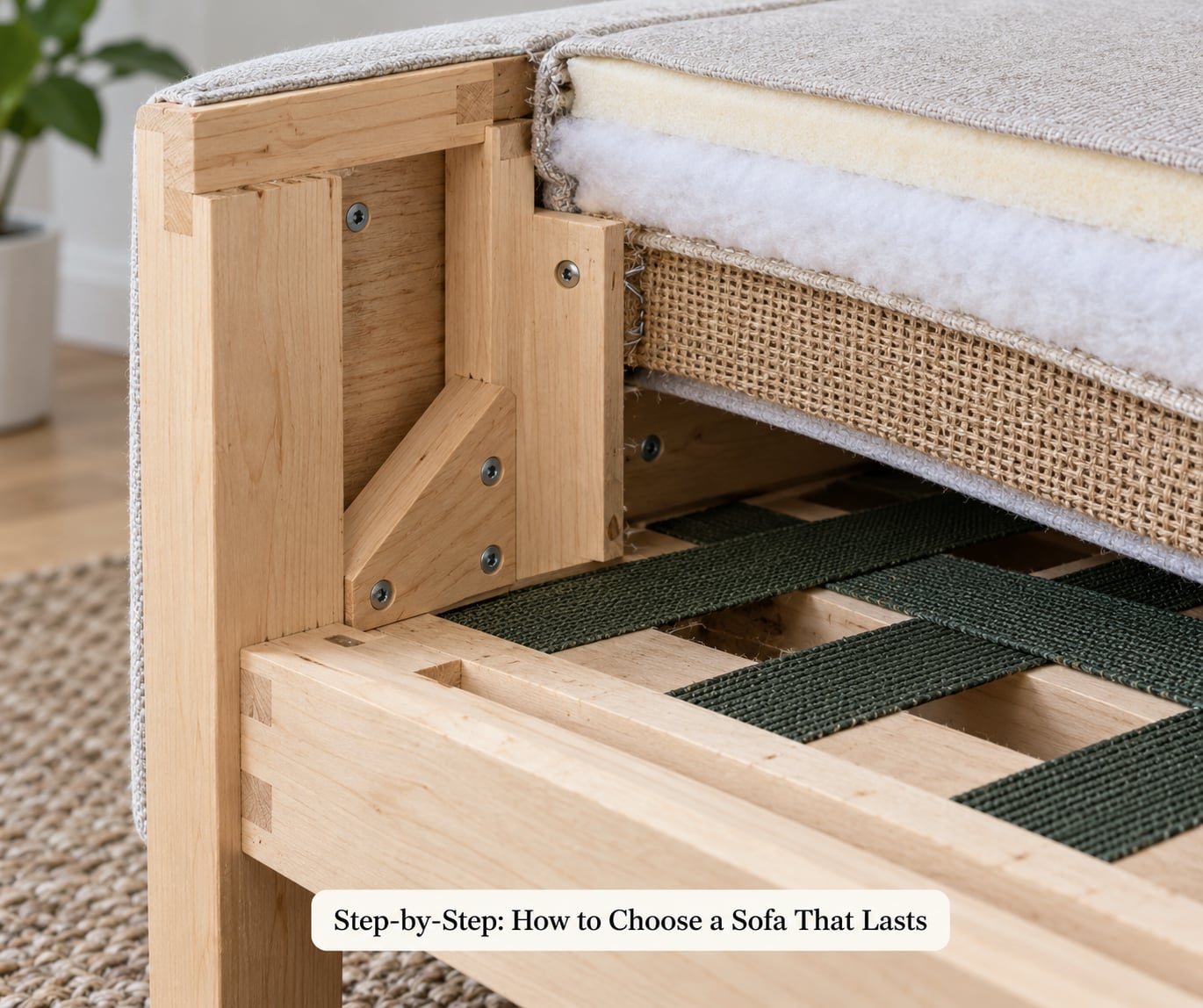
The order matters. Fit and delivery come first because a sofa you cannot get into the house is not a durable sofa, it is a firewood pile. Then work inward from the frame to the fabric, because each layer only matters if the one below it holds.
1. Measure Your Room and Every Doorway
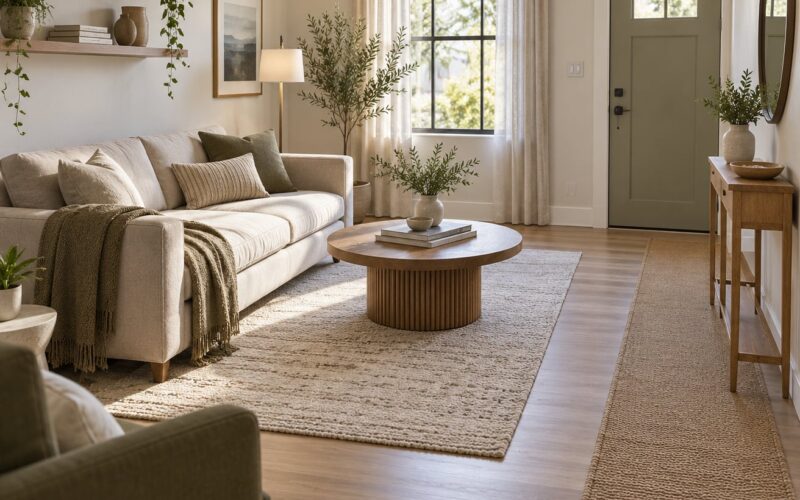
Tap the sofa’s footprint out in painter’s tape on the showroom floor, then walk around it. You want roughly 30 to 36 inches of clear walkway behind and beside the sofa for people to pass and for you to open drawers or a nearby cabinet door.
A widely used sizing rule of thumb is the two-thirds rule: size your seating to about two-thirds of the room’s width so the piece still reads as a sofa rather than filling the space wall to wall. It is a guideline, not a law, but it is the number most designers start from.
Now the delivery route. The standard sofa modules are roughly 35 to 40 inches wide, which clears most standard doors, but a sectional or a sofa with a chaise can exceed 90 inches and arrive in two or three separate boxes. The boxes are usually shorter than the assembled piece, which helps, but not always.
Measure the narrowest point of the route, not the average. Stairwell turns and elevator ceilings are where deliveries actually get stuck. If the retailer offers a white-glove delivery that includes carrying it inside and up the stairs, that is worth more to a renter than any fabric upgrade.
Renters and anyone who moves often should lean modular. Tool-free-disassembly sections are the reason those sofas survive three moves while a fixed frame gets left behind.
2. Check the Frame and Joinery
The frame is the part that cannot be replaced later, so it gets the most attention. Ask what the wood actually is, and ask where it is. On most sofas the frame is visible or partly accessible at the base, the back panel, or under the cushions.
Look for a legal tag, usually stapled under the seat deck or on the underside. It should name the frame material, the cushioning material and the cover fabric. A tag that says “wood products” instead of a species or a ply grade tells you what you need to know.
- Kiln-dried hardwood (oak, beech, maple, ash) is the target. Kiln-drying pulls almost all the moisture out of the lumber, so the frame will not warp or twist as the room’s humidity changes.
- Multi-ply hardwood plywood is an excellent frame material, sometimes better than solid wood in some ways because the layers resist splitting. Look for at least seven to eleven plies and a hardwood face veneer.
- Softwood such as pine or fir is workable but more prone to warping and to loosening at the joints. It can be fine in a well-built frame, but expect a shorter life.
- Particleboard and MDF are engineered wood and the first thing to fail. They absorb moisture, and screws loosen in them over time.
Here is the marketing trap almost nobody explains: finger-jointed lumber. Small pieces of hardwood are fingered together like interlocking fingers and end-to-end to make a long rail, and that rail is genuinely strong. But it is often described loosely as solid wood, and some sofas are built with finger-jointed pine, which is a softwood. Ask specifically whether the frame is hardwood or softwood.
For joinery, look for corner blocking. At every corner there should be a small triangular or square block glued and screwed into the joint, which stops the frame from racking when two people sit on opposite arms. Dowels or screws at the joints are a good sign. Staples and glue alone are a bad sign, because they work until someone leans on the arm and then they pull loose.
| Frame material | Expected lifespan | What to look for on the tag |
|---|---|---|
| Kiln-dried hardwood | 15 to 25 years | Species named, corner blocks, dowels or screws |
| Multi-ply hardwood plywood | 10 to 15 years | Ply count, hardwood face veneer |
| Solid softwood (pine, fir) | 5 to 10 years | Doweled joints, tight seams, no warping |
| Particleboard or MDF | 3 to 7 years | Usually absent; expect vague labeling |
Owners on r/BuyItForLife, when asked directly which sofas hold up, consistently point at the hardwood frame and the spring suspension rather than any brand name. A lifetime frame warranty, in those threads, carries more weight than any logo.
3. Test the Suspension System
Suspension is what stops a seat from collapsing into puddling, where a person sits and leaves a dent that never comes back. Three types show up in showrooms.
- Eight-way hand-tied springs. Each coil is tied to its neighbors front, back, left, right and diagonally. It is the most durable and the most expensive, and it is what traditional upholstery has used for a century.
- Sinuous springs are continuous steel wire formed into an S-shape and clipped to a hardwood or plywood rail. Good quality sinuous is close to hand-tied for everyday use. Cheap sinuous, spaced too wide, sags at the front edge within a few years.
- Webbing is elastic or jute straps stretched across the frame. Jute webbing is the weakest option and a clear sign of a budget build. Elastic webbing is acceptable in a modular sofa designed for it.
Press your palm firmly into the seat center, then the front edge, then near the back. A well-built suspension pushes back evenly and returns to shape when you let go. If it feels spongy with no rebound, or you hear creaking, keep looking.
A sofa can be soft on top and still last a long time, as long as the base underneath is firm and supportive. The opposite is the problem: a sinky, cloud-soft seat sitting on weak webbing will feel wonderful in the store and collapse in four years.
4. Inspect the Cushions and Foam
Foam density is the single most useful number on a cushion, and it is printed or stamped on the foam itself if you ask to see the cut. It measures how much foam is packed into a cubic foot, not how soft the cushion feels.
- 1.5 lb per cubic foot is low-density filler. It flattens within a couple of years.
- 1.8 lb/ft3 is the practical floor for an everyday seat.
- 2.0 to 2.5 lb/ft3 is high-resiliency foam, and it is what you want for a sofa people use daily.
- Memory foam feels wonderful for a few years and is dense by design, but it can soften in heat and it will not rebound like HR foam.
If a retailer quotes density by name, HR25 means about 2.5 lb/ft3 and HR35 about 3.5. Ask for the number rather than the marketing word.
Beyond the core, the wrapping matters. Foam wrapped in fiber or down feels softer at the edges and hides the foam’s blocky look, but the wrapping will flatten and the foam underneath will keep its shape. That is a good combination and a common one on better sofas.
An all-feather or all-down cushion feels wonderful and needs fluffing every week to hold its shape. It is a comfort purchase, not a durability one.
Test comfort the way you will actually use it. Sit for two full minutes, lean back, cross your legs, then stand up. You are checking two things: whether the back supports your shoulders at a slight recline, and whether you can get off the cushion without a struggle. Tall people and short people need different seat depths, and a seat that is too deep means your feet do not reach the floor.
Ask whether the covers unzip and whether the foam insert is sold separately. That single question is the difference between replacing a cushion for the cost of one insert and reupholstering the whole sofa.
5. Evaluate the Upholstery for Your Lifestyle
Fabric durability is measured in double rubs, which is how many times a fabric can be rubbed back and forth before its fibers break. Two common test standards are used, so match apples to apples and always compare within one standard.
- 15,000 double rubs and up: fine for a formal room or a lightly used sofa.
- 30,000 double rubs: everyday family use in a busy living room.
- 50,000 double rubs and up: heavy use, pets, and anything in a family room where people sit daily.
| Upholstery | Typical rating | Best for |
|---|---|---|
| Performance fabric | 30,000 to 100,000 double rubs | Kids and pets; treated against stains and fading |
| Tightly woven microfiber | 30,000+ double rubs | Pets and high traffic; resists claw snagging |
| Chenille | 25,000 to 40,000 double rubs | Everyday use; hides soil well, pills under friction |
| Velvet (performance) | 30,000+ double rubs | Warm, layered look; crush marks recover |
| Open linen and tweed | 10,000 to 20,000 double rubs | Low-traffic rooms; snags easily on cat claws |
| Full-grain leather | Not rated in rubs | Twenty-plus years with care; develops a patina |
| Bonded leather | Leather scraps on backing | Short-term savings only; peels and cracks |
For homes with pets, the deciding factor is weave tightness rather than the fiber name. An open linen or tweed weave gives cat claws something to hook into. Tight performance weaves and microfiber do not snag, and they can often be cleaned with a damp cloth.
Skip bonded leather. It is leather particles glued to a fabric backing, usually through a polyurethane layer, and it flakes within a few years. If you want leather, ask the grading terms out loud: full-grain, top-grain, split-grain, or genuine. Full-grain is the strongest and the most expensive; genuine leather, on the other hand, is usually the lowest grade and reconstituted.
Sunlight is the quiet upholstery killer. Ultraviolet breaks down fibers and fades dyes, so ask for a solution-dyed fabric, a light-filtering shade, or simply keep the sofa off a west-facing wall. Move it now, not after the first bleach mark.
6. Look for Repairable, Replaceable Parts
The best long-term value is a sofa you can fix yourself. A few minutes of checking here decides whether a cushion problem in year six is a small expense or a total loss.
- Seat cushion covers that unzip and come off, ideally machine washable.
- Separate cushion inserts you can order individually.
- Removable or screw-in legs, so you can raise a sofa on hard flooring and replace a foot.
- Replaceable glides and casters, so worn plastic feet never drag on hardwood.
- Back cushions filled in their own covers, and lumbar pillows that can be restuffed.
- A design where the upholstery is attached to removable panels, not stapled permanently across solid foam.
None of these features tells you how the frame is built, but together they decide how the sofa ends its life: repaired two or three times, or thrown out.
7. Read the Warranty and Test Before Buying
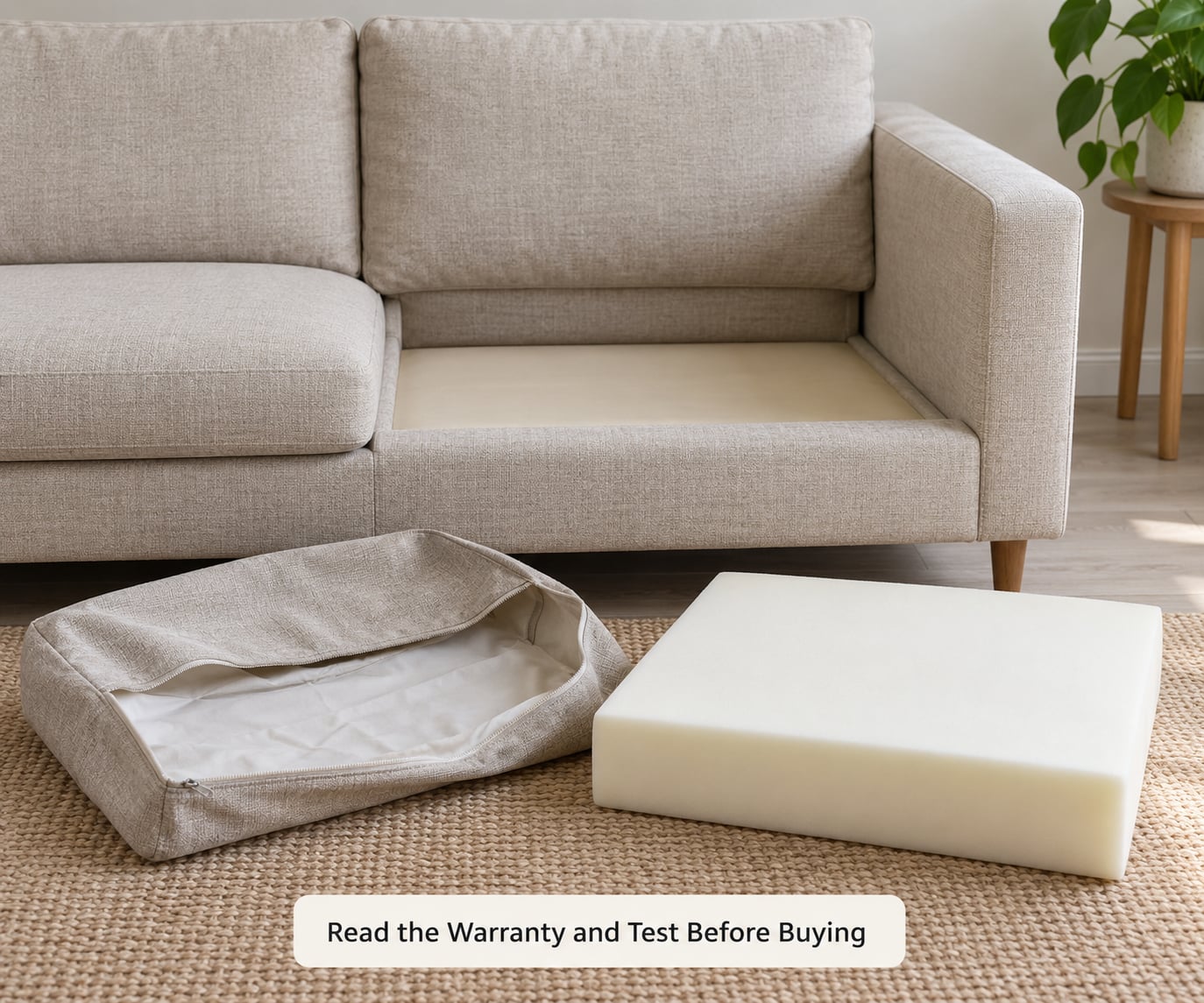
A warranty is the manufacturer’s own statement about what it expects to fail. Read the terms rather than the headline.
| Warranty term | What it tells you |
|---|---|
| Lifetime or 10-year frame | The manufacturer expects the frame to outlast the ownership period. The strongest available durability signal. |
| 5 to 10 year frame | Solid but not a lifetime claim. Check whether the term is pro-rated or limited to the original buyer. |
| 1 to 3 year limited | Often components only, and frequently excludes the frame entirely. |
| Cushion warranty of 1 to 3 years | Honest. Foam compresses and is expected to need replacing; it is a consumable part. |
| No upholstery coverage | Near-universal. Upholstery wear is usually excluded from every warranty. |
Ask specifically: what does the frame warranty exclude, is it transferable to a second owner, and does it require registration or a receipt? Then confirm the return policy in writing before you commit, since most allow 30 days and a return is easier than a warranty claim.
Finally, do your own tests. Lift one arm and see whether the frame stays square. Squeeze the seat cushion and release it. Sit, shift position several times, then stand up and look at whether the cushions recover. Check the gaps between cushions and the arms for even spacing. Sit with your back fully against the back cushion, since most frames are designed for a reclined position and a loose back will never feel right.
If the store has a floor model, sit in it. Showroom samples have absorbed a year or two of use, and a sofa that feels loose there has a problem. This is the test most people skip, and it is free information.
Common Mistakes
Choosing by appearance alone. A beautiful frame in the wrong size or the wrong fabric for a sunlit room is a short-term purchase. Judge the four build parts first, then decide whether you can live with the color.
Assuming a high price means high quality. Retail markup covers design, branding and delivery logistics as much as materials. The construction tag tells you more than the price, and two sofas in the same showroom can differ entirely under the cushions.
Skipping the floor model test. The sample has already survived real use. Push on its arms, check whether the back sags, and see if the seat has a permanent dent.
Overlooking dimensions. Measure the delivery route and tape the footprint on the floor. The two most common showroom regrets are a sofa that blocks a walkway and one that will not make it through the front door.
Buying non-removable covers. A stain on a stapled-on cover is permanent or expensive to fix. Zip-off, washable covers cost little at the factory and pay for themselves with the first spilled drink.
Failing to confirm warranty coverage in writing. Get the terms on paper before payment, not a verbal assurance from a busy sales floor. Check the frame term specifically, since cushion and fabric terms are usually short or excluded entirely.
One more worth naming: buying on the deepest seat because it feels luxurious in the moment. Deep seats look generous but force taller people to perch, and they rarely support a nap. Sit depth should roughly match your height.
Frequently Asked Questions
What type of sofa frame lasts the longest?
Kiln-dried solid hardwood, such as oak, beech, maple or ash, joined with dowels and reinforced corner blocks, generally lasts the longest, often 15 to 25 years with normal use. Multi-ply hardwood plywood is a close second at roughly 10 to 15 years and resists splitting well. Softwood frames typically last 5 to 10 years, and particleboard or MDF frames often fail in 3 to 7 years as fasteners loosen and the material absorbs moisture.
Is a solid wood sofa frame always better than plywood?
Not always. A well-built multi-ply hardwood plywood frame resists splitting and warping as well as anything solid wood does, and it is often more consistent across a large frame. The things that actually predict failure are moisture content, corner blocking and joinery. A finger-jointed pine frame sold as solid wood will fail sooner than a properly joined plywood frame, so ask what the wood is and how the corners are built rather than relying on the word solid.
How do I know if a sofa will sag?
Look at the suspension and the cushion foam. Hand-tied or quality sinuous springs spaced closely together resist sagging, while jute webbing and widely spaced sinuous springs do not. Underneath, high-resiliency foam at 2.0 to 2.5 pounds per cubic foot recovers, while 1.5 density foam flattens within a couple of years. In the store, press the seat center and front edge hard and check that the surface rebounds instead of holding a dent.
What sofa upholstery is most durable for homes with pets?
Tightly woven performance fabrics and microfiber are the most durable choices for homes with pets. A tight weave gives cat claws nothing to hook into, and a stain-resistant finish makes cleanup straightforward. Most perform well past 50,000 double rubs. Avoid open linen and tweed weaves, which snag easily, and skip chenille in homes with two or more pets, since it pills under friction. Removable washable covers matter as much as the fiber itself.
Should I buy a sofa with a ten-year warranty?
A long warranty is a genuine durability signal, so a ten-year frame warranty is worth paying for, but read the terms before you rely on it. Check whether it covers the frame only or also the suspension, whether it is pro-rated after the first few years, and whether it transfers to a second owner or requires registration. Cushion and upholstery coverage is usually short or excluded, so treat the frame term as the real signal and everything else as a bonus.
What is the most important thing to test in a furniture store?
The sit-and-stand test, followed by the arm lift. Sit for a full two minutes, lean back, shift position several times, then stand up and check whether the cushions return to shape. Next, lift one arm firmly: a solid frame stays square, while a weak one racks and you may hear a creak or a joint separating. Do both on a floor model if the store has one, since samples have already taken a year or two of real use.
Conclusion
Start in your own home, not the showroom: measure the room, tape the footprint, and walk the whole delivery route from the door to the wall where the sofa will sit. Then work inward at the store: kiln-dried hardwood or multi-ply plywood with corner blocks, real spring suspension, high-resiliency foam at 2.0 to 2.5 pounds per cubic foot, upholstery rated above 15,000 double rubs, removable covers, and a written frame warranty. Build the most durable one that suits how your household actually lives, and check the return policy before you sign.