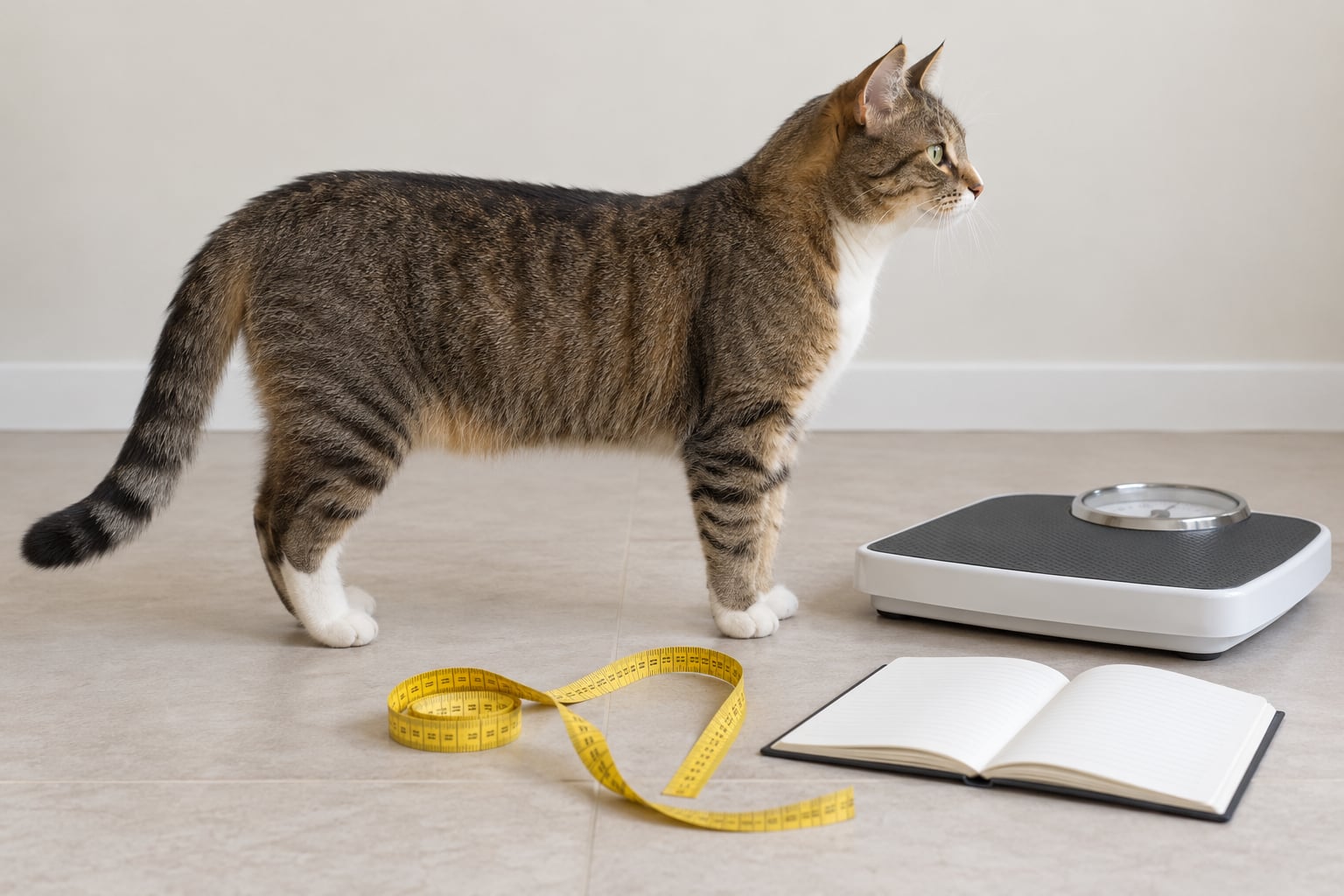
If you want to know how to tell if your cat is overweight, run a 60-second check: look down from directly above for a visible waist behind the ribs, look from the side for an abdomen that tucks up toward the hind legs, and run flat fingertips over the ribs to feel them as distinct ridges under a thin layer of fat. Those three things tell you far more than the kitchen scale does.
Here is the part that trips people up. Weight on its own means almost nothing. Two cats can both weigh 11 pounds and look completely different, because one is carrying muscle and the other is carrying fat. Owners working this out in cat forums hit the same wall repeatedly: the cat looks round, the vet writes down 4 out of 9, and nobody can explain the gap. Most of the time both are right, because they were looking at different things.
So this guide walks through a home assessment you can finish before dinner, then explains which results deserve a phone call to your vet. It is general information about body condition, not a diagnosis or a diet plan. Anything involving a medical cause needs a veterinarian.
Table of Contents
- 1What You Need
- 2Step-by-Step: How to Tell If Your Cat Is Overweight
- 3Step 1: Check Your Cat’s Weight Trend
- 4Step 2: Feel for the Ribs
- 5Step 3: Look at the Waist From Above
- 6Step 4: Check the Side Profile and Abdominal Tuck
- 7Step 5: Compare Against a Body Condition Score
- 8Step 6: Decide Whether to Contact a Veterinarian
- 9Common Mistakes When Checking Your Cat’s Weight
- 10Frequently Asked Questions
- 11Is a 20 lb cat considered obese?
- 12How do I tell if my cat is overweight or just big?
- 13At what age do cats start to get fat?
- 14How can I tell if my cat is at ideal weight?
- 15How do I slim down an overweight cat safely?
- 16Can a chubby cat still be healthy?
- 17Start With the Body Condition Check
What You Need
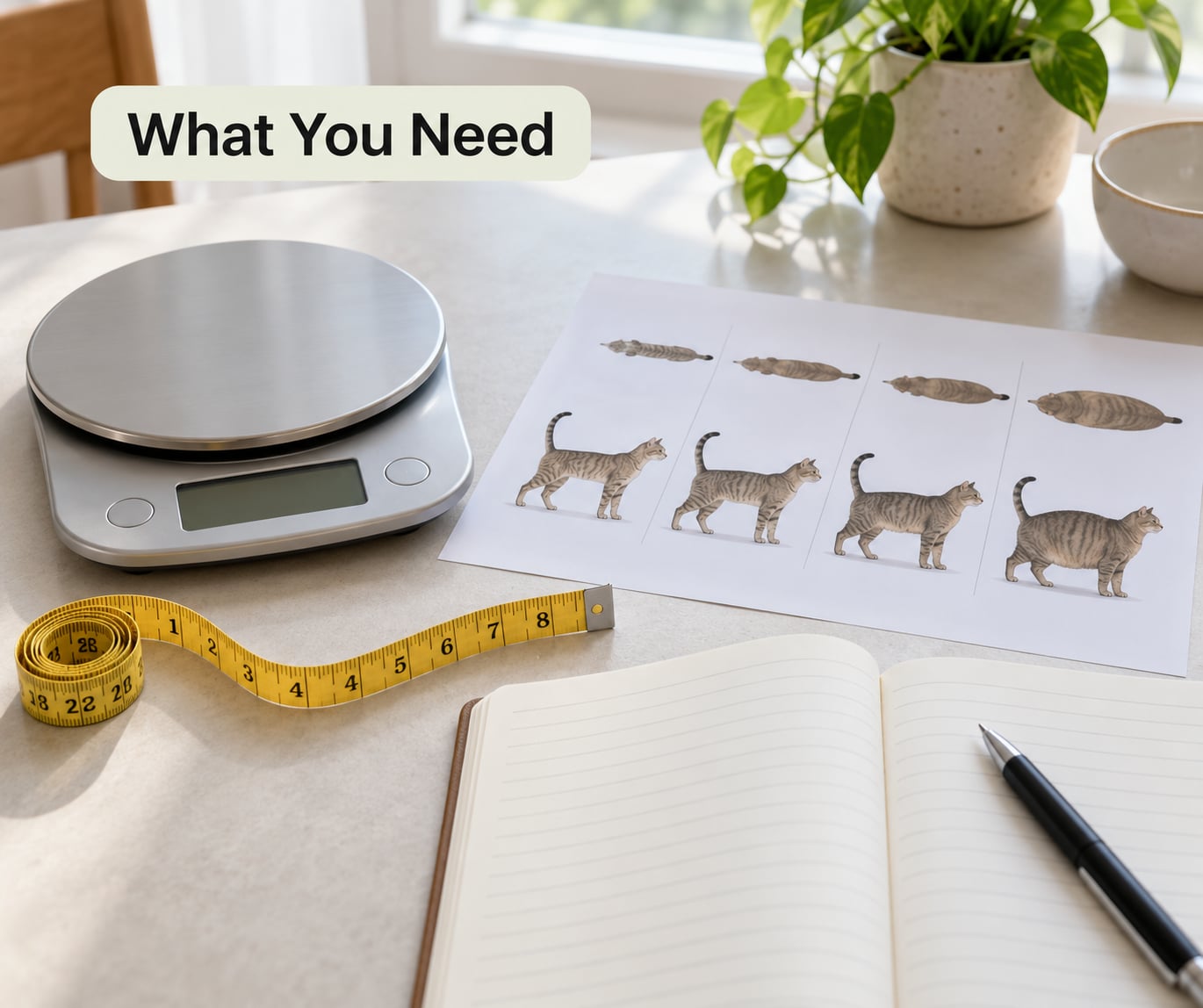
The whole check costs almost nothing and takes about a minute once you know what you are looking at. Gather these five things first.
A bathroom scale. For a cat under about 10 pounds it will round heavily, so a baby scale or a kitchen scale that reads to the nearest ounce is better. Weigh yourself holding the cat, then weigh yourself alone, and subtract. Doing it in the same spot at the same time of day makes the trend readable.
A flexible measuring tape. A soft tape around the chest just behind the front legs gives you a second number that changes slowly and quietly. It is a better early warning than weight, which can jump a pound in a week and mean nothing.
A body condition chart. A printed 1 to 9 score sheet, or a photo of the standard chart on your phone. Working from memory is how people talk themselves into a wrong answer.
A notebook or your phone. Write down the date, the weight and what you saw. Overweight creeps on in half-pound steps and nobody notices a half pound.
Access to a veterinarian. Not for the first check. For the confirmation, and for anything that changes suddenly.
Step-by-Step: How to Tell If Your Cat Is Overweight
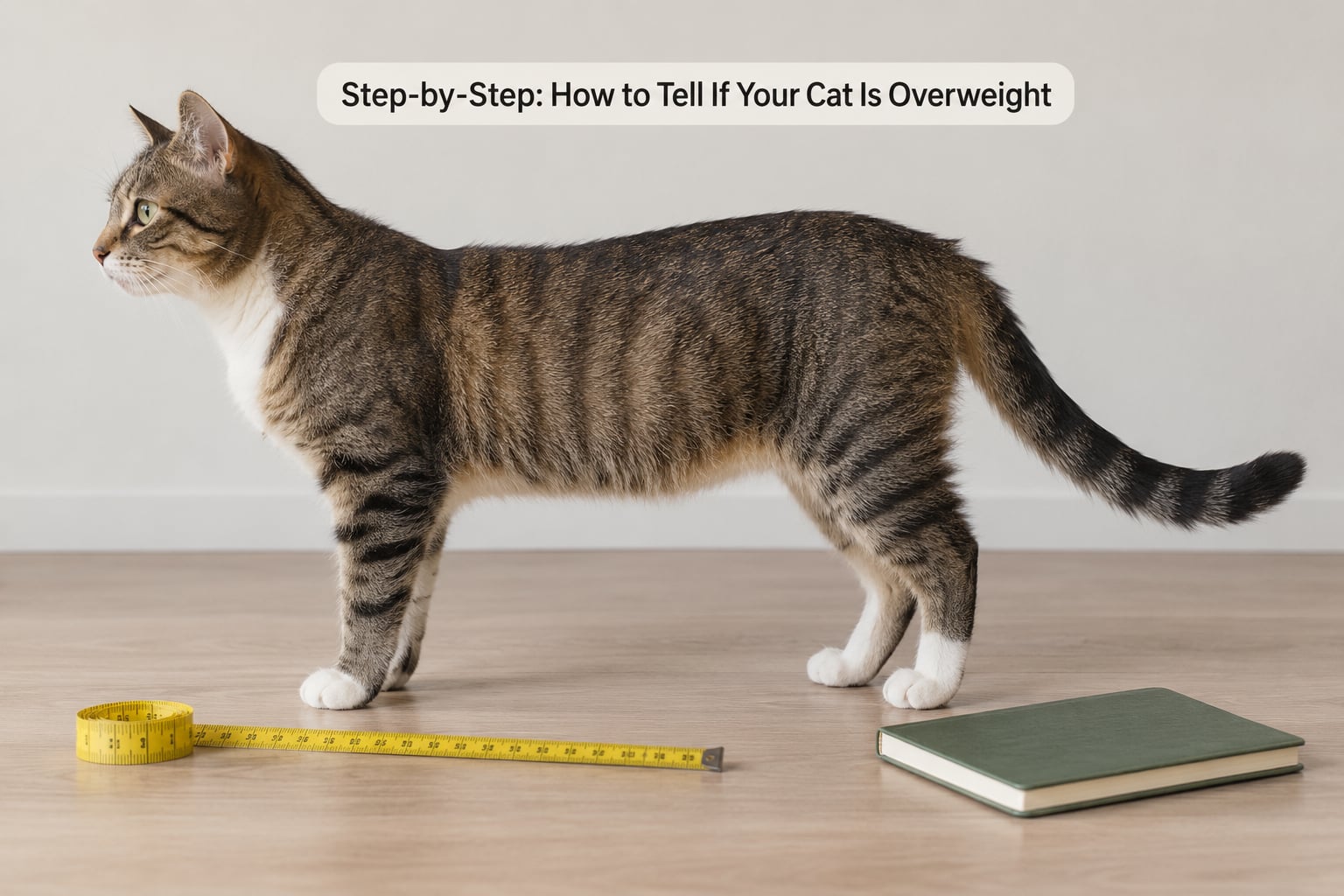
Work through these in order and in the same light each time. Coat and posture both distort the picture, so a consistent setup is doing real work for you here.
Step 1: Check Your Cat’s Weight Trend
Weigh the cat and write the number down with today’s date. Then find the previous number. One weigh-in tells you very little. Three readings a month apart tell you a direction.
Weight is useful for catching drift, not for judging fat. A young neutered cat can gain two pounds in a month of extra treats and land on a perfectly healthy score, while a cat with a naturally large frame can sit at the top of every weight chart for a breed and still be at 5 out of 9.
If you have no history at all, start one now and check again in three weeks. That single habit catches more problems than any breed chart ever will.
Step 2: Feel for the Ribs
Run your flat fingertips along the ribcage, not your thumb. Thumbs sink in and give you a falsely optimistic read. Light pressure over the ribs gives three possible answers.
- Ribs easy to feel, with a thin covering. You can feel each rib as a distinct ridge without pressing. This is the ideal read.
- Ribs covered by a thin layer of fat. You feel a smooth surface over the ribs and have to press a little to locate them. This is the overweight band, roughly 6 out of 9.
- Ribs cannot be felt at all. You find a soft, padded barrel where the ribs should be. This is obesity, 8 to 9 out of 9.
A thick winter coat will also stop you feeling ribs that are perfectly fine. Push the fur aside and feel skin and rib, not fur.
Step 3: Look at the Waist From Above
Stand over the cat while it is standing and look straight down. You are looking for a narrowing of the body just behind the ribcage, the hourglass shape. The ribs may flare slightly wider than the waist.
At ideal condition that indentation is visible from directly above. At 6 out of 9 the sides are straight lines from shoulder to hip with no narrowing. At 8 or 9 the sides bulge outward past the hips, which is the “apple shape” most owners can spot from across the room without knowing what it means.
Two things hide this. A long or dense coat rounds the outline entirely, and a cat standing with its back arched or legs splayed pulls the skin tight and fakes a waist. Let the cat settle and stand square.
Step 4: Check the Side Profile and Abdominal Tuck
Now crouch to the cat’s level and look along the line of the body from the side. At ideal condition the belly rises in a gentle tuck from the back of the ribs toward the hind legs. The deepest point of the tuck sits roughly level with or slightly above the elbow.
When the belly line flattens out and runs level with the spine, that is the clearest sign of excess fat. A belly that hangs below the line is further along still.
One exception matters here, and it causes a lot of false alarms. The primordial pouch is a normal flap of loose skin that every cat has. It hangs beneath the belly when the cat stands and sits, swings when the cat walks, and it is not fat. The difference is that a primordial pouch is loose and shiftable skin, while fat is firm and stays where it is when you press it. If you pinch it and it moves like an empty sleeve, that is anatomy, not weight.
A hard, distended belly that does not move when the cat walks is a different animal entirely. That can point to fluid, a gut problem or another medical cause, and it needs a veterinarian this week rather than a diet change.
Step 5: Compare Against a Body Condition Score
What you have been doing is body condition scoring, and it is the standard tool veterinarians use. The scale runs 1 to 9, where 4 to 5 out of 9 is ideal. The scores are grouped in pairs because the changes between numbers are subtle.
| Score | What you feel under your hands | What you see |
|---|---|---|
| 1-2 | Sharp bones, prominent shoulder blades and hip bones, no fat covering | Emaciated, tucked abdomen, ribs and spine obvious from across the room |
| 3 | Ribs palpable with no fat, very little muscle over the shoulders | Visible waist from above, obvious abdominal tuck, hips and shoulders bony |
| 4-5 | Ribs palpable under a thin covering, with a small layer of fat on the flank | Hourglass shape from above, gentle abdominal tuck from the side, a visible waist line |
| 6 | Ribs palpable under a moderate covering of fat, lumbar vertebrae just visible | Straight sides with no waist, abdomen level, fat deposits over the hips and flanks |
| 7 | Ribs difficult to feel, fat over the shoulder blades and flank, spine no longer visible | Rounded body, no waist from above, belly hangs slightly below the line |
| 8-9 | Ribs cannot be felt, fat pad over the whole trunk, heavy muscle deficit | Apple-shaped body, sides bulge past the hips, belly hangs well below the spine |
So how chubby is too chubby? A cat scoring 4 to 5 out of 9 is at ideal weight. A score of 6 to 7 counts as overweight, roughly 10 to 20 percent above ideal body weight. A score of 8 to 9 is obesity, which is more than 20 percent of body weight carried as fat. In plain terms: if you cannot feel the ribs at all and there is no waist from above, your cat is obese rather than merely chunky.
For reference, most adult cats land somewhere between 8 and 12 pounds, and larger breeds run noticeably heavier. These are broad ranges, not targets, because frame size varies so much.
| Cat type | Typical healthy adult range |
|---|---|
| Small breeds, most shorthair mixes | 8-11 lb |
| Average adult cats | 9-13 lb |
| Larger breeds such as the Savannah or large domestic shorthair | 12-18 lb |
| Maine Coon and other very large long-hairs | 12-22 lb |
| Flat-faced breeds such as the Persian | 7-12 lb, and coat makes them look heavier than they are |
| Kittens | Growing fast until about 12 months, judged on growth curve, not a number |
That brings up the question that comes up most often in searches and forums: is a 20 pound cat obese? A 20 pound Maine Coon at 5 out of 9 with visible ribs and a waist is not obese, it is a large cat in good condition. A 20 pound domestic shorthair at 8 out of 9 with no waist and no palpable ribs is obese. The number decides almost nothing. Body condition decides everything.
Step 6: Decide Whether to Contact a Veterinarian
A score of 4 to 5 with a steady weight means you can relax and keep doing monthly checks. A score of 6 to 7 with a slow upward trend is worth a booked appointment, mainly so the clinic can set a target weight you did not guess at yourself.
Some changes should not wait. Call your vet promptly if weight shifts quickly in either direction, if the cat stops eating for more than a day, if the belly is hard or swollen, if drinking and urination have changed, or if the cat is suddenly lethargic or breathing harder than usual. Gradual gain alongside extra food is a diet question. Sudden gain with no diet change is a medical question, and bloodwork comes before any diet plan.
Kittens and senior cats need adjusting for their age. A kitten is meant to look round and padded, so scoring against adult standards will mislead you. A senior cat loses muscle mass, which can leave a body that looks heavier than it is under the fur but is quietly wasting, and that combination needs a vet rather than a home judgement.
If the score is 6 or above and you do plan to act, keep any change slow. Cats that crash diet are at risk of hepatic lipidosis, or fatty liver disease, which is serious. Your vet can set a daily calorie target and a safe rate of loss rather than leaving you to guess.
Hidden calories are where most plans quietly fail. Treats should stay under about 10 percent of daily intake, and table scraps count.
| Extra item | Approximate calories | Share of a 200-calorie day |
|---|---|---|
| One medium cat treat | 1-2 kcal | 1 percent |
| A strip of cooked chicken skin | 40-50 kcal | 20-25 percent |
| One tablespoon of cheese | 30-35 kcal | 15-18 percent |
| Three semi-moist treats | 6-9 kcal | 3-5 percent |
| A tablespoon of wet food as a topper | 20-25 kcal | 10-13 percent |
Veterinary clinics report the same thing again and again: owners who measure treats and scraps see real progress, while owners who change nothing but the main food usually stall. The chunk of chicken is the diet.
Common Mistakes When Checking Your Cat’s Weight
Trusting the scale alone. This is the big one, and it is why the “is my 10 pound cat overweight” question is so common. A 10 pound cat can be ideal at 5 out of 9 or obese at 8 out of 9 depending on frame and muscle. Weigh, then look and feel.
Reading a thick coat as fat. Maine Coons, Persians, Ragdolls and long-haired mixes lose their waistline under the coat entirely. Push the fur aside and part it down the spine before you conclude anything.
Using another cat’s proportions as the standard. Frame size is genetic and varies widely inside every breed. Comparing your cat to a neighbour’s cat tells you about the neighbour’s cat.
Counting the primordial pouch as fat. Every cat has one. Loose shiftable skin that swings when the cat walks is normal anatomy, not weight gain.
Thumb-checking the ribs. Pressing with a thumb pushes into fat and makes an overweight cat feel lean. Use flat fingertips with light pressure.
Letting a vocal cat dictate the plan. Free-feeding and hunger-scheduled portions both produce drift, and meowing at the bowl reads as need when it is habit. Measured daily portions with the amount split into several small meals works better than one large serving, and a puzzle feeder stretches the meal without making it feel like a restriction.
Dropping portions suddenly. Fast weight loss on a cat carries a real risk of fatty liver disease. Any change should be gradual and ideally set with your vet.
Frequently Asked Questions
Is a 20 lb cat considered obese?
Not automatically. A 20 lb Maine Coon with ribs you can feel under a thin layer of fat and a visible waist is a large cat in ideal condition. A 20 lb domestic shorthair with no waist from above and ribs you cannot locate is obese. Weight alone cannot tell you, because frame size varies so much between cats. Score the body on the 1 to 9 scale instead, and confirm with your vet.
How do I tell if my cat is overweight or just big?
Check the shape, not the number. Look down from above: a visible narrowing behind the ribcage means a bigger cat at healthy weight. Look from the side for a gentle abdominal tuck that rises toward the hind legs. Feel the ribs with flat fingertips. Large cats carry visible ribs and a clear waist, and heavy cats do not. Two cats at the same weight can score three points apart on the body condition scale.
At what age do cats start to get fat?
Most often in the first two years after neutering, when energy needs drop sharply but eating habits stay the same. Neutered indoor cats are the group most prone to gradual gain, because nothing is burned off by outdoor activity. Senior cats can then lose muscle while keeping fat, so the body gets softer without the weight changing much. Get a target weight from your vet at that stage rather than guessing from the scale.
How can I tell if my cat is at ideal weight?
Run the three-part check. From above you should see a slight narrowing behind the ribs. From the side the belly should tuck upward toward the hind legs. Under flat fingertips the ribs should feel like distinct ridges with a thin covering. That combination usually scores 4 to 5 out of 9. Write your numbers down monthly so you can catch a half-pound drift before it becomes obvious.
How do I slim down an overweight cat safely?
Get a target weight from your vet first, then measure the daily food rather than eyeballing it. A common target for adult cats is around 200 calories a day, adjusted for size, and a prescription weight-loss diet can be useful. Keep treats under 10 percent of intake, add movement through wand toys and food stations, and weigh monthly. Loss should be gradual, because fast diets put cats at risk of fatty liver disease.
Can a chubby cat still be healthy?
A cat at 6 out of 9 carries more risk than a cat at 5, even if it seems fine today. Extra weight is linked with diabetes, arthritis, urinary disease, skin problems and shorter lifespan, and those problems tend to appear in middle age rather than immediately. A cat scoring 8 to 9 should be assessed by your vet rather than watched. Early, slow weight loss is far easier on the joints and the urinary tract than treating problems later.
Start With the Body Condition Check
Begin with the three things you can check without any equipment: a waist from above, a tuck from the side and ribs under flat fingertips. Those three answers give you a body condition score, and the score is worth more than any number on a scale or any breed weight chart.
Score 4 to 5 means keep doing what you are doing, monthly. Score 6 or above means a conversation with your vet about a target weight and a measured daily calorie target, plus an honest look at where the treats and scraps are going. Sudden change in either direction, a hard belly, or a cat who has stopped eating is a phone call the same week.
Never put a cat on a sudden restricted diet to fix a number you saw this week. Cats that lose weight quickly can develop fatty liver disease, and the safe route is a slow plan set with your vet.