To stop a dog from barking at the door, you do two things: teach a competing calm behavior like going to a mat, and desensitize your dog to the doorbell and knocking until the sound alone means nothing. That pairing, done with treats and short daily sessions, is what works. Most dogs need two to six weeks, and loud, highly vocal breeds take longer.
Door barking is not disobedience. Your dog hears footsteps in the hall or a car in the driveway and barks because the door opened last time and someone came in. Every bark that gets answered by a door opening makes the behavior stronger, so the fix is about what your dog learns before that door opens.
Below is the sequence I would follow. It runs from identifying the trigger through to calm greetings, and it assumes no equipment beyond treats and a few minutes a day.
Table of Contents
- 1What You Need
- 2Step-by-Step: How to Stop a Dog From Barking at the Door
- 3Identify What Triggers the Barking
- 4How to stop a dog from barking at the door without confusion
- 5Change the Door Routine
- 6Desensitize Your Dog to Visitors at the Door
- 7Reinforce Quiet Door Greetings
- 8Common Mistakes
- 9Quick Training Tips
- 10Frequently Asked Questions
- 11Do anti-bark collars or citronella collars work at the door?
- 12Why did my dog suddenly start barking at the door?
- 13How long does it take to train a dog not to bark at the door?
- 14How do I stop my dog barking at people passing the window?
- 15When should I call a vet about my dog’s barking?
- 16Conclusion: Start With the Doorbell Routine
What You Need
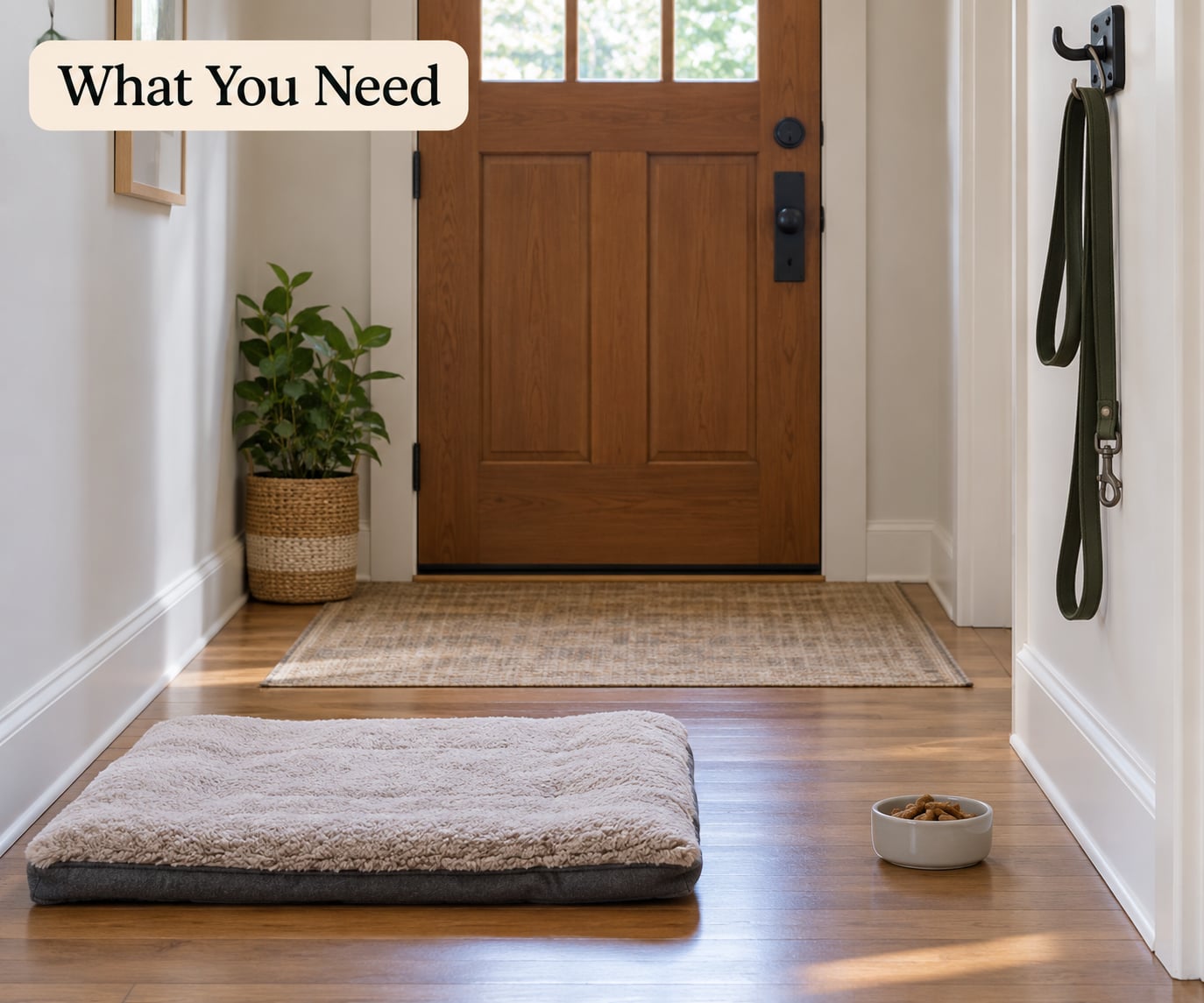
You do not need a special collar, a gadget, or a service of some kind. What you need is a few small training treats, a quiet place to work, and about five minutes at a time.
- Small training treats. Cut them into pea-sized pieces so a session stays short. If your dog is already over-aroused, a few pieces of something plain work better than rich treats, which can add to the excitement.
- A leash and a well-fitting harness. Not to drag the dog away from the door, but so you can guide them to the mat without a physical battle in the first session.
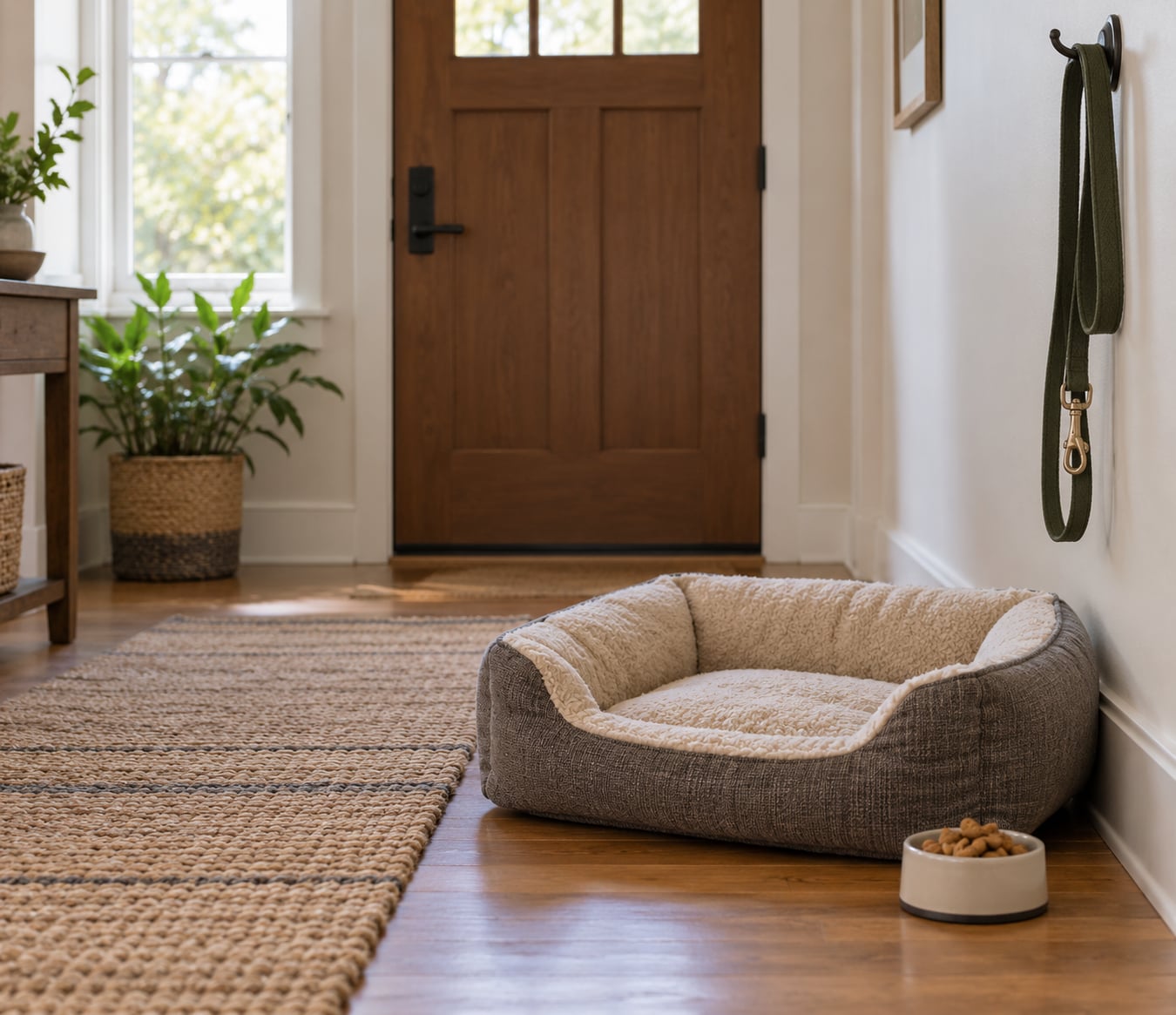
- A quiet entry area. A spot two or three steps back from the door, out of the dog’s line of sight of the door itself if possible. A mat, a bed, or a folded towel all work.
- A short written log. Note the date, who rang, and how long the barking lasted. Owners are usually surprised by what the log shows, and it is how you judge whether training is working.
- Your vet’s number. Especially if the barking started suddenly, comes with a pained posture, or comes with panting, pacing, or scratching at the door when you leave.
Treats do most of the work here, so keep them somewhere you can reach fast. A treat pouch on your waist beats a pocket, because fumbling for a treat bag while a dog barks teaches the wrong thing.
Step-by-Step: How to Stop a Dog From Barking at the Door
Identify What Triggers the Barking
Before training, work out which of these is happening, because the fix differs. Watch your dog’s posture in the first second after the sound. Alert barking is upright, head forward, ears up, and it stops the moment you acknowledge it. Territorial barking drops the body lower, leans toward the door, and keeps going. Excitement barking spins in circles, whines, and drops to the floor when you reach for the leash.
- Alert barking. The dog hears a sound outside and warns you. The goal is a quiet heads-up, not silence.
- Territorial barking. The dog treats the front door as a border. The goal is teaching that people coming in is neutral.
- Excitement barking. The dog wants to greet. The goal is a pause before access, not suppression.
- Frustration. The dog wants in or at the window and cannot reach it. The goal is removing the barrier in practice.
- Learned reinforcement. Barking gets your attention, a treat, or a conversation through the door. The goal is paying attention to quiet instead.
- Physical discomfort or hearing change. An older dog may bark at unfamiliar sounds because hearing has shifted. This one belongs with your vet, not a training session.
Write down the timing too. If the barking only happens when you are home, the trigger is more likely to be your own movement and reaction. If it happens every day regardless, the sound is doing the work.
How to stop a dog from barking at the door without confusion
The method has three moves: stop the dog from rehearsing barking, reward any pause with calm behavior, then make the situation harder in small steps. That last part is where most people rush, and rushing is what teaches a dog that barking still works.
Start by catching the moment your dog pauses. Even half a second of silence before the next bark is worth marking with a treat, out loud or with a clicker. Marking that pause is what teaches your dog that silence pays. Repeat it, and the pause gets longer because the payoff gets clearer.
Then keep the dog below what behaviorists call the threshold, meaning the point where the dog can still take a treat and still look at you. That is usually the line between alert barking and territorial barking. Work there first, and only step closer to the door once the dog can eat and respond normally.
Keep each session under five minutes and end on a calm rep. A good stop is a success, not a failure.
Change the Door Routine
Most door barking is created by the seconds between the sound and your response. Change those seconds. Before a visitor arrives, send your dog to the mat and give a treat for going. When the doorbell rings, reward whatever quiet behavior follows, usually just being on the mat, not performing a sit. Then let your dog know the visitor is not a person worth alerting you about.
A visual or audio signal helps: a clicker, a whistle, or the word “quiet” used once, calmly, the moment the dog stops. Repeating the cue over loud barking teaches nothing, because your dog cannot hear you and because the repetition turns into noise. Save the word for silence.
Two rules keep this working. Never grab the leash mid-bark and haul the dog away, since the removal of the dog from the door becomes the reward. And never open the door on a barking dog, even if the person is impatient.
For a few weeks, put a note on the door asking visitors to call or text rather than knock. It removes the trigger instead of fighting it, and most households underestimate how many ring events that deletes.
Desensitize Your Dog to Visitors at the Door
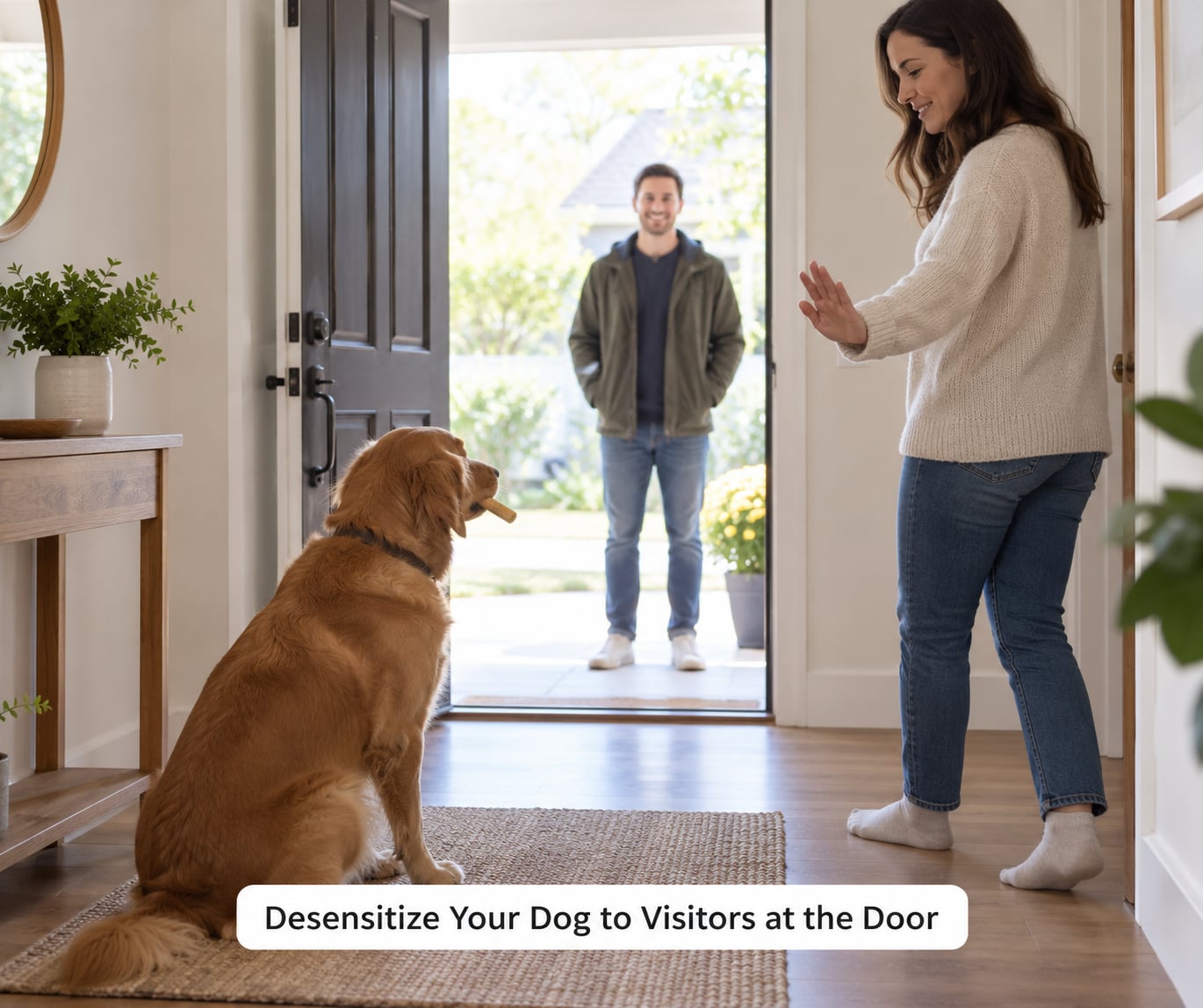
Desensitization means introducing the trigger at a level your dog can handle, rewarding calm, and raising that level only when calm holds. It is the least glamorous part of this and the part that changes results.
- Stand far from the door, with your dog on leash, and knock quietly on an interior wall. If your dog stays quiet and takes treats, mark and reward.
- Knock a little louder or closer. Stop the moment your dog’s ears go up but before barking begins. Reward the moment you get before the bark.
- Play the actual doorbell sound at low volume from several feet away, or have a helper ring your real doorbell and stand far back. Reward quiet each time.
- Move to the door itself, then open it a crack while your dog stays on the mat at the back of the room.
- Add a real person. Have a helper approach, stop at a distance your dog tolerates, reward quiet, and end the visit before your dog gets worked up.
If your dog barks at step three, back up two steps and stay there for several sessions. Training below threshold builds a habit; training above threshold just rehearses barking.
Reinforce Quiet Door Greetings
Once your dog can stay quiet with the door open, work on the greeting itself. Reward all four paws on the floor, then ask for a brief pause before you let the visitor in. A dog who sits for three seconds and then greets calmly is doing exactly what you asked.
Let your dog greet for a few seconds, then call them back to the mat and mark it. This is what keeps the door from turning into a free-for-all. It also stops the habit of the dog rushing the door and following the visitor’s scent around the house afterward.
If you are greeting someone who lives with you, wait at the door for the same pause. Consistency with family members is what separates training that holds from training that only holds around strangers.
Common Mistakes
Yelling at your dog. A bark answered with a shout reads as participation, not correction. Most dogs learn that human voices joining in means something interesting is happening, and the barking gets louder and longer.
Scolding or punishing after the fact. Arriving after the bark to scold teaches nothing about the door, because the connection is gone. It does teach you something about how barking makes you feel, which is usually worse than the barking.
Rewarding barking with attention. If your dog barks and you answer, even to say no calmly and briefly, the behavior got a response. Silence is the outcome you want, and it has to be real silence.
Vibration, citronella, or shock collars. These suppress barking at the cost of trust, and some dogs escalate to lunging or aggression when the trigger returns. PetMD and Dogs Trust both advise against them, and veterinary behaviorists see the fallout.
Sessions that run too long. Five boring minutes beat thirty exciting ones. Long sessions raise arousal, and a dog cannot learn in that state.
Using rich treats on a dog who is already frantic. High-value food adds energy to an over-aroused dog. Plain pieces or a chew placed in the quiet area work better.
Quick Training Tips
- Train daily in short reps. Sixty seconds once a day, most days, works better than a weekend session.
- Set the same rule for everyone in the house. One person letting the dog through the door undoes the whole week.
- Capture the wins. If the dog barks twice instead of twenty, write it down, because progress at the door is invisible day to day.
- Treat high-traffic doors separately. Delivery drivers, the neighbour’s dog, and the family homecoming are three different triggers and need three short progressions.
- Advance only after calm reps. Three calm repetitions in a row is a fair signal to raise difficulty by one small step.
- Use a gate, a pen, or another room when you cannot manage the moment. Management is not failure while you are building the behavior.
One habit is worth isolating: send the dog to the mat before you touch the door, not after the bell. Owners who try to hold a sit through the whole doorbell sequence usually see the sit fall apart, because a dog that is already wound up cannot hold a position and keep thinking at the same time. A mat a few feet back gives the dog something physical to do, which is what carries it through the first few seconds of a visitor arriving.
Frequently Asked Questions
Do anti-bark collars or citronella collars work at the door?
They can suppress barking in the moment, but most trainers and veterinary behaviorists advise against them. The collar stops the sound without changing the reason for it, so the dog often returns to barking and may add lunging or fear. Some dogs learn to bark quietly and keep the tension, which is harder to notice and easier to miss. Treat training takes a few weeks; the collar appears to work today and quietly damages trust tomorrow.
Why did my dog suddenly start barking at the door?
A sudden change in barking usually deserves a vet call rather than a training plan. Pain, a decline in hearing or vision, cognitive changes in older dogs, and anxiety can all change how a dog responds to sounds at the door. If the barking arrived alongside a new posture, panting, scratching at the door, or restlessness when you leave, book an appointment. Training a dog through a physical problem wastes weeks and delays finding the actual cause.
How long does it take to train a dog not to bark at the door?
Most owners report two to six weeks of short daily sessions, with loud or highly vocal breeds such as Beagles, Shelties, and Chihuahuas taking longer. The signal that it is working is not silence on day one but fewer barks per event and a faster return to the mat. Keep a one-line log of date, cause, and bark count so you can see the trend instead of judging a bad afternoon as a failure.
How do I stop my dog barking at people passing the window?
Move the trigger out of sight first. Sit on the floor where the dog can still take treats, let people walk past outside, and reward calm while they pass, raising the difficulty only when your dog can eat and look at you. Privacy film or a raised bed blocks the view without blocking light. If the barking follows every passer-by rather than specific visitors, treat window barking as its own exercise and leave the door work for later.
When should I call a vet about my dog’s barking?
Call when the barking is new, sudden, or paired with anything physical: a hunched posture, panting, licking at a paw, scratching the door, or a dog who seems to startle at ordinary sounds. Also call if barking happens when you are away, if it comes with destructiveness or escape attempts, or if it escalates to lunging at people. A general practitioner can rule out pain and hearing change, and can refer you to a veterinary behaviorist if training alone is not enough.
Conclusion: Start With the Doorbell Routine
Start with one change tomorrow: the moment before anyone can reach the door, send your dog to a mat a few feet back and pay them for going. That single routine, repeated daily for a few weeks, does more than any correction you could apply afterwards.
Then work through the trigger list, the desensitization steps, and the quiet cue, and expect a couple of bad evenings along the way. Barking that has been reinforced for years rarely disappears in a weekend. If it started suddenly, comes with pain, or turns into lunging or escape attempts, stop and speak with your vet or a certified trainer, because that is a different problem than a training one.