Most dogs settle down fine once they learn that alone time ends and you come back. The way to get there is boring and repetitive: set up a safe spot, build one fixed departure routine, leave for a couple of minutes while the dog is calm, and return before any distress starts. Repeat until minutes feel easy, then add ten seconds at a time. That’s the whole method, and it takes weeks rather than days.
Understanding how to leave a dog home alone without anxiety matters because roughly a fifth of dogs develop clinically significant separation anxiety, and untreated distress is a leading reason dogs get surrendered. Updated for 2026, this guide covers the setup, the training ladder, and the point where home work stops being enough.
Two things to get straight before you start. First, an eight-hour workday is the goal you are training toward, not the starting line, and a dog who panics at the door cannot be asked to skip ahead. Second, timing is the whole exercise: leave while the dog is relaxed, never while he’s already pacing, because a session that ends in screaming teaches him that screaming is what gets you back.
Table of Contents
- 1What You Need
- 2Step-by-Step
- 3Set up a safe home base before the first departure
- 4Use a consistent departure routine
- 5Start with very short absences
- 6Increase the time gradually
- 7Add safe mental enrichment
- 8Prepare for unavoidable long absences
- 9Common mistakes
- 10When to get veterinary help
- 11Frequently Asked Questions
- 12How long can a dog be left alone at a time?
- 13Is it okay to leave my dog alone for 8 hours?
- 14Should you crate train a dog with separation anxiety?
- 15What is the 3-3-3 rule for dogs with anxiety?
- 16Why does my puppy cry when left alone?
- 17Is it okay to leave my dog home alone for 3 days?
- 18Conclusion
What You Need
You need four things ready before the first departure, and none of them are expensive. Without them the training fails for reasons that have nothing to do with the dog.
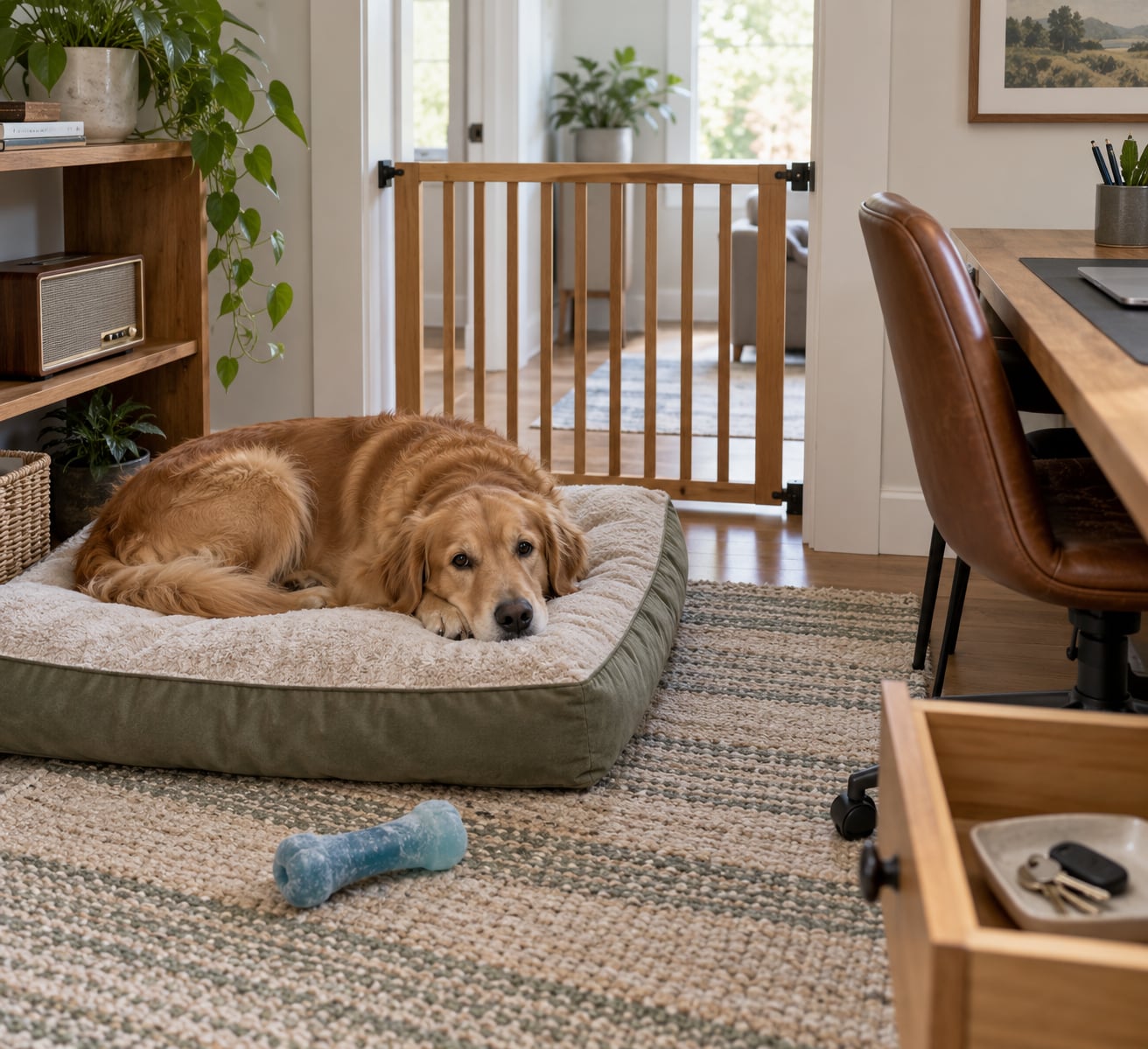
- A safe, contained space. A room with a baby gate or stair gate across the door works better than most people expect. For crates, see the warning in the steps below.
- Water within reach and a toilet plan that fits your dog’s age. A puppy under six months cannot hold it for a whole work shift.
- Something to do with their mouth and nose. A frozen Kong or a lick mat, a treat puzzle, a long-lasting chew, or a worn T-shirt of yours. Sniffing and licking occupy the part of the brain that noise and barking would otherwise occupy.
- A fixed routine and about two weeks of not needing your dog to be anywhere. If you work from home, this is the hard part.
- A vet’s number and a fallback plan. A dog walker, sitter, or daycare for the days the training stalls and you still have to go to work.
Step-by-Step
Set up a safe home base before the first departure
Pick one room and make it boring, comfortable and safe. Remove anything chewable at dog height: shoes, cables, bin bags, the mail, remote controls. Secure the windows and the bin, and check that the gate latch is one the dog can’t nose open.
Put the bed down in a corner away from the door, where the dog can see the doorway but isn’t staring at it. That sightline matters, and a den-like space is calmer than sitting in the middle of a room with the exit in view.
One warning that gets buried in most advice online: do not crate a dog that already has separation anxiety. Confining an anxious dog removes its ability to distance itself from the door, which usually escalates barking, panting and door scratching rather than settling it. A gated room gives the same containment with more room and less panic. Crates are fine for a puppy being house-trained as an occasional toilet tool, not as a cure for distress.
Use a consistent departure routine
Your dog has learned that keys, the coat rack and the sound of the front door mean you are about to disappear. Fight that association by rearranging your own habits: keys live in a drawer, coats go on before you pick them up, shoes are put on at the front step rather than by the door.
Then make the exit itself identical every time. Bathroom break, a calm word, a food delivery, and you walk out without looking back. No lingering, no long goodbye, no apologetic tone. Owners on training forums report that a consistent sequence matters more than any gadget they have bought.
Keep it the same whether you’re leaving for ten minutes or eight hours, because a variable schedule is the thing a dog cannot predict and therefore cannot relax about.
Start with very short absences
Begin inside the house: go into the bathroom, close the door, and come straight back. Once that’s easy, step into another room. Next, stand outside the door for ten seconds and return while the dog is still eating or resting.
Walk out the front door for one minute, then two, then five. The number that matters most is the one that ends before distress appears. If the dog is still tail-wagging and munching when you slip back inside, the session worked, and you go again tomorrow.
When you return, stay boring for the first ten to fifteen minutes. No excited grabbing, no checking whether the sofa is intact, no long cuddle session. Some owners say the post-departure reunion is the part their dog actually finds hardest, because it re-ignites everything you just taught.
Increase the time gradually
Progress by the dog’s behaviour, not the calendar. A good ladder looks like this: 5 minutes, 15 minutes, 30 minutes, 1 hour, 2 hours, half a day, then a full workday. Each rung usually needs two or three successful sessions before you move up.
Going back a rung is not failure. It happens with almost every dog, and the step down is where you rebuild.
Here is a realistic range for a settled adult dog once training has worked. Treat these as ceilings for a dog who’s already comfortable, not targets for week one.
| Life stage | Typical max alone time | Watch for |
|---|---|---|
| Puppy, 8-16 weeks | 2-3 hours, with a toilet break mid-way | Explosive crying, house-soiling as it happens |
| Puppy, 3-6 months | 3-4 hours | Crying that escalates for the first hour |
| Adolescent, 6-12 months | 4-5 hours | Regression after a calm spell; destructiveness at the door |
| Trained adult | 6-8 hours, with a midday walk if possible | Barking that draws neighbour complaints |
| Rescue or rehomed, first weeks | 2-6 weeks of very short sessions before normal hours | Startling at ordinary household noise |
| Senior | 4-6 hours, often less | Reduced bladder control, confusion at dusk |
Welfare bodies commonly cap any single absence at around four hours, which is a sensible default for a dog that isn’t fully trained. Long weekends and overnight trips are a different category and a different risk.
Add safe mental enrichment
Enrichment works because it burns the same mental energy barking would. The most repeated tactic in owner forums is a Kong or similar hollow toy filled with peanut butter, yoghurt or wet food and frozen solid, which lasts far longer than a smear on a bowl.
A treat puzzle is better for a dog who eats quickly and chews everything else. A lick mat stuck at eye level does the same job for dogs who are good at licking but bad at puzzles. For a chewer who is safe with chews, a long-lasting chew is genuinely useful; for a dog that inhales things, skip it and use food instead.
Background sound helps some dogs and none of them learn anything from it. A radio or white noise machine on low, tuned to a talk station, softens the silence and the street noise that sets some dogs off. A worn T-shirt of yours left in the room does something a toy cannot: it carries your scent, which is calming in a way that is measurable in the settling, not in the distraction.
Prepare for unavoidable long absences
Some gaps can’t be trained through. A three-day trip, a wedding weekend, an illness. For anything past about 12 hours, a sitter who stays in your home or a trusted person who visits several times a day beats a kennel for a nervous dog, and a neighbour popping in twice is not enough company on its own.
Daycare is the other option, and for some dogs the noise and crowd actually settles them. A midday walker is the cheapest fix for an eight-hour workday and often solves barking at the same time, since a dog that has walked at midday sleeps through the afternoon.
Leaving a dog alone for two or three days is where things go wrong. Either arrange daily human care, or make sure you’re leaving a dog who is genuinely comfortable alone, with a large safe space, a slow-release food arrangement your vet has approved, and a way to check on them.
Common mistakes
- Crating an already-anxious dog. The single most common harmful piece of advice floating around, and the reason some dogs end up with chewed doors.
- Leaving longer than the dog can handle. A bad eight-hour attempt on day three erases a fortnight of good sessions.
- A heartfelt goodbye. Long, emotional exits confirm that this moment is genuinely bad news. Leave quietly.
- Punishing the noise on return. Shouting at barking, or arriving in a stern mood, adds stress to a dog that is already distressed. Owners consistently report that a low-key reconnection works better.
- Feeding a big meal right before you go. A heavy meal plus jitters can mean vomiting as well as barking. Feed earlier, deliver a puzzle as you leave.
- Expecting the dog to entertain itself. Most dogs sleep well and cope badly. Boredom and distress look different, and only one of them is fixed by a bone.
- Skipping to a full workday because the week has been good. One great day is a good day, not proof the next eight hours will be fine.
When to get veterinary help
Call a vet or a certified behaviourist, rather than continuing to train, if the distress is severe, sudden, or not improving after three to four weeks of consistent work. Sudden onset in an adult dog that was fine for years is a medical question first, not a training one.
Urgent warning signs include self-injury, broken teeth or gums from biting at the door frame, heavy panting that doesn’t settle, salivation, destructive behaviour that risks injury, and house-soiling in a previously clean dog. In senior dogs, new confusion, night-time restlessness, bladder changes or reluctance to be touched can signal pain, a urinary infection, gut upset or cognitive decline, and every one of those looks like anxiety until a vet says otherwise.
A veterinary behaviourist or a reward-based trainer is the right call when home training stalls. Some dogs genuinely need medication alongside behaviour work, and your vet can discuss that. Never give a dog human medication; a small number of human drugs are toxic to dogs and none should be used without veterinary instruction.
Frequently Asked Questions
How long can a dog be left alone at a time?
A trained adult dog can usually manage six to eight hours, but only after weeks of gradual desensitization. Puppies need far less: two to three hours at 8-16 weeks, rising to four or five hours by their first birthday. Welfare guidance generally caps any single absence at about four hours for a dog who is not fully trained. Treat the adult number as a ceiling reached by working up to it, never as a starting point.
Is it okay to leave my dog alone for 8 hours?
Only if your dog is already relaxed after a full working morning alone, which most dogs are not on day one. If a six-hour absence is easy, eight is usually manageable with a midday walker. If your dog is destructive, vocal or house-soiling at four hours, an eight-hour day needs a walker, sitter or daycare rather than more training hours.
Should you crate train a dog with separation anxiety?
No. Crating a dog that already has separation anxiety makes it worse, because the dog cannot move away from the door and the distress escalates with nowhere to go. A gated room with water, a bed and something to lick offers the same containment without the panic. Crates are useful for a puppy being house-trained as a toilet tool, which is a different job entirely.
What is the 3-3-3 rule for dogs with anxiety?
The 3-3-3 rule is a rough adjustment guide for a newly adopted or rehomed dog: roughly three days to decompress from the move, three weeks to settle into the new routine, and three months to feel properly at home. Owners on training forums commonly report two to six weeks before a rescue dog tolerates being alone at all, so use your dog’s behaviour, not the calendar, to decide when to start.
Why does my puppy cry when left alone?
Most puppies are not anxious, they are young and badly out of their depth. Crying that escalates for the first hour or two and then stops is usually normal adjustment, and it improves fastest with very short successful absences, plenty of chew and toilet breaks that match their age. Persistent crying that continues for hours, alongside pacing or self-injury, is worth a vet conversation.
Is it okay to leave my dog home alone for 3 days?
Not without a plan. Anything past about 12 hours needs a sitter staying in your home, a trusted person visiting several times a day, or boarding your dog somewhere it already trusts. A dog that is comfortable alone will manage with food and water set up properly, but a dog with separation anxiety, a puppy, or a senior with bladder issues should never be left that long unattended.
Conclusion
Start tonight: pick one room, gate it, remove the hazards, put the bed in the corner, and freeze a Kong. Tomorrow morning, run the same routine and leave for two minutes, then come back in while he’s still calm. Do that every day until it feels boring, and add ten seconds at a time. That slow, unglamorous ladder is how you leave a dog home alone without anxiety, and it’s the difference between a dog who works and a dog you feel guilty about leaving.