A vehicle history report is a database summary tied to a vehicle’s 17-character VIN that collects reported events: title and registration changes, accident and damage entries, odometer readings, ownership transfers, service records, inspections, auctions and recalls. Knowing how to read a vehicle history report takes about 20 minutes with a VIN and a phone, and it is the fastest way to catch a branded title, a mileage rollback or unrepaired crash damage before you hand over money.
The order you read it in matters. Most people scroll to the accident section first, which is exactly backwards, because a branded title or a rolled-back odometer should end the conversation before cosmetics ever enter it.
What follows is the order I would use myself: match the VIN, read the title, read the owners, then the damage, then the mileage, then everything else.
Table of Contents
- 1What You Need
- 2The 17-character vehicle identification number
- 3A report source, plus free cross-checks
- 4Seller or dealer paperwork
- 5A pre-purchase inspection
- 6Step-by-Step: How to Read a Vehicle History Report
- 71. Confirm the Report Matches the Vehicle You Are Buying
- 82. Start With the Title and Ownership History
- 93. Review Accident and Damage Records
- 104. Check the Mileage and Service History
- 115. Look for Other Event Types in the Report
- 126. Compare Findings With the Car in Person
- 13Common Mistakes
- 14Frequently Asked Questions
- 15What is a red flag on a CARFAX report?
- 16Can a CARFAX report be wrong?
- 17Is a clean CARFAX report enough to buy a car?
- 18What does damage reported mean on a vehicle history report?
- 19Should I run CARFAX and AutoCheck, or is one enough?
- 20How do I find my VIN number and run a report myself?
- 21Bottom Line
What You Need
Four things. That is genuinely it, and none of them require you to be a mechanic.
The 17-character vehicle identification number
The VIN is the key to every report, and you should read it off the car rather than trust the listing. Look on the driver’s side of the dashboard through the windshield, on the plate riveted to the door jamb, on your registration, and on the title itself. Check at least two of those locations and make sure all 17 characters match. Listing photos get reused and swapped more often than buyers expect.
A report source, plus free cross-checks
CARFAX and AutoCheck are the two names you will hear most, and Bumper is a third option that shows up in dealer ads. Run one paid report, then confirm what it says with two free lookups: the NHTSA VIN Decoder for build data and safety recalls, and NICB VINCheck, which tells you whether the VIN has ever been declared stolen or salvage.
Seller or dealer paperwork
Ask for the records that explain the report before you ask for an explanation of the report: repair orders, body-shop invoices, alignment printouts, service receipts, emissions results, and the previous title or bill of sale. A dealer usually has these ready. A private seller often has nothing, and that absence is itself information.
A pre-purchase inspection
Book an independent mechanic, not the one the seller recommends. Mechanics say a printed report makes the inspection faster because it turns a general look-over into a targeted one. Budget the inspection before you start shopping, not after you fall in love with a car.
Step-by-Step: How to Read a Vehicle History Report
Read the timeline from the most recent event backwards, and work through these six checks in order. If step one fails, nothing after it matters.
1. Confirm the Report Matches the Vehicle You Are Buying
Compare the report’s VIN against the plate on the door jamb, character by character. Then check that the year, make, model, trim, engine and mileage on the report line up with the car in front of you and with the seller’s paperwork.
Common mismatches are subtle: a different trim level, an LSE badge on a car that does not have one, a model year that sits between two production years. Mismatches usually mean the report belongs to a similar-looking car, and anything after this point is unreadable.
2. Start With the Title and Ownership History
The title is the single most important section, because a brand follows the vehicle for the rest of its life. A clean title means no branding has ever been applied. Anything else needs a conversation.
The terms you will meet:
- Salvage declared by an insurer, meaning the vehicle was damaged beyond the point of economical repair.
- Rebuilt or reconstructed declared after that damage was repaired. Terminology varies by state, so “reconstructed” in one state may be “rebuilt” in another.
- Flood declared after water damage, which is worth taking seriously because electronics and corrosion problems often appear long after the flood recedes.
- Junk or dismantled for a vehicle whose parts were harvested, not repaired.
- Lemon for a vehicle that met a state’s lemon law buyback threshold. A car that already qualified is unlikely to please you.
- Hail for cosmetic storm damage.
Then read the ownership timeline. A steady list of owners who each kept the car for years is reassuring. Three owners in eighteen months is a rental or fleet car wearing an owner’s clothes. A cluster of state-to-state moves in a short window often means a car chasing registration costs or weather, not a family.
Note the pattern, not just the number. Buyers debate endlessly over how many previous owners is too many, and the count matters far less than whether each owner kept it long enough for the records to exist.
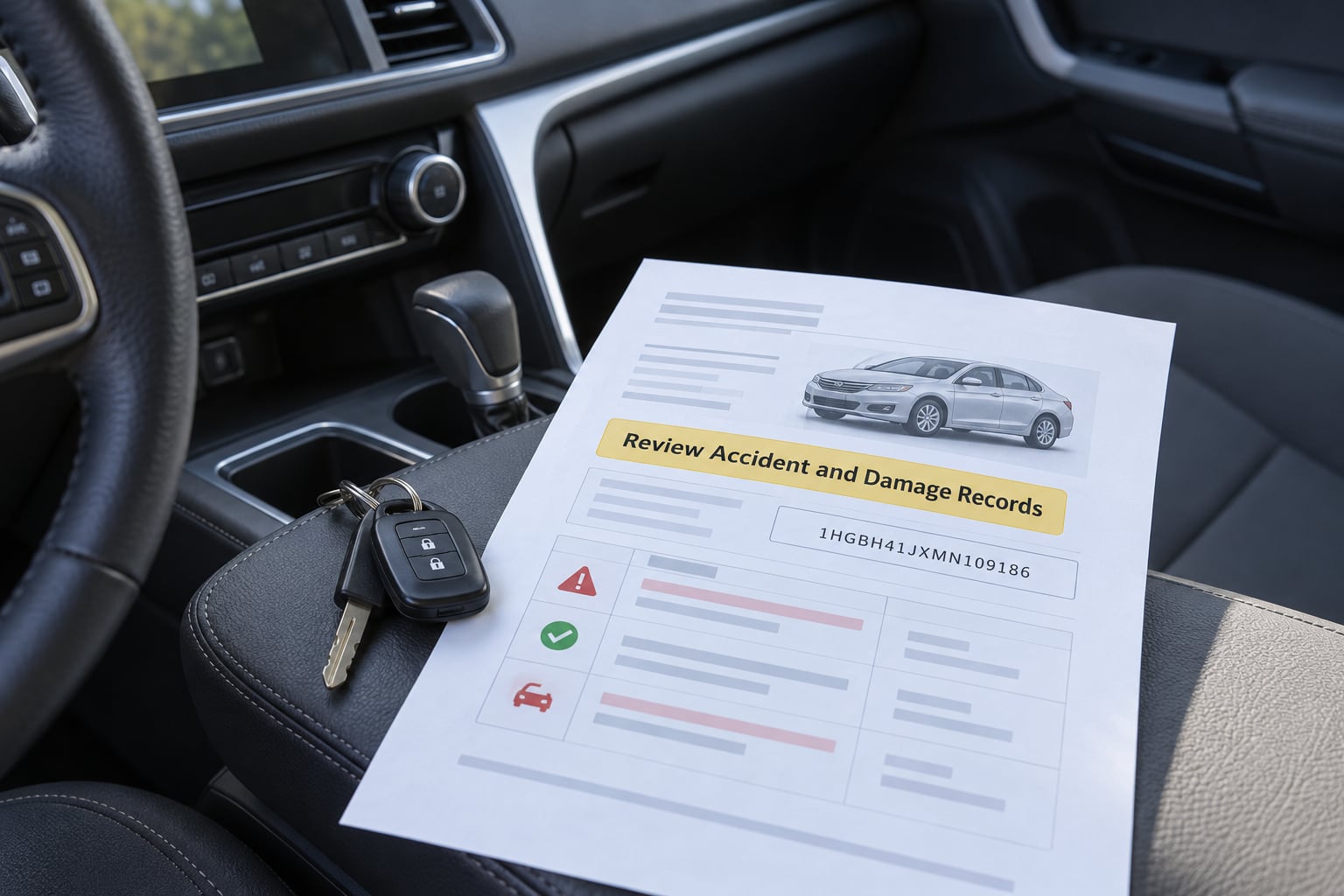
3. Review Accident and Damage Records
This is the section everyone reads first, and the wording is what people misread most. “Damage reported” and “accident reported” are not synonyms, and they usually arrive from different sources.
A “damage reported” entry typically traces back to a repair facility or body shop that supplied a repair order or estimate, sometimes years after the work was done. An “accident reported” entry most often traces back to an insurer or a state agency record. The first is frequently cosmetic. The second carries more weight, and some entries describe towing, disabling damage, underbody or frame damage, structural damage, and airbag deployment.
Airbag deployment is the one I never hand-wave. It means the crash was serious enough to trigger restraint deployment, and repair shops say seat, steering wheel and curtain airbag replacement is expensive work. Frame or structural damage on a unibody vehicle is the other serious one, because alignment problems and cracked mounts can follow a car for years.
Here is the part that catches new buyers: a clean damage section does not mean a mechanically sound car. Reports only contain what someone reported. Unreported bumps, a botched repair, a bent subframe from a driveway or a shop that never filed paperwork simply will not appear. Treat the damage section as a filter, never as a condition report.
4. Check the Mileage and Service History
Odometer readings appear as dated points, not a continuous line, so the pattern is what matters. Read them in date order. If a later reading sits lower than an earlier one, you are looking at a rollback, and that finding ends the purchase unless the seller produces a court order, auction record or insurer statement that explains it.
Two phrases cause endless confusion. “Odometer reading reported” means a mileage figure supplied by someone at a service visit, an inspection, a repair or a title transfer, and it is only as accurate as that source. “Actual mileage” is a current reading captured by a party with access to the vehicle, such as a DMV or an inspection station. When the two disagree, the older “reported” figure is the one to question.
Most reports also estimate miles driven per year from the first and last readings. A ten-year-old car with 40,000 miles estimates 4,000 a year, which fits a suburban second car. The same age with 140,000 estimates 14,000 a year, which fits a truck that worked for a living. Either is fine, but know which kind of car you are shopping for.
Service history is usually the thinnest section, because most independent shops never report to any database. Long stretches of nothing between oil changes are common and not suspicious. Gaps around the mileage of a reported crash are worth a question, and a run of failed or cancelled emissions inspections deserves a mechanical look.
5. Look for Other Event Types in the Report
Once you have read title, owners, damage and mileage, work through everything else. Each of these changes the picture in a different way.
- Auction records. A car that went to insurance or dealer auction has a reason, usually total loss or flood damage. That reason may predate the branding you can see.
- Rental, fleet, police or taxi use. Heavy highway miles, regular oil changes at odd intervals and worn steering wheels and pedal pads.
- Manufacturer service campaigns and open recalls. Recalls are listed, and the NHTSA VIN Decoder returns them free. Verify the VIN before assuming a campaign was completed.
- Emissions and safety inspections. A pattern of failures often points to an exhaust or engine problem the seller has not mentioned.
- Registration events. Expired registration, duplicate titles, out-of-state transfers and reinstated registrations all suggest a complicated past.
- Theft recovery. A recovered theft usually comes with substantial damage, so look for damage entries near the same date.
- Manufacturer buyback or lemon law repurchase. A repurchased vehicle is one the manufacturer already paid to take back once.
6. Compare Findings With the Car in Person
The report is a set of records. The car is the thing you are buying. Comparing the two is where good decisions happen.
On the walk-around, match what the report claims against what you can see. For a reported rear-end collision, look at bumper cover fit, paint depth differences in adjacent panels, panel gaps, and bolts with paint worn around the head. For frame damage, look under the car at the subframe, control arm mounts and any fresh weld or grinding. For airbag deployment, look at the steering wheel rim, the driver seat bolster and the headliner seams, and ask for the invoice that replaced them.
Then take the test drive with a purpose. A car that was repaired badly often shows up as a pull to one side, a vibration above a certain speed, a brake pedal that travels too far, or steering that wanders slightly. Any of those after a documented crash is a mechanic question, not a negotiation item.
Give the printed report to your inspector before the inspection. It turns a general safety check into a targeted one, which is why shops say a report in hand shortens the visit. Run a second report as well, because the two providers source different data. Buyers on r/cars and r/whatcarshouldIbuy repeatedly recommend running both for exactly that reason, and one often catches what the other misses.
Finally, convert findings into questions rather than accusations. “The report shows a 2019 accident with airbag deployment and an alignment printout from the following spring. Can I see the repair invoice and the post-repair alignment?” is a much better message than a guess about what happened.
Common Mistakes
Almost every mistake I see comes from treating the report as a verdict instead of a set of records. Here are the five that cost buyers money, with the fix for each.
Treating a clean report as a clean car. A report contains only what was reported, and plenty of damage is never reported. Fix: pair every report with an independent pre-purchase inspection, and treat the report as a reason to look harder, not as a reason to relax.
Reading an empty section as a clean history. Few independent shops report service, many crashes go unreported, and reporting lags run weeks behind. An empty section is unknown, not spotless.
Skipping the VIN match. A report on a different car tells you nothing about the car in front of you. Match all 17 characters against the door jamb before you read a single line.
Reacting to the word “accident” without reading the entry. Repair orders get pulled into reports as text, and a low-speed parking lot bump can sit on the page for a decade looking alarming. Read what triggered the entry, check whether airbags deployed or the frame was involved, and ask for the paperwork.
Buying before the inspection. A pre-purchase inspection runs a few hundred dollars in most markets and can save the entire cost of a bad car. If a seller resists an inspection, that reaction is the finding.
Here is the quick reference for the entries that should make you stop and ask questions.
| Entry on the report | What it usually means | What to do next |
|---|---|---|
| Salvage, rebuilt or reconstructed title | The vehicle was declared a total loss and later repaired, or repaired to legal standards after a declared loss | Expect a lower value, check financing and insurance approval, and have a mechanic inspect it before any deposit |
| Flood title | Water damage reached the vehicle; electronics and corrosion can fail much later | Skip it, or insist on a documented mechanical and electrical inspection first |
| Odometer reading lower than an earlier entry | A mileage rollback | Ask for court, auction or insurer records; walk away if the explanation is vague |
| Accident reported with airbag or structural damage | A serious crash recorded by an insurer or state agency | Request the repair invoice, check panel alignment and subframe mounts, and require an independent inspection |
| Auction record or short ownership cycles | The car was likely a total loss, rental or fleet vehicle | Ask why it was sold, and treat high-mileage wear as expected rather than surprising |
One more situation deserves its own paragraph, because it is the one buyers ask about most: what if the entry is just wrong? Reports do get things wrong, since repair facilities and insurers file what they file, and airbag counts in particular get duplicated across states. Ask the provider for a correction with your documentation attached, in writing, and keep a copy of everything you send. The practical evidence that moves a dispute is a dated repair invoice, a body-shop estimate, an insurer claim number, a police report or a court order, plus photos of the repaired area. Keep the originals, since copies of invoices are rarely enough on their own. If a damage entry truly is overstated and the car is otherwise sound, the correction usually takes a few weeks. Get the process started before you close, not after.
Frequently Asked Questions
What is a red flag on a CARFAX report?
The serious red flags are a branded title such as salvage, rebuilt or flood, and an odometer reading that is lower than an earlier dated entry. Next in line: an accident entry naming airbag deployment, structural or frame damage, or disabling damage, plus any auction record or a burst of short-term owners. Minor paint damage without airbag or frame involvement is worth a question, not an automatic walk-away.
Can a CARFAX report be wrong?
Yes, and it happens for ordinary reasons. Repair orders and body-shop notes get filed as text, so a small cosmetic repair can read like a serious collision, and airbag deployment counts are sometimes duplicated across states. Odometer figures copied from a service visit reflect whatever the writer wrote down. A report is also incomplete by design, since unreported damage never appears. Ask the provider to correct entries in writing, attach dated invoices or police reports, and keep copies.
Is a clean CARFAX report enough to buy a car?
No. A clean report means nothing was reported, which is not the same as nothing happened. Unreported collision damage, a botched repair, corrosion and worn suspension parts all stay invisible, and most independent service work is never reported at all. Use a clean report as permission to proceed to an independent pre-purchase inspection, not as a reason to skip one. If a seller declines an inspection, treat that refusal as the finding.
What does damage reported mean on a vehicle history report?
It usually means a repair facility or body shop supplied a repair order, estimate or invoice that mentioned the damage, often years after the work happened. That is why cosmetic entries so often show up this way. An accident reported entry is more likely to come from an insurer or a state agency record. Read the whole entry rather than the label, and check whether it mentions airbag deployment, frame or structural work, or towing.
Should I run CARFAX and AutoCheck, or is one enough?
One is enough to start, two is better. The two providers draw on different contributing sources, so a vehicle can show a damage entry on one and not the other, and owners regularly catch discrepancies by running both. Add two free checks, the NHTSA VIN Decoder for build and recall data and NICB VINCheck for stolen or salvage history. Both are quick, and together they close most of the gaps.
How do I find my VIN number and run a report myself?
The VIN is on the driver’s side of the dashboard, visible through the windshield, and on the plate riveted to the driver’s door jamb. It is also printed on your registration, your insurance card and your title. Check two locations so you know the number is right, then enter it into CARFAX or AutoCheck yourself rather than using a report the seller printed. Run it before you pay a deposit or schedule a test drive.
Bottom Line
Read the report yourself, in this order: VIN match, title and brands, ownership pattern, damage wording, mileage progression, then everything else. If the first check fails, stop there.
And book the inspection before you negotiate. The report tells you what somebody reported. The mechanic tells you what the car actually is.