The two moves that keep a used car deal honest are simple: negotiate the out-the-door price in writing, and pay for an independent pre-purchase inspection before you commit. Everything else in this guide is the detail work that supports those two decisions.
Learning how to buy a used car without getting ripped off comes down to order of operations. Know the car’s fair market value before you go look at it. Bring financing arranged on your own. Read a vehicle history report from the VIN. Then inspect, test drive, negotiate, and sign, in that order, without skipping ahead.
The mistake almost everyone makes is going backwards. They fall in love with a listing, walk onto a lot with no valuation and no loan approval, and end up negotiating against a monthly payment while a finance manager works the desk. That is the setup. The protection is preparation that happens at your kitchen table, hours before you turn the key.
Roughly 2 to 3 hours of homework before the first viewing prevents the majority of costly errors, and most of that homework costs nothing. This guide was updated for October 2026.
Table of Contents
- 1What You Need
- 2The VIN and a shortlist of target vehicles
- 3A vehicle history report
- 4Two fair market value numbers
- 5A pre-approval letter from your own lender
- 6An independent mechanic on speed dial
- 7A small kit and a worksheet
- 8Step-by-Step
- 91. Set a Realistic Budget Before Shopping
- 102. Research the Vehicle Before You See It
- 113. Check the Vehicle History for Red Flags
- 124. Inspect the Car in Good Light
- 135. Take a Careful Test Drive
- 146. Verify the Seller and the Paperwork
- 157. Negotiate From the Total Cost
- 168. Get an Independent Inspection Before Buying
- 179. Sign Only After a Final Walk-Around
- 18Common Mistakes
- 19Buying without reading a vehicle history report
- 20Skipping the independent inspection
- 21Negotiating the monthly payment
- 22Letting the seller choose your financing
- 23Paying a deposit or full amount before verification
- 24Accepting add-ons decided at the desk
- 25Ignoring state law on written contracts and cooling-off periods
- 26Frequently Asked Questions
- 27What is the 20% rule when buying a car?
- 28How much does a used car pre-purchase inspection cost?
- 29Can you take a used car back to the dealership if you do not want it?
- 30What happens if I buy a used car and it breaks down?
- 31Is it safer to buy a used car from a dealer or a private seller?
- 32How do I tell if a dealer is overcharging me?
- 33Conclusion
What You Need
You need six things ready before you contact a seller, and four of them take less than an hour to assemble. Gathering these first is not bureaucratic; it is what lets you say no quickly and walk away without guilt.
The VIN and a shortlist of target vehicles
Start with model, model year, trim, and mileage range rather than a specific car. Write down two or three models you would happily own, which makes it far easier to ignore a shiny listing that is the wrong color with the wrong engine.
A vehicle history report
Most reports can be pulled from a VIN you have not yet seen in person, once a seller gives you one. Reports come from services such as Carfax and AutoCheck. Pull your own, not the copy the seller prints, and read it yourself rather than trusting a summary badge.
Two fair market value numbers
Kelley Blue Book and Edmunds both give a private-party value and a dealer value for a given ZIP code and mileage. Note both. The gap between them is roughly what a dealer expects to make, and knowing it in advance tells you which number a seller is quoting.
A pre-approval letter from your own lender
A credit union or bank will issue a pre-approval letter, usually the same day, often the same hour online. It fixes your rate and your monthly figure before you ever walk in. Buyers on forums describe it plainly: with that letter in hand you negotiate like a cash buyer, because a dealer cannot reprice financing you already have.
An independent mechanic on speed dial
Before you go see the car, call a shop near the listing and reserve a pre-purchase inspection slot. r/UsedCars buyers recommend exactly this: book in advance, ask what the inspection includes, and confirm the cost, which usually sits in the low hundreds of dollars. Asking that question in advance also tells you how the seller reacts.
A small kit and a worksheet
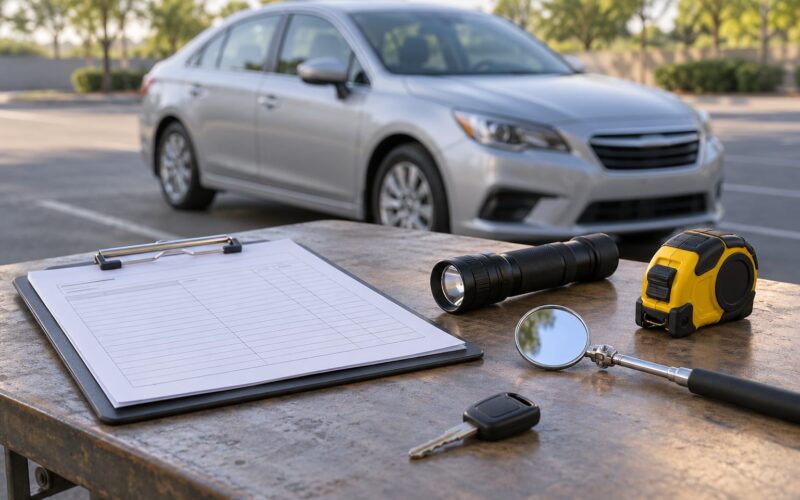
A bright flashlight, a tire pressure gauge, an OBD2 scanner with a phone app, a paint depth gauge if you are serious about accident repair, and a phone that takes photos. Plus a one-page worksheet with your max out-the-door figure, your repair estimate from the inspection, and a 10 to 15 percent contingency for the surprise you have not found yet.
Step-by-Step
The nine steps below run in order, and each one exists to make the next one easier. Budget first, research second, verify third, inspect fourth, negotiate fifth, sign last. Skipping a step rarely saves time; it usually moves the risk somewhere you cannot see it.
1. Set a Realistic Budget Before Shopping
Most budgets are wrong because they only count the sticker. A real used-car budget is a total ownership number covering purchase price, sales tax, registration and title fees, insurance, fuel, routine maintenance, and a repair reserve.
Build it as a monthly figure. Take your total monthly payment including tax and fees, add fuel, add an insurance quote for that exact model, and add a sinking fund for repairs. A common rule of thumb for a normal used car is one percent of the purchase price per month set aside for maintenance, which sounds high until you replace a set of tires and a battery in the same year.
Then add the contingency: 10 to 15 percent on top. Every experienced buyer I have talked to budgets this way, and it is the single biggest reason their final number feels boring rather than stressful. Keep the sinking fund in a separate account you do not think of as car money.
For financing, work out what you can genuinely afford and check three affordability rules. The 20/3/8 guideline suggests no more than 20 percent down, no more than a three-year term for a used car, and no more than 8 percent of take-home pay going to the payment. Nothing forces you to use it, but if a deal needs a seven-year loan, the price is the problem.
2. Research the Vehicle Before You See It
Once you have a VIN, learn everything the car tells you before you have seen the paint. Pull the model year, trim, engine, drivetrain, and factory options, then check three things: reliability for that specific model year, open recalls, and real-world fuel economy.
Reliability data tells you which failure to expect. Recalls tell you whether the seller has had work done, and a dealer who cannot produce a recall repair record for an open campaign is telling you something. Insurance quotes matter more than buyers expect: a sporty trim or a large SUV can cost several times more to cover than the sedan next to it, which changes which car is cheaper to own.
Compare the price against the private-party value for that ZIP code. If a listing sits thousands above that number, you are most likely looking at a dealer whose front-end margin is baked into the price, which is normal and negotiable. Buyers in r/UsedCars report this pattern repeatedly with one-hour rental car chains in particular.
Use cost per mile as your tiebreaker between two finalists. Divide purchase price plus expected first-year repairs by expected miles you will drive. A cheaper car with 110,000 miles and a pricier one with 45,000 miles can land in nearly the same place once you factor insurance and likely work, or they can diverge sharply. The math takes five minutes and kills a lot of wishful thinking.
3. Check the Vehicle History for Red Flags
A vehicle history report is a record of what owners, insurers, and states reported, and it is only that. It shows accidents that were claimed, title events, mileage readings from inspections and service visits, ownership counts, and commercial use. It does not show a leak, a bad alternator, a stretched head gasket, or a hidden flood.
Read the damage lines carefully, because the severity words carry very different price consequences. Minor damage is cosmetic scrapes and dents. Moderate usually means body panels were replaced or structural components were involved. Major and severe mean the insurer declared the car a total loss. Frame or unibody damage is the one to run from, because it bends the structure the car is built around.
Salvage means the insurer took the car. Rebuilt means someone put it back on the road after that. Flood and hail titles carry their own surprises, since water gets into wiring, seat foam, and air bags long after the visible interior dries out. A commercial-use history, like a rental or rideshare fleet, usually shows up as a large number of owners in a short period.
Mileage entries that go backwards, or a digital odometer reading, deserve a walk-away on their own. Compare the report against the odometer on the dash and against the driver’s door jamb sticker. A report is a reason for more questions, never a substitute for looking at the car.
Here is what the entries on a history report mean and what to do about each one:
- Salvage title — the insurer wrote the car off, and value is usually 30 to 70 percent below clean-title comps. Walk away unless the price reflects the title by thousands.
- Rebuilt or reconstructed title — repaired after a write-off, with quality unknown. Independent inspection only, and expect repairs for years.
- Frame or unibody structural damage — the structure the car is built around was bent. Walk away, no exceptions.
- Certificate of destruction — the vehicle was destroyed, sometimes by a parts thief. Walk away.
- Flood title — submerged water, with hidden electrical and interior damage. Walk away unless you can verify a full rebuild.
- Reported mileage lower than the odometer — rolled back or a cloned VIN. Walk away and report the listing.
- Reporting discrepancies — inconsistent reporting, another cloned-VIN signal. Ask for a police report and the last title in hand.
- Three or more owners in two years — fleet, rideshare, rental, or plain churn. Expect hard use and ask who drove it and how much.
- Five previous owners — possibly rentals or a problem car. Price it well below comps and inspect twice.
- No service records at all — unknown maintenance history. Assume deferred maintenance and budget for it.
- Open recall, never repaired — safety or reliability work not done. Ask for the invoice or fix it yourself after purchase.
- Clean report with high mileage — the report covers claims only, not wear. Inspection is not optional, no matter how clean it looks.
4. Inspect the Car in Good Light
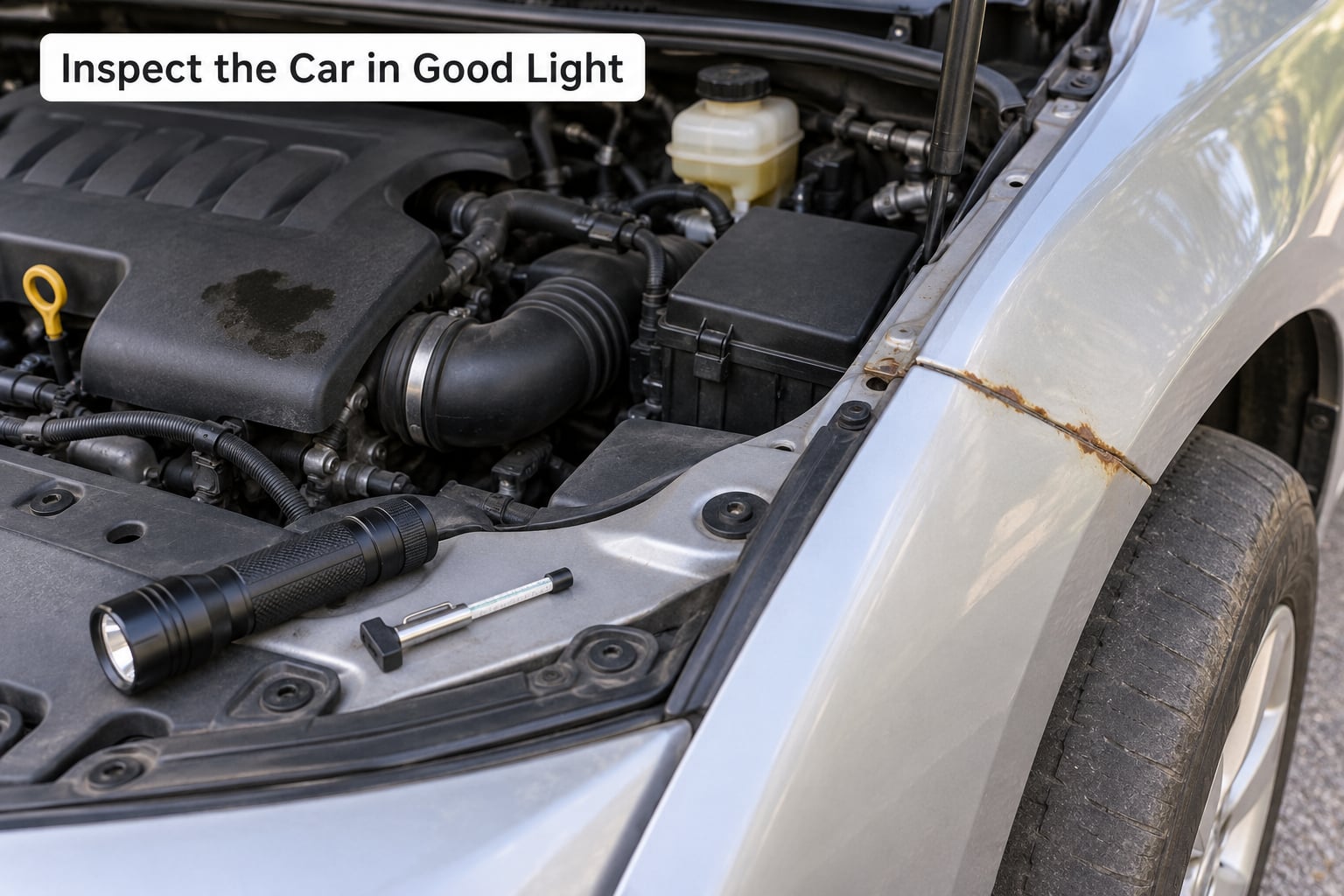
Look at the car outdoors, in daylight, and dry. Overcast light hides dents; garage light hides rust. Give yourself at least twenty minutes with a phone full of photos before you talk money.
Walk the body panels in order. Check that the paint depth reads the same on every panel, since a reading that drops sharply on a door or fender means that panel was replaced or resprayed. Look at door seams and panel gaps for uneven spacing. Check the door seals, wheel-well liners, and exhaust tips for paint overspray, a classic sign of a repainted car. Fresh black undercoating sprayed over a surface that is otherwise clean deserves a question.
Look underneath. Rust bubbling at the rockers, the lower doors, or around the wheel arches is structural. Freshly painted over rust is worse than visible rust, because someone wanted you not to look closely.
Check the tires for tread depth, age, and whether all four match. Uneven wear across one axle points at alignment or worn suspension parts. Mismatched tires on an all-wheel-drive car wear fast and cost more than the price difference you saved.
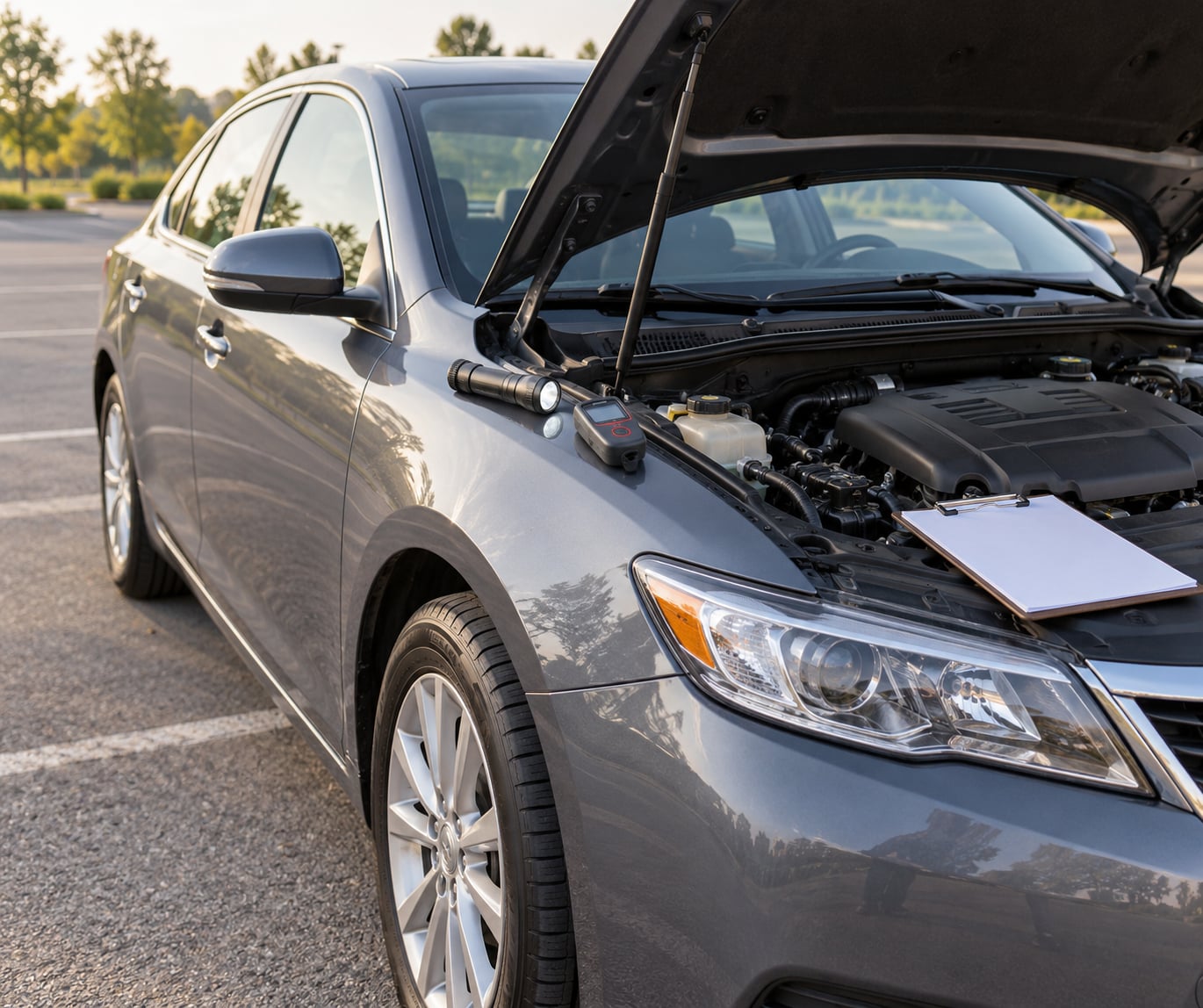
Open the hood. Look for fresh fluid stains on the engine pad or a bright oil ring, coolant that leaves a film around the cap or the radiator neck, and fuel residue near the rails. A cold start is the tell: an engine that needs several seconds to catch, shakes at idle, or makes a knocking sound is telling you something a clean report never will. Milk-colored sludge under the oil cap on a gas engine means coolant mixed into the oil.
Inside, wear the seat bolsters and the pedal area against the mileage. A low-mileage car with a destroyed driver’s seat is hiding something. Smell for mildew, air freshener over smoke, and heavy perfume. Check under the seats for shattered glass, which usually means a window was broken, and check the headliner and rear cargo area for water staining.
Reasons to stop immediately: smoke from under the hood, a burning smell on start-up, a steering wheel or pedal box with a significant gap, a frame that has clearly been cut or welded, or a seller who will not let you see the underside. There is always another car.
5. Take a Careful Test Drive
Ask for at least fifteen minutes in daylight, and ask to take the highway as well as neighborhood streets. Ten minutes around the block hides nearly everything that matters.
Cold start and idle first. Note any warning light, hesitation, or rattle that clears after a moment. Then drive low and slow: brakes should feel firm and straight with no pulsing, vibration, or grinding. At low speed listen for clunks when you change direction, which point at sway bar links, struts, or transmission mounts.
Accelerate moderately from about 30 mph. Hesitation, a shudder, or a slow shift is a transmission or fuel system problem, not a tuning question. Corner on a smooth road and feel for wandering or a knock over bumps. On the highway, check that the car tracks straight, that the engine holds a steady speed, and that wind noise is not noticeably worse on one side, which can mean a door seal or an unclosed window.
On the way back, let the engine idle for a couple of minutes and watch your temperature gauge. Some cars warm up slowly when the thermostat sticks, others climb toward the needle after a long drive. A worn cooling system that looks fine when cold is one of the most expensive surprises in used-car buying.
Write down anything that felt odd while it is still fresh. If the car overheats, pulls, shakes, steers poorly, or makes a new noise, that is the moment to spend money on an independent inspection. If the seller refuses a long test drive or tries to follow you in another car, treat that as a red flag.
6. Verify the Seller and the Paperwork
Confirm the person selling is the person titled on the vehicle. The name on the title, the driver’s license, and the payment all need to match, and you do this before you agree on anything else.
Read the title itself, not just the bill of sale. Look for erasures, overwritten entries, a different state than the seller claims to live in, or corrections written in a different ink. Ask directly about any lien, and if there is one, ask for the payoff amount and a lien release from the lender. Never accept a vehicle with an unresolved lien; in many states the lienholder still has a claim on the car after you buy it.
Match the VIN on the title, the VIN on the dashboard, the VIN on the door jamb, and the VIN on the vehicle history report. Four matching numbers is the cheapest insurance in this whole process.
When you meet a private seller, bring a friend, view in daylight, and meet at the seller’s home so you have an address on record. Some buyers prefer a bank or an empty parking lot for the signing, which is reasonable too. Have the bill of sale signed at the same time as payment, and keep a copy. Complete your title transfer and registration within the deadline your state sets, which is usually a short window.
7. Negotiate From the Total Cost
Negotiate the out-the-door price, not the monthly payment. The out-the-door number includes the selling price plus doc fees, title, registration, taxes, and every add-on, and it is the only figure you can actually compare across dealers.
Anchor from your research, not from the asking price. The common rule of thumb is that a first offer around 10 to 20 percent below asking is a reasonable starting point for a used car with a clean report and some mileage on the clock. Buyers call this the 20 percent rule. For a dealer that has been sitting for more than about 60 days, the deeper end of that range is fair. For a rare, low-mileage car, offer closer to asking but still on the out-the-door basis.
There is a second rule people repeat, the so-called 3,000 dollar rule, which says negotiate at least 3,000 dollars off the asking price. It is a useful floor for a shop that wants to move inventory, and it is bad advice as a universal standard, since a sub-3,000 car cannot take 3,000 off. Use the percentage rule when the car is inexpensive and the dollar rule when it is not.
Make the first offer in person, calmly, and then stop talking. Silence does the work that arguing cannot. If they counter, you can counter once more based on a fact: your inspection found worn front tires and rotors, your valuation puts fair market value at a specific number, or you have three other options.
Keep the inspection invoice and use it. Buyers report doing this and it works: a written list of needed work, totaling a known amount, is a factual reason to lower the price rather than an insult. Negotiate repairs and accessories as separate line items, never as part of the car price.
If you are trading something in, keep the two deals in the same transaction. In most states you pay sales tax only on the difference between what you owe and what the dealer pays you, so a separate trade deal costs you money for no reason. And have a decision rule before you arrive: if the out-the-door number is not at or under your number, you drive home and take your business elsewhere.
8. Get an Independent Inspection Before Buying
A pre-purchase inspection is the single highest-value thing you can buy in this process, and it usually costs in the low hundreds of dollars. One forum buyer reported about 130 dollars for an inspection that turned up front tires, rotors, and brakes on a car that looked excellent and would have cost thousands to sort out.
Choose a shop that has no relationship with the seller. Independent of the dealership, and ideally not the mechanic the dealer recommends, since those shops are not always independent in practice. Call ahead, ask what the inspection covers, and book a slot. If a seller resists, asks you to skip it, or gets angry about it, that reaction is itself information.
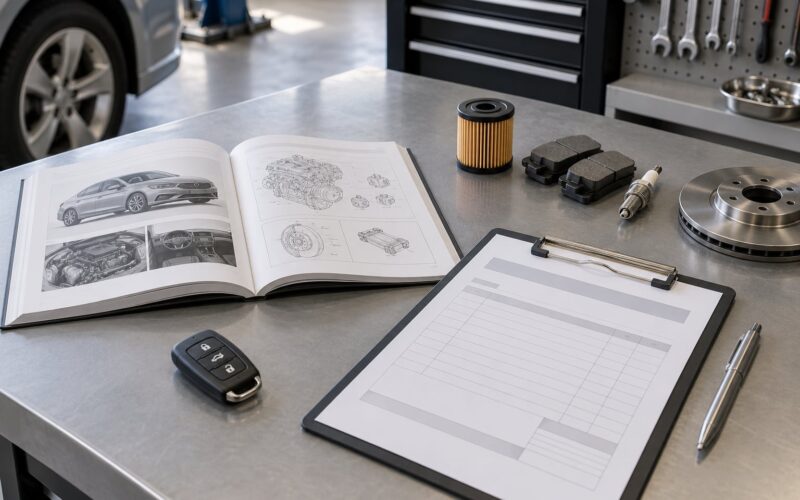
A proper inspection covers the engine and transmission, brakes and suspension, steering, tires, exhaust, emissions readiness, fluid condition, road test, and a scan for stored fault codes. Some shops offer a diagnostic fee deducted from the purchase price; some do not. Ask whether the written report is yours to keep, because you want the document to use in negotiation.
The seller’s own quick look, whether it is a dealer pre-inspection or a ten-minute check by the friend who sold them the car, is not a substitute. It is designed to confirm that the car starts and drives, not to find what it will cost to keep. If you have already paid and driven away, no inspection will exist for this car, which is why step eight comes before step nine.
9. Sign Only After a Final Walk-Around
The last walk-around takes ten minutes and catches the small errors that happen while you were in the finance office. Confirm the VIN on the buyer’s order matches the car, the odometer reading matches what you agreed, and the price and any equipment you negotiated are written down exactly as agreed.
Read the buyer’s order line by line. Verify the out-the-door total, the financing terms and rate, any trade-in value, and every add-on. If the number on the contract is not the number you agreed on in the parking lot, stop right there and say so before signing anything. Get every change initialed by someone at the dealership.
For the title and bill of sale, confirm the title is signed over to you, the odometer disclosure is completed where your state requires it, and a lien release is attached if there was a loan on the car. Keep copies of everything, including your pre-approval letter and the inspection report.
Do not hand over the full payment before you have the signed title and the keys. If the seller wants to meet you at a bank or with a mobile notary, that is a reasonable request. A wire transfer to a seller you have not met, a gift card, or a request to send a deposit to hold the car with no inspection, are all reasons to end the conversation.
Finally, register and title the car in your own name within your state’s deadline, get insurance in place before you drive it off the lot, and keep every service record from this point forward. The first oil change and a set of baseline maintenance costs tell you whether the car you bought is worth what you paid.
Common Mistakes
Every expensive regret I hear about follows one of these patterns, and each one has a straightforward fix.
Buying without reading a vehicle history report
Fix: pull your own report from the VIN before you meet the seller, and read the damage designations and ownership count rather than scrolling past the summary. A clean report is a starting point, not a verdict.
Skipping the independent inspection
Fix: book the shop before you go see the car, not after you are emotionally committed. The inspection routinely finds tires, brakes, and fluid services that look fine from the driver’s seat.
Negotiating the monthly payment
Fix: ask for the out-the-door price in writing and negotiate that. A payment figure hides doc fees, add-ons, and interest, and lowering the payment is often just a way of raising the total.
Letting the seller choose your financing
Fix: arrive with a pre-approval letter from a credit union or bank. Dealers routinely make money on the loan, and they will not beat an approval you already have. Compare the dealer rate to yours out loud and let them respond.
Paying a deposit or full amount before verification
Fix: no money moves before you have seen the car, read a report from the VIN, matched the title, and taken the car to an inspection. Sight-unseen purchases with a shipping timeline or a buyer’s premium are scams, plain and simple.
Accepting add-ons decided at the desk
Fix: decide on every add-on before you sign, and default to none. Here is your line for the ones that come up most:
- Nitrogen tire fill — tires filled with nitrogen instead of air. “Declined, thanks. Air is fine.”
- Paint sealant or ceramic spray — a protection product sold with a large margin. “I will wax it myself.”
- Window tint — often illegal on certain windows, and local rules vary. “No tint, please.”
- Etching or theft registration — a window etch with a tracking number. “Not interested.”
- GAP or service contract — a contract product, usually with heavy markup and fine print. “I will look at my own options first.”
- Prepayment penalty — a fee if you pay off the loan early. “Penalty fee removed, or I walk.”
Ignoring state law on written contracts and cooling-off periods
Fix: read the buyer’s order, not just the summary the salesman points at. Many states give you a short window to take delivery of a new car, but used cars are commonly sold as-is with no return period. Assume no recourse after signing and act like it.
Frequently Asked Questions
What is the 20% rule when buying a car?
The 20 percent rule is a negotiation starting point: make your first offer around 20 percent below the asking price on a used car, then work from there. It is a guideline, not a formula. Adjust the depth based on mileage, condition, how long the car has been listed, and how much research you have done. The important part is that the offer is anchored to market data rather than the seller’s number.
How much does a used car pre-purchase inspection cost?
Most independent shops charge in the low hundreds of dollars for a standard pre-purchase inspection, and more for a diagnostic or a full teardown. The price varies by region, vehicle type, and how long the inspection takes. Call ahead, ask what the inspection covers, and confirm whether the written report is yours to keep so you can use it in price negotiation.
Can you take a used car back to the dealership if you do not want it?
Usually not. Used cars are typically sold as-is with no return period, and a certified pre-owned badge is a warranty on mechanical failure, not a satisfaction guarantee. Some states give new cars a brief cooling-off window, but that generally does not extend to used purchases. The only real protection is an independent inspection and a clear written condition before you sign.
What happens if I buy a used car and it breaks down?
You are likely responsible for repairs once you sign, because used purchases carry no warranty unless one was specifically included. Lemon law in most states applies to new vehicles and to used vehicles sold with a written warranty, and it requires a defect the seller could not reasonably have disclosed. Keep your inspection report and records, and check your state’s rules before buying from a private seller.
Is it safer to buy a used car from a dealer or a private seller?
Dealers give you more paperwork, a paper trail, and often a limited warranty, but they also have a financial incentive and more room for add-ons. Private sellers usually price lower and have less markup, but you carry more risk around title problems, mechanical condition, and scams. Verify the VIN, get an independent inspection, and confirm the title matches the seller’s ID in either case.
How do I tell if a dealer is overcharging me?
Compare the out-the-door price to the private-party value for that ZIP code and mileage on Kelley Blue Book and Edmunds, and check the same year, trim, and mileage on two or three marketplaces. If the listing sits thousands above fair market value, that is the dealer’s front-end margin. Arriving with a pre-approval letter and an independent inspection report gives you the leverage to close the gap.
Conclusion
The safest sequence is fixed: total budget, target models, VIN research, history report, walk-around, test drive, seller and title verification, independent inspection, out-the-door negotiation, then signature. Each step exists to protect the one after it.
Start tonight. Pick two models, set your all-in monthly number including a repair reserve, get a pre-approval letter, and save a shortlist of independent shops near where you expect to shop. When a listing interests you, ask for the VIN first, and everything else becomes easier.