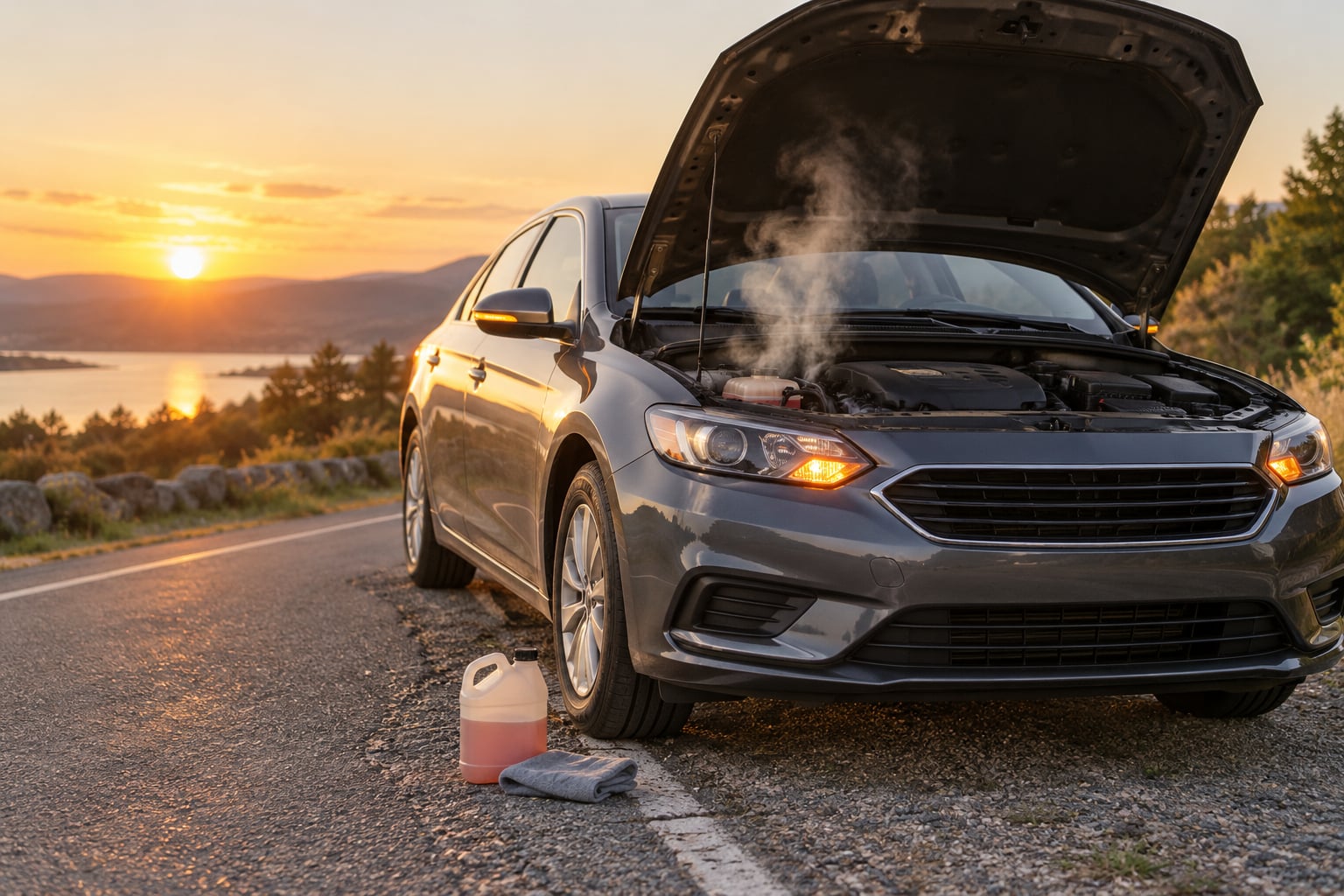
If your car overheats, turn off the air conditioning, crank the cabin heater to maximum, and pull over somewhere safe as soon as you can. Shut the engine off and wait at least 15 to 30 minutes before opening the hood, because the coolant can still be above 230 degrees under pressure. Never open a hot radiator cap or pour cold water on a hot engine. Once the engine is fully cool, check the coolant level, top off if needed, then drive a short distance to a shop or arrange a tow.
That sequence matters because damage can start within a minute or two of running hot. Metal expands, seals warp, and coolant that has nowhere to go ends up in the oil or the exhaust. A single brief overheat caught early is usually survivable; the car gets ruined by the ten extra minutes of driving someone was hoping would clear it up.
Below is the full response, step by step, with the mistakes that make a bad situation worse.
Table of Contents
- 1What You Need
- 2Step-by-Step: What to Do When Your Car Overheats
- 31. Move to a safe place and stop the engine
- 42. Check the temperature warning and dashboard signs
- 53. Let the engine cool before opening the hood
- 64. Check for an obvious leak or visible problem
- 75. Do not keep driving when your car overheats: drive or tow?
- 86. Know when a temporary refill is reasonable
- 97. Have the cooling system checked before driving again
- 10What your symptoms usually mean
- 11Common Mistakes to Avoid
- 12Frequently Asked Questions
- 13Can you still drive your car if it’s overheating?
- 14How long does it take a car to cool down after it overheats?
- 15Can an engine be saved after overheating?
- 16What is the fastest way to cool down a hot car?
- 17What is the most common reason a car overheats?
- 18Why is my car overheating but the coolant level is full?
- 19What to Do First If Your Car Is Overheating
What You Need
A roadside emergency goes better when the right things are already in the car. Most of the supplies for handling car overheating are cheap, and none of them require you to work on a hot engine.
- A jug of the correct coolant for your make and model, mixed to the ratio your owner’s manual specifies. One gallon covers an emergency top-off in most cars.
- Distilled water as a backup for topping off, not as a replacement for coolant.
- A clean rag or old towel to cover the cap and to wipe up whatever spills.
- Heavy-duty gloves that handle heat, because even a cooled-down engine bay holds hot metal.
- A flashlight, since roadside stops are often dark and under the car is darker.
- A phone charger and your roadside assistance number, saved in the phone rather than looked up mid-highway.
- Your owner’s manual, or a photo of the coolant spec page on your phone.
Two things you do not need. You do not need tools, and you do not need to open anything in the cooling system while it is hot.
There is a hard rule underneath all of this. Most drivers should not open a hot cooling system, touch a hot engine part, or attempt any repair until the engine is completely cold. A pressurized cooling system holds scalding liquid behind a cap that looks like it is nothing special, and releasing it can cover your arm in 200-degree coolant.
Step-by-Step: What to Do When Your Car Overheats
1. Move to a safe place and stop the engine
Pull over as soon as it is safe to do so. The safe place is a level spot away from traffic, ideally off the roadway entirely, where the car will not roll and where you are not standing between moving cars and yours.
Turn on your hazard lights before you leave the lane so other drivers see you early. Signal, then merge, then choose the spot.
Put the transmission in park, or the gearbox in neutral, set the parking brake, and switch the engine off. Do not idle it at the roadside waiting to see if the temperature settles. An idling engine keeps the coolant circulating with no airflow through the radiator, which is the one thing that cools it down.
If you cannot stop safely, keep going slowly to the nearest safe place rather than stopping in a live lane. And if traffic is blocking the roadway entirely, or you are on a bridge with nowhere to pull over, call emergency services before you are boxed in.
The cabin heater trick belongs here, before you shut down. Turning the A/C off and the heater to maximum heat pulls extra coolant into the heater core, where cabin airflow acts like a second radiator, and it drops the load from the A/C compressor. It is worth doing for the minute or two it takes to find a spot. It cools the car, and it feels strange, which is why so many drivers skip it.
2. Check the temperature warning and dashboard signs
Most drivers notice an overheating engine before the gauge tells them, and that instinct is usually right. These are the signs worth knowing.
- The temperature gauge climbing past its normal mark into the red zone, or sitting unusually high while the needle stops moving.
- A temperature warning light shaped like a thermometer or a wavy line over a coolant drop, sometimes with wording.
- A check engine light that comes on alongside rising temperature.
- Steam rolling out from under the hood. Steam is white, cool to the touch, and smells sweet. Smoke is grey or black, hot, and smells burnt. If you cannot tell the two apart, treat it as smoke and get away from the hood.
- A sweet, sharp smell of antifreeze, sometimes strong enough to smell inside the cabin.
- A sudden loss of power, a rough idle, or the engine stumbling and recovering.
- A high-pitched squeal from the engine bay when the belt-driven fan or an accessory pulley spins against something.
A gauge that never reached the red does not clear the car. Many vehicles run with the needle above normal for a while before the light appears, and some never show a light at all.
Two signs mean stop driving no matter where you are. The first is loss of power. The second is any flashing warning light combined with rising temperature, which often means the coolant is being lost fast enough that the gauge climbs even with the engine off. Roll to the nearest shoulder and shut it down.
3. Let the engine cool before opening the hood
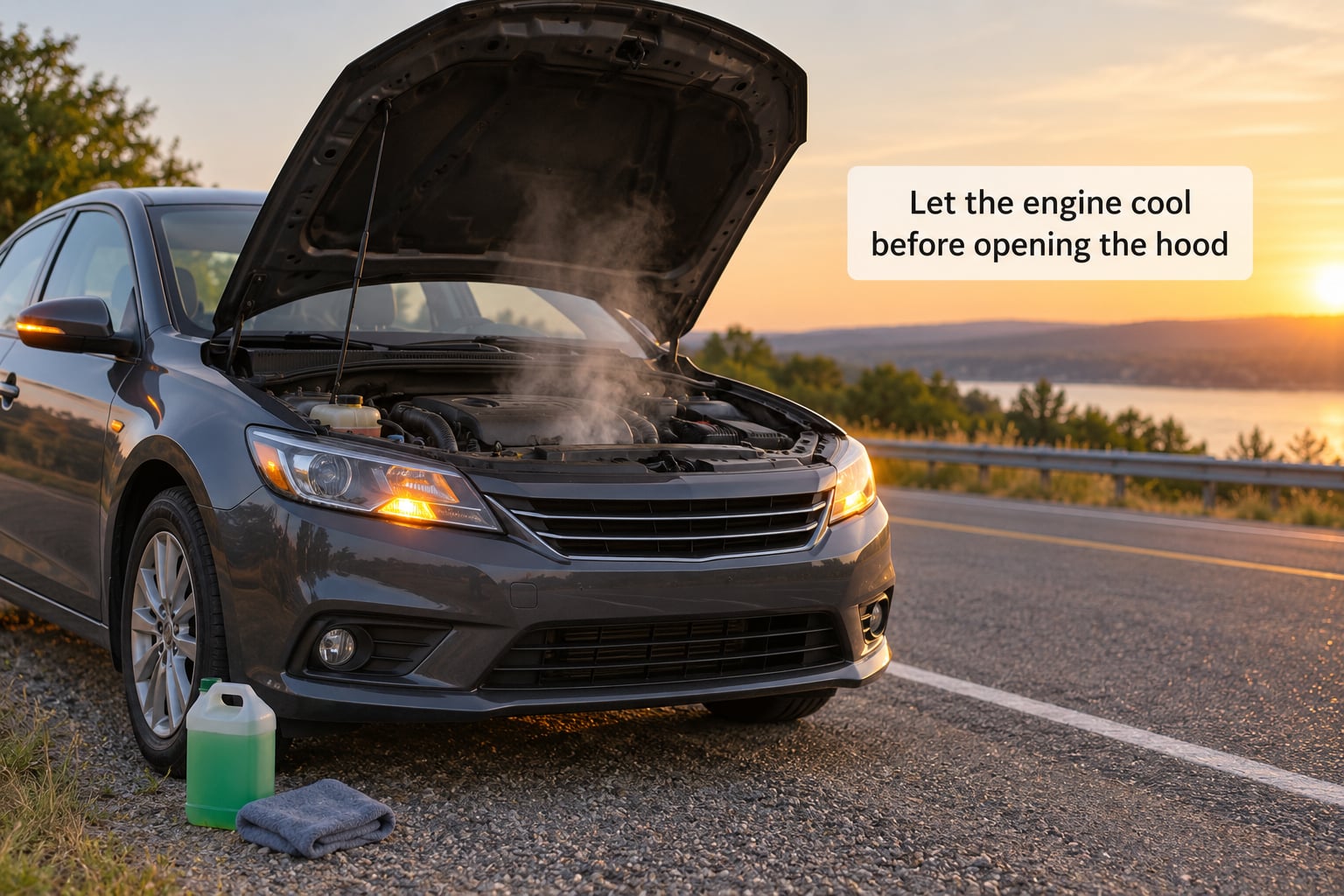
Wait at least 15 to 30 minutes after the engine is off. Longer in summer, and longer after a long highway drive at high load.
Coolant in a hot engine can be above 230 degrees Fahrenheit while still under pressure, held there by the cap. Open it early and that pressure releases as a jet of near-boiling coolant. This is the single most common way people get burned doing what to do when your car overheats, and it happens in ordinary driveways.
Keep people back. Steam burns are less obvious than flame but they are real burns, and an engine that has just boiled over can throw coolant out from under the hood in a burst.
The test is the gauge, not the clock. Wait until the temperature reading has dropped all the way to cold, not merely back to normal. If you open the hood and can comfortably hold your hand on the radiator cap, the system has released its pressure. If you hesitate, wait longer.
4. Check for an obvious leak or visible problem
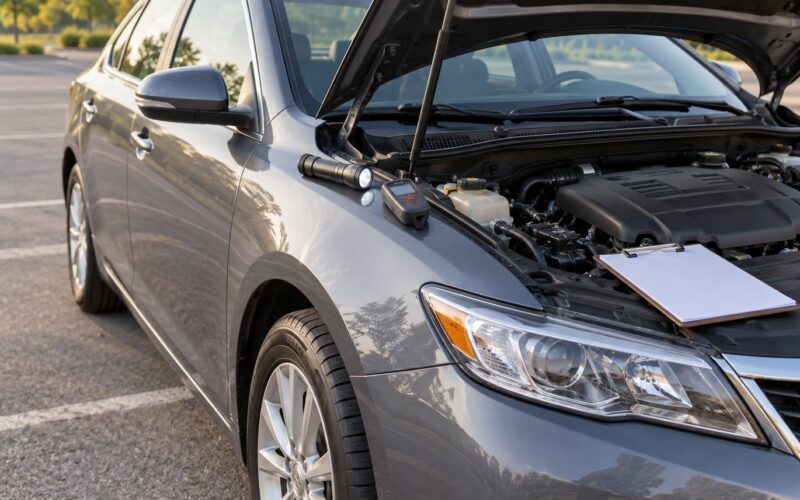
Once the engine is fully cool, do a visual pass only. You are looking, not opening anything.
- Puddles or wet spots under the car, especially between the front wheels and near the radiator.
- A coolant reservoir that reads empty, or below the minimum mark on the side.
- A visibly split, collapsed, or loose upper or lower radiator hose.
- A radiator cap that is loose, damaged, or has a crusty ring of dried coolant around it.
- Damage to the fan, a fan blade bent into the shroud, or a fan that does not run when the engine is started and cold.
- Dead grass, mud, or plastic bags pressed against the front of the radiator.
Take a photo of anything you find. It saves you explaining and it helps whoever works on the car.
Stop the visual check there. Do not remove hoses, do not test the radiator with a pressure gauge, do not feel for leaks with your hand. Those are shop jobs performed with the car cold, raised properly, and with the right tools.
5. Do not keep driving when your car overheats: drive or tow?
The honest answer is no. Driving an overheating car converts a small cooling-system problem into an expensive one, and you have no way to predict which kind of problem you currently have.
Tow it, or call roadside assistance, if any of these apply:
- The gauge climbs back into the red within a few minutes of driving.
- You see steam, white exhaust smoke, or a sweet smell.
- The engine lost power, misfired badly, or shut itself off.
- You are carrying passengers, towing a trailer, or driving in heavy traffic at high outside temperature.
- The engine overheated more than once, or it overheated and shut off.
- You have no idea what the temperature was doing because the gauge or the warning light is not working.
A short drive to a shop is sometimes defensible. In my view it only works if the trip is under 10 to 15 miles, the gauge sits steadily below the red zone, there is no steam or sweet smell, the engine makes normal power, and the weather is not extreme.
Watch the gauge the entire way and pull over the moment it climbs. Drivers on forums such as r/MechanicAdvice describe a rule of thumb that matches this: if the car will not settle back down once it is moving, the problem is not a small one. Drive a short hop only when the car is behaving predictably.
If the car overheated and shut itself off, treat it as a tow until a mechanic has looked at it. Restarting a hot engine pushes coolant into places it should not be, and the second failure is often worse than the first.
6. Know when a temporary refill is reasonable
A top-off is reasonable when the engine is completely cold, the coolant loss was small, and you are driving straight to a shop. It is not a repair, and it does not explain the loss.
Use the coolant your manufacturer specifies. Some cars take a plain glycol coolant, some require a long-life or extended-life formula, and some specify a particular mix ratio that is not 50/50. Color is not a reliable guide, since long-life coolant comes in several colors. Read the spec in the owner’s manual.
Check the reservoir or the radiator as your manual describes. Most reservoirs have cold and hot marks rather than a single range, which is why you check with the engine cold and read between the two lines. Do not fill a radiator unless your manual tells you to, since many are filled at a shop with air bled out of them.
If the cap is stubborn, cover it with your rag, loosen it a quarter turn to let pressure escape, then finish removing it slowly. That single habit prevents the burst of steam that catches people.
Plain water is not a substitute for coolant. Water has no freeze protection and no corrosion inhibitors, so using it as a permanent top-off degrades the system. In a genuine emergency, distilled water gets you home and the system should be flushed and refilled properly soon after.
Adding coolant to a hot engine carries real risk. Pouring cold liquid into a hot system can crack a hot engine block or cylinder head, and it can also mask a leak while the head gasket is already letting coolant into the oil. Never do it.
7. Have the cooling system checked before driving again
Once the engine is cool and the car is no longer overheating, have a mechanic work through the cooling system in this order. It matches the sequence experienced owners tend to follow and it puts the cheap, common causes first.
- Low coolant, usually from a slow leak at a hose, the cap, the water pump weep hole, or a cracked reservoir.
- A stuck thermostat that never opens, so the engine runs hot at idle and on slow climbs.
- A radiator fan or fan clutch that does not come on when it should, plus the relay or fuse behind it.
- A water pump with a failing impeller, which leaks a little and then stops circulating properly.
- A clogged radiator core from debris or collapsed hoses, or a radiator that no longer holds pressure.
- Trapped air in the cooling system, which circulates instead of coolant and prevents cooling entirely.
- A blown head gasket, where coolant enters the oil and exhaust gas enters the cooling system.
- An overheating transmission cooler, common on tow-heavy vehicles and automatic transmissions.
Low oil is a separate problem that looks similar from the driver’s seat. Oil carries heat away from the cylinder walls and the crankcase, so a low or failing oil system can produce rising temperature that no coolant level will explain.
Follow your owner’s manual for service intervals and coolant type, and stop using the car until the cause is found. One overheat is a diagnosis opportunity. Repeated overheating on the same car after a repair usually means the first diagnosis missed something, and it is worth saying so plainly to the shop.
What your symptoms usually mean
Drivers spend a lot of time guessing from the dashboard. Here is what the most common observations actually point to, and the right next move for each one.
- Gauge high in town, normal on the highway. Usually a weak radiator fan, a clogged radiator core, or air trapped in the system. Tow it in and check the fan operation first.
- Overheats with the reservoir still full. Failed water pump, fan relay, or thermostat, and sometimes a head gasket. Stop topping up coolant and have it diagnosed.
- Coolant puddle under the front of the car. A failed upper or lower radiator hose. Tow it in rather than refilling and driving on.
- Sweet smell, no visible leak. A small leak or pressure loss at the cap or reservoir. Top off cold, watch the level, and book an inspection.
- White exhaust smoke or milky residue on the dipstick. Head gasket failure. Tow it in and stop driving.
- High-pitched squeal from the engine bay. Belt or bearing failure, sometimes a damaged fan. Shut it off immediately and tow it.
- Warning light with no gauge reading. Coolant loss or a failed temperature sensor. Pull over and look under the hood once it is cool.
- Overheats only while towing or under heavy load. A restricted cooler, a weak fan, or a transmission cooler problem. Stop towing and have it inspected.
Common Mistakes to Avoid
Most of the damage I see described in owner threads happens in the first ten minutes, before anyone thinks to stop.
- Continuing to drive. The instinct is that the car is fine if it still moves. It is not. Every minute above the red zone widens the damage.
- Opening the radiator or coolant cap while it is hot. The coolant can be above 230 degrees under pressure, and it comes out as a scalding jet.
- Pouring cold water on a hot engine. The thermal shock can crack a hot block or cylinder head.
- Adding the wrong fluid. Transmission fluid, engine oil, or plain tap water in the reservoir does more harm than an empty tank would have.
- Ignoring the warning because it went away. An intermittent warning is a warning, not a false alarm. Cooling problems often show up once and then behave for weeks.
- Replacing parts without finding the cause. Swapping a thermostat, then a water pump, then a radiator in turn is how a car ends up overheating after three repairs. Get the diagnosis first.
- Leaving the car running to keep an eye on the gauge. A boil-over can happen without anyone in the driver’s seat.
Prevention is dull and it works. Keep the coolant at the right level and change it on the interval in your manual, because old coolant loses its corrosion protection and turns acidic. Look at the radiator and hoses during routine service, keep the front of the radiator clear of debris, and treat any sweet smell or damp spot under the car as something to look at now rather than next month.
If you are near a service interval anyway, ask them to run the cooling system to full operating temperature and watch that the fan comes on and the gauge stays steady. It takes minutes and it catches problems before they happen in traffic.
Frequently Asked Questions
Can you still drive your car if it’s overheating?
Not safely, and not for long. Damage can begin within a minute or two of running hot, and you cannot see the damage from the driver’s seat. A short trip under 10 to 15 miles is defensible only if the gauge stays steadily below the red zone, there is no steam, no sweet smell, and the engine makes normal power. If the gauge climbs back toward red, tow it instead.
How long does it take a car to cool down after it overheats?
At least 15 to 30 minutes with the engine off, and longer in summer heat or after a long highway drive. Judge it by the temperature gauge rather than the clock: wait until it has dropped all the way to cold, not merely back to its normal position. Coolant in a hot engine can sit above 230 degrees under pressure, which is why the cap stays shut until the system has cooled.
Can an engine be saved after overheating?
Usually yes, if the overheat was brief. A gauge that crept up, a short drive home, and an immediate shutdown typically costs nothing. Damage is signalled by white exhaust smoke, milky residue on the dipstick, a sweet smell inside the cabin, or coolant disappearing quickly. Prolonged overheating, repeated overheating, or an engine that ran in the red zone for minutes can warp a cylinder head, blow a head gasket, or crack a block.
What is the fastest way to cool down a hot car?
Turn the air conditioning off, set the cabin heater to maximum heat with the fan on high, and shut the engine down. The heater core works like a second radiator, and switching off the air conditioning removes the load from the compressor. Then leave the car closed up for 15 to 30 minutes. Driving with the windows open does not cool the engine, and idling it keeps the coolant moving without airflow.
What is the most common reason a car overheats?
Low coolant, usually caused by a leak, is the single most common cause. After that come failed radiator fans and their relays, water pumps with worn impellers, and a thermostat stuck closed. Blocked radiator cores and low engine oil account for more cases than most people expect. Ignoring the cooling system maintenance interval in the owner’s manual is the reason a large share of these failures happen at all.
Why is my car overheating but the coolant level is full?
A full reservoir usually rules out low coolant but not a cooling failure. The likely causes are a failed radiator fan or relay, a water pump impeller that has stopped circulating, a thermostat stuck closed, or air trapped in the system. If the coolant is low in the radiator but full in the reservoir, or if it drops quickly, a head gasket failure moves to the top of the list. Get it diagnosed rather than topping it up.
What to Do First If Your Car Is Overheating
Pull over safely, turn the air conditioning off and the heater on, and shut the engine down. Wait 15 to 30 minutes until the gauge reads cold, then look only at what you can see without opening anything: a puddle, an empty reservoir, a split hose, a fouled radiator.
Do not open a hot cap, do not pour cold water on a hot engine, and do not keep driving hoping it will cool. Arrange professional help when the problem persists, when it happens twice, or when you see steam, a sweet smell, loss of power, or milky residue in the oil.
Updated for 2026.