If your steering wheel shakes at high speed, the most common causes are an out-of-balance wheel or tire, a tire that is damaged or unevenly worn, a bent rim, worn steering or suspension parts, warped brake rotors, and a failing wheel bearing or CV joint. Below roughly 40 mph the suspension absorbs each of these small imperfections. Above that, they amplify into a buzz you feel through your hands.
The fix depends entirely on when the shake shows up. A shake that only appears over 45 mph, a wheel that pulls to one side, and a wheel that hums worse the faster you go are three different problems wearing the same symptom.
Table of Contents
- 1Why Does My Steering Wheel Shake at High Speed?
- 2Is It Safe to Drive When the Steering Wheel Shakes?
- 3What Are the Most Common Causes?
- 4Out-of-balance wheel or tire
- 5Damaged, unevenly worn or underinflated tire
- 6Bent rim, loose wheel nuts, or wheel damage
- 7Worn steering and suspension components
- 8Warped brake rotors
- 9Wheel bearings, CV joints and the driveline
- 10Engine or transmission mounts
- 11How Can I Tell Whether It Is a Tire or Wheel Problem?
- 12Why Does the Steering Wheel Shake When I Brake?
- 13Why Does the Steering Wheel Shake When I Accelerate?
- 14Can Road Surfaces Cause a Steering Wheel Vibration?
- 15How Do Wheel Imbalance and Uneven Tire Wear Differ?
- 16What Should I Ask a Mechanic or Tire Shop to Check?
- 17Why Does My Steering Wheel Shake at High Speed Only?
- 18Frequently Asked Questions
- 19Why does my steering wheel shake when I go over 45 mph?
- 20Why does my steering vibrate at 70 mph?
- 21Why does my car shake when I’m driving at 80 mph?
- 22Should I be worried that my steering wheel is shaking while on the highway?
- 23Can adjusting tire pressure fix the shaking?
- 24Do I always need a wheel alignment after fixing the shake?
- 25Conclusion: Start With the Simplest Safe Check
Why Does My Steering Wheel Shake at High Speed?
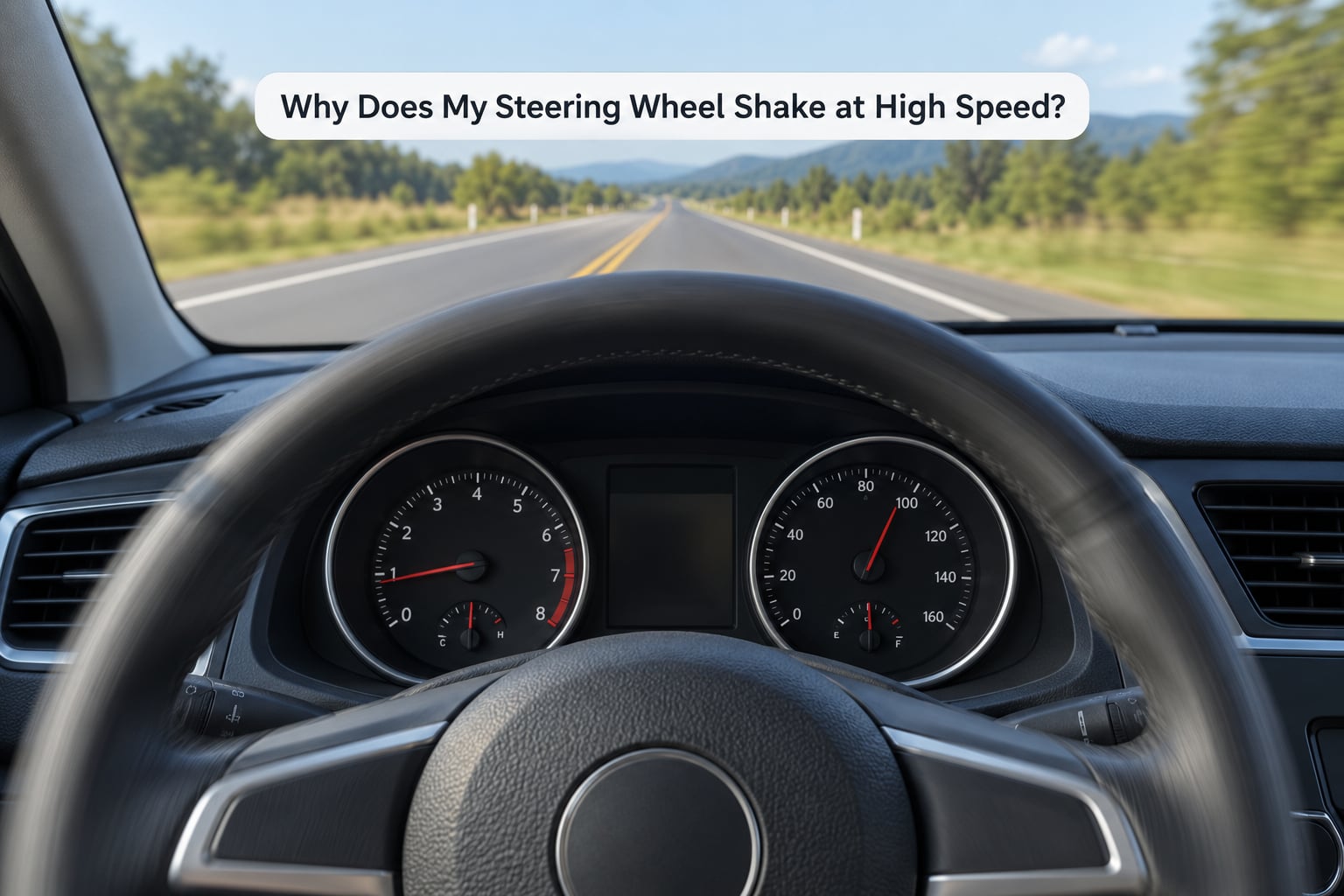
Anything that creates a force which changes once per wheel revolution will shake the steering wheel once the car is moving fast enough for that force to beat against the suspension. An unbalanced wheel, a flat spot in the rubber, a warped rotor, or free play in a bearing all produce that repeating shock.
The suspension is very good at swallowing small inputs at low speed. It stops being able to do that somewhere around 40 to 50 mph, which is why the same wheel that feels perfectly fine in a parking lot can be uncomfortable at highway speed.
| What you feel | When it happens | Most likely cause | Confirm with |
|---|---|---|---|
| Rhythmic buzz, roughly steady, gets worse the faster you go | Above 45 to 50 mph, constant through the speed range | Out-of-balance wheel or tire | Spin the wheel in the driveway and watch for a visible wobble, then have it rebalanced |
| Shake plus a pull to one side | On and above about 50 mph | Uneven tire wear or alignment out of spec | Compare tread depth across the tire and check pressure cold |
| Pulsing through the pedal and the wheel | Only while braking, worse when the brakes are warm | Warped brake rotors or uneven pad wear | Park on a quiet straight road and brake gently at low speed |
| Shudder under acceleration, often with a clicking noise | Standing starts and hard acceleration | Worn CV joint or inner CV boot | Coast down a straight road in neutral and listen |
| Shake starts at a fixed speed then fades above it | A band, usually 45 to 70 mph, quiet above 75 | Resonance excited by a small imbalance | Note the exact speed where it appears and where it stops |
| Groan or hum that rises with speed, plus rattle over bumps | Any speed, getting louder with miles | Wheel bearing or hub play | Hand-check the wheel at the 12 and 6 o’clock positions for play |
| Vibration felt in the seat or floor more than the wheel | Highway cruising | Rear wheel, half shaft, or driveshaft issue | Compare whether the wheel is steady while the seat buzzes |
| Short sharp shimmy over bumps and expansion joints only | Bad road surfaces | Normal road input, sometimes amplified by worn shocks | Compare the same speed on a smooth versus rough surface |
Is It Safe to Drive When the Steering Wheel Shakes?
Usually you can get the car home, but do it carefully. Ease off the accelerator, hold a steady speed in the right-hand lane, and stay off the highway if the freeway is the only place the shake appears.
Stop and pull over as soon as you safely can if any of these show up.
- The steering pulls to one side or wanders, or the wheel feels vague or disconnected from the road.
- The vibration becomes harsh rather than buzzy, or it keeps growing the faster you go.
- You hear grinding, clunking, or a hum that changes with speed.
- A tire looks bulged, torn, or is down to the wear bars, or you can see a bent rim.
- ABS, stability control, or brake warning lights come on, or the pedal travel changes.
- You notice one wheel or lug nut that looks loose, or a wheel that seems to move when you wiggled it at the driveway.
If you hit a pothole or curb and the shake starts immediately, assume the wheel or suspension was damaged until a shop checks it. That is the one case where I would not drive it any distance at all.
What Are the Most Common Causes?
Here is how the causes break down by system, with the clue that usually gives each one away.
Out-of-balance wheel or tire
A small weight missing off the rim, a tire that has lost its shape from age or underinflation, or a tire/wheel combination the shop has not put on the machine since it was mounted. The signature is a smooth, rhythmic buzz that grows with speed and shows up on smooth road surfaces too.
Damaged, unevenly worn or underinflated tire
Cupping and feathering are wear patterns that create a repeating shape change in the rubber, and pressure matters because it is what keeps the sidewall round. Cold mornings make it worse because pressure drops as temperatures fall, which is why some shakes appear only in winter. If your tires are five years old with low mileage, age itself can matter more than tread depth.
Bent rim, loose wheel nuts, or wheel damage
Curbs and potholes bend rims, and sidewall bulges come from hitting a pothole at speed. A wheel with lateral runout, meaning the rim wobbles side to side as it spins, shakes the wheel hard and is not fixed by balancing. If it started the day after a tire change, check that the lug nuts were torqued properly.
Worn steering and suspension components
Tie rod ends, ball joints, control arm bushings, struts, and shocks all fail in ways that change how force travels into the steering wheel. Worn bushings and failing struts are the usual explanations for a shake that survived a balance and an alignment, and they also tend to add noise over bumps and a bit of vagueness in the steering.
Warped brake rotors
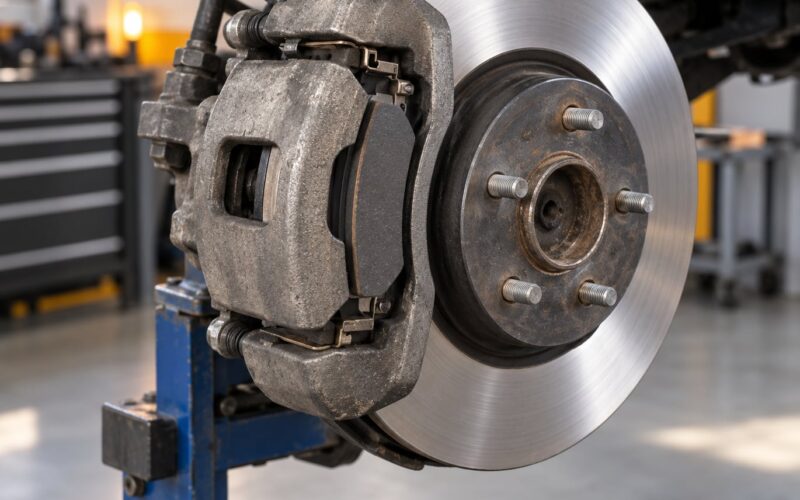
Rotor thickness variation means the disc is slightly thicker in one spot than another, so each revolution the caliper grips a little harder and then releases. It shows up as a pulse through the pedal and wheel during braking, and it usually gets worse once the rotor is hot.
Wheel bearings, CV joints and the driveline
A worn bearing hums first and gets louder with speed, and once the bearing starts to have actual play in the hub you get a shake and a rattle over bumps. CV joints are different: they chatter or click during acceleration and coasting, and a torn inner boot throws grease down the half shaft. A bent half shaft or an unbalanced driveshaft can produce a steady highway-speed shudder you feel more in the seat than the wheel.
Engine or transmission mounts
Cracked or softened mounts let the drivetrain move under torque, which shakes the body and feeds into the wheel. They typically come with a shudder on hard acceleration, clunks on launch, and engine movement when you come off the throttle.
How Can I Tell Whether It Is a Tire or Wheel Problem?
These are checks you can do in your own driveway without lifting the car, and they cost nothing.
- Check pressure cold. Use the number on the driver’s door jamb placard, not the number molded into the tire sidewall, and check all five tires including the spare. Do this before driving more than a mile.
- Look at the tread across the tire. Turn the wheel and compare the depth of the grooves from the inner edge to the outer edge. If one shoulder is noticeably smoother, that tire has been unevenly loaded and the wheel or alignment needs attention.
- Check for cupping. Scalloped or wavy dips in the tread, spaced evenly around the circumference, point to a shock or strut problem rather than a balance issue.
- Look for bulges, cuts and exposed cords. A sidewall bulge is the reason to stop driving that tire immediately, not something to watch.
- Spin the wheel and watch the tread. With the car in park on level ground, spin the wheel and look at the sidewall or tread as it turns. A visible wobble, or a wheel that rocks when you push it at the top and bottom, means runout or play.
- Look for missing balance weights. Run a finger around the rim bead area and you can often feel the gap where a weight used to sit, which is a free diagnosis.
If the vibration survives all of that, a tire shop should check balance, runout and rim condition on a balancer. That is the first measurement worth paying for, because it either confirms the cheap cause or rules it out in a few minutes.
Why Does the Steering Wheel Shake When I Brake?
Brake-related shake has a different signature from speed-related shake: it appears when you press the pedal and relaxes or disappears when you let off, and it usually gets stronger the faster you are going, because you are putting more energy into the pads.
Warped rotors are the leading cause, followed by worn or contaminated pads, seized caliper slide pins that let one side stick, and loose or worn brake hardware. A rotor can also look fine but have a hot spot on it, and a set of new pads can transfer a flat deposit onto a rotor and give you a brake pedal that pulses harder than the old one did.
My advice here is simple: if the shake is tied to braking, get the brakes inspected before the next long highway drive. A warped rotor that also reduces braking performance is not something to run a road test on repeatedly, and heat cycling will keep flattening the high spots back up even after the discs are turned.
Why Does the Steering Wheel Shake When I Accelerate?
When the shake appears under power and calms down at steady speed, you are looking at the driveline rather than the wheel. A worn CV joint on a front-wheel-drive or all-wheel-drive car makes a clicking or chattering noise during acceleration and hard turns, and a torn inner boot is often visible as a ring of grease around the joint.
A bent or damaged half shaft, or a driveshaft that has lost weight, produces a steady shudder that increases with load and usually shows up more in the seat than the wheel. On rear-wheel-drive and all-wheel-drive trucks, worn U-joints make a clunk at low speed and a vibration that changes with torque.
One useful road test: on a straight, empty road, shift into neutral and let off the gas. If the vibration fades, you are exciting the driveline. If it stays exactly the same, it is on the other end of the car and you should keep hunting in the wheel, tire, and brake areas.
Failures in this group tend to progress rather than stay flat. That makes them worth a professional diagnosis even when the noise is not very loud yet.
Can Road Surfaces Cause a Steering Wheel Vibration?
Yes, and it is the one cause that needs no repair. Rough pavement, bridge joints, concrete seams, washboard ruts, patched asphalt, and packed snow all put a repeating input into the suspension that the steering wheel reports directly.
Some tires make it worse. Aggressive all-terrain tread blocks and winter tires with stiff sipes can hum or shimmy over texture even on wheels that are perfectly balanced, because the tread itself is designed to move.
To test safely, hold a steady moderate speed, keep both hands on the wheel, and compare how the car feels on a smooth stretch against a rough stretch at the same speed. Do not do this while reading your phone, and do not make abrupt lane changes to provoke the shake. If the difference tracks the surface and disappears on the smooth road, the car is telling you about the road.
How Do Wheel Imbalance and Uneven Tire Wear Differ?
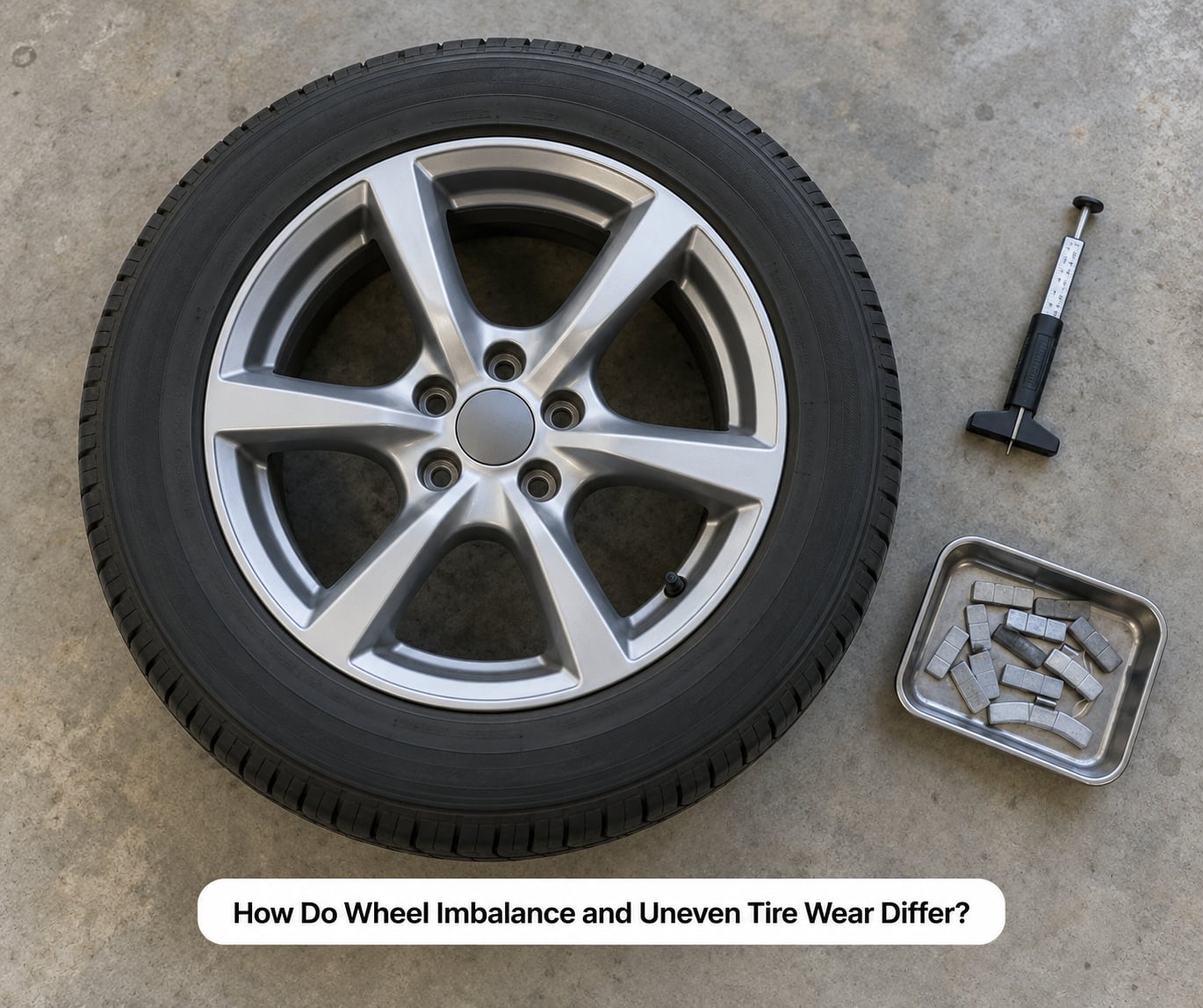
They get confused constantly because both produce a shake at highway speed. One is a weight problem, the other is a shape problem, and the repair is completely different.
| Wheel imbalance | Uneven tire wear | |
|---|---|---|
| Typical causes | Missing or shifted balance weight, an old or deformed tire, a heavy spot in the tread | Alignment out of spec, worn shocks and struts, chronic underinflation, chronic overloading |
| How it feels | Smooth rhythmic buzz, steady, grows with speed | Rougher, less regular shake that often comes with a pull to one side |
| Speed range | Usually starts around 45 to 50 mph and stays with you | Often present over a narrower band, sometimes worse at lower highway speeds |
| Best clue | You can feel or hear a dead spot in the tread as the wheel spins | One shoulder of the tread is measurably shallower than the other |
| Repair | Rebalance the wheel and tire as a set | Replace the tire, then correct the underlying cause, alignment or shocks |
The important part is what happens when a balanced, properly inflated tire still shakes. Balance corrects mass distribution, not geometry. A bent rim with runout, a wheel that is not seated properly, or a suspension or steering part with free play will all keep shaking the wheel after a perfect balance, and the shop needs to move on to those next.
What Should I Ask a Mechanic or Tire Shop to Check?
Ask for the diagnosis before you authorize the work, and ask what each measurement found. A short list like this keeps the visit focused.
- Tire pressure on all four corners, cold, against the door jamb specification.
- Tread depth measured across the full width of each tire, plus any feathering or cupping.
- Wheel and tire balance on all four corners, including the spare.
- Lateral and radial runout on each wheel, to catch a bent rim that balancing will not fix.
- Wheel nut torque and whether any fastener shows movement.
- Play at the tie rod ends, ball joints, and control arm bushings, including an unloaded and loaded comparison.
- Shock and strut condition, including damping and any tire cupping on the vehicle.
- Brake rotor thickness variation and lateral runout, plus pad wear and caliper slide pin condition.
- Wheel bearing play and noise, and hub preload where applicable.
- CV axles, half shafts, and driveline components on front-wheel-drive, all-wheel-drive, rear-wheel-drive and four-wheel-drive vehicles.
- Engine and transmission mounts if the shake is tied to acceleration.
Ask for the road test notes too: what speed the shake appeared at, whether it changed under braking or coasting, and whether it appeared in the wheel, the seat, or the floor. That data is what turns a guess into a diagnosis, and it is worth more than the parts themselves when you are deciding what to approve.
Why Does My Steering Wheel Shake at High Speed Only?
Because the symptom is a function of force, and force is a function of speed. At 60 mph a wheel is turning many more times per second than at 25 mph, so a small imbalance delivers its shock that much more often and with that much more energy behind it.
There is a second effect on top of that. A tire, spring and damper system has a natural frequency, and near that frequency a small input gets amplified instead of cancelled. That is why a shake often begins abruptly at a particular speed, feels worst across a band of roughly 45 to 70 mph, and then quietens above 75 or 80. Some drivers notice the vibration return again at higher speed once they pass through the band.
A hard onset at a fixed speed, say 45 mph, is a strong hint at balance. A vibration that grows steadily all the way to 80 without ever letting up is more consistent with a bent rim, worn bushings, a failing bearing or a damaged driveline part.
That does not mean the speed tells you which part. It tells you the pattern, and the pattern is the useful clue: whether the vibration is brake-dependent, load-dependent, surface-dependent, or constant.
Frequently Asked Questions
Why does my steering wheel shake when I go over 45 mph?
A vibration that starts abruptly at one fixed speed is the classic signature of a wheel balance problem. At low speed the suspension absorbs the tiny uneven mass in the wheel and tire, but past that speed the shock repeats often enough to excite the vehicle’s natural frequency and you feel it in your hands. A rebalance of all four corners is the first thing to try.
Why does my steering vibrate at 70 mph?
Around 70 mph you are usually sitting inside the resonance band, which is why the vibration feels strongest there. Most of the time that points to an out-of-balance wheel, a tire with a flat spot or deformation, or a worn shock letting the wheel hop. If the shake eases above 75 mph and then returns, that pattern still points at the wheel and tire rather than the driveline.
Why does my car shake when I’m driving at 80 mph?
A vibration still present at 80 mph is less likely to be a simple balance issue, because balance problems tend to quiet down once you pass the resonance band. A bent rim with runout, worn control arm bushings or struts, a failing wheel bearing, or a damaged half shaft all keep shaking at higher speed. Braking that makes it worse points at the rotors instead.
Should I be worried that my steering wheel is shaking while on the highway?
Usually it is not immediately dangerous, which is why most people drive the car to a shop. Ease to a lower speed, stay out of heavy traffic, and avoid the freeway if that is the only place the shake appears. Pull over right away if the car pulls to one side, the steering feels loose or vague, you hear grinding, a warning light is on, or you can see a bulge or bent rim.
Can adjusting tire pressure fix the shaking?
It can, if the tires are significantly underinflated or the pressure is uneven across the axle. Low pressure lets the sidewall flex unevenly, which changes the effective shape of the tire and can create a periodic force similar to a balance problem. Always set pressure cold to the door jamb figure. If the shake is unchanged at the correct pressure, pressure was not the cause.
Do I always need a wheel alignment after fixing the shake?
Not always. An alignment corrects toe, camber and caster, and it is the right call when the car pulls to one side or when the tires show uneven inner or outer shoulder wear. If the shake is a pure balance problem on tires that wear evenly and the car tracks straight, an alignment adds cost without adding a fix. Ask the shop what wear pattern they measured before you approve one.
Conclusion: Start With the Simplest Safe Check
Write down the speed where the shake begins and the speed where it stops, then note whether braking, coasting in neutral, or rough pavement changes it. Check all five tire pressures cold against the door jamb number, look for bulges and uneven tread, and spin the wheel for a visible wobble.
That gives whoever works on the car real data instead of a guess, which is the fastest way through the whole list of causes. If the vibration is severe, worsening, pulling the car to one side, tied to the brakes, or accompanied by a noise or a warning light, get the car towed rather than driven.
Updated for 2026, and always check your owner’s manual for the pressure and service specs for your specific vehicle.