
An online certificate is worth it when a named body issues it, an official register shows that body is recognised, an employer can verify it in seconds, and the assessment tested something you can do rather than something you watched. This guide gives you the six checks that get you there on one specific program.
The honest answer to how to tell if an online certificate is worth it is that most course pages are built to get you to enroll, not to help you decide. They put the institution’s logo on a PDF, call it accredited, and let the testimonials do the rest. You need a process that ignores all of that.
Budget about two hours for a proper audit. Some of it is spent reading, some of it is spent searching job boards, and one step asks an admissions office a direct question and waits for the reply.
Table of Contents
- 1What You Need
- 2Step-by-Step
- 31. Define the Job or Skill You Want
- 42. Check the Provider and Accreditation
- 53. Review the Curriculum and Assessment
- 64. Compare the Total Cost and Time
- 75. Look for Real Career Outcomes
- 86. Make a Final Value Decision
- 9Common Mistakes
- 10Frequently Asked Questions
- 11Is an online certificate worth it if it is not accredited?
- 12Do employers actually recognize online certificates?
- 13How can I tell if an online certificate program has good career outcomes?
- 14Is a certificate better than a degree for getting a job?
- 15How much should I expect to pay for a reputable online certificate?
- 16Can I take an online certificate while working full time?
- 17Conclusion
What You Need
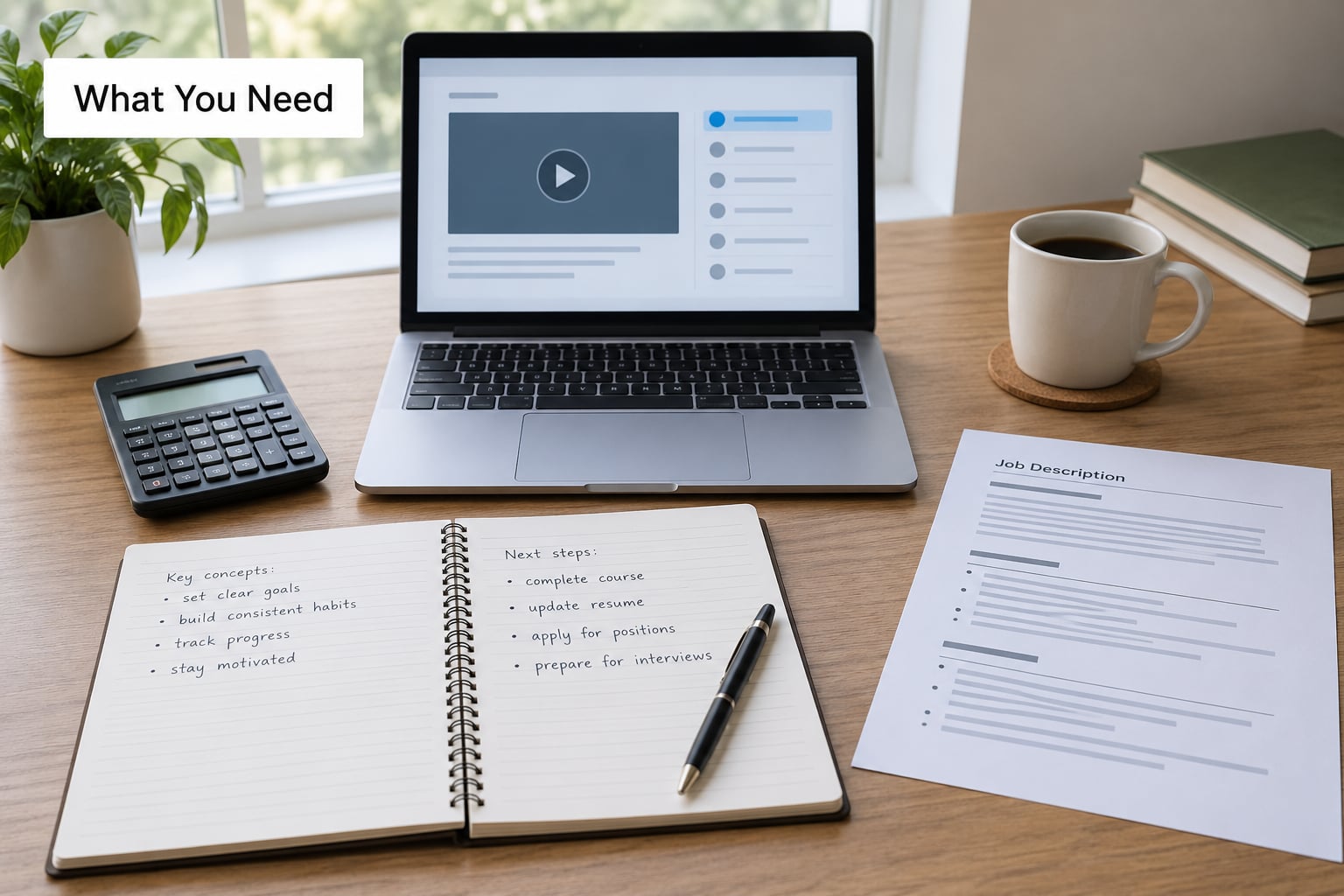
Gather these before you open a single enrollment page, because the evaluation is much easier when you are comparing a program against a real job rather than against its own marketing.
- One target job description. A posting for the role you actually want, with the requirements listed rather than summarised.
- 20 more postings in the same role. Search the job board, save them, and count which skills and which named credentials keep appearing.
- The full curriculum. Module list, syllabus, or a detailed table of contents. A vague “10 hours of content” tells you nothing.
- Provider details. The legal name of the institution, the awarding body, and any accreditor it names.
- The full cost breakdown. Tuition, assessment or exam fees, software subscriptions, lab access, capstone review, and any renewal charge.
- Completion requirements. How many hours per week, how long people actually take, and what you must submit to pass.
- Any outcome claims. Completion rates, placement rates, graduate job titles, or income figures, with the date they refer to.
- A word processor. You will end up writing to the provider, and the reply is evidence.
Step-by-Step
Run the checks in order. Each one is cheap, and each one can end the evaluation on its own without wasting the rest of your afternoon.
1. Define the Job or Skill You Want
Start with the outcome, not the credential. Decide which job title you want in eighteen months, then pull twenty postings and list the tools, methods and named certifications that show up more than twice.
That list is your target. Anything on the program page that does not map onto it is decoration. A recruiter on r/paralegal described the effect better than any vendor page can: the certificate is a prompt for a conversation, not the conversation itself, and no employer will fault you for holding one. They will notice a skill claim they cannot question you on.
If the program teaches a subject you do not want to be hired for, drop it here. This is the single most common way people end up with a badge that changes nothing, and it is entirely avoidable.
2. Check the Provider and Accreditation
Find out who actually issues the credential, because the course platform and the awarding body are usually different organisations. A platform may host the lectures while a university, a professional body or a vendor certificate company signs the name on the certificate. Only the second one matters for recognition.
Then confirm that awarding body is real. In the US, search the accrediting organisation in the Department of Education’s Database of Accredited Postsecondary Institutions and Programs at ope.ed.gov/dapip, and cross-check it in the Council for Higher Education Accreditation directory at chea.org. Outside the US, the relevant national quality body and the regulator for that field do the same job.
Two details worth checking while you are there. Accreditation status labels are public, and a provider carrying probation or show-cause status is telling you something important. And an accreditor nobody has heard of, which cannot be found in either register, is not an accreditation at all.
Institutional accreditation covers the whole school. Programmatic accreditation covers the specific course or department, and it is the one that speaks to your subject. A school can be institutionally accredited and still have nothing accredited about the certificate you are buying.
3. Review the Curriculum and Assessment
Read the syllabus rather than the summary. What you want to see is assessment that could have failed you. Multiple-choice quizzes, attendance checks and a final multiple-choice exam describe a course, not a capability.
Stronger signals: a proctored assessment, a hands-on project, a capstone with published rubric, a recorded practical demonstration, or a graded portfolio piece you keep afterwards. That last one matters twice, because the artefact outlives the certificate.
Also check who teaches it. Named instructors with relevant industry experience beat anonymous content teams, and a published rubric means someone decided in advance what competent work looks like.
4. Compare the Total Cost and Time
Add up everything before you compare anything. The tuition figure is rarely the total once you include exam or assessment fees, paid software a job expects you to have, lab access, capstone review and any renewal charge two years out.
Divide that total by the specific skill it buys, then divide it by the hours it takes. A short expensive course in a skill nobody in your region hires for is a worse bet than a longer cheap one in a skill that appears in every posting you saved.
Ask what the credential expires after and what renewal costs. Most short certificates have a shelf life, and in fast-moving fields the renewal cycle becomes part of the ongoing cost rather than a one-off.
5. Look for Real Career Outcomes
Treat completion rates and testimonials as marketing until proven otherwise. Completion rates tell you how many people finished. They say nothing about what happened afterwards.
What carries weight is specific and dated: which employers hired graduates, into which roles, in which region, and for which cohort. Ask the admissions office directly and see whether the reply is concrete or generic. Silence or evasion is itself an answer.
Reddit users have said the quiet part plainly on r/UKJobs: plenty of these courses promise jobs and generally do not deliver, unless the certificate maps to a skill that is genuinely respected and in demand. Ask the provider what happened to the students who finished last year. If the answer is a list of job titles with no employer attached, treat it as unverified.
6. Make a Final Value Decision
Score the program out of six, one point per step you cleared. Six points means enrol. Four or five means enrol only if the cost sits comfortably inside your budget and the skill is one your field actually hires. Three or below means walk away, and consider the free course instead.
Then apply one override. If the program produces a portfolio artefact you will still be showing in three years, it scores an extra point no matter how thin the accreditation story is. Work you can point at beats a logo every time.
The reverse override matters too. If the credential is required by a regulator, a licensing board or a specific employer policy, skip the scoring and check that the program satisfies the requirement. That is the one case where the credential is the point.
Common Mistakes
These are the evaluation errors that cost people the most, and each has a straightforward fix.
- Confusing accreditation with licensing. Accreditation is a quality judgement about a school or program. Licensing is a legal permission to practise. A fully accredited certificate does not let you do a regulated job, and a licence requirement is never satisfied by a course certificate.
- Judging the program by its marketing. Stock photos, countdown timers and alumni testimonials are ads. Correct for this by deciding your evaluation questions before you read the sales page, then answering only those.
- Ignoring the total cost. The headline price is a selling point, not a total. Fix: list every fee, every required subscription and every renewal charge, then divide by the skill rather than by the course.
- Treating the certificate as a replacement for experience. It is a conversation starter with a recruiter, not proof you can do the job. Fix: pair it with a portfolio artefact and expect to talk about the work in the interview.
- Piling up cheap certificates. Six badges in unrelated subjects dilute the page rather than strengthening it. Fix: one or two credentials tied to your target role beat a shelf of them.
- Trusting an accreditor name you cannot verify. If the body does not appear in the official registers, the word accredited carries no weight. Fix: check ope.ed.gov/dapip and chea.org, and the field’s own accreditor, before you pay.
- Enrolling under deadline pressure. Sales countdown timers exist because hesitation costs them the sale. Fix: write down a decision date, and only then start the enrolment flow.
Frequently Asked Questions
Is an online certificate worth it if it is not accredited?
Sometimes, and the deciding factor is whether the skill is real and the work is verifiable. Unaccredited credentials from a widely known vendor or a strong industry body still carry weight, because employers recognise the name rather than the accreditation status. Unaccredited credentials from an unknown seller rarely do. Check whether the program requires real assessed work and whether you can point to it afterwards.
Do employers actually recognize online certificates?
Most do, though recognition varies sharply by field and by issuer. Software, data, HR and business credentials are commonly listed in postings because the skills are demonstrable. Clinical, laboratory and licensed trade roles care far less about any certificate and much more about hours, supervised practice and a licence. The format being online matters far less than who issued it.
How can I tell if an online certificate program has good career outcomes?
Ask for placement data by cohort and date, then look for employer names and specific job titles rather than generic claims. Compare what the provider says with what graduates report in forums and on professional networks for the same program. If the provider will not give figures, or gives figures with no employer and no role attached, treat the outcome story as unverified.
Is a certificate better than a degree for getting a job?
For a first job or a career change, a targeted certificate plus portfolio work often moves faster than another degree, because it is cheaper and aimed at one specific gap. For licensed professions and for large employers that filter on degree completion, the degree still wins. Check whether your target postings list a degree requirement at all before deciding, and stack your credential toward one where you can.
How much should I expect to pay for a reputable online certificate?
There is no single figure, because reputable programs range from low-cost vendor credentials to expensive professional exam tracks. Judge the total rather than the headline: add assessment fees, required software and lab access, and any renewal charges, then compare that total against the value of the specific skill in your field. Amounts vary by country and change often, so check the current figure with the provider.
Can I take an online certificate while working full time?
Most people can, provided the program is genuinely flexible and the skill is one they can practise immediately. Look for self-paced delivery with a stated weekly time commitment rather than fixed live sessions. The risk is drift, not scheduling: a course that takes six months of evenings gets abandoned, while one built around four focused hours a week usually gets finished.
Conclusion
Knowing how to tell if an online certificate is worth it comes down to three actions today. Pull twenty job postings for the role you want and count the skills that repeat. Find the awarding body on the certificate rather than the platform that sold it, and confirm it in ope.ed.gov/dapip, chea.org or your field’s own accreditor. Then write down the full cost including fees and renewals before you look at the enrolment button again.
If the program survives all three and the assessment would have failed you, it is worth the money and the evenings. If it only survives on the strength of a logo and a testimonial, take the free version of the course, keep the artefact you built, and spend the money elsewhere.