
A study schedule that works is simple: every task gets a named subject, a fixed start time, and a set session length, placed in hours you genuinely have free. Build it from your real commitments backwards, not from an idealised template, and it takes about 30 minutes a week to maintain.
Most schedules fail for boring reasons, not dramatic ones. They assume eight free hours that do not exist, they say “revise chemistry” instead of “20 questions on bonding”, and they have no slack for a single bad evening. Fix those three things and the rest follows.
Table of Contents
- 1What You Need
- 2Step-by-Step: How to Make a Study Schedule You Can Follow
- 31. List Every Commitment and Deadline: How to Make a Study Schedule Realistic
- 42. Identify Your Most Important Tasks
- 53. Choose Study Blocks That Match Your Energy
- 64. Add Breaks, Meals, and Life
- 75. Build in Buffer Time
- 86. Review and Adjust Weekly
- 9A Weekly Study Schedule Template You Can Copy
- 10What This Looks Like for a Student With a Part-Time Job
- 11Paper Planner or Digital Calendar?
- 12What to Do When You Break the Schedule
- 13Common Mistakes and How to Fix Them
- 14Frequently Asked Questions
- 15How can I focus 100% on study?
- 16How long should each study session be?
- 17How to make a study plan for exams?
- 18Why do my study plans fail?
- 19What is the 1/3,5/7 rule in study?
- 20What is the 3-2-1 rule for study?
- 21What is the 9 8 7 rule for studying?
- 22Conclusion
What You Need

Gather these before you draw a single block. Without them you will be guessing, and guesses are what produce plans that collapse by Wednesday.
- Your assignment list and syllabus. Every due date, weight, and topic list in one place.
- Fixed commitments. Class timetables, work shifts, the commute each way, appointments, sport, care duties for siblings or family.
- A real count of free hours. Track one ordinary week honestly, including the hour you usually waste scrolling, then subtract the slack.
- Your energy pattern. Note when you actually think clearly: early morning, after dinner, mid-afternoon. Most students guess wrong here.
- One planner and a timer. Paper weekly planner or a digital calendar. The timer matters more than the planner.
Step-by-Step: How to Make a Study Schedule You Can Follow
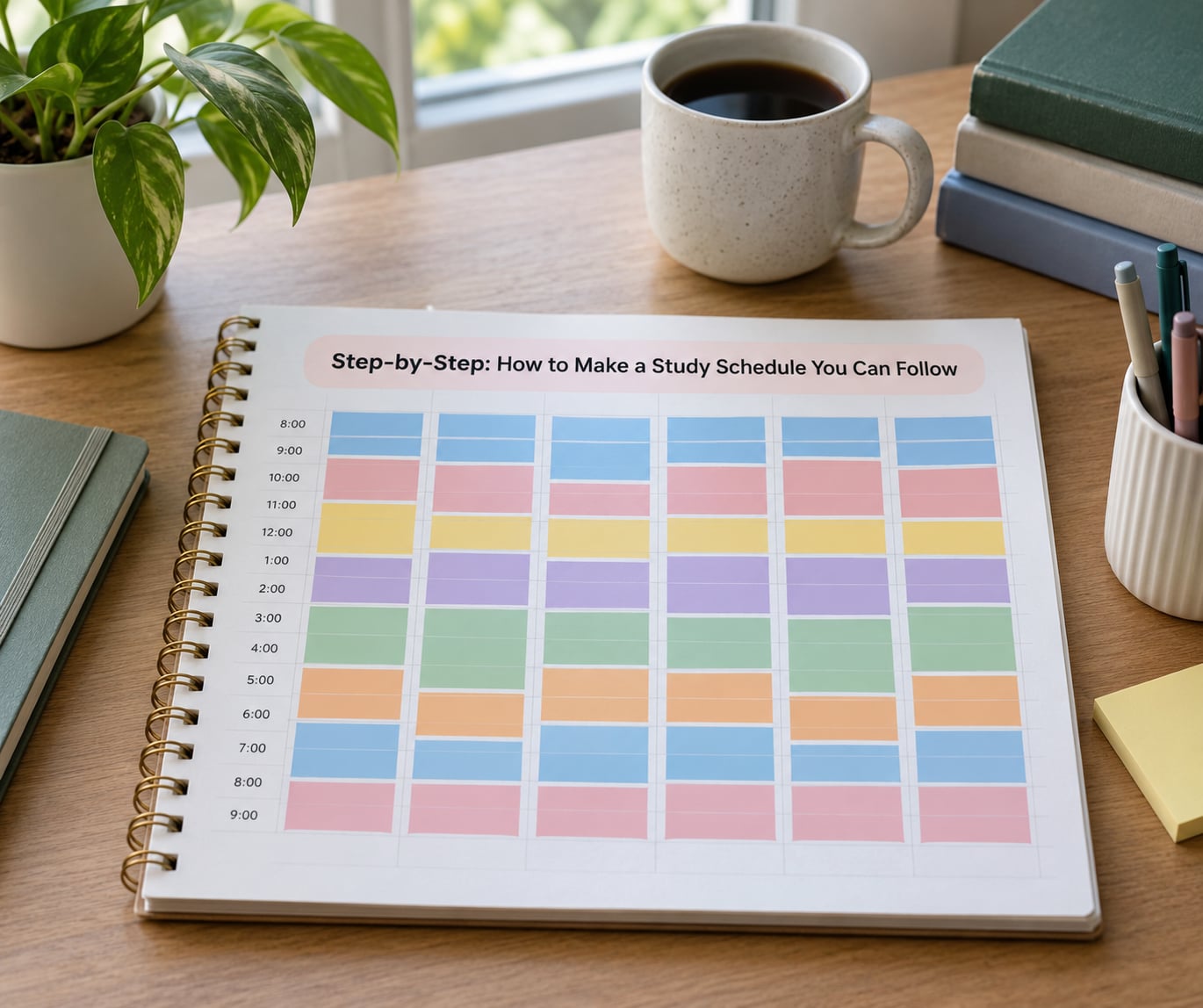
1. List Every Commitment and Deadline: How to Make a Study Schedule Realistic
Put classes, work shifts, travel, meals, sport and appointments on the week first, in ink. These are the immovable anchors everything else has to fit between.
Then add deadlines in date order: essays, lab reports, problem sets, reading, exams. Note which subjects already get study time in class or labs, so you do not pay for that work twice in your own schedule.
It works when you can look at the week and see no collisions and no mystery gaps. If a block is empty and unexplained, it will quietly turn into rest and the plan will drift.
2. Identify Your Most Important Tasks
Rank everything by urgency, how much syllabus weight it carries, and how much effort it takes. A 40 percent essay due Friday outranks a 30-page reading due in three weeks, even if the reading feels heavier right now.
Then break each task into chunks of 40 to 60 minutes with a named output. “Read chapter 4” is a wish. “Write 300 words on the Krebs cycle, referencing the diagram on page 88” is a session you can finish.
Set three priorities per day. Fifteen tasks on a list is a wish list, not a plan, and you will quit by Thursday.
3. Choose Study Blocks That Match Your Energy
This is the single biggest variable in whether a schedule survives, and almost every guide skips it. Match the block length to your concentration, not to your ambition.
| Block | Break | Best for | Suits you if |
|---|---|---|---|
| 25 minutes | 5 minutes | Warm-ups, reading, flashcards, admin tasks | Your focus wanders or you have ADHD or low executive function |
| 50 minutes | 10 minutes | The default: problem sets, essay drafting, note review | Most students on most days |
| 90 minutes | 20 minutes, plus a meal before starting | Hard problem sets, timed papers, first drafts | You can hold focus for over an hour without drifting |
Put your hardest task in your best energy window and let admin, filing and re-reading take the flat hours. A schedule that makes you do algebra at 9pm because that is when the calendar was empty is a schedule you will not keep.
4. Add Breaks, Meals, and Life
Meals, sleep, exercise, travel and downtime are blocks too, not leftovers. Write them into the week at the same weight as a study block and the plan stops asking you to sacrifice something every evening.
Take a break between every study block and use it to move, eat or look out of the window. Twenty-five minutes of scrolling does not count as a break, it just moves the distraction into the gap.
Keep the phone out of reach, in another room or in a bag, for the length of the block. On community study threads the most repeated tip is not motivation, it is putting the phone in another room before starting.
5. Build in Buffer Time
Leave 10 to 20 percent of your waking study hours unplanned. That empty stretch is not wasted time; it is where the overruns, the illness and the surprise deadline from your tutor go. A schedule with zero buffer fails the first week something unexpected happens.
When exams are involved, work backwards from the exam date. Spread the syllabus across the weeks you have, then revisit each topic in shorter passes nearer the date, spaced across days rather than crammed into one. Spacing beats a single long session every time, because recall strengthens when it has faded a little first.
6. Review and Adjust Weekly
Block twenty minutes on Sunday evening for a reset. Three questions: what got finished, what ran longer than estimated, what moved.
Use the real numbers from the week that just happened to build next week’s schedule. Most estimates are wrong by a factor of two on first attempts, so a schedule built on guesses has to be rebuilt on data after week one.
A Weekly Study Schedule Template You Can Copy
Here is the format I would start from. Copy it into a notebook or a calendar, fill in your own subjects, and stop at three study blocks per day.
| Time | Monday to Friday | Saturday and Sunday |
|---|---|---|
| 7:00 to 8:00 | Morning block: hardest subject | Longer revision block |
| 8:00 to 13:00 | Classes, work or appointments | Classes, work or catch-up |
| 13:00 to 14:00 | Lunch and a real break | Lunch and a real break |
| 14:00 to 15:30 | Second block: second priority | Second block |
| 15:30 to 16:00 | Buffer: overflow and admin | Buffer |
| 16:00 to 18:00 | Work, travel or sport | Errands, exercise, rest |
| 18:00 to 19:00 | Dinner, no screen | Dinner |
| 19:00 to 19:50 | Third block: review or flashcards | Optional light review |
| 19:50 to 20:00 | Buffer | Buffer |
| After 20:00 | Downtime, then sleep | Downtime, then sleep |
What This Looks Like for a Student With a Part-Time Job
A student with school until 4pm and a shift at a cafe on Tuesday and Thursday evenings has roughly two usable hours on a normal weekday. Trying to book six hours into that week produces the guilt spiral most people describe: a plan that looks reasonable on paper, gets missed once, and gets abandoned.
The working version is different. Tuesday and Thursday are short days, so they carry one 50-minute block each and no third task. Monday, Wednesday and Friday carry two blocks. The weekend holds the two 90-minute deep sessions for problem sets, because that is the only time with real focus available.
Sleep stays at a fixed hour, and the study blocks stop at 9pm on shift nights even if work could end earlier. The plan wins because it survives the worst week, not because it looks ambitious on a good one.
Paper Planner or Digital Calendar?
| Consider | Paper weekly planner | Digital calendar |
|---|---|---|
| Setup time | Ten minutes a week to copy the week in | None, but blocks take longer to enter |
| Moving a session | Erase and rewrite, or use a sticky note | Drag it in seconds |
| Distraction risk | Low | High, unless notifications are off and the phone is out of the room |
| Reminder nudges | None | Alerts before a block starts |
| Accessible in class | Easy to glance at | Easy, if you can open it quickly |
| Best for | Students who drift when screens are open, and anyone who writes faster than they type | Busy weeks where deadlines shift constantly |
If you use a digital calendar, block the time for the study session itself, not just a reminder to start studying. A notification asking if you are ready to begin is an invitation to ignore.
What to Do When You Break the Schedule
You will miss sessions. Everyone does, and the difference between a schedule that survives and one that dies is what you do in the next 24 hours.
Use the 24-hour rule: reschedule the missed work within a day, before it becomes a backlog. Do not double up two sessions to “make up” time, and do not restart the whole week from scratch on Sunday with grand plans. You will be back in your rhythm within a single session.
Then ask one question: why did it not happen, a real answer rather than “procrastination”? Two evenings a week going to the same commitment, a phone that lives on the desk, or a subject scheduled at the wrong energy time all have a fixable cause.
Common Mistakes and How to Fix Them
Most broken schedules share a handful of causes. Here are the ones I see most often, with the fix for each.
- Overloading one day. You put six hours of study into Tuesday because it had gaps, then miss it and lose the whole week. Fix: cap study at three blocks a day and spread the rest.
- Studying only your favourite subjects. The plan fills with the topic you enjoy and quietly drops the one you are worst at. Fix: give your weakest subject your best energy slot on a fixed day.
- Ignoring sleep. A plan that assumes a 1am finish looks efficient and produces poor recall. Fix: set a fixed sleep time and end study before it.
- Filling every free minute. A schedule with no gaps has no room for a bad day, and one bad day ends the system. Fix: keep 10 to 20 percent as buffer.
- Tasks that are too vague. “Study history” cannot be started or finished, so it slides forever. Fix: every task names a chapter, a question set or a word count.
- No priorities. Everything looks equal, so nothing gets chosen. Fix: rank the day’s tasks and mark the top three.
- Never adjusting. The same plan is reused every week even after your deadlines and workload change. Fix: a 20-minute Sunday reset, every week, no exceptions.
A few things help across all of these. Time blocking works best when the block is visible and named, not buried in a to-do list. Checking something off at the end of a session gives you a record of real timings you can plan from next week. And an accountability partner, even one who only asks how the week went, cuts the number of skipped weeks noticeably.
Students studying with ADHD or low executive function usually need shorter blocks, more visible structure, and fewer decisions per session. A 25-minute block with a timer and one named task beats a vague two-hour plan every time, because starting is the hard part.
Frequently Asked Questions
How can I focus 100% on study?
Nobody studies at 100 percent for hours, and chasing that is what burns people out. Aim instead for one full block at a time. Put the phone in another room, start a 50-minute timer, and write the single task on paper in front of you. Start with the 25-minute version if focus is hard, and take real breaks away from screens between blocks.
How long should each study session be?
Match the block to your concentration rather than to an ideal. 25 minutes with 5-minute breaks suits low-focus days and warm-ups. 50 minutes with 10-minute breaks is the best default for most students. 90-minute blocks pay off for problem sets and timed papers, but only when focus is genuinely strong that day.
How to make a study plan for exams?
Work backwards from the exam date. List every topic on the syllabus, estimate what each needs, and spread it across the weeks available. Revisit each topic in shorter passes nearer the date rather than one long cram session, and leave the final two days light. Buffer time matters most in the week before exams.
Why do my study plans fail?
Almost always for one of four reasons: the plan assumes free hours you do not have, tasks are too vague to start, there is no buffer for overruns, or you never review and revise it. Write tasks as named outputs, cap the day at three blocks, leave 10 to 20 percent unplanned, and rebuild the week each Sunday from what actually happened.
What is the 1/3,5/7 rule in study?
It is a spaced revision guideline: review a topic once a day for the first three days, then around day five, then again near day seven. The gaps between sessions force you to retrieve the material from memory rather than recognise it, which is what makes the knowledge stick.
What is the 3-2-1 rule for study?
A memory technique where you learn something, then close the book and explain it in three sentences, answer two questions about it, and finish with one practical application. The point is retrieval, not rereading, so it works well inside a 50-minute block at the end of a session.
What is the 9 8 7 rule for studying?
It describes a slow nine-week revision arc: new material in the first stretch, then consolidated review weeks, then exam technique practice, then a lighter final week. It is a rough shape rather than a formula, and the useful part is the light final week, which most students skip.
Conclusion
A study schedule that works comes down to four things: real commitments written down first, tasks specific enough to start, blocks sized to your energy, and slack left over for the week going wrong.
So do not start by filling the whole week. Write down every deadline you have, pick your three most important tasks, and place one realistic block in an hour you know is free. Use that block, note how long it actually took, and build outward from there. A schedule you follow imperfectly beats a perfect one that lasts a fortnight.