When your car makes a grinding noise when braking, it is almost always metal touching metal where nothing should be touching. The usual culprit is brake pads whose friction material has worn away, leaving the steel backing plate scraping the rotor with every stop. Sometimes it is a trapped stone, a caliper that drags, or a thin film of rust that wears off after a few stops.
The good news is that most of these are quick to identify once you know what to listen for. The bad news is that genuine metal-on-metal wear keeps damaging the rotor while you keep driving, and that is what turns a simple pad replacement into a much bigger job.
Table of Contents
- 1What Does a Grinding Noise When Braking Mean?
- 2Is It Safe to Keep Driving with a Grinding Brake Noise?
- 3What Causes a Car to Grind When Braking?
- 4How Can You Tell What Kind of Brake Noise It Is?
- 5Listen for the first stop after the car has been parked
- 6Note whether it happens on gentle stops or only hard ones
- 7Compare the start of braking with the release
- 8Listen for one corner
- 9Check for vibration and smell
- 10What Noise Do Worn Brake Pads Make?
- 11Can Rusty or Worn Brake Rotors Cause Grinding?
- 12Surface rust: a nuisance, not a fault
- 13Deep rust pitting: a fault
- 14Grooves, cracks, lipping, and thin rotors: replacement territory
- 15What Should You Check Before Replacing Brake Pads?
- 16How Do You Fix a Grinding Noise When Braking?
- 17Why grinding can continue after a fresh brake job
- 18Grinding Noise While Braking vs. Other Common Car Noises
- 19When Should You Get Brake Service Immediately?
- 20Frequently Asked Questions
- 21Is it safe to drive if my brakes are grinding?
- 22How much does it cost to fix grinding brakes?
- 23Do I need new rotors if my brakes are grinding?
- 24What are signs of bad brake rotors?
- 25Why do my brakes still grind after I got new pads?
- 26Can I fix grinding brakes myself?
- 27Conclusion: Start with the Sound and the Braking System
What Does a Grinding Noise When Braking Mean?
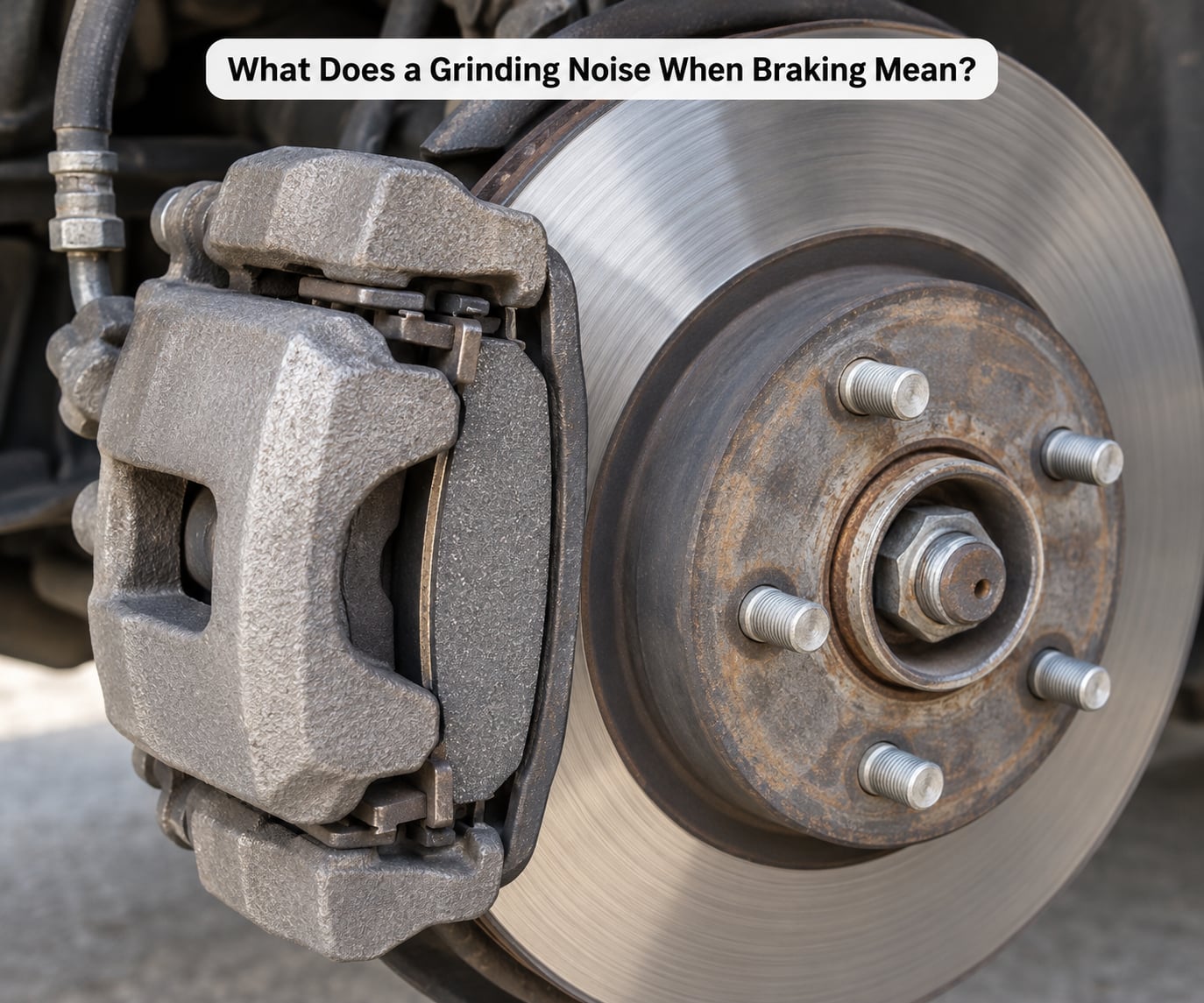
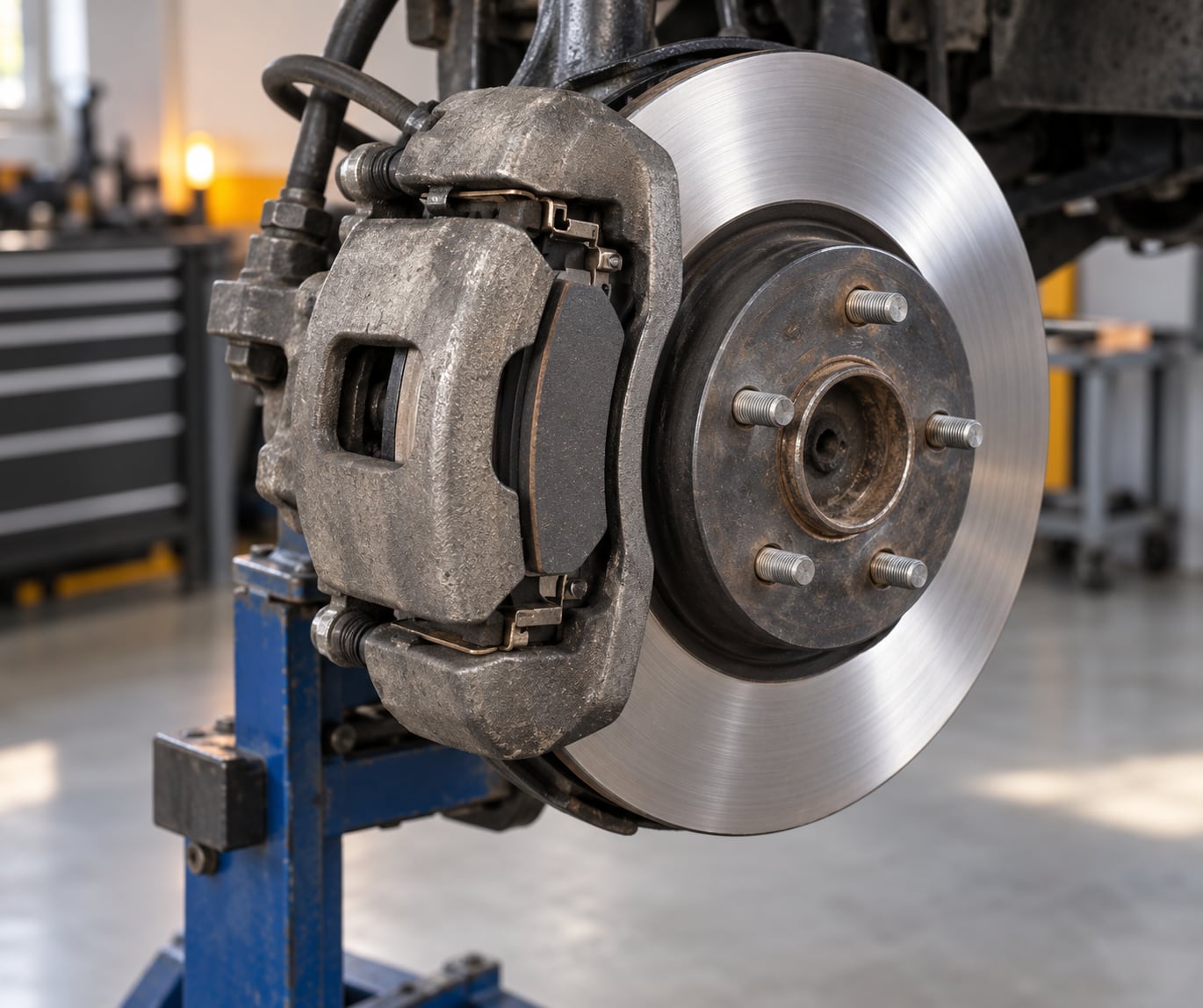
A brake pad is two materials bonded together: a friction layer on the front, and a rigid steel backing plate behind it. The friction layer is the part meant to touch the spinning rotor, and it is the part that wears away over thousands of stops.
Once that layer is gone, the backing plate does the braking instead. It is a harsh, ringing scrape rather than the soft hiss of friction material, and it cuts a groove into the rotor as it goes. That is the sound most people describe as grinding, and it is why a car makes a grinding noise when braking more often than it squeals.
Grinding is not always a dead pad, though. A small stone wedged between pad and rotor reproduces the noise in about a mile and then disappears. A caliper that sticks slightly drags one pad across the rotor and grinds only while you brake. Light surface rust after rain or a week in the driveway gives you a brief scrape on the first stop and then goes quiet.
The distinction that matters is whether the noise is constant and worsening, or occasional and tied to specific conditions. A car makes a grinding noise when braking on every single stop, every single time, and the sound gets louder week to week, and that is a genuine fault worth booking an inspection for.
Is It Safe to Keep Driving with a Grinding Brake Noise?
A short, low-speed drive to a shop is generally fine when the pedal feels normal, the car stops straight, and the noise comes and goes. Continuous loud grinding under braking is a different situation, and the honest answer is that you should not keep driving it. Here is where I draw the line.
Stop driving and arrange a tow if any of these show up:
- The pedal feels soft, spongy, or slowly sinks toward the floor on its own
- Stopping distance feels longer than it used to, or the pedal travels much further
- The car pulls to one side under braking
- You smell hot brakes, see smoke, or notice fluid on the ground under a wheel
- The noise is loud and constant rather than occasional
- You can see a cracked rotor, a damaged wheel, or a caliper hanging loose through the spokes
Why the caution: once the backing plate is scrubbing the rotor, every stop removes more material from both surfaces. A rotor that was fine when the pads went can be scored and thin by the time you get around to booking the work. The friction material that stops your car is also the friction material that was doing the smoothing, and without it the rotor takes the punishment.
That is the amplifier people miss. A pad-only job is straightforward. A pad-and-rotor job on the same axle is significantly more involved, and if a caliper or a suspension part gets dragged into it, the bill grows again. Book the inspection instead of testing the car for another month.
What Causes a Car to Grind When Braking?
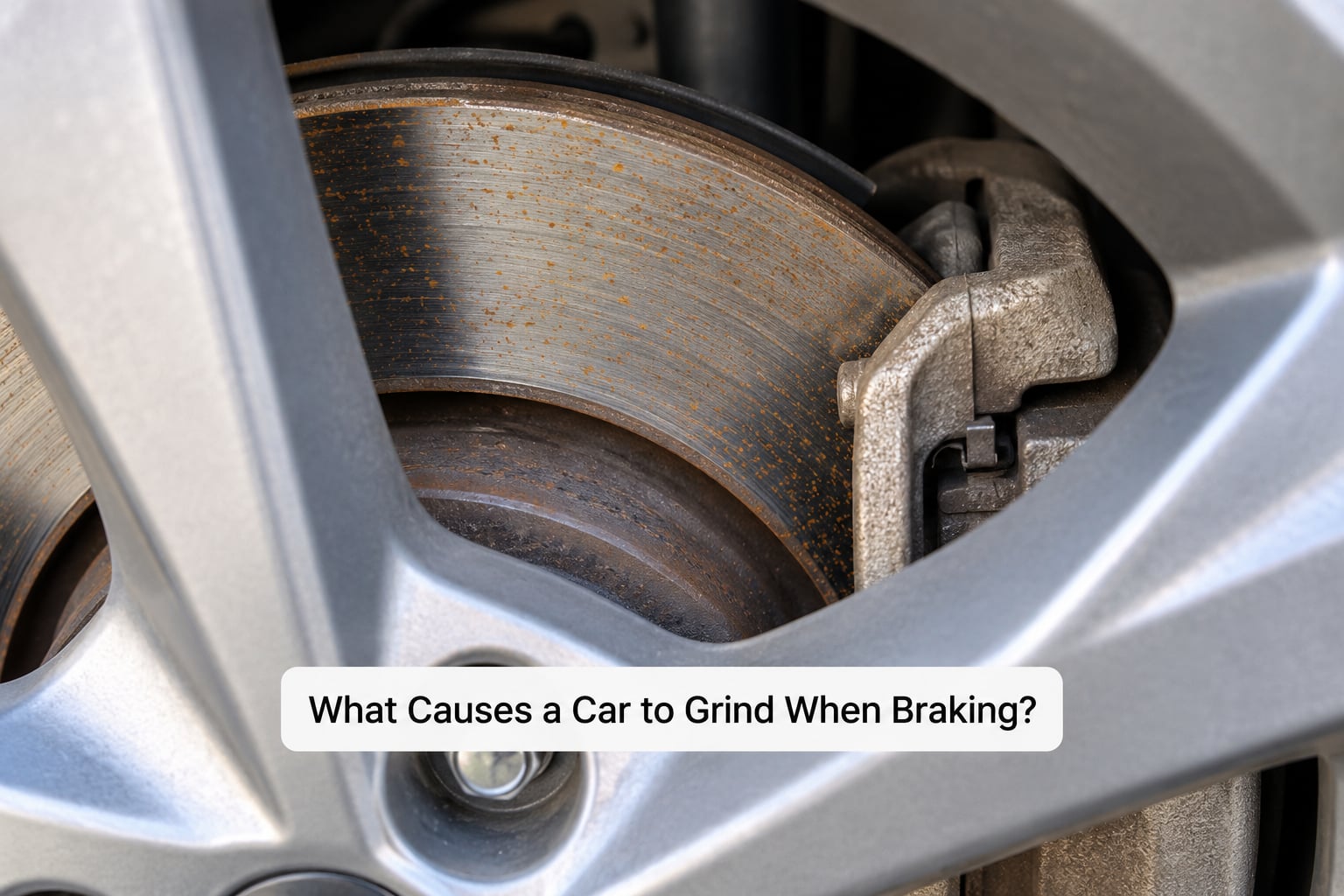
These nine causes cover nearly every case, ordered roughly by how often they turn out to be the answer.
- Worn brake pads. The friction layer is gone and the steel backing plate scrapes the rotor. Continuous, louder as the mileage climbs, often with a burning smell.
- Debris between pad and rotor. A single stone or a piece of gravel wedges into the caliper and grinds until it works itself out. Temporary, and it disappears on its own.
- Surface rust on the rotors. After rain, snow, or several days parked, a thin rust film makes the first stop of the day rasp. A few more stops wear it off and it goes quiet.
- Normal ABS operation. The anti-lock braking system cycles rapidly on a hard stop on a slippery surface, and it can sound like rhythmic grinding or buzzing under the pedal. It disappears on dry pavement and the pedal pulses rather than fades.
- Seized caliper or slide pins. A corroded slide pin stops the pad from retracting fully, so it drags continuously. You hear it as soon as you lift off the gas, before you even touch the brake.
- Warped or scored rotors. Grooved, cracked, or thin rotor surfaces change how the pads grip, which produces grinding, pulsing, or a rumble rather than a clean scrape.
- Loose or missing brake hardware. Anti-rattle shims, pad retaining clips, and caliper bolts left off or installed dry let the pad rattle against the caliper bracket.
- Worn wheel bearings. A dry or failing bearing changes pitch as you turn the wheel, and it often gets louder with speed rather than with brake pressure.
- Suspension components rubbing. Worn control arm bushings, sway bar bushings, or struts can transmit a noise through the same corner of the car and sound exactly like a brake fault.
Items one through four are the ones people search for most. Items five through nine are the ones that get misdiagnosed, usually because the noise is being blamed on brakes simply because it happens while braking.
How Can You Tell What Kind of Brake Noise It Is?
Compare the sound with acceleration, coasting, and braking. The moment it appears tells you more than the noise itself, and you can learn a lot without touching the brakes.
Listen for the first stop after the car has been parked
A scrape that appears on the first stop of the day and disappears within a few stops is rust or debris. A scrape on the twentieth stop of the day is a wear problem.
Note whether it happens on gentle stops or only hard ones
Noise on light braking points at pads or a dragging caliper. Noise only under heavy braking on a slippery road, with a pulsating pedal, is usually the ABS doing its job.
Compare the start of braking with the release
A sound at the moment you first press the pedal is usually pad or rotor contact. A sound that starts when you let go points to a caliper that is not retracting cleanly.
Listen for one corner
Brake noise from a single wheel narrows the cause immediately. Have a passenger roll the windows down and drive slowly through an empty parking lot, stopping gently, to find which corner it comes from.
Check for vibration and smell
A pulsating pedal or steering wheel points to rotor thickness variation. A hot rubber or metal smell after braking points to a pad or rotor that is being cooked rather than used. Note whether the noise changes as the brakes warm up; many pad noises fade once hot.
Do all of this gently and only once. Repeated hard stops to see how loud the noise gets is a good way to damage a rotor that is already marginal.
What Noise Do Worn Brake Pads Make?
Most pads are designed to warn you before they reach metal. A small wear indicator tab built into the friction material is designed to touch the rotor and produce a loud squeal when the pad gets down to a few millimetres, giving you time before the metal makes contact.
That warning is not a guarantee. Plenty of pads have no tab at all, and plenty of drivers treat the first squeal as background noise for a few more thousand miles. That is how a car makes a grinding noise when braking months after anyone noticed the squeal.
The sequence usually goes: a high-pitched squeal at low speed while the brakes are cold, then a harsher rattling or grinding as the pad thins, then a steady metallic rasp that is present at any speed and any brake pressure. Some owners notice the sound fades once the pads are hot, which is normal, and returns again on the next cold start.
One more detail worth knowing: the sound alone does not tell you the rotor is fine. Worn pads drag across the whole braking surface, so a set of pads that has been grinding for a month can leave a rotor that looks acceptable in daylight but is scored past the point a shop will reuse.
Can Rusty or Worn Brake Rotors Cause Grinding?
Yes, but there is a clear line between a temporary surface issue and a mechanical defect, and they sound completely different.
Surface rust: a nuisance, not a fault
A thin film of orange rust forms on a rotor that has been damp and exposed. It scuffs off within a few firm stops and the noise goes with it. A rotor that has surface rust still has plenty of material left, and the noise is a function of the film, not the metal.
Deep rust pitting: a fault
Pitting happens when a rotor sits damp for a long time, or after repeated light braking never gets hot enough to dry it. Pitting is corrosion below the surface, so it does not simply wear away. It stays, it changes the surface the pads ride on, and it can hold a pad off the rotor.
Grooves, cracks, lipping, and thin rotors: replacement territory
Visible grooves mean metal has been removed. A crack means the rotor cannot safely carry heat. A raised lip at the outer edge means the surface is no longer flat. And any rotor measuring below its minimum thickness has no service life left, whether it looks fine or not.
The minimum thickness is stamped on the rotor or listed in the service manual for your vehicle, and that number, not appearance, is the authority. A rotor can often be machined or resurfaced back into spec if enough material remains. Signs of bad brake rotors include a pulsating steering wheel or pedal under braking, a rhythmic rumble that changes with speed, visible grooves or pitting, a raised lip at the edge, clicking when turning the wheel slowly at low speed, and a rotor thinner than its stamped minimum.
What Should You Check Before Replacing Brake Pads?
Pads are the cheapest part of a brake job, so a good technician confirms the pads are actually the problem before ordering them. Anyone who charges you for pads without looking at the rotor surface is guessing.
- Pad thickness and condition against the wear limit in your service manual, plus uneven wear, cracking, glazing, or oil contamination
- Rotor thickness and surface at several points, the machined face for grooves and cracks, and the edge for lipping
- Caliper operation including piston retraction, slide pin movement, and whether the caliper returns fully on release
- Brake lines and hoses for leaks, corrosion, or swelling
- Hardware including shims, pad clips, anti-rattle pieces, and caliper bolt torque
- Wheel condition including lug torque, and for rear brakes, the drum or rotor and wheel cylinder
- Brake fluid level, condition, and moisture content, since old fluid makes a spongy pedal
- Suspension and steering parts on the same corner, because their noise arrives while you are braking
What you can safely do yourself is limited and genuinely useful. With the car on level ground, chocked, and the wheel off, look through the spokes at the rotor face for obvious grooves, heavy rust, or a cracked caliper. Compare the pad against the manual’s wear limit. Check for a burning smell, a hot wheel, or a spot of fluid. That takes twenty minutes and tells you a lot before anyone touches a wrench.
Use the owner’s manual and the manufacturer service specifications as the authority for anything beyond observation. Generic advice about pad life or wear limits varies a lot between vehicles, and the numbers printed for your car beat anything written on the internet, including this.
How Do You Fix a Grinding Noise When Braking?
The repair follows whatever the inspection confirms, in this order.
- Inspect first. Nothing gets replaced until the corner making the noise is identified and the cause is confirmed.
- Handle surface rust. If the rotor is above minimum thickness and only has a film of surface rust, cleaning it and taking a light skim off the surface is usually enough. No part required.
- Replace the pads as a set. Pads are normally replaced in pairs on an axle, and at minimum the two on one corner, because uneven thickness causes the pedal to pulse.
- Replace the rotors if they are out of spec. Scored past the discard limit, cracked, warped, or below the stamped minimum thickness means replacement. They are usually done on both corners of an axle so the car stays balanced.
- Service the caliper. Clean and lubricate the slide pins and pad contact points, replace seized pins or a sticking caliper, and make sure the caliper returns fully.
- Correct hardware and rubbing parts. Reinstall shims, clips, and anti-rattle hardware, torque bolts correctly, and address any suspension or bearing noise found during inspection.
Why grinding can continue after a fresh brake job
This is the most common brake question owners ask, and the title is usually some version of new brakes and still grinding. The pads were new, the rotors were new, and the sound stayed. When that happens, the cause is usually one of these:
- Corroded caliper slide pins that stopped the pad retracting, so the new pad drags too
- Pad hardware left off, installed dry, or fitted incorrectly
- New pads fitted onto old scored rotors, which puts the noise straight back
- A rotor installed already below its minimum thickness
- No bedding-in after the job, so the pads never seated against the rotors
- Only one corner was replaced while the noise came from another
- Control arm bushings, sway bar bushings, or a wheel bearing mistaken for a brake
The bedding-in step is the one people skip. Follow the pad maker’s instructions, which usually means a series of moderate stops from highway speed to seat the friction material onto the rotor, and avoid hard braking for the initial period. Where that step is skipped, the friction layer never fully conforms and owners report the same scrape that sent them to the shop in the first place. The other giveaway is the timing: a noise at the very start of braking or on release, with the pedal otherwise feeling normal, points at the caliper or the suspension rather than the pads.
Grinding Noise While Braking vs. Other Common Car Noises
Metallic sounds near the wheels are easy to mix up. This table separates the usual suspects by when they happen and how they sound, so you can narrow the list before booking anything.
| Source | When it happens | How it sounds | What it usually means and how urgent |
|---|---|---|---|
| Brake pads | Under braking, any speed, worsening over time | High squeal first, then a harsh metallic rasp | Worn friction material. Book an inspection soon; stop driving if the pedal feels soft. |
| Rotors | Under braking, often with vibration | Rasping with a pulse through the pedal or steering wheel, sometimes a rhythmic rumble | Thin, warped, scored, or cracked rotor. Book an inspection; a pulsating pedal with visible damage means tow. |
| Caliper | As soon as you lift off the gas, or continuously | Dragging scrape, sometimes changing with speed or warming up | Seized slide pin or piston. Book an inspection; dragging burns pads and rotors fast. |
| Wheel bearing | With speed, changes as you turn the wheel, not with brake pressure | Whine, growl, or clicking that rises and falls with cornering | Worn bearing. Book an inspection; a rough bearing near a brake can damage the seal and fluid. |
| Suspension | Over bumps, turns, and braking load changes | Clunk, knock, or rattle rather than a continuous scrape | Worn bushings, sway bar bushings, or struts. Still needs a look, but it is not a brake repair. |
One quick test helps more than it sounds: a noise that ignores the brake pedal completely is unlikely to be a brake fault. A noise that arrives every single time you press the pedal, and every single time you release it, is.
When Should You Get Brake Service Immediately?
Arrange service the same day, and do not keep testing the car, if you notice any of these.
- Grinding that is present on every stop and getting louder
- A soft, spongy pedal or one that sinks on its own
- Noticeably longer stopping distance
- Pulling to one side under braking
- A burning rubber or hot metal smell, or visible smoke
- Brake fluid leaking under a wheel or into the wheel rim
- Visible cracks in the rotor, or a rotor edge badly lipped or gouged
- A wheel that looks loose, a caliper visibly hanging, or a wheel with visible damage
- Vibration through the steering wheel that gets worse as the car slows
Where stopping safety is uncertain, tow the car. A tow costs far less than a collision, and none of the signs above improve by driving another hundred miles. If the pedal feels normal, the car stops straight, and the noise is intermittent, a careful low-speed trip to a shop is reasonable.
Frequently Asked Questions
Is it safe to drive if my brakes are grinding?
A short, low-speed drive to a shop is usually acceptable when the pedal feels normal, the car stops straight, and the noise comes and goes. Do not drive if grinding is loud and continuous, the pedal feels soft or keeps sinking, stopping distance has grown, the car pulls to one side, or you smell hot brakes. In those cases arrange a tow instead.
How much does it cost to fix grinding brakes?
It depends on your vehicle and on how far the damage has progressed. A pad-only job is the simplest and cheapest, while pads and rotors together cost more because rotors are normally replaced on both corners of an axle. A seized caliper, a rotor below minimum thickness, or suspension noise blamed on the brakes all add parts and labour. Get the inspection first, then ask for a written quote.
Do I need new rotors if my brakes are grinding?
Not automatically, but often. A rotor can be reused if it measures above the manufacturer minimum thickness, is not warped, and is not scored past the discard limit. Once metal-on-metal contact has gouged a groove into the surface, or the rotor is cracked or thin, it has to be replaced. Most shops also price pads and rotors together more favourably on one axle.
What are signs of bad brake rotors?
Look for a pulsating brake pedal or steering wheel under braking, a rhythmic rumble that changes with speed, visible grooves or scoring, rust pitting that does not wipe away, a raised lip at the rotor edge, clicking when turning the wheel slowly at low speed, and a rotor thinner than the minimum stamped on its face. Any one of these means the rotor has reached the end of its usable life.
Why do my brakes still grind after I got new pads?
The usual reasons are a seized or corroded caliper slide pin, pad hardware missing or installed dry, new pads fitted to old scored rotors, a rotor below minimum thickness, or no bedding-in after the job. Owners routinely replace pads, rotors, and even calipers and still hear the noise, and in plenty of those cases the real culprit was a suspension bushing rather than the brakes.
Can I fix grinding brakes myself?
Partly. Cleaning light surface rust off a rotor, lubricating caliper slide pins, and checking pad thickness and rotor condition are reasonable jobs with a jack, wheel chocks, and basic tools. Anything involving caliper removal, retracting a piston, replacing hardware, or correcting a spongy pedal belongs in a shop, where the system gets bled and inspected properly afterwards.
Conclusion: Start with the Sound and the Braking System
Start with the sound, because it carries the diagnosis. Note whether the grinding happens on every stop or only the first one of the day, whether it is worst under hard braking or gentle braking, whether it arrives when you press the pedal or when you release it, and whether it comes from one corner.
Then back off repeated hard braking and get the brakes inspected. Genuine metal-on-metal wear cannot be fixed by driving gently, and the rotor damage it causes is what turns a straightforward pad replacement into a much more expensive one. Only a proper inspection can tell you whether you are looking at pads, rotors, a caliper, a bearing, or a suspension bushing, and that distinction is the whole answer.