To plan a birthday party at home on a budget, pick your total spending limit before you pick anything else, then divide it across food, decorations, activities and everything else. Most hosts finish the whole plan in an afternoon, three to four weeks out, and most of the savings come from three decisions made early.
The one idea that changes everything: hosting at home means the venue line is already zero. That is where the bulk of the money in a rented party comes from, and it disappears the moment you use your own kitchen table.
Planning is roughly 15% deciding and 85% doing the small boring things on time — the guest count, the shopping list, the coat pile. Miss one of those and you overspend. Here is the order that works.
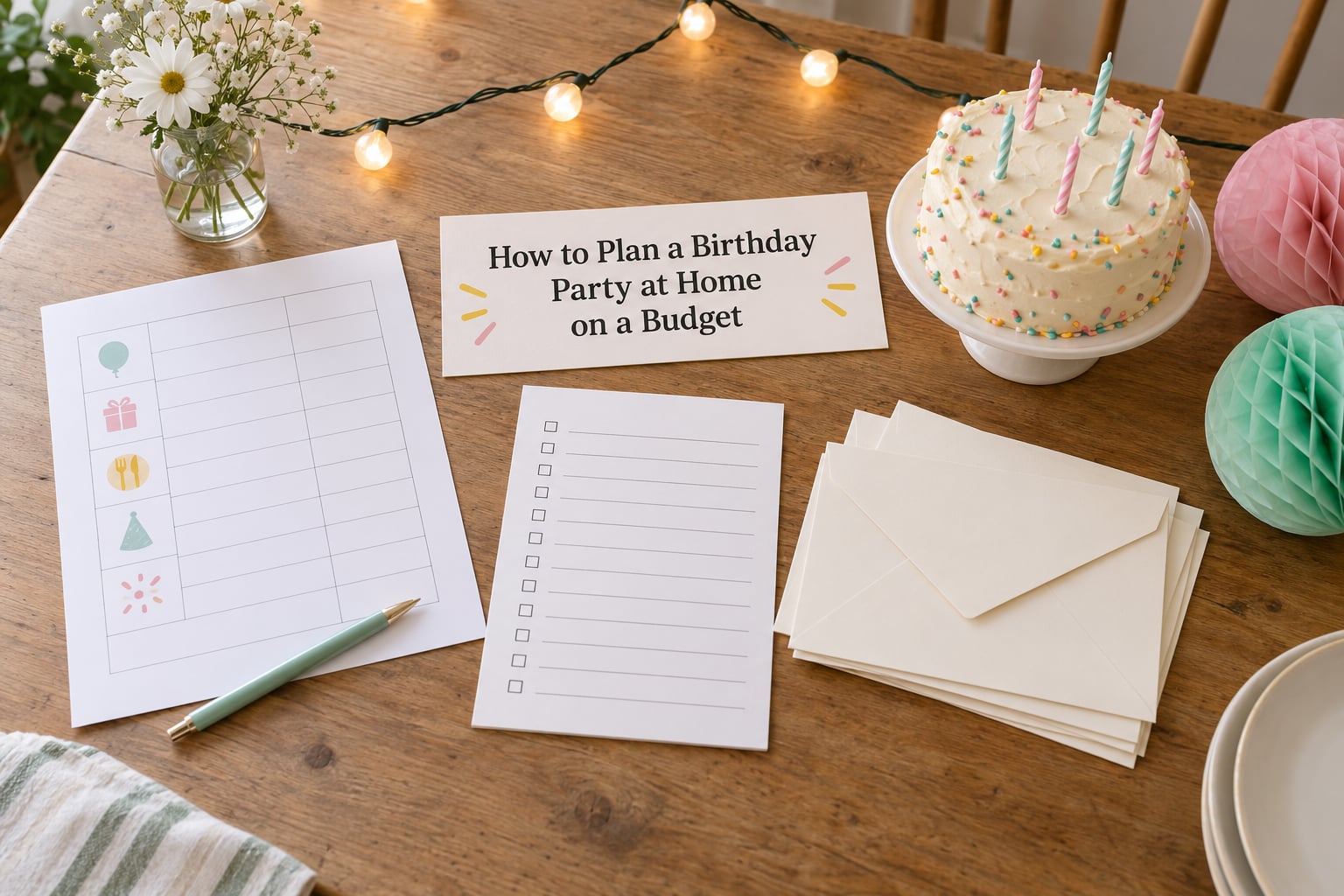
Table of Contents
- 1What You Need
- 2Step-by-Step: How to Plan a Birthday Party at Home on a Budget
- 31. Set the Party Budget and Choose the Format
- 42. Pick a Date, Guest List, and Headcount
- 53. Create a Low-Cost Decorations and Atmosphere Plan
- 64. Plan an Affordable Food and Drink Menu
- 75. Choose Simple Entertainment Everyone Can Join
- 86. Send Invitations and Make a Party-Day Checklist
- 97. Set Up, Troubleshoot Small Problems, and Wrap Up
- 10Common Mistakes
- 11Frequently Asked Questions
- 12How many people can I comfortably celebrate at home?
- 13What is the cheapest food to serve at a birthday party?
- 14How can I celebrate a birthday at home without buying a cake?
- 15How much should I budget for a home birthday party?
- 16What decorations are cheapest for a birthday party?
- 17How do I keep food and drinks organized during a home party?
- 18Conclusion
What You Need
You need very little. Everything below is either paper, something already in your kitchen, or something you borrow from a neighbour. If you can gather the list before you set a date, planning takes about two hours.
- A budget worksheet. One page, six categories, the total you agreed not to exceed written at the top.
- A guest list. Names and numbers on one sheet, with a yes/no column you can fill in as replies come back.
- Invitations sent digitally or printed at home on plain card. A date, a time, an address and an RSVP deadline is the whole message.
- Food and drink for your confirmed headcount, plus roughly a tenth extra for the friend who brings a sibling nobody counted.
- Decorations you already own or make from craft paper — two or three colours is enough.
- A cake or an alternative dessert. Both are worth comparing; a dessert that needs no oven saves more than most people expect.
- Two or three activities that need no paid entertainer.
- Cleaning supplies decided in advance: bin bags, a stack of towels, a stain spray if children and red juice are both present.
- An emergency float — about a tenth of your budget in cash or a saved card that nobody is allowed to spend on the theme.
The other thing to define now is per-guest cost: divide your total by your confirmed guest count, and that single number is the honest price of your party. Every later decision gets compared against it.
| Category | Share of your total | Where the savings are |
|---|---|---|
| Food and drink | 40% | Fewer dishes, not fancier ones. One hot item, one snack, one dessert. |
| Cake or dessert | 10% | Homemade, a grocery-store cake decorated by hand, or a sheet cake cut into squares. |
| Decorations | 10% | Two colours of paper, reused lights, no licensed characters. |
| Activities | 10% | Free games, a scavenger hunt, a craft table from craft-box scraps. |
| Invitations | 2% | Digital, or printed at home on plain card. |
| Favors | 5% | Skip them, or use small printed tags on treats you were buying anyway. |
| Tableware and cleanup | 8% | Reusable plates and cups for anything you already own. |
| Emergency buffer | 15% | Untouched until something actually goes wrong. |
Food is the biggest expense on this list, and it stays that way no matter how clever the rest of the plan gets. That is why step four below spends more words on the menu than any other step.
Step-by-Step: How to Plan a Birthday Party at Home on a Budget
1. Set the Party Budget and Choose the Format
Write down one number and one time limit. A three-hour afternoon party for twelve people with a set total is a finished plan; the same number stretched over six hours and twenty guests is a slow leak.
Split that number into the eight categories in the table, then pick the format that fits your space. A twenty-person afternoon party works in a living room and kitchen. A casual movie night works in almost any space at all. Drop-off parties, where the birthday child and their friends are handed over for a set window and the adults leave, cut the food bill hardest of any format — though they need a clear explanation in the invitation or people read them as rude.
You know step one worked when you can say the guest count, the length and the ceiling out loud in one breath, without doing arithmetic.
2. Pick a Date, Guest List, and Headcount
Choose a date that gives you three to four weeks. Longer feels safer and mostly produces a guest list you did not want; shorter turns every errand into a panic.
Then list guests and send the invitations the same day. Ask for replies by a specific date rather than “let me know”, and set an honest RSVP deadline around a week before the party. Plan food on your realistic number, not your hopeful one, and add about a tenth for surprises.
A useful test: divide the food portion of your budget by your realistic headcount. If a slice of pizza plus a drink costs more than that figure, the menu is wrong, not the guests.
This step is where most overspending starts. When you confirm the headcount early, you buy exactly what you need. When you wait, you buy for everyone you hoped would come, and the food that nobody eats is the most expensive kind.
3. Create a Low-Cost Decorations and Atmosphere Plan
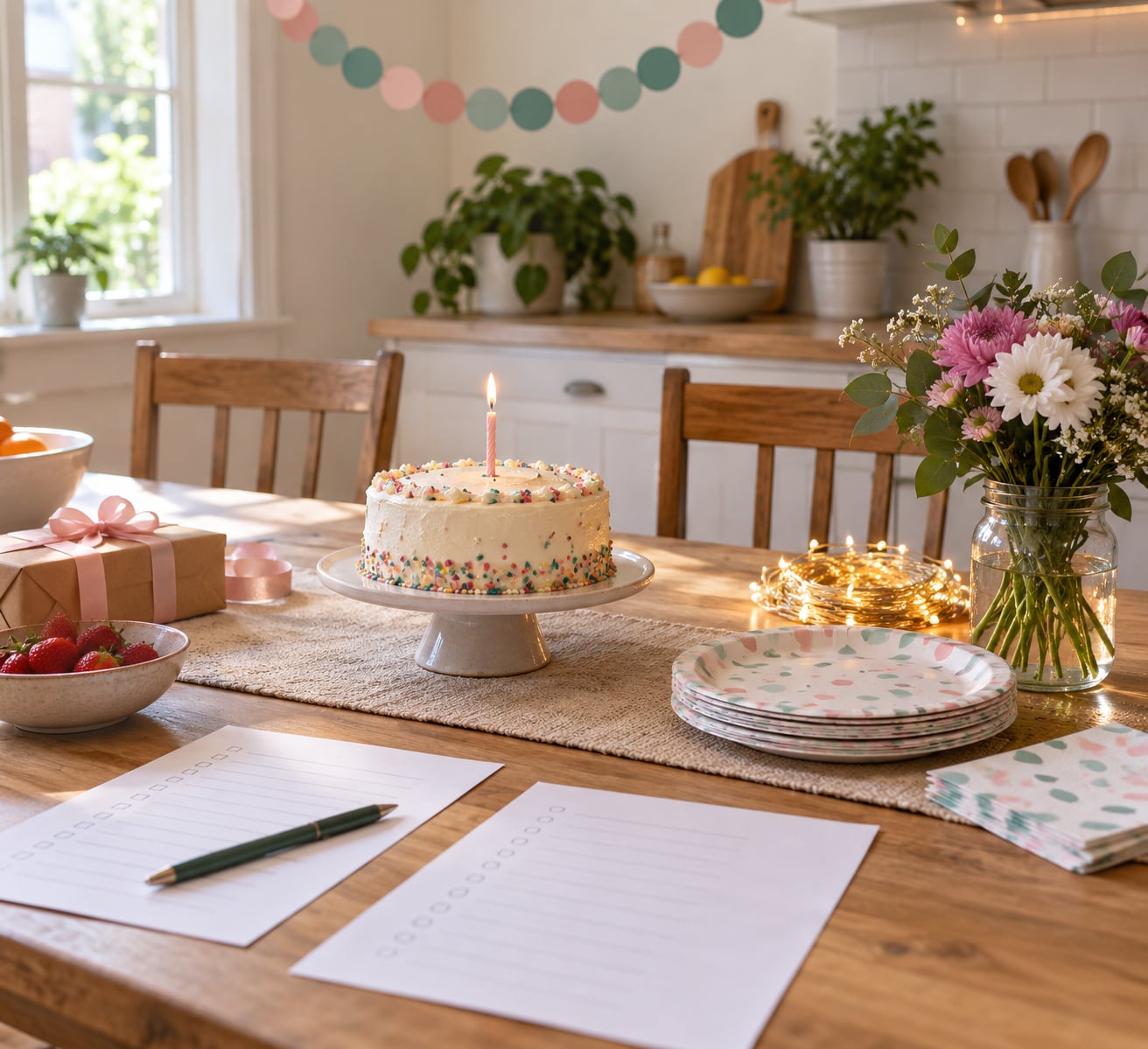
Pick two or three colours and one theme word — jungle, racing, outer space, dinosaurs. Then build the room from what you already have: string lights you use at Christmas, a tablecloth, a jar or two of flowers from the garden, and paper cut into triangles for a banner that takes fifteen minutes.
Balloons are fine in moderation. Tie a handful to a chair or a step rather than attempting a balloon arch, which costs several times as much and collapses the day after.
Build one focal display rather than decorating every surface. A wall of paper flowers, a board covered in birthday messages everyone writes on, or a corner with the cake and the lights is enough for the room to read as deliberate. You want guests to walk in and immediately understand that somebody made an effort, which costs nothing but an hour.
You know this worked when the room looks finished from the doorway. That is the angle most guests see first, and it is the cheapest one to fix.
4. Plan an Affordable Food and Drink Menu
Choose one or two menu categories instead of five. The cheapest reliable combination is a main, a snack board and a dessert, with drinks in a self-serve station so nobody queues for the kitchen.
- Main: homemade pizza with toppings the children assemble themselves, a taco bar, or a baked pasta dish. Assemble-at-the-table pizza doubles as an activity.
- Snack board: crackers, cheese cubes, grapes, popcorn, and goldfish crackers, set out in bowls on a side table so the kids stay off the food table.
- Dessert: a homemade cake, a grocery-store cake you decorate yourself, a sheet cake, brownies, or a bowl of fruit with a candle.
- Drinks: water in a jug, one soft drink, and whatever the adults usually drink, in a cooler out of the way.
For around twelve children this menu feeds everyone twice over, which is the margin you want. Cooking for guests is where the kitchen-hours cost sneaks in, so keep the hot dish to something you have made before.
Ask about allergies when you RSVP, and put the nut-free snacks on a separate tray if anyone needs it. If you are reheating chicken or other poultry, cook it to 165°F (74°C) and hold it hot, exactly as you would for family dinner.
Serve cake at a set time rather than whenever people notice it. Slicing a cake in the middle of a busy room is the single most common cause of a stained shirt and a broken afternoon.
You know the menu worked when you could feed every guest a second helping without a second shop.
5. Choose Simple Entertainment Everyone Can Join
Pick two or three things, not a full programme. More activities than that turns a party into a waiting room between queues.
- Open-floor games: pass the parcel, musical chairs, hide and seek, or a treasure hunt with things you already own.
- A build activity: a craft table with a craft box, tape, string and scissors on a tray, or decorating their own cupcake.
- A watch: a film with popcorn, which suits a rainy afternoon and a small room better than anything that needs floor space.
- Outdoor play if there is a yard, a local park or a quiet street: chalk, bubbles, a ball, scooters, and a timer.
Match the activity to the room. Loud running games need a yard or a park; a living room suits crafts, music and building games. For a crowd of older children, a mystery or quiz with a small prize works better than anything aimed at five-year-olds.
One r/Anticonsumption thread asked for the cheapest genuinely good kids party and the answer was cake, goldfish crackers, fruit, juice boxes, letting them run around, pass the parcel and one piñata. Nobody in that thread mentioned a paid entertainer, which tells you something.
You know this step worked when nobody asks a parent for entertainment, because the kids have already started something on their own.
6. Send Invitations and Make a Party-Day Checklist
Your invitation needs the date, the start and finish time, the address, whether to bring a gift, and the RSVP deadline. Anything else is an extra. Send it from a free phone app or your own email, and print plain cards only if the guest list is small and the occasion suits it.
Two sentences handle the awkward part of a small at-home party: “We are keeping it cosy this year, just the close group, so it is nothing fancy.” Guests worry about the formality of an invitation far more than hosts expect, and that sentence removes the worry.
Then write the party-day checklist on one sheet, in order: shopping, setup before guests arrive, food preparation, arrivals, activities, cake, gifts, cleanup, and the extras you keep in a box. Include the small items people always forget — bin bags, a spare light bulb, a phone charger, more bin bags.
Keep a coat and bag plan in the same list. One of the most-repeated complaints in planning forums is a doorway jam on arrival because nobody decided where 20 coats and shoes go. Pick a room, clear a bench, and say out loud that bags stay there.
You know this step worked when you can hand the list to someone else and they could run the party without asking you a question.
7. Set Up, Troubleshoot Small Problems, and Wrap Up
Set up before anyone arrives. That means the food table and drink station are stocked, chairs are in place, the bathroom is clean, the rubbish and recycling bins are out, and the music is queued. Setting up in front of guests is the worst use of a host’s attention.
Then watch for the four predictable problems. Early arrivals get a small job — a craft, a puzzle, a helper task. Missing supplies get solved with a household substitute, not a trip to the shop. Timing problems get fixed by moving cake earlier or shortening the film. Spills get caught with a towel, not a panic.
Have one backup plan written down: if the weather turns or someone is ill, you move the whole thing indoors and swap the running games for building games. Deciding that in advance means the decision takes ten seconds instead of ten minutes.
For cleanup, the order matters: bin bags filled and tied first, leftover food into containers for the guests to take, then dishes soaked rather than washed, then surfaces, then the bathroom, then the floor last. A bin bag per category keeps it fast.
You know the party worked when nobody mentioned the money, which is the only review that matters.
Common Mistakes
Most budget birthday disasters are the same five mistakes, each with a cheap fix attached.
- Inviting too many people. The guest count drives food, seating, space and tableware, so it is the decision everything else depends on. Fix: set the number first, work backwards from your per-guest cost, and invite to that number rather than to the list of everyone you like.
- Buying decorations too early. Themed banners and balloon arches are bought in a rush weeks ahead, then thrown away after two hours — the most-cited waste in budget party advice. Fix: buy decorations in the final week, in two colours, and reuse anything you already own.
- Overplanning the menu. Five dishes cost more in ingredients, more in kitchen hours and more in leftovers than three. Fix: one main, one snack board, one dessert, and make the main an activity if you can.
- Forgetting dietary needs. Discovering an allergy after the shopping trip forces a second, expensive trip. Fix: ask at RSVP time and put safe snacks on a separate tray from the start.
- Leaving no setup time. Hosts who start decorating an hour before arrival spend the first twenty minutes of their own party in a kitchen. Fix: set up fully before anyone comes, including bins, bathroom and music.
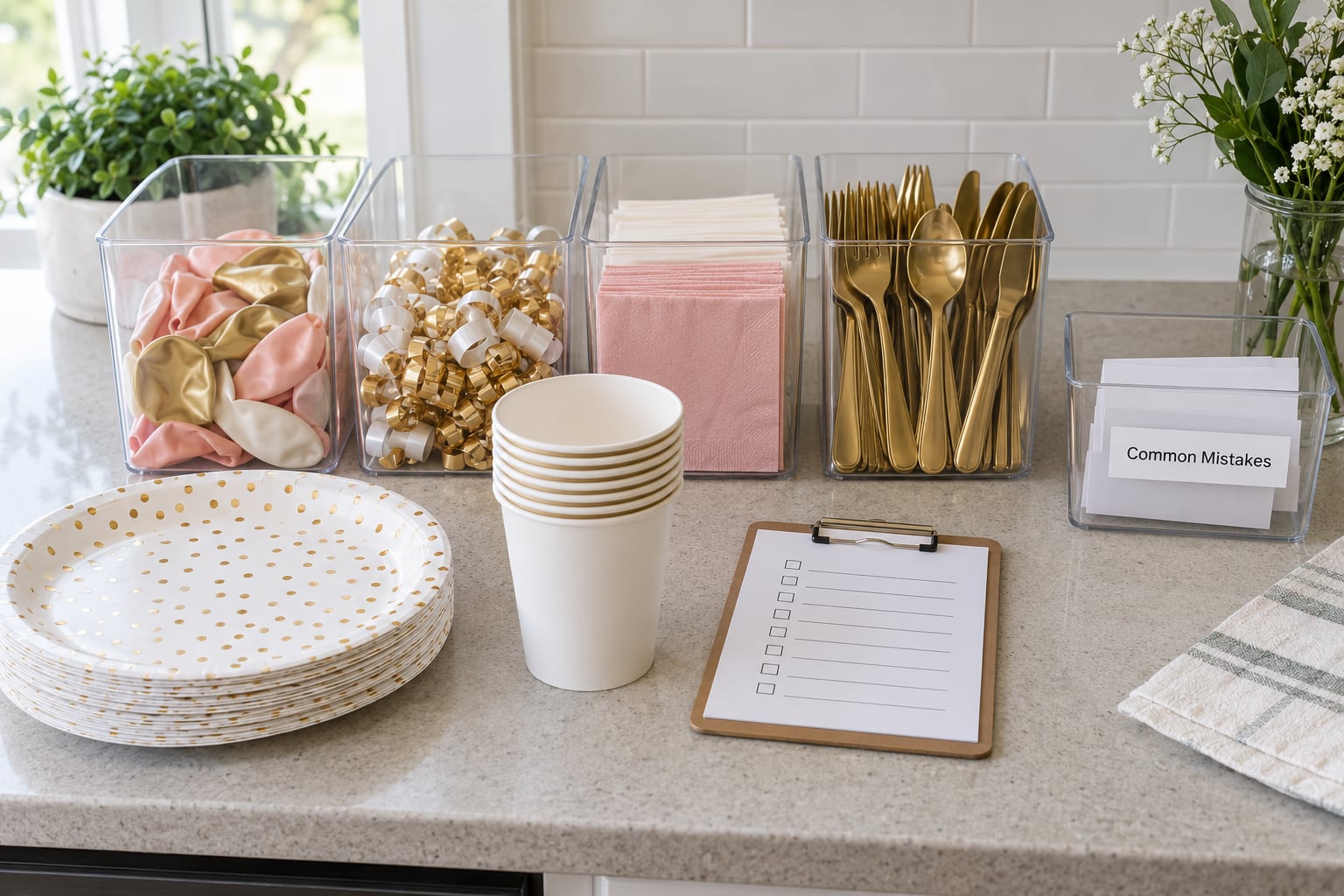
The fastest savings come from a skip list. Do not buy licensed character plates and cups, balloon arches, a piñata paired with a custom cake, themed paper invitations, or goodie bags filled with small toys. One or two of these is a choice; all five is most of a budget gone.
Spend the money you saved on the thing guests actually remember: food, and a cake people sing about. One r/Parenting poster described an under-20 celebration built from reduced-rate movie tickets, a dollar-store banner and balloons, and homemade pizza-making as the activity — and the child never noticed the budget was tight.
Frequently Asked Questions
How many people can I comfortably celebrate at home?
For a three-hour at-home party, twelve to fifteen guests is comfortable in a normal living room and kitchen, with twenty pushing it unless you push furniture back and keep activities seated. Give yourself about one guest per three square metres of usable floor space once furniture is moved, and remember every extra adult eats too. Kids’ parties often need fewer guests than adults expect, and a smaller group plays longer.
What is the cheapest food to serve at a birthday party?
Crackers, cheese, grapes, popcorn and goldfish crackers cost almost nothing and fill small children quickly. Add one hot dish such as homemade pizza, tacos or a baked pasta, then a simple dessert like brownies or fruit. Skip anything that needs an ingredient you would only use once. The snack board does more work than most hosts expect, so make it the thing kids reach for first.
How can I celebrate a birthday at home without buying a cake?
Options that work well: a homemade cake, brownies or a batch of cupcakes, a grocery-store sheet cake you decorate yourself with the decorations you already have, or a bowl of fruit with a candle and a song. For a first birthday, a trifle or a decorated pudding works just as well. The candle, the song and the moment when everyone stops and sings are what people remember, not the recipe.
How much should I budget for a home birthday party?
Work in shares rather than a fixed figure, because costs differ everywhere. A home party typically runs about 40% on food and drink, 10% on cake or dessert, 10% on decorations, 10% on activities, 2% on invitations, 5% on favors, 8% on tableware and cleanup, and 15% as an untouched emergency buffer. Set your total first, split it by those shares, and divide by your guest count for a per-guest figure to judge every idea against.
What decorations are cheapest for a birthday party?
Two colours of craft paper, a jar or two of flowers, string lights you already own and a hand-cut paper banner. Make one focal display instead of covering every surface, and skip licensed character tableware entirely. A board covered in birthday messages that guests write on costs nothing and makes a better photo backdrop than anything you would buy.
How do I keep food and drinks organized during a home party?
Set up a self-serve station: a side table for snacks so children do not crowd the main food, a cooler or drinks table away from the door, and bins for rubbish and recycling within a step of both. Pre-portion snacks into bowls rather than leaving open packets, and put dessert out at a set time. In the kitchen, cook in order of use and keep one dish out for grazing so you are not making food while guests wait.
Conclusion
Start with three things this week, in this order: write your total and split it by the eight categories, confirm the guest count and the RSVP deadline, then choose the menu and the two colours of paper.
Everything after that gets easier, because every later decision has something to measure itself against. Spend what is left on food and the cake moment. Kids remember the running around, not the price tag.