
Finding cheap flights without tricks comes down to four things: how flexible your dates are, how many airports and routes you are willing to consider, when you search, and whether you compare the full price or just the base fare. The tools do the heavy lifting once you give them the right inputs. A full run of this method takes about 30 minutes, most of it spent deciding what you will and will not compromise on.
The reason most people overpay is not bad luck. It is a narrow search. One set of dates, one airport, one site, and a price that was never the lowest one available. Widen any one of those four inputs and the same trip usually costs less, sometimes by a lot.
What follows is the method, in order, followed by the tactics people repeat online that do not move the price at all. Prices, rules and schedules shift constantly, so treat every number here as a planning range rather than a promise.
Table of Contents
- 1What You Need Before You Search for Cheap Flights
- 2Step-by-Step: How to Find Cheap Flights Without Tricks
- 3How to find cheap flights without tricks when your dates are fixed
- 4Use flexible dates and nearby airports
- 5Compare flexible-date fare calendars
- 6Set price alerts and check fare trends
- 7Compare the total price, not just the fare
- 8Book directly when the itinerary is right
- 9Recheck the itinerary before you leave
- 10Common Mistakes
- 11Tips for Getting the Best Practical Fare
- 12Frequently Asked Questions
- 13What is the cheapest way to book a flight?
- 14How early should I book a flight to get the cheapest fare?
- 15Does incognito mode actually get you cheaper flights?
- 16Do flight prices really drop on Tuesday nights?
- 17Can I find cheap flights without knowing where I want to go?
- 18Should I book through the airline or a third-party site?
- 19Conclusion
What You Need Before You Search for Cheap Flights
Preparation is the boring part that decides whether the search works. Five minutes here replaces an hour of tab-switching later.
The trip basics. Origin, destination, and the rough shape of the trip: round trip, one way, or multi-city. Multi-city itineraries from and back to different places are often far cheaper than two separate one-way tickets, and searching them together in one session costs nothing.
Your real flexibility. Write down how far your dates can move in either direction. Most people know it in the abstract and then get annoyed when a search reveals the flexible version is two days earlier and 40 percent cheaper. Decide the window before you look, not after you see a price.
A total budget ceiling. Set a number you are willing to pay for the whole trip, including bags, seats, and getting to and from the airport. The cheapest base fare you can find is frequently not the cheapest actual journey, especially on a low-cost carrier where one checked bag can add more than the fare difference you were chasing.
An alert-capable account. Free fare alerts are standard on the major search tools. Set one up before you start comparing so the alert is already running while you look at other options.
Nearby airports and their ground connections. Know which secondary airports serve your city and how long it takes to reach them. A secondary airport 40 miles away with a cheap flight is only a good deal if the drive, parking, and the trip back still leave you ahead.
Realistic expectations. On a fixed-date, high-demand route like holiday travel or a short-notice international trip, flexibility buys very little. On a flexible trip booked a few weeks out, it buys a great deal. Knowing which type you have saves you from chasing a saving that was never there.
Step-by-Step: How to Find Cheap Flights Without Tricks
How to find cheap flights without tricks when your dates are fixed
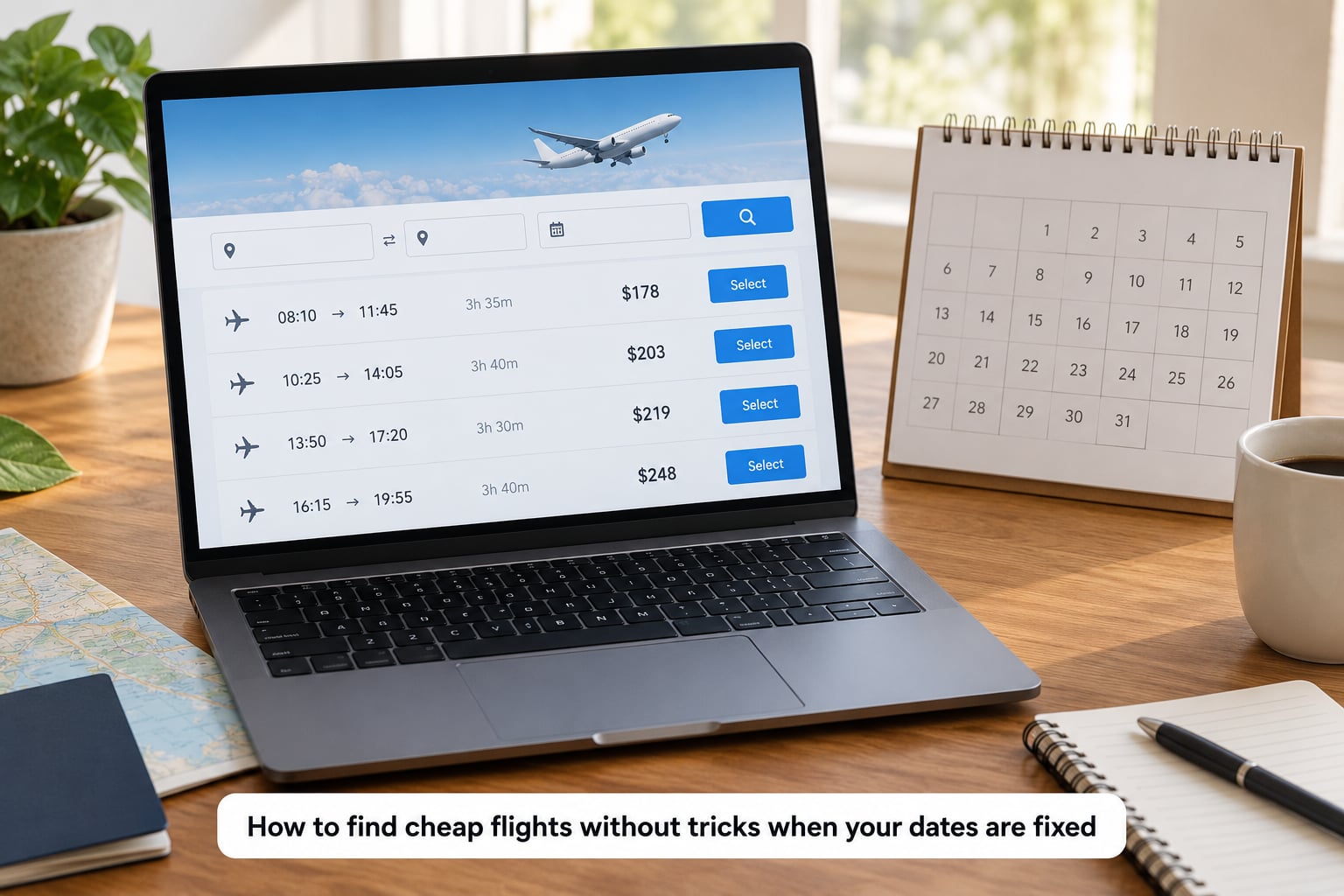
When your dates cannot move, you change the other inputs instead: nearby airports, alternative routes, and the fare rules you are willing to accept. Search a month either side first, even if you will only use the dates you need. That search costs two minutes and tells you whether being locked in is actually costing you anything.
Then widen the route. A flight into a different airport with a ground connection can beat a direct flight from your usual one. A one-stop itinerary with two different airlines is sometimes cheaper than a single carrier’s direct flight, though separate tickets carry a real risk if the first leg is delayed. Check the layover is long enough to recover, ideally two hours or more.
Once you know the fixed dates cost more than the flexible version, that is the end of it. Moving your life to save on airfare rarely makes sense once you price in the change fee, a different hotel booking, and the days you lose at work.
Use flexible dates and nearby airports
Flexibility has two parts, and the airports half is usually the bigger one. Airfare is set per route, so a city with three or four usable airports has far more cheap seats than a city with one. Search each airport as its own origin and compare the total trip cost, not the fare alone.
The test is simple. Take the fare saving, then subtract the extra fuel, parking, tolls, a shuttle or a rental car, and the extra hour each way. If the total still comes out lower, take it. If it washes out, the closer airport was the right answer all along and you saved yourself a long afternoon.
Compare flexible-date fare calendars
A price calendar shows the lowest fare across a month or more at a glance, which is the fastest way to see whether your dates are expensive or normal. Read it carefully: the cheap days on a calendar are usually days where flights are full or badly timed, so the calendar price is not always a fare you can actually book for your schedule.
What you want from the calendar is direction, not a specific date. If the whole month is flat, waiting will not help and your flexibility is worthless on this route. If there is a clear dip, you have a decision to make about which days matter more, and you can make it with numbers in front of you instead of a hunch.
Set price alerts and check fare trends
Fare alerts work best in a narrow window. Set one for a fixed date range two to ten weeks out for a domestic trip, or four to sixteen weeks out for an international one. Outside that range, a fare has usually already moved in one direction and is not going to reverse.
Choose a threshold you would actually book at, not the lowest number on the page. An alert that fires on a fare you would never take trains you to ignore alerts, which defeats the point. Where a tool offers price history or a prediction of whether a fare is likely to rise, treat it as one input alongside your own budget, not as an instruction.
An alert tells you the price moved. It does not reserve anything, and it cannot promise you the lowest fare will ever appear. Book promptly when a threshold you like is hit, and keep going if it is not.
Compare the total price, not just the fare

The cheapest fare on a results page is the cheapest base fare, and the base fare is rarely the total. Before choosing an itinerary, add up everything you will actually pay: checked bags and their per-bag charges, seat or seat assignment fees, boarding order charges, any fare class difference between legs, and the card or booking fees some sellers apply.
Worked example: a base fare that is noticeably lower than the alternatives, with one checked bag and a paid seat assignment, can finish above a higher base fare that includes both. On a short trip with a tight connection, a 90-minute layover that misses you is worth more than the difference you saved, because a missed connection means a rebooking you may have to pay for yourself.
Two itinerary shapes are worth comparing deliberately. One is the cheapest fare with the worst travel time and the least flexibility. The other is a few notches higher with a nonstop, an earlier arrival, and changeable terms. Decide which one you are buying before you start comparing prices, because the cheapest option on the screen will always look like the best option until you price in your own day.
Book directly when the itinerary is right
Once you have chosen an itinerary, check who is selling it and confirm the details before you pay. The seller should show the full airline name, the flight numbers, the dates, the airports, and the baggage allowance for your fare. A page that hides the operating airline or that lists an implausibly low price for a long route is a reason to walk away.
Read the fare rules rather than the headline. Look at what a change costs, what a cancellation costs, whether the ticket is changeable at all, and whether the price includes taxes and fees or adds them later. In the United States, bookings made directly with an airline at least seven days before departure generally carry a 24-hour cancellation or hold option, which lets you confirm the details before you are committed. Use it, then decide.
Keep the confirmation email and take a screenshot of the itinerary. If you have status with the airline or a travel credit card, booking direct is the version that makes problem-solving easier later, because everything sits in one account with one support team.
Recheck the itinerary before you leave
Schedules change, so confirm the flight numbers, times, and airports again a day or two before departure, and again if the airline notifies you of a change. Schedules are also more likely to shift around storms and staffing issues, so check before you leave for the airport as well.
Re-read the baggage allowance rather than assuming, and check whether your fare includes a carry-on at all. Confirm anything you bought separately is attached to the reservation. If the schedule has moved, contact the airline directly rather than the booking site, and keep the reference numbers from your confirmation to hand.
Common Mistakes
Judging fares by search order. Results are ranked by the seller’s algorithm and can include paid placements. The top line is not a verdict on the market. Compare a handful of options and look at the fare rules, not the position.
Booking before you understand the fare rules. A non-changeable basic economy fare with no carry-on can be cheaper up front and worse in every other respect. Know what you are buying before you click.
Chasing phantom prices. If the fare rises after a few searches, that is usually demand and inventory, not personal targeting. Repeatedly clearing your history or switching browsers does not reset anything.
Ignoring the total cost. This is the one that actually costs travelers the most, and it is covered in detail above.
Believing incognito mode lowers fares. It does not. Airlines price by route, demand, and inventory, and they have no reliable way to know it is the same person searching again. Private browsing is fine, but it is a privacy habit, not a pricing tool.
Waiting for a Tuesday-night sale. The idea that fares drop overnight on a particular weekday has been repeated for years without consistent evidence behind it. Airfares move when demand and seat inventory move, and they move at all hours.
Using a VPN to change your apparent location. Prices do sometimes differ by region and currency, but deliberately misrepresenting your location to get a different fare breaks the terms of most sellers and can get a booking cancelled with no refund.
Tips for Getting the Best Practical Fare
Book inside the window, not early. Research on large booking datasets has repeatedly pointed to a narrow sweet spot: roughly three to seven weeks before a domestic trip, and somewhere between two and eight months before an international one. Book too far out and the airline has not released enough inventory to price it well. Book too late and you are shopping the leftovers.
Fly midweek and in shoulder season. Weekday flights, particularly early morning or late evening, usually carry less demand than Friday and Sunday evening departures. January and February tend to be quieter than the summer months and the holiday period, though the pattern is strongest on domestic routes and weaker on long-haul.
Let the route work for you. A longer layover in a bigger hub can cut the fare, and an overnight connection can save you a hotel night. Accepting a red-eye or a five-hour stop is a reasonable trade only if you have somewhere to shower at the other end.
Treat separate tickets as a calculated risk. Two bookings on two tickets with a self-transfer mean no protected connection: if the first flight is delayed, the second airline owes you nothing. It is a legitimate way to save, and it is the one tactic on this list that can cost more than the fare difference if your plans slip.
Skip the mileage detour on your first trip. Points and miles reward people who fly constantly and pay attention to award availability. For an occasional traveler buying their own tickets, a well-timed cash fare will beat a bad award redemption almost every time.
Last-minute fares do exist, and they are uneven. Unused seats on a flight nobody wants to fill are the cheapest inventory an airline has, so a flexible traveler with two options can sometimes do well. A traveler with one date and one destination is not getting a deal, they are getting a fare with no competition left.
Frequently Asked Questions
What is the cheapest way to book a flight?
The cheapest way is usually a comparison search across a few large metasearch tools, using flexible dates and nearby airports, then booking direct with the airline once you have picked an itinerary. Compare the total price including bags, seats and fees rather than the base fare, and book inside the window of roughly three to seven weeks before a domestic trip.
How early should I book a flight to get the cheapest fare?
For most domestic US routes, the best results tend to appear about three to seven weeks before departure. International trips often book best somewhere between two and eight months out. Booking much earlier rarely helps because airlines release inventory gradually, and booking in the final days means taking whatever is left.
Does incognito mode actually get you cheaper flights?
No. Airlines price by route, demand and seat inventory, and there is no reliable evidence that they raise fares for a returning searcher. Private browsing is still a sensible habit for everyday privacy, but it will not change the fare you are quoted.
Do flight prices really drop on Tuesday nights?
The story goes that Tuesday evening bookings unlock a wave of cheaper fares. Large booking datasets have not consistently supported it, and fares move whenever demand or inventory changes, which happens at every hour. Use a price alert and book when it hits a number you like rather than waiting for a particular weekday.
Can I find cheap flights without knowing where I want to go?
Yes, and the tools make it fairly quick. In flexible destination search you enter your home airport and a rough price or month, and you get back a map or list of destinations sorted by fare. Treat it as inspiration, then run a normal search once a destination appeals, because the grid prices are often the least bookable ones.
Should I book through the airline or a third-party site?
Either can be cheaper, and the cheapest itinerary is often sold by several sellers. Book direct when the airline offers a 24-hour cancellation or hold window, since that lets you confirm the details with little risk. Third-party sites are fine when they hold the lowest total price and display the operating airline and fare rules clearly.
Conclusion
Start by deciding how flexible you really are, then search a wider range of dates and nearby airports than feels natural. Compare the total price and read the fare rules before you pay, and ignore every tip that promises a discount for how or when you search. The cheap fare exists. Finding it is a matter of widening the search and narrowing the comparison, not knowing a secret.