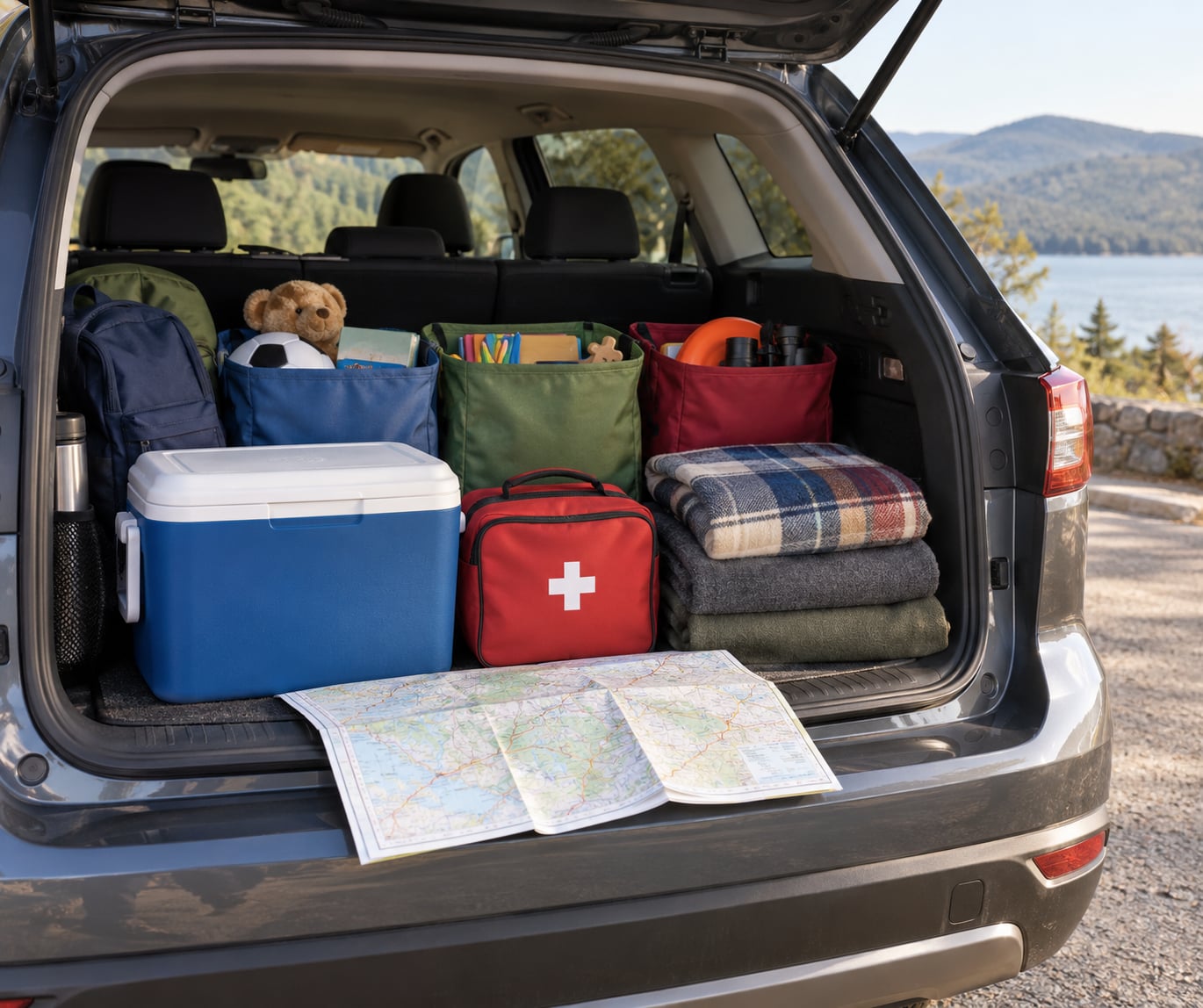
Planning a road trip with kids comes down to one habit: plan the breaks as carefully as the destination. The trips that work best are built from two to three hour driving blocks, each with a planned toilet, snack and movement stop, plus a schedule that assumes twenty to thirty percent more time than your map says.
Get those two things right and the drive stops being dead time and starts being part of the trip. Get them wrong and you will hear “are we there yet” four hundred times before lunch.
Most families can put a workable plan together in an evening once they know what to decide, in what order, and where the buffers go. This guide walks through that order, from the first decision about trip length right through to the moment you pull out of the driveway.
Table of Contents
- 1What You Need
- 2Step-by-Step
- 31. Decide on the Destination and Trip Length
- 42. Build a Route Around Safe Driving Times
- 53. Choose Family-Friendly Stops
- 64. Create a Flexible Daily Itinerary
- 75. Pack for Children and Common Road Problems
- 86. Set a Budget and Control Costs
- 97. Prepare for Delays and Start the Trip
- 10Common Mistakes
- 11Frequently Asked Questions
- 12How long should a road trip with kids be each day?
- 13How often should we stop on a long family road trip?
- 14How do I keep kids entertained in the car without screens?
- 15What should we do if a child gets carsick?
- 16Should we book hotels and attractions before or after planning the route?
- 17What emergency items should every family keep in the car?
- 18Conclusion
What You Need
Before you open a booking site, gather the practical inputs. Having these written down saves the arguments that happen later when someone assumed a four hour drive and someone else assumed a two hour drive.
- Dates and season. Fixed school dates, holiday crowds and weather all shape how long the trip can comfortably be.
- Destination and total driving distance. Measured door to door, including the last stretch from the car park.
- Who is actually travelling. Adults who will drive, and whether there is one driver or two.
- Every child’s age, and their needs. Toddlers who nap at a fixed hour, children who get carsick, sensory sensitivities, allergies, nappies or a booster seat.
- A budget ceiling you can live with. Set before you look at hotels, because the ceiling changes what is realistic.
- How much flexibility you genuinely have. Some families can absorb a two hour delay. Most cannot.
- Documents. Passports or IDs, insurance details, bookings, vaccination records if you are crossing borders, and the car seat manual.
- Emergency contacts and your roadside assistance number. Written down, not just saved in a phone.
- Correct car seats. Fitted and checked in the actual car you will drive, not a borrowed one.
- Offline maps downloaded and a charger cable that fits your car sockets.
If you cannot fill in most of that list yet, keep the trip as a plan rather than a booking. That single check saves the expensive mistakes.
Step-by-Step
How to plan a road trip with kids in a way that survives contact with reality takes seven decisions, done in this order. The order matters because each step sets up the next one. Confirm the trip is manageable before you spend money on anything nonrefundable.
1. Decide on the Destination and Trip Length
Match the drive to the children, not to the holiday dates. A preschooler and a fifteen year old can share a seat in the same car and still need completely different days, so plan for the youngest traveler’s tolerance.
Count total driving hours first, then divide by your realistic daily limit. If the answer lands more than one full day above what you actually want to be in the car, you have two honest options: choose a closer destination, or split the drive across two days with a real overnight stop in the middle. Adding one more hour to a nine hour day does not work. Splitting it does.
| Age band | Comfortable stretch between stops | What breaks it |
|---|---|---|
| Under 3 | 90 minutes to 2 hours | Nappy changes, naps on schedule, need to move |
| 3 to 5 | 2 hours | Boredom and questions, not physical discomfort |
| 6 to 9 | 2 to 3 hours | Need for a toilet, a fight with a sibling, screen fatigue |
| 10 and up | 3 hours or more | Back seat boredom, headphones, needing the toilet |
These are comfort limits, not screen time limits. A child can technically sit still for four hours and still have a miserable trip, which is why the stops matter more than the mileage.
2. Build a Route Around Safe Driving Times
Run at least two route options through a mapping tool and compare them on drive time, number of highways, tolls and where the rest areas actually sit. The fastest route is rarely the one that keeps a tired toddler calm.
Set a hard limit on consecutive driving. Two to three hours is the working ceiling, and you should be able to point at a rest area, a fuel stop or a proper meal break roughly every two hours along the route.
There is a simple rule families on forums keep coming back to, sometimes called the 3-3-3 rule: drive about three hours, take roughly three breaks along the way, and try to arrive within about three hours of your destination. It is not a safety standard, just a rough shape that keeps any single stretch manageable.
Two things that regularly wreck an otherwise good schedule. Time zone changes eat a full hour out of the day without anyone noticing until a child is impossible at bedtime. And traffic around cities can add ninety minutes to a leg your map called two hours, so build the buffer before the drive, not after.
One thing to leave out entirely: any schedule built on children sitting perfectly still for the whole drive. That plan has no failure mode left in it.
3. Choose Family-Friendly Stops
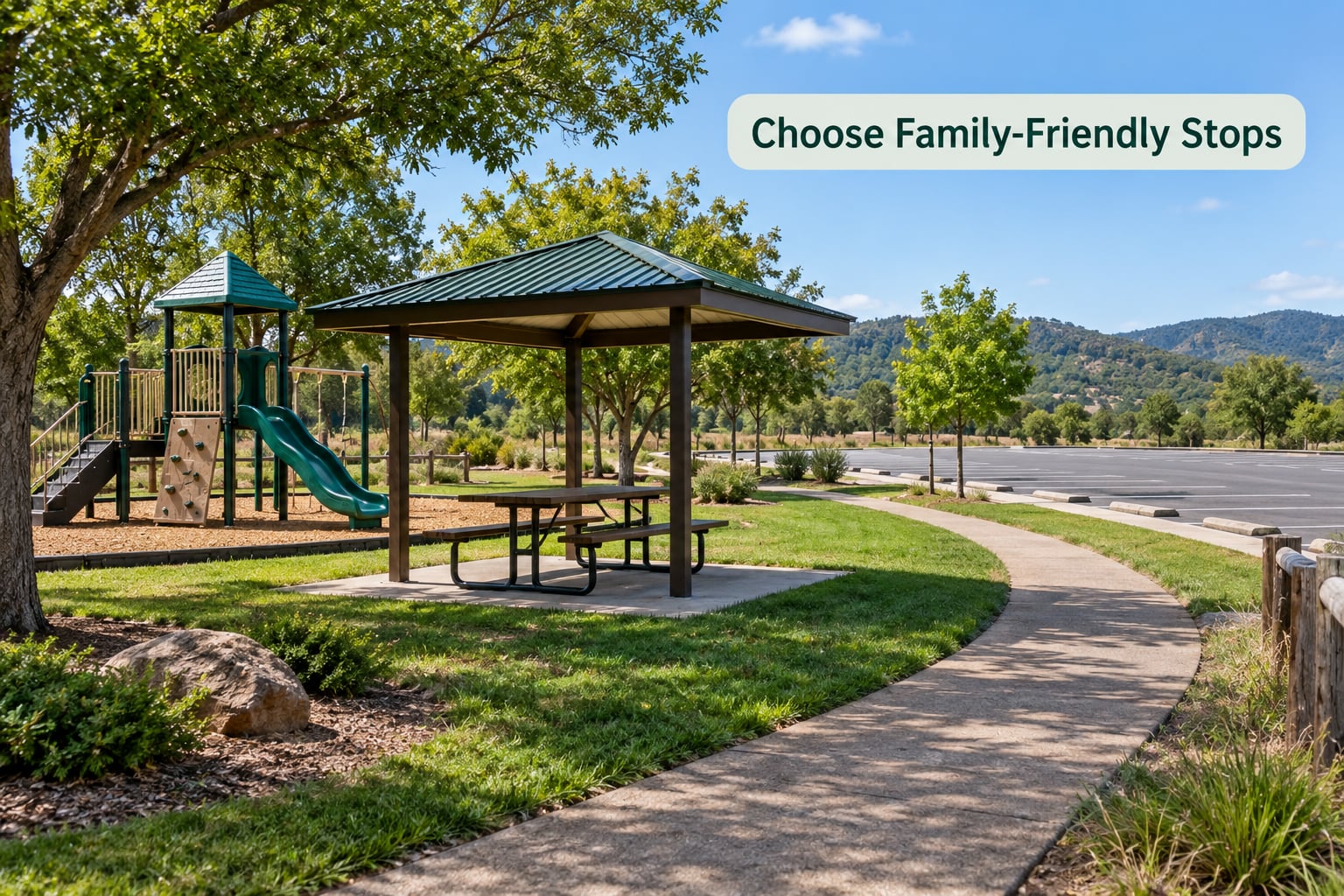
Pick one or two stops worth doing per driving day, not six. A stop that takes twenty minutes and lets kids run, climb or feed ducks resets everyone better than three fifteen minute service station stops.
Good candidates are easy to find and easy to check: a playground just off the route, a short interpretive trail, a picnic spot with shade, a swimming pool or splash pad at a state park, a small science centre in a town you would otherwise drive straight past. Free stops with a bathroom and some open space are worth more than a paid attraction, because everyone moves.
Check three things before you commit. Whether the place suits your children’s ages, whether it has toilets and somewhere to eat, and whether it is open in the season you are driving. Trails close for seasonal work, splash pads drain in autumn, and small attractions shut on weekdays.
You can also let each child claim one stop. That single step buys more cooperation than any amount of explaining, because the trip now contains something they chose.
4. Create a Flexible Daily Itinerary
A workable daily itinerary is short. Aim for six lines: departure time, two driving blocks, a meal break, one main activity, and an arrival time. Anything longer stops being a plan and becomes a pressure.
Add a backup option to every day. Not a backup activity, but a backup version of the day. If the museum is a write-off, the picnic at the park still works. Families who name the alternative out loud before they leave tend to roll with delays far better.
Where the buffer goes is the part most plans get wrong. Add twenty to thirty percent on top of the mapped driving time for any day with a toddler or a long leg. Do not add it evenly across the day, add it to the arrival, so an early problem quietly eats the gap instead of ruining the evening.
Leave the last two hours of the day deliberately soft. Arrivals after dinner are the ones that turn into fussy bedtime, and tired children do not negotiate well with a dark car park.
5. Pack for Children and Common Road Problems
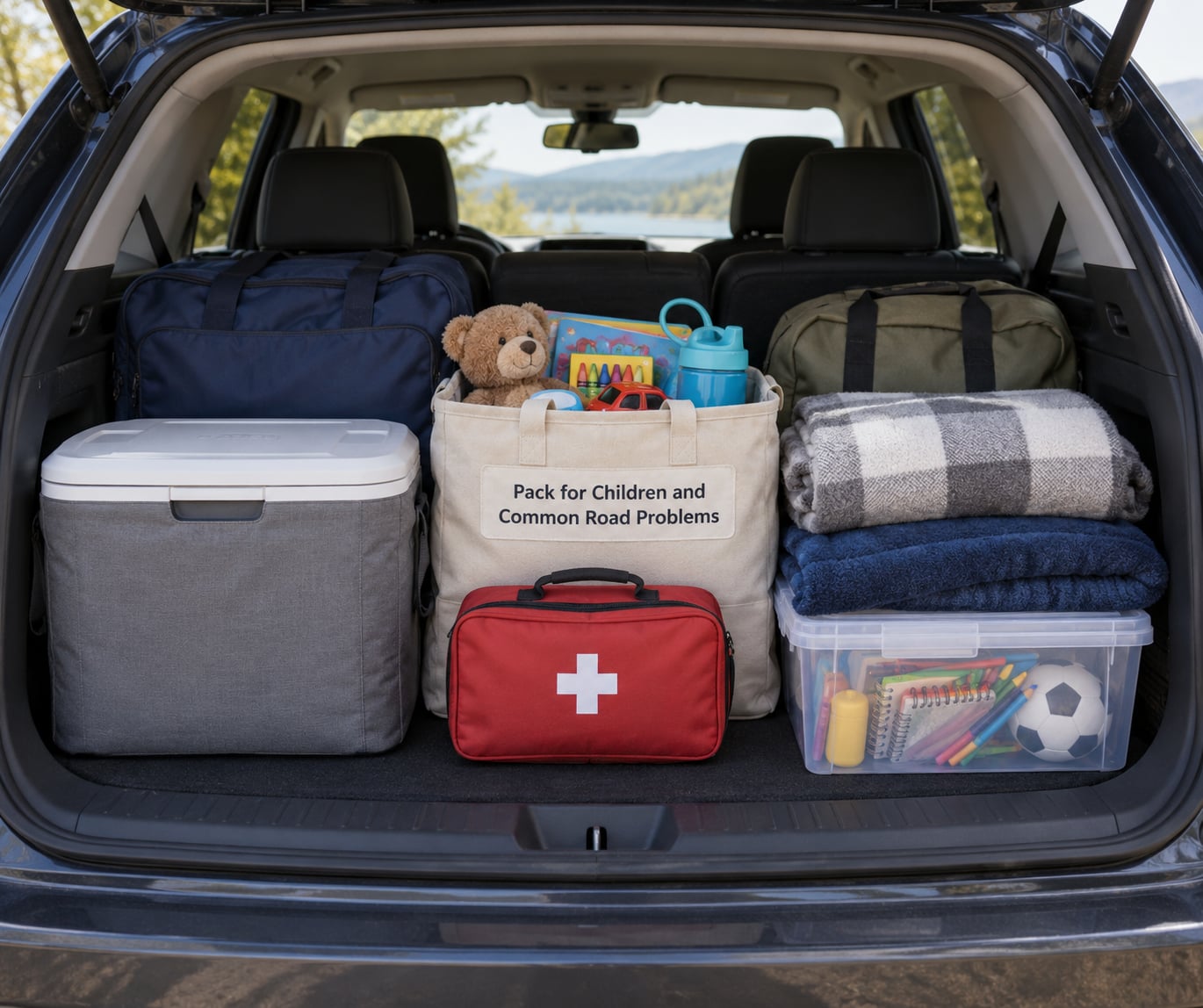
Pack by category rather than by room, and put the emergency items where an adult can reach them without unpacking. A labelled box per child saves a lot of rummaging during a stop.
- Documents and health items. Medication in the original packaging, a child’s list of allergies, a basic first aid kit, any prescription letter, and copies of insurance details.
- Comfort. Two layers more than the forecast suggests, blankets and a travel pillow for quiet time, window shades for strong sun.
- Food and drink. Enough for everyone plus one extra portion per child, water within reach, and snacks you can hand over without stopping.
- Entertainment. An activity box per child, headphones, sticker books or crayons, and downloads rather than streams, because signal drops in exactly the stretches you cannot predict.
- Car seat hardware. The manual, the tool if your seat needs one, and a second set of straps if your car can carry two.
- A roadside kit. Reflective vest, torch, water, basic tools, jumper leads or tyre kit, and a small first aid box that stays in the car rather than in the boot with the luggage.
On snacks, the commonest failure is handing over everything in hour one and then facing a hangry child at hour four. Portion it out into small bags and reveal them across the drive instead.
Keep water flowing rather than waiting until someone asks, especially in warm weather where children often drink nothing for two hours and then feel unwell.
Do not rely on unfamiliar roadside food for infants or for a child with allergies. Those meals solve nothing and can end a day early.
6. Set a Budget and Control Costs
Set the ceiling before you book, then estimate in categories so you know which one is actually eating the money. Prices vary widely by route, season and region, so treat any figure you see as a starting point to check, not a quote.
| Category | How to estimate | Where families save |
|---|---|---|
| Fuel | Total miles, current average price per gallon, and the real-world economy figure | Slower steady speeds, shorter detours, filling up before a cheap stretch |
| Lodging | Nights needed times the room rate in that town and season | Two nights in one town instead of moving nightly, which children also prefer |
| Meals | People times days, plus a roadside allowance | Breakfast from the accommodation, picnic for one meal a day |
| Activities | Admission per child per stop, multiplied by your planned stops | Swapping paid attractions for playgrounds, trails and free town stops |
| Tolls and parking | Route toll estimate plus the parking fees of every town you stop in | Choosing the toll-free route once you have compared drive times |
| Unexpected | A flat percentage of everything above | Nothing. This line is the reason the rest works. |
Trim costs by changing the plan rather than the safety gear. Skipping a nap stop to save fuel is a bad trade, and so is cutting the car seat, first aid kit or roadside kit to make the budget balance.
Moving hotels every night is the quiet budget killer and the mood killer at the same time. Most children do better with two or three nights in one place.
7. Prepare for Delays and Start the Trip
The day before, check the weather forecast for the whole route and for the arrival city, not just your departure point. Check road conditions and closures, then adjust the stops if a stretch is affected.
Share the itinerary with someone who is not travelling. Include the route, hotel names, the car registration, the roadside assistance number and the times you expect to check in. One message, sent before you leave, settles a lot of worry for free.
Inspect the car properly. Tyre pressure and tread, oil, coolant, washer fluid, lights, spare or tyre kit, and a full tank. If something is wrong, you would rather find out in a car park than on a rural shoulder.
Print the itinerary and download offline maps, even if signal has been fine for years. That is thirty minutes of preparation for the one stretch where your phone has no bars and the children are asking when you are stopping.
Then plan for the four things that actually go wrong: a breakdown, a sick child, traffic that adds hours, and children who will not sleep. Each needs only a small pre-agreed response, written down so nobody is deciding in the moment. For breakdowns, pull over somewhere safe, turn on hazard lights, get the children out of the car on the far side and call for help rather than trying a repair in a layby.
On departure, start with a toilet stop every single time, even for a short leg. It prevents the inevitable request ten minutes after you set off, and it gives everyone a chance to stretch before the car is moving.
Common Mistakes
Most family road trips that go wrong share a handful of avoidable causes. Each has a simple fix, and the fix costs nothing.
- Planning more miles than children can sit through. Fix: set the daily limit from the youngest traveler’s table above, then choose a destination that fits inside it.
- Booking fixed activities before checking conditions. Fix: hold off on nonrefundable tickets until road, weather and health conditions are confirmed.
- Over-packing the day. Fix: one main activity per driving day, with a free alternative written underneath it.
- Handing over every snack and toy at once. Fix: portion snacks into small bags and reveal an activity item every hour or so.
- Moving hotels every single night. Fix: two or three nights per town, which cuts cost and calms children down.
- Relying on the phone alone. Fix: offline maps downloaded, a charger cable packed, and a printed copy of the itinerary in the glovebox.
Two more worth naming: leaving the car seat install to the morning of, and skipping meal and rest breaks to claw back time. Both cost you far more later than they save.
A few closing habits that make the biggest difference: leave earlier than you think you need to, overestimate arrival times, force a toilet stop before every departure, and treat a day with fewer meltdowns as a good day. That last one keeps the whole trip from turning into damage control.
Frequently Asked Questions
How long should a road trip with kids be each day?
For most families, four to six hours of driving per day works well, split into two or three blocks with a stop between each one. With a toddler, keep it closer to three or four hours and accept a slower pace. The daily total matters less than the longest single stretch without a break, because that is what wears everyone down.
How often should we stop on a long family road trip?
Stop every two to three hours, and stop more often with younger children. Use that break for a toilet, water, a snack and fifteen to twenty minutes of walking or climbing, not just a fuel top-up. Roughly speaking, plan a stop for every two hours of driving so nobody is waiting until they are desperate.
How do I keep kids entertained in the car without screens?
Rotate a small number of activities rather than a big pile. Spotting games like I Spy or counting cars in a colour work well, as do the Alphabet Game, Story Chain and 20 Questions. Audiobooks, downloaded playlists and sticker books fill quiet stretches, and a reward chart with a small treat at each stop gives younger children something to count toward.
What should we do if a child gets carsick?
Pull over safely and early, at the first sign of nausea rather than the worst of it. A window open for fresh air, a sip of water and lying down usually settles it. Ginger candy and motion sickness bands help some children, though you should check with your own doctor or pharmacist first about anything used on a child. Keep bags within reach and change the seat position if you can.
Should we book hotels and attractions before or after planning the route?
Book after you have settled the route and the realistic daily driving limit, because the route decides which towns you can sleep in. Confirm any accommodation that is nonrefundable only after road and weather conditions are checked. Keep flexible bookings refundable where you can, and hold tickets for activities until you know the trip is running on time.
What emergency items should every family keep in the car?
Keep a stocked roadside kit reachable rather than packed in the luggage: a reflective vest per adult, a torch, water, a basic tool or tyre kit, jumper leads, and a first aid kit with plasters, antiseptic wipes, antihistamines for minor bites and any child prescriptions. Add a power bank, a printed itinerary and your roadside assistance number.
Conclusion
How to plan a road trip with kids comes down to a sequence, not a document: decide the trip length, build a route you can genuinely drive, choose a couple of good stops, write a short flexible itinerary, pack in categories, set the budget, then prepare for what goes wrong.
Start with the one check that prevents most of the rest. Compare the total driving time with your family’s realistic daily limit, using the youngest child’s tolerance rather than your own, and adjust the destination or the number of days before you book anything or pack the car.