
Studying for a certification exam works best when you build your plan from the provider’s official exam objectives, learn each domain with active recall instead of rereading, and test yourself under timed conditions until your score stops moving. Most candidates do the opposite: they read broadly, practice untimed, and hope the knowledge shows up on the day.
That gap is where scores get lost. A certification exam is scored against a fixed blueprint and a pass threshold, not against effort. Knowing how to study for a certification exam means treating it like a performance problem with a deadline, not a reading list.
Here is the process that holds up across IT and cloud certs, nursing credentials, project management and finance exams, and HR or education certifications: find the blueprint, take a diagnostic, study domain by domain with active recall, drill questions without notes, run timed simulations, and rehearse exam day itself.
Table of Contents
- 1What You Need
- 2How to Study for a Certification Exam Step by Step
- 3How to study for a certification exam: Build your baseline
- 4Map the exam content to your study plan
- 5Learn the material with active recall
- 6Practice questions in focused blocks
- 7Take timed full-length simulations
- 8Review mistakes and strengthen weak areas
- 9Plan the final week and test day
- 10Common Mistakes
- 11Rereading notes as your primary method
- 12Cramming the last two days
- 13Ignoring the official blueprint
- 14Practicing without reviewing errors
- 15Studying without a schedule
- 16Skipping sleep in the final week
- 17Frequently Asked Questions
- 18How far in advance should I start studying for a certification exam?
- 19What is the best study method for a certification exam?
- 20Should I study every day or use longer study sessions?
- 21How many practice questions should I answer before test day?
- 22Is cramming effective for a certification exam?
- 23What should I do if I do not know the exam format?
- 24Conclusion
What You Need
You need five things before you plan a single study session, and most of them take an afternoon to gather.
- The official exam outline or blueprint. Every certifying organization publishes one, usually as a PDF listing domains, objectives and their weights.
- Official sample questions. These show you the real question wording and format, which matters more than most people expect.
- Access to practice tests. Providers often include one or two with your study guide or exam voucher.
- A calendar with your test date blocked on it. An unbooked date slides.
- A quiet study location and your reference material. One place, phone in another room, laptop closed unless you are practicing questions.
Requirements vary a lot between certifications, so let the official provider settle any dispute. If a third-party guide contradicts the vendor’s own objective list, the provider wins. That rule alone prevents most of the bad study purchases people regret.
How to Study for a Certification Exam Step by Step
How to study for a certification exam: Build your baseline
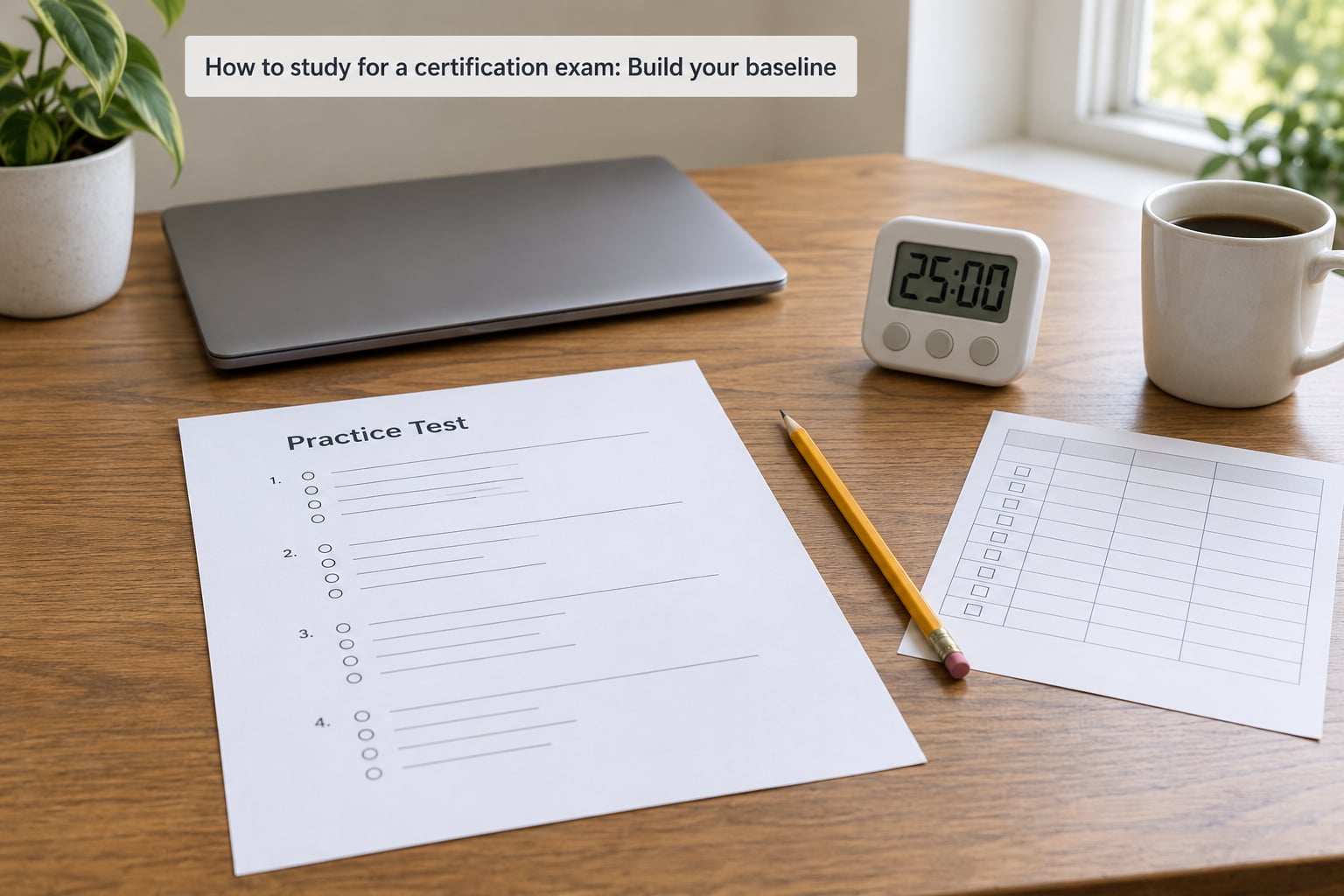
Take a diagnostic practice test before you study anything. Sit down, close the book, set a timer and answer it exactly as you would the real exam.
Then write down three things: your score, the score you need to pass, and the per-domain breakdown. That last one matters most, because a provider will rarely weight every domain equally.
Here is a concrete example. Suppose you score 62% against a 72% passing mark, and the blueprint splits into four domains weighted 25/25/25/25. Your domain scores come back at 40% on the heaviest-weight domain and 85% on the lightest. Ten points below the line sounds hopeless; six points of focused work on the two weakest domains does not.
Write that weakness list down and keep it. You will check it every week for the rest of your preparation, and it is the only honest measure of whether you are improving.
Map the exam content to your study plan
Turn the blueprint into a table with one row per domain and four columns: weight, current score, study hours needed, and status.
Allocate hours by need, not by the order of the objectives. A domain worth 30% of the exam where you score 45% deserves three times the hours of a domain worth 10% where you already score 90%.
Then spread those hours across the weeks you actually have. If a candidate has eight weeks and needs 60 total study hours, that is roughly 8 hours a week, which is about 45 minutes on five weekdays plus a longer weekend block.
Put practice sessions in the calendar before reading sessions. A week with two scheduled practice blocks and three reading blocks will beat the reverse every time, because the practice blocks tell you what the reading should cover next.
Learn the material with active recall
Active recall means producing an answer from memory instead of recognizing it on a page. Recognition feels like learning and is not, which is why candidates can explain a concept on Sunday and freeze on a reworded question on Saturday.
- Flashcards for definitions, port lists, formula recall and the small factual details you always lose points on.
- Self-explanation for processes: explain why each step happens, out loud, without notes.
- Practice problems for anything numerical or procedural.
- Closed-book summaries for structure: one page per domain, written from memory, then checked against your notes.
Use each method where it fits. Flashcards are poor for understanding a workflow and excellent for recall; summaries are poor for memorizing specifics and good for organizing them.
Check retention by testing, not by feeling. If you cannot answer a card correctly three days after making it, it was not learned, only read.
Practice questions in focused blocks
Study one domain at a time and answer questions without notes or a book open. Twenty-five to thirty questions is a workable block for most domains.
Then review every single incorrect or uncertain answer. Not just the wrong ones. A right answer you guessed is still a gap, and it will show up again in a different order on the real exam.
For each miss, write down one line: the cause. Knowledge gap, misread the question, ran out of time, or knew it but forgot under pressure. Those four categories behave differently. Knowledge gaps need more study; time pressure needs pacing work; forgetting needs spaced repetition.
Keep the misses in an error log. After three blocks in the same domain, the pattern is obvious, and the pattern is your study plan for the next week.
Take timed full-length simulations
Untimed drilling lies to you about your readiness. Question count matters far less than whether you can finish a full-length test inside the official time limit.
Run at least three full simulations, spaced across your schedule rather than crammed into the last week. Follow the real procedures: no pausing, no notes, phone in another room, and the same break rules the exam allows.
If your provider offers an online proctored exam, run one simulation under proctoring conditions. The system check, the desk-clearing rules and the camera angle are all things you do not want to discover for the first time while being scored.
Compare your three scores. A rising trend with steady or improving pacing is a good sign. A flat line across three attempts means the method is not changing what you know, and it is time to go back to weak domains rather than keep drilling.
Review mistakes and strengthen weak areas
Your error log is the most valuable study material you own, because it is personalized and built entirely from your own misses.
Re-read it weekly. For each recurring error, go back to the objective in the blueprint and fix the underlying gap properly rather than memorizing the answer to that one question.
Space the revisits out. Day one, day three, day seven, day fourteen. Revisiting a topic five times in one evening teaches very little; revisiting it four times across two weeks is what moves a weak domain to green.
Plan the final week and test day

In the last week, stop adding new material. Review your error log, revisit red and yellow domains, and do one final timed simulation no later than three or four days out.
The night before, do a light 20 to 30 minute review and stop. Set out what you need, confirm your ID and admission documents, check the time zone if you are testing remotely, and test your internet and webcam if a proctor is involved.
On exam day, eat normally, avoid new study material, and skip the coffee top-up if that normally makes you jittery. Know your test-taking strategy before you sit down: answer the questions you know first, flag the ones you are unsure about, and come back with whatever time is left rather than grinding one hard question for ten minutes.
Common Mistakes
Rereading notes as your primary method
Rereading feels productive and transfers poorly. Replace every second reading pass with a closed-book recall attempt, even if it feels awkward at first.
Cramming the last two days
Cramming works for recall of familiar material and does almost nothing for new domains. If you only have two days, spend one on the weighted domains and one on timed practice, not two on reading.
Ignoring the official blueprint
The blueprint tells you what is on the exam and what is not. Studying topics outside it is a direct waste of hours, and it is more common than anyone admits.
Practicing without reviewing errors
A practice test you take and forget teaches you very little. Every incorrect and every uncertain answer gets reviewed and logged. That review step is the actual study.
Studying without a schedule
Unscheduled study expands to fill whatever gaps exist, which on a working week is almost none. Block specific hours in a calendar and treat them like appointments with a client.
Skipping sleep in the final week
Sleep is when the day’s material gets consolidated. Two short nights before the exam will show up in your score, and no amount of extra flashcards makes up for it.
Two more worth naming: using exam dumps, which train recognition of memorized wording rather than recall of the concept and collapse when questions are phrased differently, and collecting resources without finishing one. Pick a primary resource, work it fully, and add a second only when you have hit its limit.
Frequently Asked Questions
How far in advance should I start studying for a certification exam?
Most candidates do best with six to twelve weeks of structured preparation, which is enough time to cover the blueprint, take two or three timed simulations and repair weak domains. Shorter plans work if the exam covers material you already use professionally, longer plans are needed when the content is entirely new. Count backwards from your test date and protect at least three practice sessions in the final fortnight.
What is the best study method for a certification exam?
Active recall combined with practice questions is the most effective combination, because it forces you to produce answers instead of recognizing them. Work one domain at a time, test without notes, then review every incorrect or uncertain answer and log it. Passive reading feels productive and consistently underperforms under the time pressure of a real exam.
Should I study every day or use longer study sessions?
Short daily sessions usually beat occasional long ones for retention, because spaced repetition only works if the spacing is real. A working candidate often does better with 45 minutes on five weekdays plus one longer weekend block than with a single five-hour session on Saturday. Protect consistency first and add length only when short sessions stop producing progress.
How many practice questions should I answer before test day?
There is no magic number, and total count matters less than quality of review. What matters is that you work through enough timed simulations to finish comfortably inside the real time limit, and that every incorrect or guessed answer gets reviewed and logged. Three to four full-length timed simulations, spread across your schedule, is a reasonable target for most certifications.
Is cramming effective for a certification exam?
Cramming helps you hold on to material you already understand, but it does very little for topics you have never studied. Two days before the exam is far better spent on weak domains from your error log and one timed simulation than on new reading. Candidates who cram tend to recognize material on the day and then blank on questions phrased differently.
What should I do if I do not know the exam format?
Start with the official exam objectives page, which lists question count, time limit, question types and whether the exam is proctored. Sit an official sample or practice test under timed conditions before planning further. If the format is still unclear, ask the certifying organization directly rather than guessing from third-party guides that may describe an outdated exam version.
Conclusion
Start with three actions this week: download the official exam blueprint, book your test date, and sit one timed diagnostic to see where you stand.
Everything after that follows from those three results. Candidates who study actively, review every mistake and rehearse the real exam conditions consistently pass. Last-minute cramming rarely does, and it is entirely avoidable with a plan built in advance.