To stay safe in a hotel room, spend the first two minutes checking the door, the locks, the windows and every place a person could hide, then use all of the door’s locks and a secondary barrier each night. Most problems happen because a door stood unlocked or a room was picked because of where it sits in the building, and both are easy to fix. This guide covers solo travelers, business travelers, families and anyone arriving late at night.
It matters more than it sounds. A hotel is the one place on a trip where you sleep unlocked, often alone, in a building you do not control. Staff and contractors have legitimate reasons to knock, so a few habits replace the reassurance of your own front door at home.
Table of Contents
- 1What You Need
- 2Step-by-Step: How to Stay Safe in a Hotel Room
- 3How to stay safe in a hotel room when you arrive
- 4Check the locks, windows, and room entry points
- 5Protect valuables and limit what strangers can learn
- 6Use the room safely while staying there
- 7Respond to disturbances and emergencies
- 8Leave the room safely
- 9Common Mistakes
- 10Frequently Asked Questions
- 11How do I stop someone from breaking into my hotel room?
- 12What is the towel trick in hotels?
- 13What is the most stolen item from a hotel room?
- 14What is the 5’10 rule in hotels?
- 15How can I check a hotel room for hidden cameras?
- 16What happens if I accidentally break something in a hotel room?
- 17Conclusion
What You Need
You need very little, and almost all of it is already in your bag.
- A phone with a working torch and a charged power bank. The torch is how you check corners and under furniture. The power bank matters because a guest room deadbolt sometimes has no working room phone beside it.
- Photo ID and your booking confirmation. Staff should be able to match your face to the reservation before handing over a key. If the name on the key envelope is not yours, say so at the desk.
- Your room key, kept apart from its envelope. The paper sleeve often has the full room number written on it, and it is easy to lose or leave behind.
- Two phone numbers written on paper: the hotel’s front desk number and the local emergency number. Emergency numbers differ by country, so look yours up before you land rather than assuming 911 works.
- Optional: a portable door lock or a rubber door wedge. These add real delay for anyone pushing the handle. No gadget stops a master key, so treat them as a layer, not a guarantee.
Step-by-Step: How to Stay Safe in a Hotel Room
Run the routine in this order, arrival through departure. Most of it takes under two minutes on the first day and about twenty seconds on the rest.
How to stay safe in a hotel room when you arrive
Get the room number written down or shown on the key envelope rather than announced aloud at the front desk, and pocket the key before you turn away. Walk to the room with your phone in hand and glance back once in the corridor; if someone followed you in from the lobby, keep walking past your door to the elevator, come back, and enter while they are still on the stairs.
Unlock the door while standing to one side of the opening rather than in front of it, switch on the bathroom and entry lights, then look before you unpack. A quick sweep from the door outward covers most of what matters: bathroom, curtains, bed, wardrobe, then the far corners.
Ask the desk for a room change without hesitating if something is wrong. A connecting door that does not lock from your side, a window that opens onto a fire escape, or a room directly above an entrance is a reasonable thing to decline.
Check the locks, windows, and room entry points
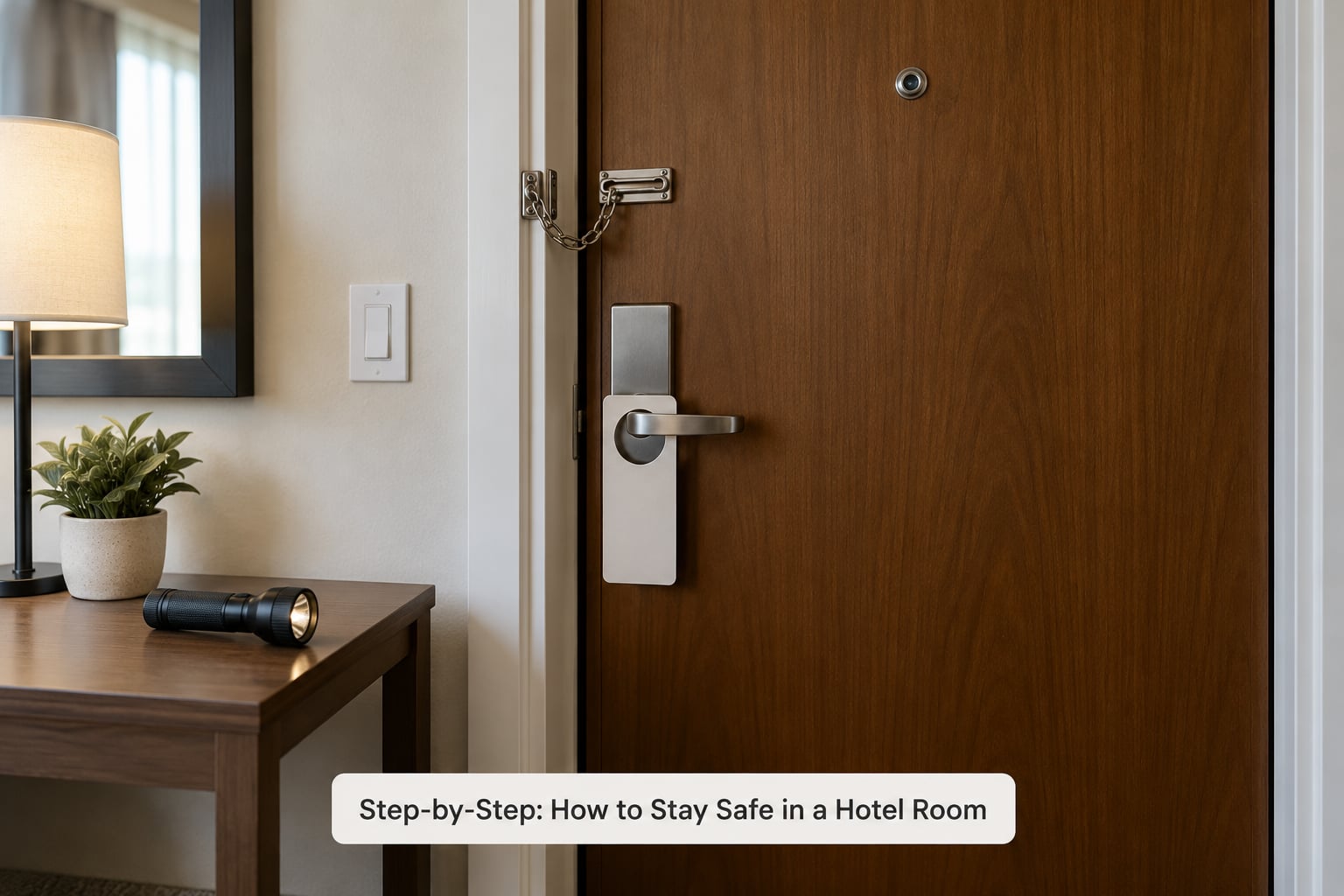
Work through the security features one at a time. Test the main lock and the deadbolt by opening the door and pulling it toward you; both should hold without any force. Check that the security chain or latch catches, and note that it is for a knock-and-announce warning, not for locking someone out. Slide the window latch, the balcony door and any connecting door to an adjoining room and confirm each one actually latches.
Test your key card in the reader before you close the door for the day, since a card that silently stops working is how travelers get locked out of their own bag in the corridor at midnight.
Be clear-eyed about the limit here. Housekeeping, maintenance and the front desk can open most doors with a master key, and no portable lock changes that. What your locks do stop is a stranger walking an unlocked door or forcing a handle, which is the overwhelming majority of incidents.
Protect valuables and limit what strangers can learn
Use the hotel’s front-desk safe rather than the in-room box for passports, cash and anything you cannot replace. In-room safes are convenient and frequently opened with an override or master code, so travelers who care about a document or a large amount of cash usually keep it with them or hand it to the front desk in a sealed envelope and get a receipt for it.
Laptops, cameras and prescription medication travel with you rather than in a drawer. Anyone who gets into the room can open a small safe, and a phone or laptop left visible is a target even when the door was locked.
Do not post your room number, the fact that you are alone, or your travel schedule online. Real chat and location apps can be read by the person you are sitting next to in the lounge, and travel plans shared publicly tend to travel further than you expect. On hotel Wi-Fi, use a VPN for anything sensitive, and connect to the network the staff points you to rather than an open network with a name that mimics it.
Use the room safely while staying there
Find the fire exit on arrival and note the route from your room to it, including whether you would need a key card to pass through it. Learn where the smoke detectors are and check that the one near the bed has a working indicator light.
In the bathroom, use the tub and shower with the mat down, and keep the balcony door closed if you have small children. Check balcony railings if you have a toddler in the room; the gap that stops an adult leaning over is often wide enough for a child to climb through.
Hang the do-not-disturb sign when you do not want interruptions. It signals that someone is inside, which is useful, but it also tells staff not to knock. If you want both privacy and the option of service, ask housekeeping directly to skip the room while you are in it, and confirm the next visit rather than assuming.
Respond to disturbances and emergencies
When someone knocks unexpectedly, do not open the door. Look through the peephole first, and if you cannot identify the person, call the front desk on the room phone or your mobile and ask them to send the person up. Nobody legitimate objects to that check, and a caller who pressures you into opening without being verified is telling you something.
If you are asked to leave the room for maintenance, take your key card, phone and valuables with you and stand in the corridor while it happens. If you would rather not, ask for a written record of the reason and for a supervisor.
For smoke or fire, stay low where the air is clearer, feel the back of doors for heat before opening, and move toward the exit route you identified earlier. Call the local emergency number from outside the building rather than from inside the room. For a medical issue, use the room phone if it works, and give the front desk your exact room number.
If you believe someone is in the room with you, stay calm, move toward the door without confronting anyone, get into the corridor, call emergency services, and wait for staff. Do not touch anything until the scene is settled, then write down times, descriptions and names while they are fresh.
Leave the room safely
Before you go, check behind furniture, inside the wardrobe, under the safe and behind the curtains. Things get moved during a stay, and a phone left on a windowsill is the most common loss reported by hotel guests, ahead of wallets and passports.
Close the window and the balcony door, switch off the air conditioning, and leave the key at the desk only after your bag is with you. Walking out through a well-lit lobby or an attended exit beats a side door that opens onto an empty car park. For a late-night ride, use the hotel’s taxi desk or a ride-hailing app rather than a driver who approaches you in the street.
Common Mistakes
Most hotel-room mistakes are small and repeat the same way. Here is the correction for each one I see most often.
- Unlocking the door for a knock without looking. Use the peephole first, then call the front desk to verify anyone who is not clearly staff.
- Propping the door open with the security chain to carry a suitcase in. The room is unsecured for as long as it is open. Carry the bag in one trip.
- Assuming the deadbolt means the room is locked. Deadbolt engaged, window latched, balcony door closed: check each one separately, since they are separate failures.
- Using only the in-room safe for a passport. Use the front-desk safe with a receipt, or keep the document with you.
- Posting the room number or travelling alone to a bar. Keep the room number on your phone and share plans with someone at home instead of publicly.
- Skipping the fire exit because it is down the hall. You need to know the route while you are calm, not at three in the morning.
These viral door hacks come up constantly, and it is worth being honest about what each one does.
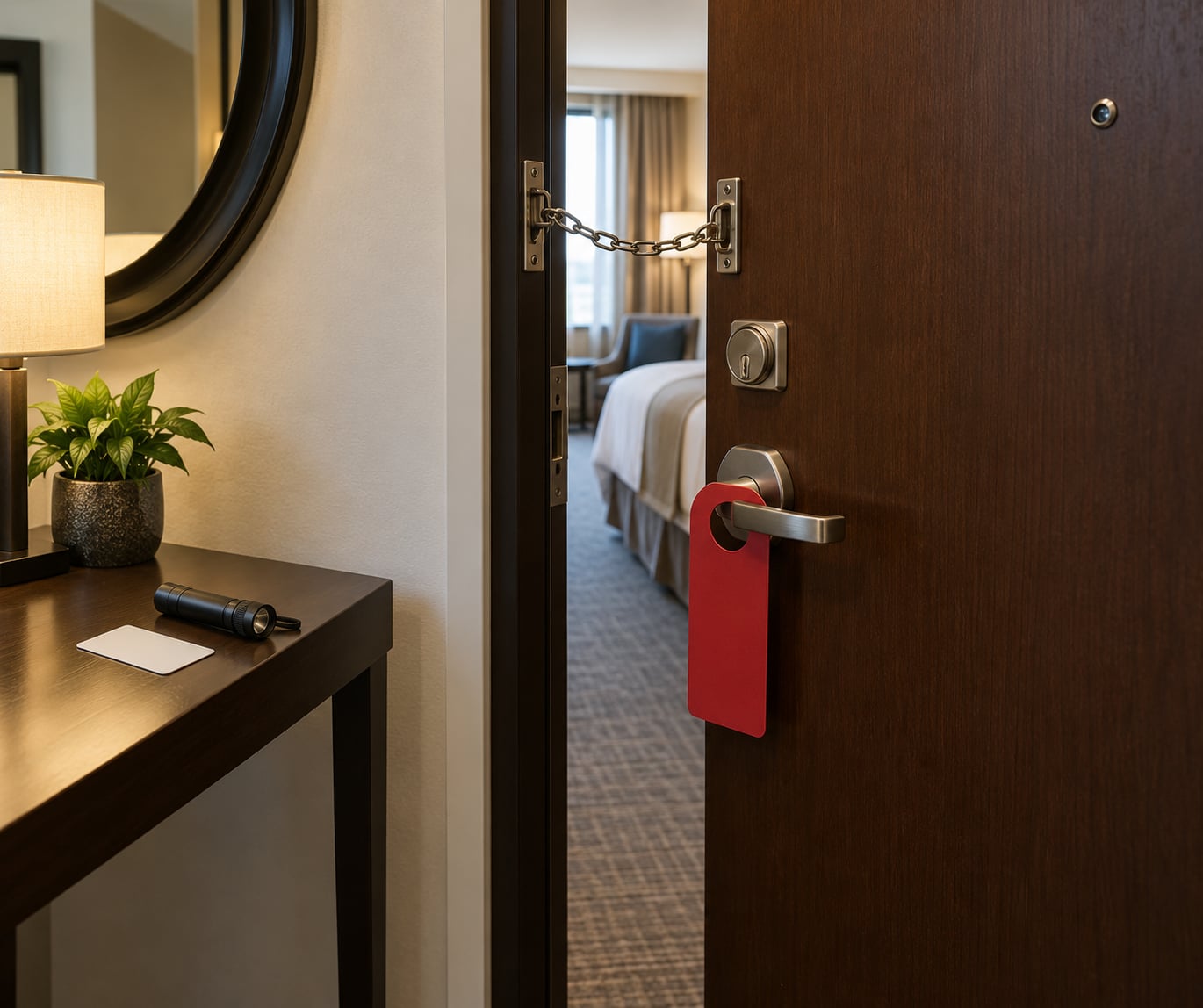
- Towel or clothing hung over the door handle. Warns you the handle moved. It does not lock anything, and a towel across the bottom of the door can block an evacuation route from outside.
- Washcloth wedged in the latch or strike plate. Blocks a shoulder or kick from opening the handle. It adds nothing once the deadbolt is thrown and can jam the door.
- Hanger over the handle and deadbolt. Hardens the handle against prying. Limited value when the deadbolt already holds, and it can obstruct a rescue.
- Cup under the handle as an alarm. Wakes you if the handle is pushed. It takes a real shove to move the handle anyway, so it rarely tells you anything new.
- Tape over the peephole. Stops someone watching you, and stops you using the one tool that helps you identify a visitor.
- Chair or suitcase under the handle. Buys a few seconds. Nobody physically enters through a locked hotel door in daylight.
Before you travel, check reviews for mentions of security, broken locks or staff conduct, and pre-arrange the room preferences you care about. During the stay, do a five-minute version of the room sweep each evening and use the do-not-disturb sign. After the stay, report anything that went wrong to the front desk in writing before you leave the property, because your leverage disappears once you are gone.
Frequently Asked Questions
How do I stop someone from breaking into my hotel room?
Use every lock the door has: the main lock, the deadbolt and the security chain, then add a portable lock or wedge for delay. Keep the connecting door and window latches secured too. Check the reader with your key card before closing the door, and do not prop it open. Most intrusions happen through an unlocked door, not a forced lock.
What is the towel trick in hotels?
It means hanging a towel over the door handle so it falls if anyone pushes the handle from the corridor. It is an alarm, not a lock, and a towel across the bottom of the door can block an evacuation route, which hotels rightly dislike. Use it as a backup warning, never instead of the deadbolt.
What is the most stolen item from a hotel room?
Phones are the item travelers most often report missing, followed by wallets, passports and laptops. Nearly all of it comes from an unlocked or propped door rather than a forced lock, which is why securing the entry points matters more than any gadget. Keep the valuables on your person or in the front-desk safe.
What is the 5’10 rule in hotels?
It is a floor and layout rule of thumb: request a room between roughly the second and sixth floor, away from stairwells, elevators and emergency exits, and never on the ground floor if you can avoid it. The idea is to reduce the routes someone outside can use. Treat it as a reasonable preference, not a guarantee, since buildings differ.
How can I check a hotel room for hidden cameras?
Look at anything that needs a cable or a view: smoke detectors, air vents, thermostat housings, TV screens, USB chargers, alarm clocks and the little clock display on the bedside table. Move objects and check for reflections or a lens that does not belong, and never post about your inspection online. Leave the item in place and report it to management or police.
What happens if I accidentally break something in a hotel room?
Tell the front desk before you check out and ask whether they will note it on your folio. Most ordinary damage is charged at replacement cost, and a small charge is far easier to settle than a disputed bill after you have flown home. Photograph the item before it is moved, and ask for the charge in writing.
Conclusion
Start with the door: confirm the key matches your reservation, lock the main lock, the deadbolt and the chain, and check the windows and any connecting door before you unpack anything. Then put passports and cash in the front-desk safe, learn your fire exit route while you are still calm, and hang the do-not-disturb sign when you want the room quiet. Five quiet minutes at the start of a stay is what makes the rest of it boring, which is the goal.