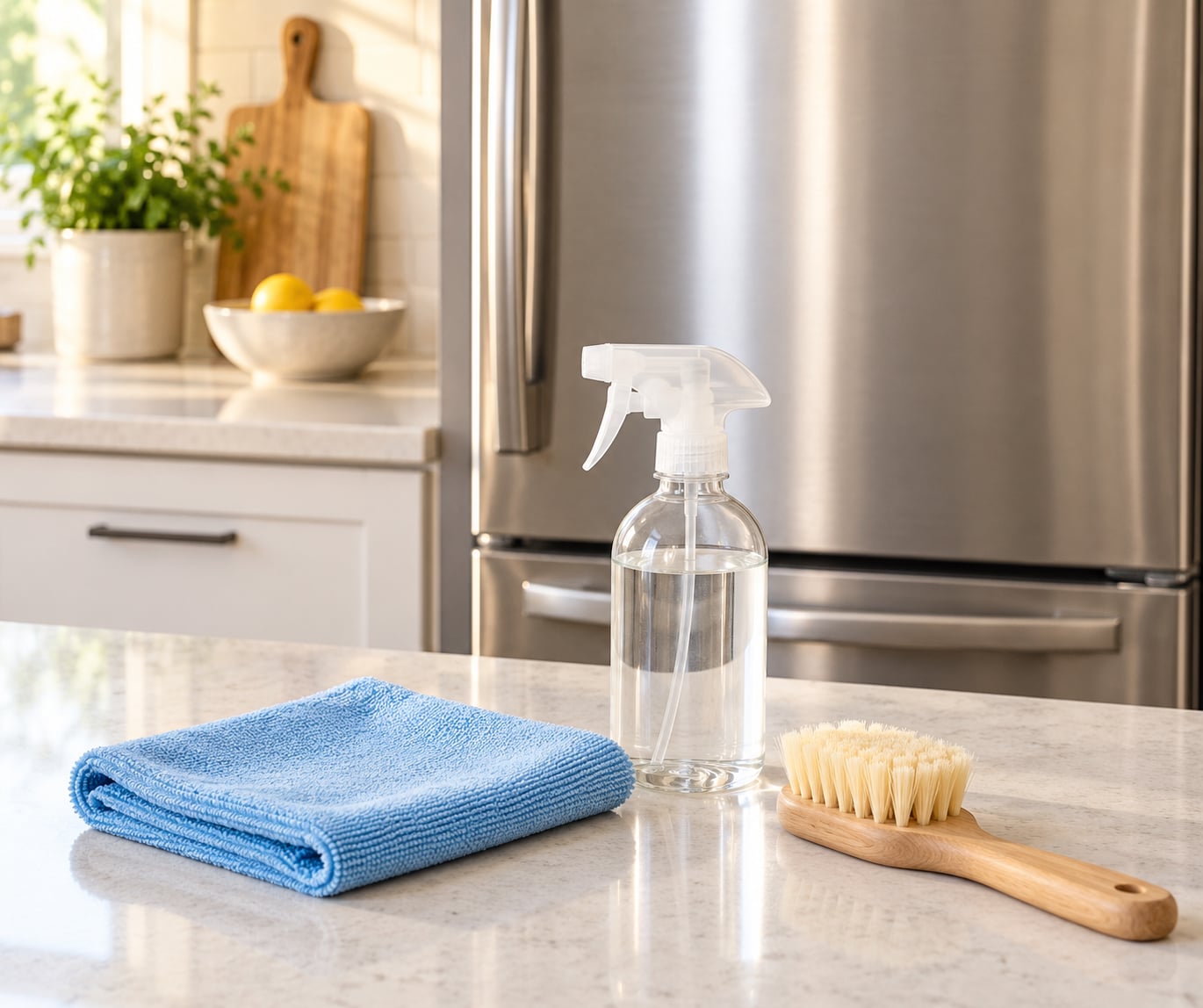
Learning how to clean stainless steel appliances without streaks takes about ten minutes, a soft cloth, and one habit most people skip: wiping with the grain and drying the surface completely. The fastest fix is a 50/50 mix of white vinegar and water applied to a clean microfiber cloth, followed by a dry buff and a few drops of olive oil to bring the shine back.
Streaks are not a sign that your stainless is dirty. They are what happens when water, soap film, or fingerprint oil dries inside the microscopic grooves that run across the metal, and the fix is a method rather than a product. This guide covers what to use, the six-step method, the marks that need different treatment, and how to rescue a surface that already failed a first attempt.
Table of Contents
- 1What You Need to Clean Stainless Steel Appliances Without Streaks
- 2What never to touch stainless steel with
- 3Not every surface is plain stainless steel
- 4Step-by-Step: Cleaning Stainless Steel Without Streaks
- 51. Identify the stainless steel finish
- 62. Wipe away loose dirt first
- 73. Prepare a mild cleaning solution
- 84. Wipe with the grain to clean stainless steel without streaks
- 95. Remove residue and dry the surface
- 106. Buff stubborn marks carefully
- 11Where streaks hide: appliance by appliance
- 12Common Mistakes That Cause Streaks
- 13Match the mark to the treatment
- 14Fixing a surface that is already streaked
- 15Frequently Asked Questions
- 16Why do my stainless steel appliances have streaks?
- 17Can I use Dawn dish soap on a stainless steel fridge?
- 18Can I use a Magic Eraser on my stainless steel refrigerator?
- 19What should I never use to clean stainless steel appliances?
- 20Is microfiber safe on stainless steel?
- 21How do I remove existing streaks from stainless steel?
- 22Conclusion
What You Need to Clean Stainless Steel Appliances Without Streaks
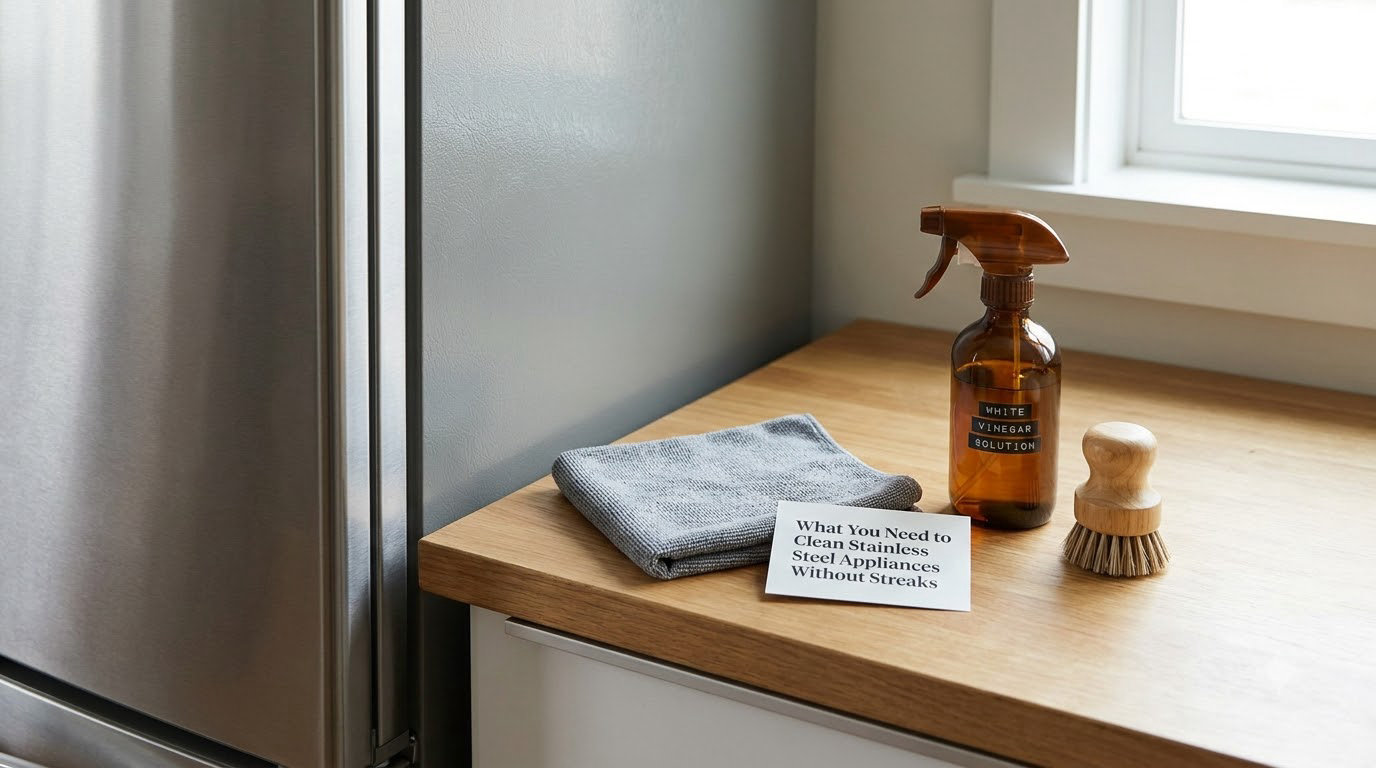
The whole job needs four things: a clean microfiber cloth, warm water, a mild dish soap, and a dry cloth for buffing. Add white vinegar for mineral marks and a drop of olive or mineral oil for shine. Keep one set of microfiber cloths dedicated to appliances so grease and grit from counters never transfer onto the finish.
A spray bottle beats pouring solution straight onto the door. Wipe the cloth damp, not dripping, and never spray the appliance directly. Liquid that runs into seams and crevices dries there and leaves exactly the marks you are trying to remove.
What never to touch stainless steel with
Five tools cause most of the damage people blame on cheap appliances:
- Steel wool and abrasive scrub pads except 0000 polishing grade, and only on a mirror finish with the grain.
- Chlorine bleach, which pits the surface and dulls the luster permanently.
- Paper towels and newspaper, which shed lint and leave their own streaks behind.
- Circular scrubbing or any wipe against the direction of the grain.
- Glass cleaner such as Windex, which leaves an oily film that shows every fingerprint.
Not every surface is plain stainless steel
Fingerprint-resistant finishes carry a matte coating over the steel, and some dishwasher and range panels are painted black or graphite. A coated panel that gets scrubbed with an abrasive pad will not come back. Check the care instructions in your owner’s manual, and if the finish looks evenly matte with no directional grain, treat it as a coated surface and stick to soapy water and a soft cloth.
Step-by-Step: Cleaning Stainless Steel Without Streaks
1. Identify the stainless steel finish
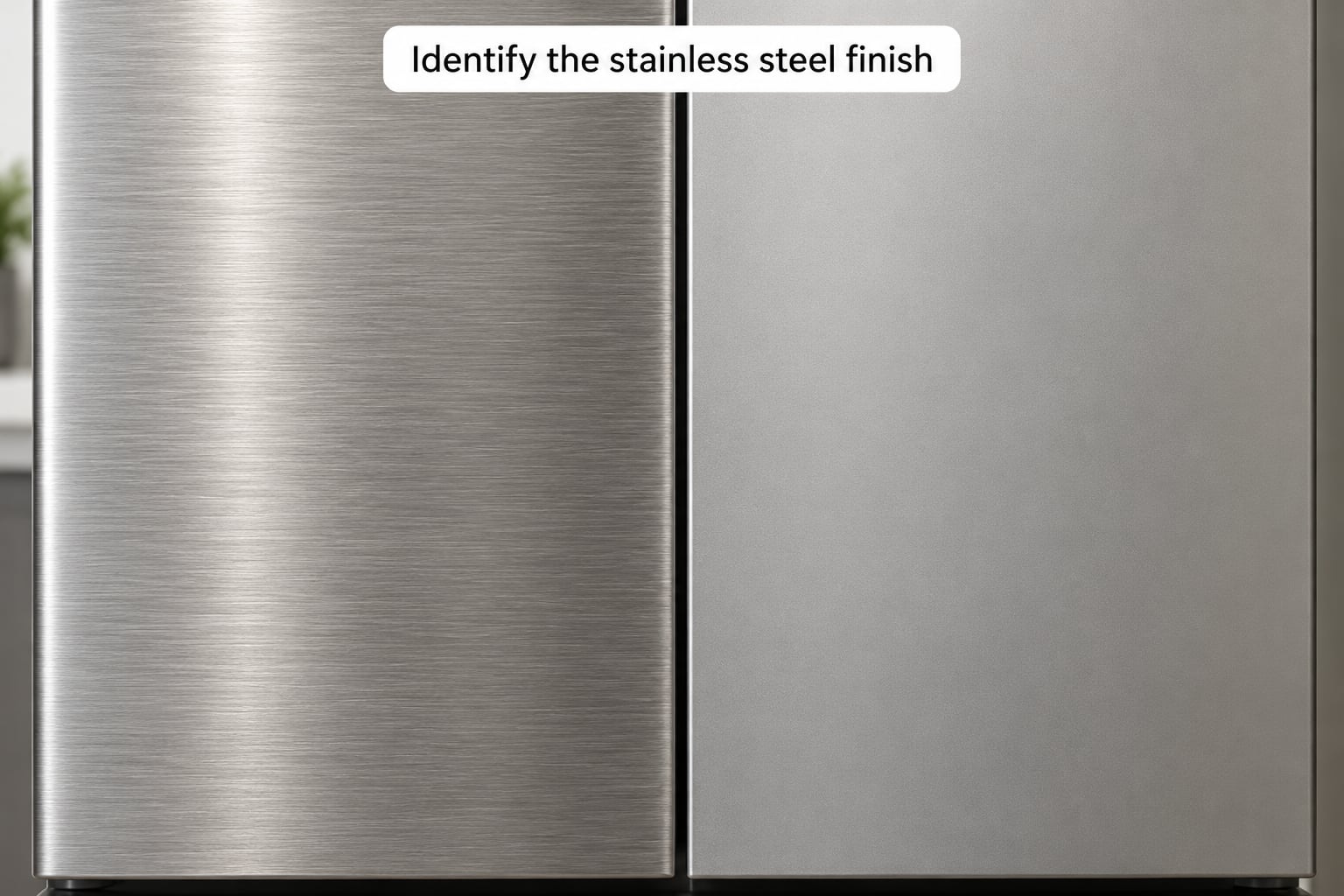
Run your fingers lightly along the panel and you will feel fine parallel lines. That direction is the grain, and every wipe should follow it. A brushed panel has visible grain, a mirror or polished panel is smooth and reflective, and a matte anti-fingerprint finish has almost no grain at all. The technique that works on brushed steel can scratch a mirror finish and strip the coating on a matte one.
Manufacturers say the same thing in their manuals, so check yours before using anything stronger than soap and water.
2. Wipe away loose dirt first
Dust, crumbs, and dried food scratch the surface when you drag a cloth across it. Wipe the panel with a barely damp microfiber cloth to pick up debris, then change to a fresh cloth. Dry-brushing stainless with a rough cloth grinds those particles into the grooves, which is where the dull, hazy look comes from.
3. Prepare a mild cleaning solution
For routine cleaning, mix a drop of mild dish soap into a bowl of warm water and swirl it. For mineral marks, use a 50/50 mix of white vinegar and water in a spray bottle, or a 3:1 water-to-vinegar ratio for a gentler version. Never pour bleach into a bucket with vinegar or ammonia. The combination releases a gas that has injured people in small bathrooms, and both can etch stainless.
Two squirts of soap is plenty. Soak a cloth rather than the panel, and let baked-on food soak for five to ten minutes before you scrub.
4. Wipe with the grain to clean stainless steel without streaks
Dampen the cloth with your solution and wipe in one long pass along the grain. Start at the top of the door and work down so any drips run toward a clean area instead of across a finished section. Keep the cloth flat rather than folded into a corner, since a bunched corner concentrates pressure into a small spot.
Cross-grain wipes push grime into the grooves at an angle, and the light scatters off those crossed grooves. That crossed pattern is what reads as streaks and dullness even on a clean panel.
5. Remove residue and dry the surface
This is the step people skip, and it is the single biggest cause of streaking. Take a second cloth, dampen it with plain water, and wipe off all the soap and vinegar. Any film you leave behind becomes a magnet for the next fingerprint and dries into a visible mark.
Then take a third cloth, dry, and buff along the grain until the panel feels dry and slightly squeaky. Air-drying is what leaves water spots: as the water evaporates, whatever is dissolved in it stays behind and dries into rings.
6. Buff stubborn marks carefully
For a mark that survived one pass, repeat the soapy water step rather than reaching for something stronger. A second gentle pass usually gets it. If it does not, a product approved by your appliance manufacturer is the next step, used exactly as directed and wiped off with a clean damp cloth.
For a shine that has gone flat, put two or three drops of olive oil or mineral oil on a clean cloth and buff with the grain until it disappears. The oil settles into the grooves so fingerprint oils have nowhere to sit. Skip this on anti-fingerprint finishes, which are matte by design and only look greasy afterward.
Where streaks hide: appliance by appliance
On the refrigerator, handles, the water dispenser recess, and the rubber door gasket collect the most grime and the most fingerprints. Pull the gasket loose and wipe it separately.
The dishwasher front usually streaks hardest along the bottom edge, where condensation drips. Open the door and dry the underside and the inner lip of the door after the load finishes.
On a range and cooktop, let the surface cool completely first. Cleaning a warm panel bakes the cleaner onto the finish, and the glass cooktop needs a different approach than brushed trim. Wipe the trim with the grain and use a manufacturer-approved cleaner on the glass.
Range hoods and backsplashes collect airborne grease that has already cooked onto the metal. A paste of baking soda and water, left for ten minutes, loosens it before you wipe. Microwave exteriors mostly need fingerprints removed, which a dry microfiber cloth handles on its own.
Sinks and faucets deal with hard water constantly, so they need the vinegar rinse more often than any other surface.
Common Mistakes That Cause Streaks
Almost every streaked panel comes down to one of these six habits, and each has a simple correction.
Wiping against the grain. The correction is to run the cloth along the parallel lines you can feel, not across them. If you cannot feel a grain, the finish is matte or coated, and light pressure is the safest approach.
Letting the solution air-dry. The correction is a dedicated dry buff with a third cloth. If you only have two cloths, the second one has to do both jobs: rinse cloth first, then flip to a dry face.
Spraying cleaner straight onto the appliance. The correction is to spray the cloth. Liquid that runs into a seam dries there and leaves a mineral ring nobody can wipe away.
Using paper towels. The correction is microfiber or a clean cotton cloth. Lint fibers from paper towels sit in the grain grooves and read as fine streaks.
Leaving soap film unrinsed. The correction is a plain-water rinse pass with a clean cloth, always, even when the panel looks clean already.
Cleaning a hot or warm panel. The correction is to wait. Warm surfaces flash the solution into a film before you can rinse it.
Match the mark to the treatment
Work out what you are actually looking at before you pick a cleaner, because the same wipe that fixes soap film will not shift a rust spot.
- Cloudy haze across a panel is soap film or dried cleaner. A plain water rinse, then a dry buff with the grain, clears it.
- White rings near the dispenser or faucet are hard water minerals. Use a 50/50 vinegar and water mix, let it dwell ten minutes, then rinse and dry.
- Greasy film and dull patches are airborne cooking grease. A baking soda paste for ten minutes, then soapy water, lifts it.
- Small orange-brown dots are rust from a wet cloth or a wire left too long. Use baking soda or Bar Keeper’s Friend paste with light pressure, always with the grain.
- A sticky patch around a spot is adhesive or sticker residue. Warm soapy water softens it, then the edge of a plastic card lifts it.
- A blue or gold tint near a burner is heat discoloration. No cleaner restores it; a metal polish reduces the contrast, or the panel gets replaced.
Fixing a surface that is already streaked
Start with a fresh, clean microfiber cloth, because a cloth that has been used on counters is often the cause of the streaks you are looking at. Wipe the panel with warm soapy water along the grain, rinse with a second damp cloth, and buff dry with a third.
If streaks remain, they are almost always in the grooves. Buff a small amount of olive or mineral oil into the panel with the grain, leave it for a few minutes, then wipe it off with a dry cloth. One more soapy wash afterwards clears any remaining film.
Frequently Asked Questions
Why do my stainless steel appliances have streaks?
Stainless steel is covered in microscopic pores and fine directional grooves. Fingerprint oils, soap film, and water that air-dries all settle into those grooves and dry into visible marks. Wiping against the grain pushes grime in at an angle, and the crossed grooves scatter light, which reads as dull streaks. Streak-free results come from wiping with the grain, rinsing, and buffing dry.
Can I use Dawn dish soap on a stainless steel fridge?
Yes. A drop of mild dish soap in warm water is the safest everyday option for stainless steel, and it will not etch or corrode the surface. Put a drop on a damp cloth rather than the door, wipe with the grain, rinse with a clean damp cloth, and buff dry. Concentrated PowerWash-style degreasers are different: dilute them heavily, never leave them sitting on the finish.
Can I use a Magic Eraser on my stainless steel refrigerator?
Use it sparingly, and only on a mirror or polished finish. Melamine foam is mildly abrasive, so test it in an inconspicuous corner first and use light pressure along the grain. Skip it entirely on brushed panels, matte anti-fingerprint finishes, and black or graphite coated trim, where the abrasion leaves a dull patch that does not blend back in.
What should I never use to clean stainless steel appliances?
Avoid steel wool and abrasive scrub pads, except 0000 polishing grade on a mirror finish. Skip chlorine bleach, which pits the surface and dulls it for good. Paper towels and newspaper shed lint into the grooves. Never scrub in circles or against the grain, and skip glass cleaner, which leaves an oily film that attracts fingerprints. Never mix bleach with vinegar or ammonia.
Is microfiber safe on stainless steel?
A clean, lint-free microfiber cloth is the most important tool in this job. Keep a set used only on appliances so grease and grit from counters never transfer. Dampen it before wiping a dusty panel, since a dry cloth drags grit into the grain and dulls the finish. Keep a second clean cloth for rinsing and a third for buffing dry.
How do I remove existing streaks from stainless steel?
Begin with a brand-new microfiber cloth, since an old one is often the original cause. Wash the panel with warm soapy water along the grain, rinse with a clean damp cloth, and buff dry. If marks remain, work a small amount of olive or mineral oil into the grooves with the grain, leave it a few minutes, then wipe off with a dry cloth and wash once more with soapy water.
Conclusion
Start with warm water and a drop of mild dish soap on a clean microfiber cloth, wipe along the grain, rinse with a second damp cloth, and finish with a dry buff. That sequence takes about ten minutes and removes the residue that turns into streaks.
For a shine that has gone flat, a few drops of olive or mineral oil buffed into the grain will do it. If your appliance has a matte or coated finish, check the manufacturer’s care instructions before you use anything beyond soapy water.