An invitation only has to answer five things clearly: who it is for, what the occasion is, when, where, and how to reply. Write those in that order, match your wording to the formality of the event, and you have a party invitation that works. Most hosts can draft one in about fifteen minutes once the details are settled.
The rest is polish. Where you put the RSVP line, whether you add a dress code, how far ahead to send it — those small choices decide whether people turn up on the right day, in the right clothes, with the right food.
Table of Contents
- 1What You Need
- 2Step-by-Step: How to Write a Party Invitation
- 31. Choose the Invitation Format
- 42. Decide the Tone and Visual Style
- 53. Write the Main Invitation Details
- 64. Add the Host, RSVP, and Extra Details
- 75. Proofread and Send the Invitation
- 8Common Mistakes
- 9Frequently Asked Questions
- 10What information should a party invitation include?
- 11How far in advance should I send party invitations?
- 12Should I write the year on a party invitation?
- 13Is it okay to send a party invitation by text or email?
- 14How do I ask for an RSVP on an invitation?
- 15Should a party invitation include a dress code?
- 16Conclusion
What You Need
Gather these before you type a single word. Every invitation worth sending comes down to the same short list.
- The occasion and guest of honour. Birthday, shower, housewarming, milestone dinner — and whose event it is.
- The date, written out. Spell out the day and date so nobody has to do the mental arithmetic. “Saturday, the 14th of November” beats “11/14”.
- Start and end time. Give both. Guests plan their evening around the finish, not just the start.
- The full address, including street, number, postcode or ZIP, and the floor or unit. Add parking or entry notes if they are not obvious.
- The hosts. One name or both, as suits the event.
- Dress code or theme, if either applies. Skip it when the event is genuinely relaxed.
- What to bring, if anything — a dish for the potluck, a bottle if it is BYOB, or nothing at all.
- The RSVP method and a deadline. An email address, a phone number or a link, with a date roughly two weeks out.
Sort that list before you design anything. Once the information is settled, writing takes minutes rather than an evening of rewording the same sentence.
Step-by-Step: How to Write a Party Invitation
1. Choose the Invitation Format
Pick the format that fits the guest list and the event. Text messages suit a birthday or a spontaneous get-together. Email works for anything with more than a dozen guests, because you can attach a map and a calendar link. Printed cards still matter for weddings, milestone birthdays and anything where the invitation is part of the occasion itself.
A group chat is the one format I would think twice about. People in a chat rarely know who is actually invited, and replying to a group in front of thirty people is its own kind of pressure. A short message to each guest, sent separately, removes both problems.
2. Decide the Tone and Visual Style
Match the wording to the room. A casual birthday invitation sounds like one: “Come celebrate with us.” A wedding or a shower invitation runs more formal, with the couple’s or family’s name at the top and the details set out in order.
Here is the same party written two ways.
Casual: “You’re invited! Join us on Saturday, 14 November at 7 pm for Sam’s 40th. House party, bring your own snacks. 12 Elm Road, Austin. RSVP to sam@ by 31 October.”
Formal: “Mr and Mrs Bennett request the pleasure of your company at a dinner party celebrating their daughter Olivia’s fortieth birthday. Saturday, the fourteenth of November, at half past six in the evening. Twelve Elm Road, Austin. Kindly reply to the Bennetts by the thirty-first of October.”
Both are correct for their own event. Neither is wrong; they simply serve different guest lists. Design follows the same logic — playful lettering and colour for a kids party, clean type and generous white space for a formal dinner.
3. Write the Main Invitation Details
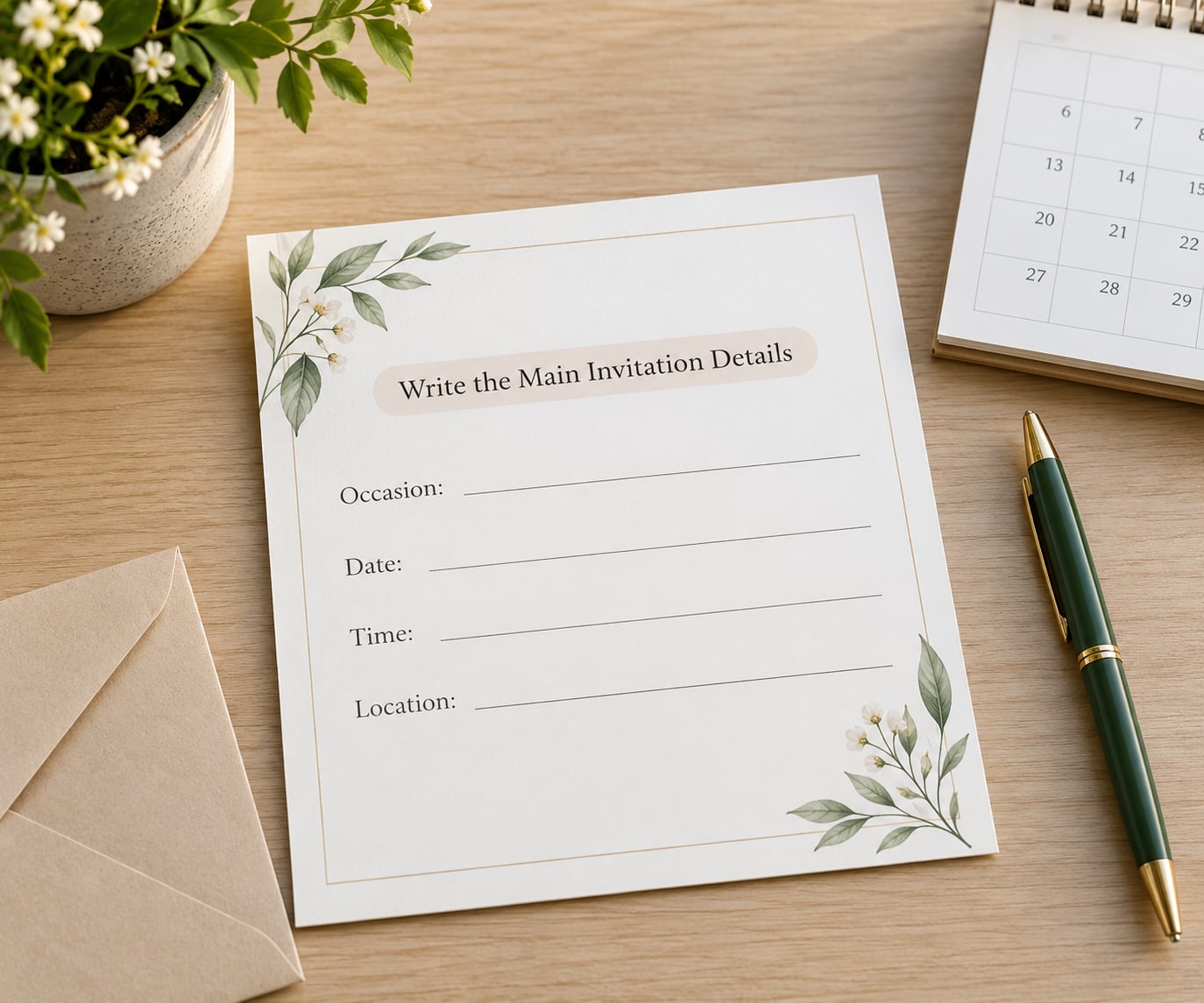
Work down this order and you will never leave a gap: occasion, date, time, location, hosts, RSVP. Here is a fill-in skeleton you can copy straight into a message or onto a card.
You’re invited to a [occasion]
for [guest of honour]
[Day], [date] at [start time] until [end time]
[Full address, including postcode]
Hosted by [host name]
[Dress code or theme]
RSVP to [email, phone or link] by [deadline]
Fill in a children’s party and it reads: “You’re invited to Noah’s 7th birthday. Saturday, 20 September at 2 pm until 4 pm. 4 Oakfield Close, Bristol BS6 7QT. Hosted by Priya and Sam. Come as you are, just bring a towel. Please RSVP to priya@ by 12 September.”
Two details people forget and everybody wants. The end time tells guests whether to plan for a quick party or an evening one. And the postcode or ZIP means the taxi driver gets it right the first time.
4. Add the Host, RSVP, and Extra Details
Name the hosts so guests know who to ask when something is unclear. Then give one clear way to reply, plus a deadline. Two to three weeks before the party is standard, because food and drink orders need lead time of their own.
The optional lines are where invitations become useful. A few phrasings that do real work:
- Plus-ones: “You’re invited, and you’re welcome to bring a plus-one.” Name it plainly if the list is short: “This invitation is for you only.”
- Adults only: Say it directly. “An adults-only evening — no children, please.” A short reason settles most awkwardness: “It’s a cocktail party with drinks served.”
- No gifts: “No presents, please — your company is the gift.” Donation wording works well too: “In place of gifts, we’ve set up a charity donation.”
- Food: “Dinner and drinks provided,” “potluck — bring a dish to share,” or “BYOB.”
- Surprise party: “Please arrive by 6.30 pm so we’re all inside before the guest of honour. Do not mention this.”
- Access: “Street parking is limited; the entrance is on the side gate. Access code 4821.”
- Rain date: “In case of rain, we’ll move indoors — same address, no need to check.”
- Allergies: “Let us know about any food allergies when you RSVP.”
Add at most three of these. An invitation stuffed with instructions reads like a briefing note, and guests skim it.
5. Proofread and Send the Invitation
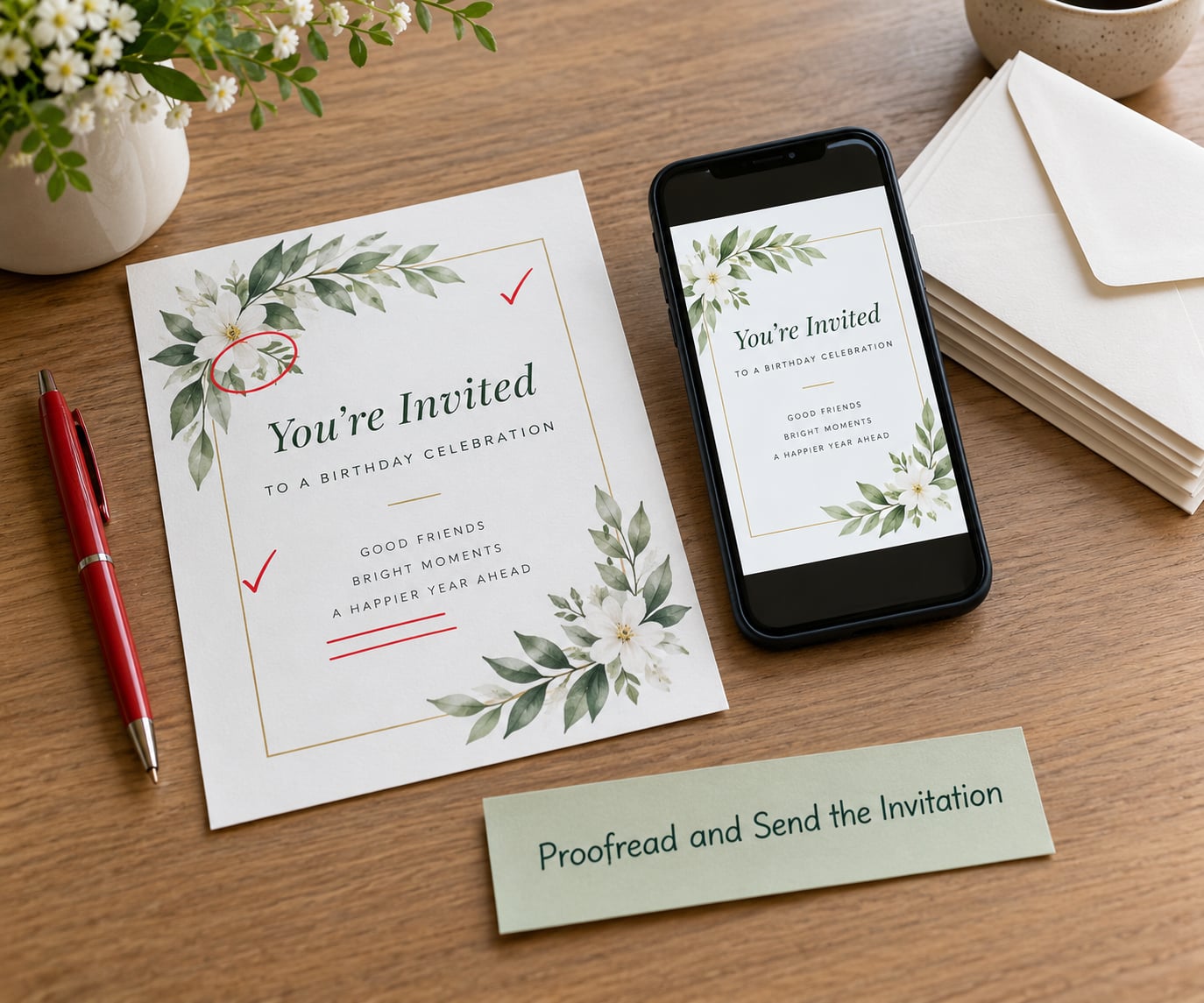
Before anything goes out, check the day and the date against a real calendar. That single mismatch causes more missed parties than anything else on the list. Then read it once out loud, slowly. Anything you stumble over, a guest will too.
Use this final pass:
- Every guest’s name spelled correctly, with partners and children named as intended.
- Day, date and start time confirmed against the calendar.
- Full address, including postcode or ZIP, and an end time.
- Links tested on a phone, not just on the computer that made them.
- RSVP contact works and the deadline is sensible.
- Nothing left in placeholder brackets.
On timing, send printed invitations six to eight weeks ahead for a wedding or a milestone birthday, about four weeks for most adult parties, and two weeks for a casual get-together. Kids party invitations for schoolmates can go out the week before — but a paper one is worth it, because it avoids the schoolyard.
Send digital invitations by email wherever you can, with a plain subject line and the key details repeated in the body of the message, since some people preview without opening. Text the ones who will not read email.
Common Mistakes
The day and the date don’t match. Always verify against a calendar before sending. Spelling out the day removes the error entirely.
No RSVP deadline. Without one, half your replies land the week of the party, when the food is already ordered. Set a date two to three weeks ahead and repeat it in your message body.
A location guests can’t find. “At our place” fails. Give the full street address, then add the unit, gate, entry code or parking note if there is anything unusual.
A dress code nobody understands. “Smart casual” means five different things. Name the garments instead: “Cocktail attire — no jeans,” or “Come dressed for a garden party, flat shoes advised.”
A spoiled surprise. Surprise invitations need an arrival time earlier than the guest of honour’s and an explicit “please don’t mention this.” Without the first, people trickle in at the wrong moment.
Unclear plus-one rules. “Bring someone if you like” produces guesswork. Say whether a guest may bring a partner, a friend, or nobody, and say it the same way to everyone.
Too much on one card. If the layout needs a second read, cut something. An invitation with the occasion, date, time, address and RSVP in plain sight beats a decorative one nobody can parse.
Tone that does not match the event. Cartoon lettering on a wedding card, or a stiff formal register for a child’s fifth birthday, both read as an oversight. Match the design to the room you are actually creating.
Frequently Asked Questions
What information should a party invitation include?
Six things cover almost every invitation: who the event is for, what the occasion is, the day and date, the start and end time, the full address, and how to reply with a deadline. Add the host name, a dress code or theme, what to bring, and access or parking notes when they apply. If those six are missing, guests will text you anyway, so write them down first.
How far in advance should I send party invitations?
Send printed invitations six to eight weeks ahead for a wedding or milestone birthday, around four weeks for most adult parties, and two weeks for a casual get-together. Digital invitations can go out later without harm. Whatever the format, set your RSVP deadline two to three weeks before the party so catering and drink orders are not guesswork.
Should I write the year on a party invitation?
Write the year when the date falls in the following calendar year, and consider adding the weekday. This matters most for December and January events, where a card arriving in November can be read as next year instead of this one. For any date inside the current year, the day and date carry enough information on their own.
Is it okay to send a party invitation by text or email?
Yes, for almost everything except a wedding or a milestone event, where the invitation is often kept as a keepsake. Email works best for larger guest lists because you can attach a map and a calendar link, and repeat the key details in the body since some people preview without opening. Text suits short-notice parties and anyone who does not read email.
How do I ask for an RSVP on an invitation?
Give one clear method and one date. “Please RSVP to sam@ by 31 October” is enough. Make it easy by asking for the number of guests attending and any food allergies in the same breath. Avoid several options at once, since replies then arrive in threads, texts and comments with no record of who said what.
Should a party invitation include a dress code?
Only when guests would otherwise guess wrong. Add one for weddings, milestone birthdays, dinners and any themed or cocktail event. Say it in garments rather than labels: “Cocktail attire, no jeans” beats “smart casual.” Skip the dress code entirely for a children’s party, a casual get-together or a house party where guests already know the host.
Conclusion
Start by choosing the format, because it decides how much room you have for the details. Then gather the occasion, date, times, address, hosts and RSVP contact, and draft the invitation in that order before you touch a single design element. Send it early enough for guests to plan and far enough ahead that you know your numbers. The rest is tone, and tone follows the party.