To organize a game tournament at home, pick a format that matches how many players you have, set a round timer, write your rules before anyone sits down, and keep every result on paper you can see from across the room. A whiteboard, a phone timer and a printed bracket sheet are enough. The whole thing takes three to four hours once you know how the formats work.
I ran one for twelve people in a dining room on a Saturday, and the only thing that actually mattered was deciding the format and the round length before the invitations went out. Everything else was pencil work. This guide walks through the whole sequence, including the two questions organizers always get stuck on: which format fits your group, and what happens to the people who lose early.
Table of Contents
- 1What You Need
- 2Step-by-Step: How to Organize a Game Tournament at Home
- 3Step 1: Choose a Date, Guest List, and Player Limit
- 4Step 2: Decide How to Organize a Game Tournament at Home
- 5Step 3: Choose a Game Everyone Can Play
- 6Step 4: Write the Rules and Tiebreakers
- 7Step 5: Invite Players and Explain What to Bring
- 8Step 6: Build the Bracket and Assign Opening Matches
- 9Step 7: Run the Matches and Keep Fair Play
- 10Step 8: Record Results, Crown the Winner, and Clean Up
- 11Common Mistakes
- 12Tournament-Day Tips
- 13Frequently Asked Questions
- 14How many players do I need for a home game tournament?
- 15What is the best game to use for a tournament at home?
- 16How long should a game tournament at home take?
- 17What is the easiest tournament format for beginners?
- 18How should I handle ties in a board game tournament?
- 19Do I need special software to run a home tournament?
- 20Conclusion
What You Need
You need far less than a store event requires. There is no tournament software worth installing for eight people in your living room, and the free options beat anything you’d pay for once the group is that small.
- Paper and pen. A printed bracket or score sheet, plus a spare sheet for everything that does not fit on it. One person holds the pen and nobody else touches it.
- A visible surface. A whiteboard, a large sheet of flip-chart paper on the wall, or a corkboard. If people cannot see the standings without standing up, you will get arguments.
- A timer everyone can see. A phone on a stand counts. A kitchen timer with a loud bell works better because you are not the only one watching it.
- Something to mark scores. Tokens, coins, sticky notes, index cards. Coins are ideal because a stack of quarters is an instant standings board.
- Table numbers. Index cards and a marker. Printable table cards remove most of the confusion on the day, because everyone knows where to sit.
- Prizes, optional. A winner takes something, but the tournament works fine without one. Extra tokens, a spare set of dice or a pack of the game you played are perfectly good prizes.
Skip the dedicated tournament furniture. A sixty-inch round table seats eight comfortably, and a couple of folding trays will hold a game board when you run two matches at once.
Step-by-Step: How to Organize a Game Tournament at Home
Step 1: Choose a Date, Guest List, and Player Limit
Work backwards from your evening. Decide what time the final has to end, count backwards by round length, and that tells you when you start and how many rounds you can promise.
Set a hard player cap and stick to it. Formats get messy above sixteen people in a home setting, and every extra body is another bracket branch to draw by hand. Expect roughly one player in ten to drop out after saying yes, so invite three or four more than the number of bracket slots you have.
Write down the start and finish times when you invite people, not just the date. Tournament organizers who run regular events keep to this rule: run the rounds you advertised or fewer, because players plan their evening around the number you gave them.
Step 2: Decide How to Organize a Game Tournament at Home
Single elimination, round robin, and Swiss are the three formats that actually work in a home. Double elimination and team formats are possible but rarely worth the extra complexity for a single evening.
- Single elimination means one loss and you are out. Every round halves the field, so eight players take three rounds to reach a champion. It is fast, dramatic, and it produces exactly one winner.
- Round robin means everyone plays everyone once, then standings decide the winner. It is the fairest format and the longest one: eight players means seven rounds. Best for four to six people.
- Swiss means everyone keeps playing, nobody is knocked out, and you pair players with similar records each round. Four rounds with no cut is a solid default for a small regular event; three rounds tends to feel too short.
- Double elimination gives players two losses before they are out. It suits eight players or more and stretches the evening by a round or two.
Match the format to your group size before you match it to the game. That order matters more than most people expect.
Here is the quick version by player count:
- 4 players: round robin or single elimination, 3 rounds, under 2 hours.
- 6 players: round robin, or single elimination with byes, 3 to 5 rounds, 2 to 3 hours.
- 8 players: single elimination or a 4-round Swiss, 3 to 4 rounds, 2.5 to 3.5 hours.
- 10 to 12 players: Swiss, or single elimination with a bye round, 4 to 5 rounds, 3 to 4 hours.
- 16 players: single elimination or Swiss, 4 to 5 rounds, 4 hours or more.
With eight players, single elimination is the easy answer. It is the format most people mean when they say they want to run a bracket at home, and it finishes in three rounds.
Step 3: Choose a Game Everyone Can Play
Pick the game before you draw the bracket, because game length decides how many rounds fit in your evening. A two-hour game with eight players and single elimination is a five-hour event, and that is how a tournament turns into a night nobody enjoys.
Aim for a round length between thirty and forty-five minutes. That gives you four or five rounds in a three-and-a-half-hour window with a break in the middle. Games with heavy downtime, long setup or rules that need a fifteen-minute explanation are the ones that blow the schedule.
For mixed groups, a competitive game with an approachable rulebook beats an abstract strategy game every time. If the group spans children and adults or first-timers and regulars, a party or card game with a short teachable ruleset is the safer pick. Cooperative games work too, though you score them as a team rather than running a bracket.
Two things to check before you commit: can several matches of this game run at the same time on your tables, and does the box have enough copies of the pieces for that to be true?
Step 4: Write the Rules and Tiebreakers
Write one page and read it out loud at the start. It should cover round length and the time limit per turn, scoring and how wins are decided, turn order, whether draws are allowed, what happens to a tied game, and how a disputed result gets settled.
Decide the tiebreaker now, while nobody has a stake in it. The common choices are sudden death overtime, most rounds won, head-to-head result, or an objective score taken from the final state of the game. Write the one you chose on the rules sheet and do not revisit it mid-evening.
Add two house rules that save arguments later. First, the host’s ruling is final unless the whole table agrees to check the printed rules. Second, bad luck is part of the tournament; results stand once the game ends cleanly.
Step 5: Invite Players and Explain What to Bring
Your invitation carries the whole plan. Send it with enough detail that nobody has to ask a question: date, start time, expected finish, location, format, the game being played, and what you are providing.
List what players should bring and what you are supplying. Saying the host provides the game, the score sheets and the snacks removes half the replies you would otherwise field. Ask for dietary restrictions when you mention food, not afterwards.
Collect contact details with the reply, not after. When a round gets rescheduled or a table needs to change, a group message reaches everyone at once, and chasing six people individually is how the evening loses twenty minutes.
Step 6: Build the Bracket and Assign Opening Matches
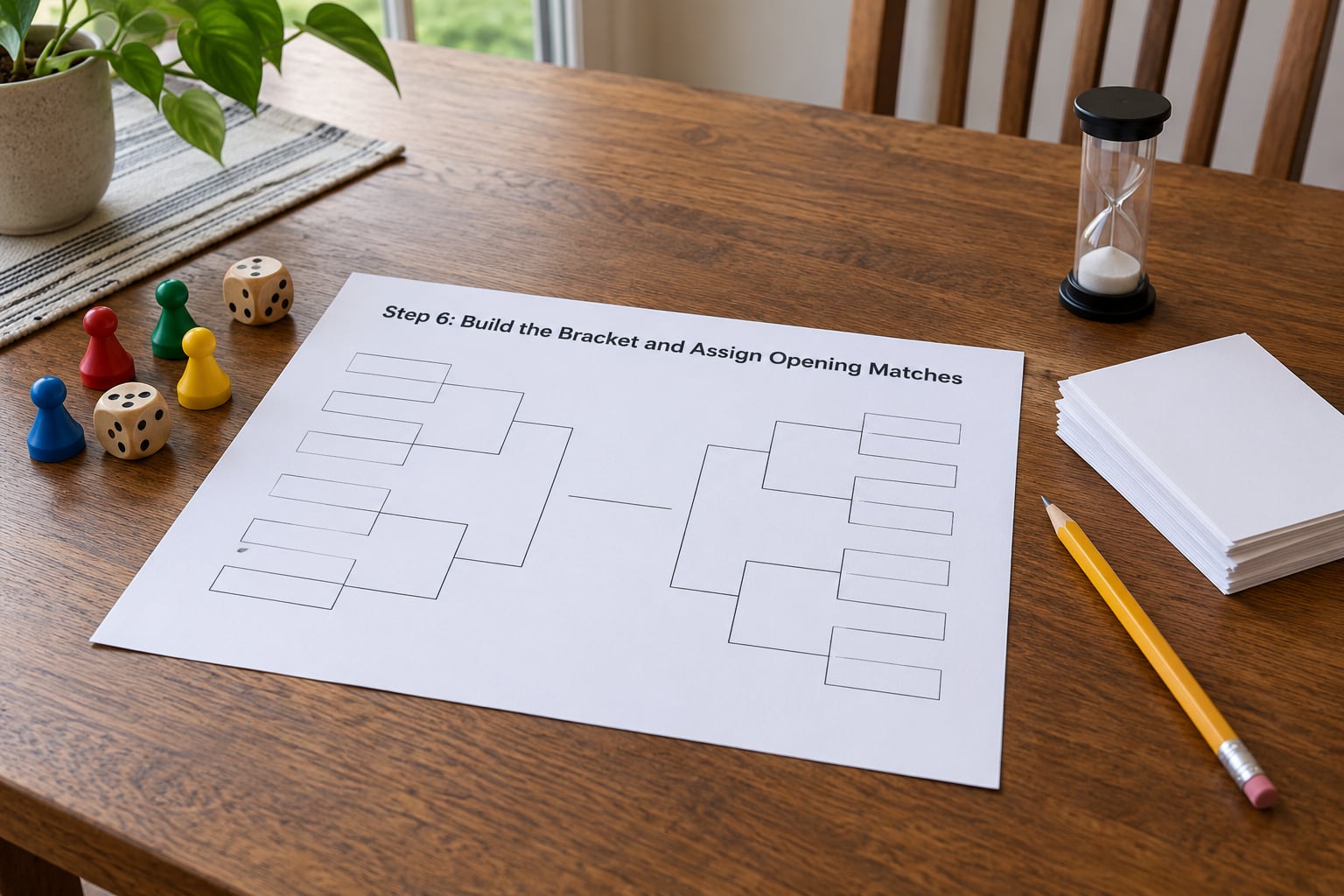
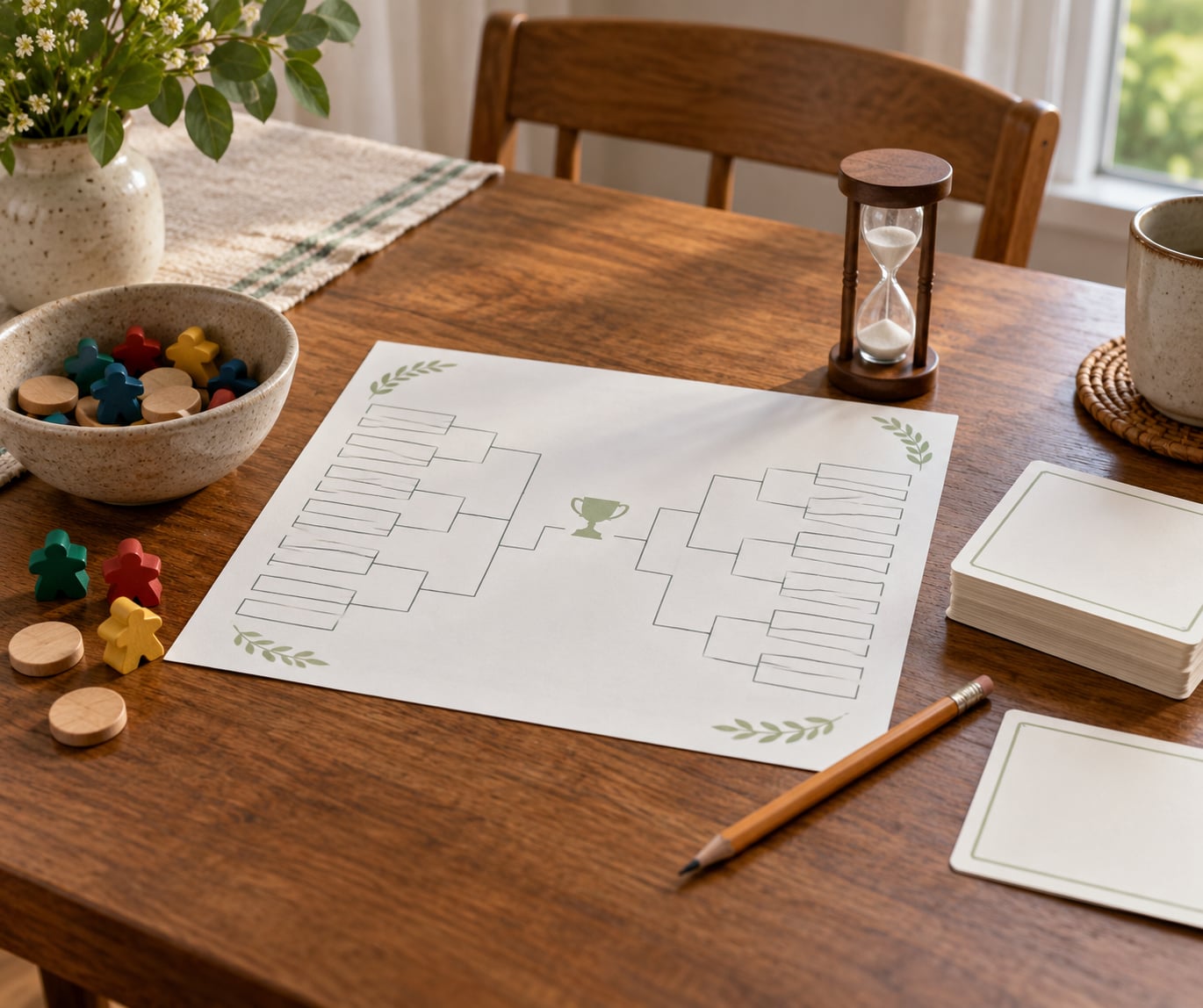
Draw the whole bracket before anyone arrives. Label every match with a number, write each player’s name against their first-round slot, and leave the later rounds blank.
Seeding decides who plays whom in round one. Rank players by experience and give the top seed the bye when the field is odd, so the strongest player is not sitting out while a beginner opens against the group’s best. Six or seven players means at least one bye; twelve with a bye round is where odd numbers get awkward, which is another argument for Swiss at that size.
Put table numbers on the matches rather than on the players. Table one is match one, and it stays that way for every round, so nobody has to remember who they are supposed to be facing.
Write the first-round pairings on a separate card for each table. That card is what players check instead of interrupting you mid-game to ask who they are playing.
Step 7: Run the Matches and Keep Fair Play
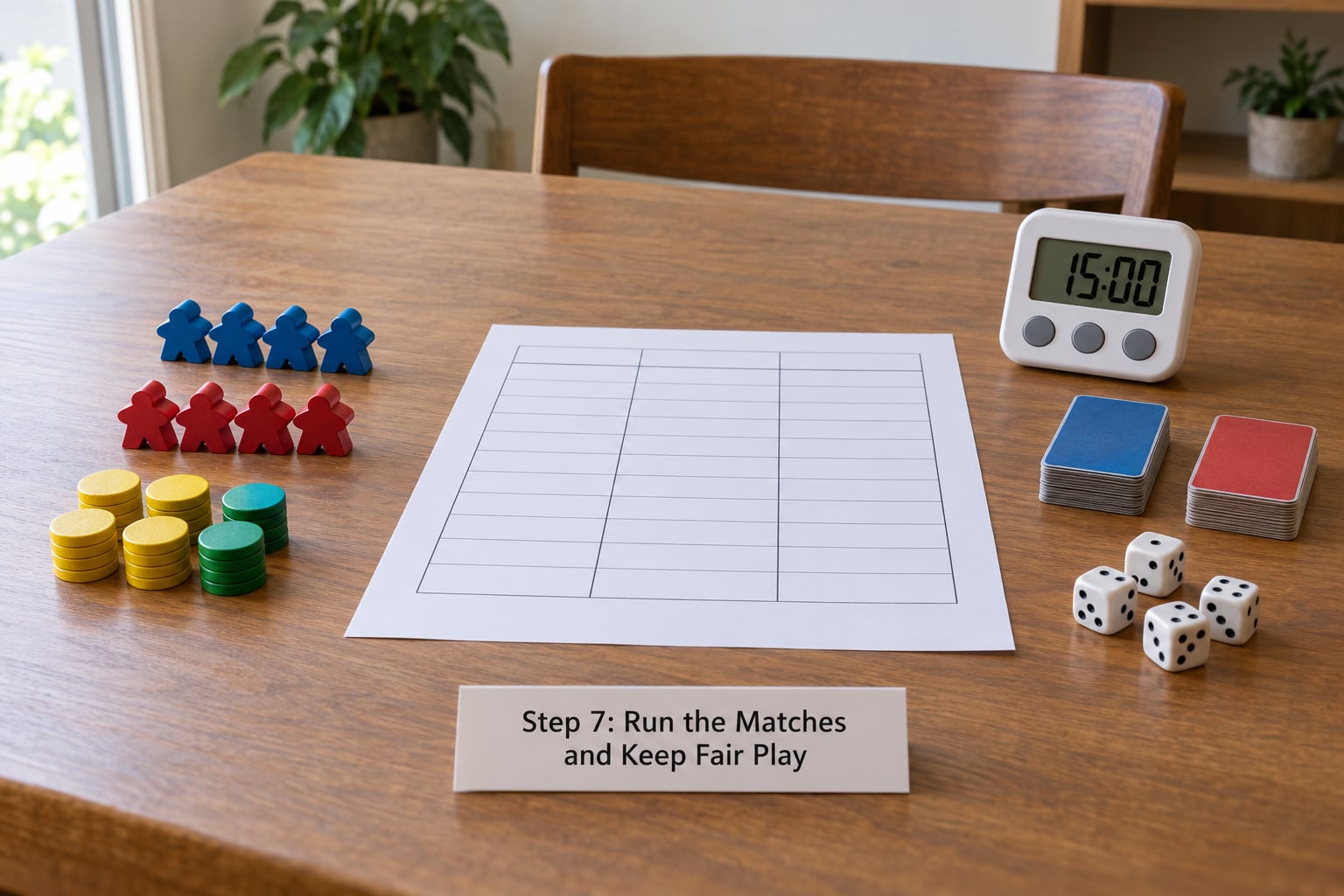
Announce each round in one sentence: the match numbers, the table numbers, and the time limit. Then stop talking and let them play.
One person owns the score sheet for the whole event. They write results the moment a match ends, move the winners onto the next round, and update the visible standings board. If everyone keeps their own record, you will end the evening with four different versions of the same tournament.
Announce a result, confirm it once, and move on. When players dispute a ruling, point at the printed rules sheet and apply it as written. The reason people argue at home is that no neutral judge exists, so the agreed rule set has to play that role.
Handle arrivals and dropouts simply. A late player takes the next available slot or sits out that round. A player who leaves takes a full bye rather than half a point, which keeps the standings honest.
Keep eliminated players in the room. Set up a side table with the leftover games, and give them something competitive to do: a bounty for first to score a certain total, a trivia card, a small knockout game of the losers’ bracket. Hosts who run regular home tournaments say a separate table for the knocked-out players beats almost any cash alternative, because the empty half of the room is what makes an event feel dead.
Schedule a break after the second round and a stretch break after the third. Five minutes of moving around saves the last hour of slumping.
Step 8: Record Results, Crown the Winner, and Clean Up
Fill in the final round, then read out the standings from your sheet so the result is stated once and clearly. Announce the champion, the runner-up, and a sportsmanship mention if someone earned it.
If you ran single elimination, the final match decides everything on its own. If you ran Swiss or round robin, decide the tiebreaker cases before the last round and apply them to the final standings.
Offer a rematch with the finalists or start a fresh round robin with whoever is still there. This is the moment where a one-off tournament quietly turns into a regular league night, and if you are hoping for that, announce the next date before anyone leaves.
Finish by resetting the room. Return components to the box, wipe the standings board, and put chairs back. Clearing the space yourself takes ten minutes and saves you the job next month.
Common Mistakes
Choosing the format after choosing the date. Fix the format first, then check the round count against the hours you have. Reversing the two is how people end up running four of six advertised rounds.
Changing rules mid-tournament. Every ruling you change after round three will be challenged for the rest of the night. Announce clarifications to everyone at once, never just to the table that asked.
Seeding badly. Giving beginners the toughest first match does not make the bracket fair, it makes them leave early. Seed by experience and hand the top seed any bye available.
Losing the score records. If it exists only in the group chat, it is gone. Use one paper sheet in one pair of hands, and post a photo of it to the chat after every round.
Overloading the schedule. Four rounds of thirty-five minutes is a comfortable evening. Six rounds of an hour is a different event entirely, and it is the number people will be counting down to when they plan to leave.
Ignoring noise and space. Loud games plus small rooms means shouted rulings and players who cannot hear their own turn. Spread matches across rooms where you can, and avoid putting two loud games at the same table.
Letting eliminated players drift off. The most common complaint from people who host regularly is that the room empties out after the first eliminations. Have the side table ready before the second round starts, not after.
Tournament-Day Tips
- Run one test round. Play a throwaway match with two players an hour before the event so you catch setup problems while you can still fix them.
- Label everything. Table numbers, match numbers and a rules sheet on the wall. Organizers who host regularly say printed table cards eliminate most of the confusion on the day.
- Set the timer where everyone can see it. Announce the last five minutes out loud; nobody should be the only person responsible for ending a match.
- Keep backup tiebreakers written down. One page, agreed in advance, with the fallback option if the primary one fails. This is the single detail that prevents most late-night arguments.
- Protect the break. Put the break after round two, not after round four. By round four everybody is tired and the break does no good.
- Plan the cleanup before the day. A box for components, a bag for trash, a rule that food stays out of the play area. Then the last ten minutes are not spent searching for a missing card sleeve.
- Write down what to change. Keep the printed round sheets and note timings while they happen. If you host a second tournament in 2026, that record is worth more than any advice on this page.
Frequently Asked Questions
How many players do I need for a home game tournament?
Four players is the practical minimum, and eight is the sweet spot for a home evening. With four you can run a clean round robin in three rounds or a short single-elimination bracket. Six to eight gives you byes to handle and more people per table, which makes matches finish faster. Above sixteen the bracket gets hard to run by hand, so plan on Swiss rather than elimination.
What is the best game to use for a tournament at home?
Choose a game whose rounds run thirty to forty-five minutes, teaches its rules in a couple of minutes, and supports several matches at once if you have more than one table. Competitive card games, party games with a clear scoring system, and mid-weight board games all work. Avoid anything over two hours, anything with a long setup, and anything with hidden information that makes spectating confusing.
How long should a game tournament at home take?
Plan for three to four hours including a break. Four rounds at thirty-five minutes each is 140 minutes of play, plus fifteen minutes for check-in, announcements and a twenty-minute break, and you land near three hours. With eight players on single elimination you only need three rounds, which fits a shorter evening. Tell people the finish time when you invite them and keep to it.
What is the easiest tournament format for beginners?
Single elimination, without question. Every player stays in until they lose once, each round halves the field, and eight players reach a champion in three rounds. Round robin is easier to explain but takes every match. Swiss needs scorekeeping and tiebreak decisions mid-event. Start with elimination, write the rules sheet, and move to Swiss once your group hosts often enough to want standings.
How should I handle ties in a board game tournament?
Decide before the first match. Write your tiebreaker on the rules sheet and apply it as written, which is the only thing that keeps a tie from becoming an argument. Common options are sudden death overtime, most rounds won, head-to-head record, or a final objective score. Avoid sudden death on long games. If a game ends tied and no tiebreaker applies, replay it as a draw and award half a point.
Do I need special software to run a home tournament?
No. A printed bracket or score sheet, a whiteboard or flip-chart paper for standings, and a phone timer handle any home event up to sixteen players. Dedicated tournament software exists, but it earns its keep at store events with entry fees, list submissions and dozens of rounds. At home, one person with a pen and a clear rule that only they write scores is simpler and less likely to break.
Conclusion
Learning how to organize a game tournament at home comes down to three decisions made before anybody arrives: the format, the player count, and the game. Get those right, print the bracket, write the tiebreaker on a sheet of paper, and the rest is running the clock and writing down results.
Start with the player-count guide above, pick the line that matches your guest list, and build from there. The first tournament is always worth doing badly, because the second one is much easier.